|
TRANSLATE THIS ARTICLE
Integral World: Exploring Theories of Everything
An independent forum for a critical discussion of the integral philosophy of Ken Wilber
  Frank Visser, graduated as a psychologist of culture and religion, founded IntegralWorld in 1997. He worked as production manager for various publishing houses and as service manager for various internet companies and lives in Amsterdam. Books: Ken Wilber: Thought as Passion (SUNY, 2003), and The Corona Conspiracy: Combatting Disinformation about the Coronavirus (Kindle, 2020).
Check out my other conversations with ChatGPT
The Western Peace Movement:
Captured by Russian War Propaganda? The Peace Movement's Blind Spot Peace by Surrender? Where Are the Peace Protests in Russia? Everybody Wants Peace - But How? Everybody Wants PeaceSo Why Do We Disagree?Frank Visser / ChatGPT
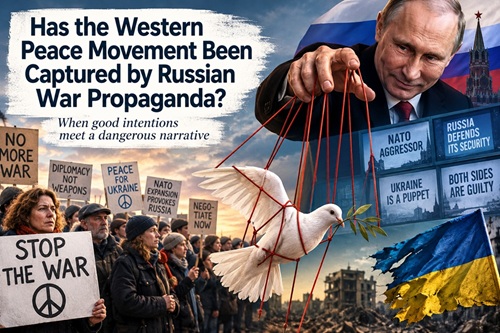 The most popular word in politics Everybody wants peace. Or almost everybody. Politicians invoke it, protesters march for it, governments promise it, religious leaders pray for it, and ordinary people long for the day when their children no longer have to fear bombs, bereavement, displacement, or conscription. In the war in Ukraine, there is no shortage of people declaring themselves on the side of peace. The disagreement begins when we ask what peace requires, how it can be achieved, and who must make the necessary concessions. This is where an apparently shared moral aspiration becomes a fierce political dispute. One side argues that the fighting must stop as soon as possible, even if that requires Ukraine to accept territorial losses or other painful compromises. Another argues that a ceasefire imposed while Russian forces occupy Ukrainian territory could reward aggression and invite renewed war. Some believe Western arms deliveries prolong the conflict; others believe that withholding those weapons would weaken Ukraine's bargaining position and make a just or durable settlement less likely. Each position can be presented as a defense of peace. Yet their practical consequences may be radically different. The problem, then, is not that some people want peace while others want war. That distinction is usually too crude to illuminate anything. The real disagreement concerns the relationship between peace and justice, between ending violence and preventing its recurrence, and between the immediate saving of lives and the longer-term conditions under which people can live without fear. Peace is not a methodThe word peace names an aspiration, not a policy. It does not tell us whether to negotiate, arm an invaded country, impose sanctions, offer security guarantees, demand a withdrawal, accept territorial concessions, or continue military resistance. Those are questions about means, and they require arguments about consequences. A person who demands an immediate ceasefire may sincerely believe that stopping the shooting is the first moral obligation. A person who supports continued military assistance may sincerely believe that allowing an aggressor to consolidate territorial gains will make future violence more likely. Both may be horrified by the human cost of the war. Neither position becomes correct merely by invoking the word peace. This distinction matters because political rhetoric often smuggles a conclusion into the aspiration itself. If someone declares that they are for peace, opponents can be made to look as though they must be against it. A supporter of Ukrainian military resistance becomes a warmonger; a supporter of negotiations becomes an appeaser. But neither label settles the question. We must examine the proposed policies, the assumptions behind them, and the outcomes they are likely to produce. The proper question is not, "Who wants peace?" It is, "What kind of peace is being proposed, by what means, and with what consequences?" The difference between stopping a war and resolving itA war can stop without the conflict that produced it being resolved. Armies may cease firing because they have exhausted their resources, reached a stalemate, accepted a temporary truce, or been compelled to negotiate. The absence of active fighting can be a tremendous relief. But it does not necessarily establish a stable political settlement. A ceasefire may freeze a front line without resolving the dispute over territory. It may leave an invaded country exposed to renewed attack. It may provide time for both sides to rearm. Alternatively, it may become the first step toward a negotiated settlement that gradually reduces the likelihood of renewed violence. Much depends on the terms, the incentives of the parties, and the credibility of the arrangements that follow. The distinction is not an argument against ceasefires. On the contrary, ceasefires can save lives, open humanitarian corridors, facilitate prisoner exchanges, and create opportunities for diplomacy. The point is that a ceasefire should be evaluated as a possible means toward peace, not treated as proof that peace has already been achieved. The same applies to negotiations. Talks are necessary in many conflicts, but the mere existence of negotiations tells us little about whether a settlement is fair, enforceable, or durable. A government can enter negotiations in good faith, use them to buy time, or seek terms that the other side regards as tantamount to surrender. Diplomacy is indispensable, but diplomacy is not magic. It operates within a balance of power and a set of political intentions. The Ukrainian dilemmaThe war in Ukraine illustrates these distinctions with particular clarity. Russia launched its full-scale invasion in February 2022. Ukraine responded by defending its territory and political independence. Since then, the question of how to end the war has become inseparable from the question of what Ukraine would have to accept in exchange for an end to the fighting. For Ukrainians, the issue is not simply whether they prefer peace to war. They plainly have powerful reasons to want the killing and destruction to stop. The dilemma is whether the available route to peace would protect their country's future or leave it vulnerable to further coercion. If Russia were to stop fighting and withdraw its forces, the war could end without Ukraine having to abandon its claim to sovereignty over occupied territory. If Ukraine were to stop resisting while Russian forces remained in place, the immediate fighting might diminish, but the resulting arrangement could entail the loss of territory, the restriction of Ukrainian political choices, or the continuing threat of renewed Russian military pressure. That is not a prediction that every ceasefire would inevitably lead to Ukrainian defeat. It is a question about the conditions under which a ceasefire could be sustained. What would prevent a renewed invasion? What security guarantees would be credible? Who would monitor compliance? What would happen if the agreement were violated? Would Ukraine retain the ability to defend itself? Would its population be able to determine its political future without coercion? These questions cannot be dismissed as obstacles raised by people who do not want peace. They are questions about whether a proposed peace would last. The moral asymmetry of surrenderOne of the most persistent problems in the debate is the tendency to treat the demands placed on Russia and Ukraine as interchangeable. Both sides, we are told, must compromise. Both sides must show flexibility. Both sides must stop fighting. In the abstract, this sounds even-handed. In practice, it can obscure the difference between the country that invaded and the country whose territory was invaded. Of course, Ukraine is not exempt from scrutiny. Its government must consider the welfare of its population, the costs of continued fighting, the limits of available resources, and the possibility that negotiations may secure a better outcome than further resistance. No country can sustain a war indefinitely without regard for the lives and future of its citizens. Nor can outsiders reasonably demand that Ukrainians continue fighting simply to vindicate an abstract principle. But neither should outsiders casually prescribe concessions whose costs they themselves will not bear. Asking a country to surrender territory is not like proposing a compromise over a trade agreement. It affects the people who live there, those who have fled, those who have been displaced, and those who may find themselves governed by a state they did not choose. It raises questions about occupation, repression, citizenship, cultural identity, and the security of neighboring countries. A settlement may eventually require painful compromises. Recognizing this is realism, not betrayal. But the possibility of compromise does not mean that every compromise is wise, that every demand is legitimate, or that the victim of aggression bears equal responsibility for bringing the war to an end. The moral asymmetry does not eliminate the need for negotiation. It clarifies what must be taken into account when judging its terms. The limits of moral purityThere is a corresponding danger on the other side of the debate. People who emphasize resistance to aggression can sometimes speak as though justice alone determines the best policy, regardless of cost. They may treat any territorial compromise as capitulation, any negotiation as appeasement, or any concern about escalation as cowardice. This can turn a legitimate defense of sovereignty into an inflexible moral posture. But political decisions are made under conditions of uncertainty, scarcity, and competing obligations. A government must weigh the immediate lives at risk against the dangers of future aggression. It must consider whether military objectives are attainable, whether its allies will continue their support, and whether a negotiated agreement can protect its population more effectively than continued fighting. There is no moral virtue in demanding unlimited sacrifice from others. Nor does the fact that a country has a right to defend itself mean that every conceivable military strategy is prudent. The right to resist aggression and the question of how best to exercise that right are separate questions. A serious peace policy must therefore avoid two symmetrical mistakes. The first is to treat the cessation of fighting as the supreme objective, regardless of the conditions under which it occurs. The second is to treat the continuation of resistance as a moral imperative, regardless of its prospects or costs. One risks sacrificing security and sovereignty for immediate relief; the other risks sacrificing lives to a strategy that may no longer be achievable. Between these extremes lies the difficult work of political judgment. The peace we want, and the peace we can getThe hardest question is whether the peace we want is attainable under the circumstances we face. It is easy to demand a settlement that is simultaneously just, comprehensive, immediate, and permanent. It is much harder to find terms that the parties will accept and that can survive changes in military fortunes and political leadership. A maximalist settlement may be morally attractive but practically unreachable. A quick compromise may stop the fighting but leave the underlying conflict unresolved. A temporary armistice may save lives while postponing difficult questions. A security guarantee may deter future aggression, but only if those making the guarantee are willing and able to honor it. These are not reasons to abandon moral principles. They are reasons to connect principles to realistic assessments of power, incentives, and institutional arrangements. A settlement that ignores the aggressor's incentives may prove fragile. A settlement that ignores the invaded country's security may merely postpone another war. A settlement that cannot be enforced may look persuasive on paper and collapse in practice. The relevant distinction is not between idealism and realism. It is between realism that takes all the relevant facts into account and realism that selectively treats the stronger party's demands as unavoidable while presenting the weaker party's resistance as the principal obstacle to peace. There is also a difference between accepting an imperfect settlement because it is the least harmful available option and declaring that the settlement is just because it has been reached. Negotiated outcomes can be necessary without being morally satisfying. Recognizing that distinction allows us to support diplomacy without pretending that every agreement represents a victory for peace. The propaganda problemBecause everyone claims to want peace, the language of peace is particularly vulnerable to political manipulation. Governments can portray military objectives as defensive necessities. Opponents can depict every form of military assistance as warmongering. An aggressor can demand negotiations while continuing attacks. An invaded country can invoke justice while facing difficult choices about the costs of resistance. The existence of propaganda does not mean that every peace proposal is dishonest. Nor does it mean that every person advocating a ceasefire is an agent of the aggressor. It means that the moral prestige of peace should not exempt political proposals from scrutiny. We should ask who is being asked to make concessions, who retains the ability to use force, whose security is guaranteed, and what happens if the agreement breaks down. We should examine whether a proposed settlement addresses the conditions that produced the war or merely suspends the fighting. We should distinguish an offer of negotiations from a willingness to accept a mutually sustainable agreement. Above all, we should resist the assumption that the side calling most loudly for peace must therefore be the side acting most responsibly. The language of peace is not a substitute for evidence about the intentions and behavior of the parties. What a consistent peace movement would demandA genuinely independent peace movement would not measure its success by the number of weapons it opposes or the number of governments it condemns. It would begin with the reduction of human suffering, but it would also ask how that reduction can be sustained. It would demand that Russia end its aggression and engage seriously in negotiations that respect Ukraine's sovereignty. It would insist that Ukraine's government and population have a meaningful say in any settlement affecting their future. It would scrutinize Western policy, including arms transfers, sanctions, diplomatic initiatives, and the risks of escalation. It would support humanitarian measures, prisoner exchanges, and credible arrangements for monitoring and enforcing a ceasefire. It would ask what security guarantees could make a settlement durable and what mechanisms could respond to violations. Such a movement would not automatically support every military decision made by Ukraine or its allies. It would not dismiss diplomacy as appeasement. It would not confuse the desire for justice with a guarantee that justice can be achieved at any cost. But neither would it treat the invaded country's disarmament or territorial surrender as the obvious price of ending the war. Its guiding question would be practical as well as moral: which available policies are most likely to reduce suffering now while minimizing the danger of renewed aggression later? The answer may change as circumstances change. That is not inconsistency. It is what responsible political judgment requires. Everybody wants peace—but not the same peaceThe phrase "everybody wants peace" is both true and misleading. It is true because few people openly desire endless war, mass casualties, ruined cities, and generations of hostility. It is misleading because peace can mean very different things to different people. For one person, peace means the immediate cessation of violence. For another, it means the restoration of territorial integrity. For a third, it means a balance of power that prevents future aggression. For a fourth, it means a negotiated compromise that allows exhausted populations to rebuild their lives. These goals can overlap, but they can also conflict. The task of politics is to determine how much can be reconciled, what must be sacrificed, and who has the right to decide. The deepest disagreement, therefore, is not between those who want peace and those who want war. It is between competing understandings of the road to peace and of the risks that road entails. Some fear that continued resistance will produce needless deaths and a wider conflict. Others fear that a settlement reached under military coercion will reward aggression and make another war more likely. Both fears deserve examination. Neither can be settled by questioning the sincerity of the people who hold them. The ultimate test is not whether we proclaim peace as our objective. It is whether our proposed methods offer a credible path toward it—and whether we are honest about their costs, their uncertainties, and the people who will bear them. Peace is not the absence of disagreement about war. It is the achievement of conditions under which disagreement no longer has to be settled by war. That is a much more demanding objective than simply calling for the fighting to stop. But it is the only one worthy of the word peace.
Widget is loading comments...
|