|
TRANSLATE THIS ARTICLE
Integral World: Exploring Theories of Everything
An independent forum for a critical discussion of the integral philosophy of Ken Wilber
  Frank Visser, graduated as a psychologist of culture and religion, founded IntegralWorld in 1997. He worked as production manager for various publishing houses and as service manager for various internet companies and lives in Amsterdam. Books: Ken Wilber: Thought as Passion (SUNY, 2003), and The Corona Conspiracy: Combatting Disinformation about the Coronavirus (Kindle, 2020).
Check out my other conversations with ChatGPT
The Western Peace Movement:
Captured by Russian War Propaganda? The Peace Movement's Blind Spot Peace by Surrender? Where Are the Peace Protests in Russia? Everybody Wants Peace - But How? The Peace Movement's Blind SpotHas the Western anti-war movement been captured by Russian war propaganda?Frank Visser / ChatGPT
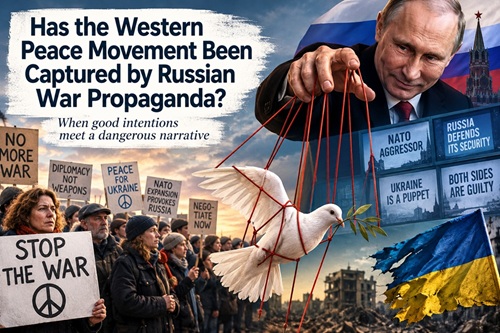 There is an uncomfortable question that the Western peace movement has largely avoided: what happens when your opposition to Western militarism begins to make you useful to Russian militarism? This is not the crude accusation that every pacifist is a Putin sympathizer. Nor is it the equally crude claim that criticism of NATO, American foreign policy or Western arms shipments is Russian propaganda. Democracies need such criticism, and pacifism is a respectable political and moral tradition. The more interesting phenomenon is subtler. A section of the Western anti-war movement has developed an interpretation of the Ukraine war in which Western responsibility is so heavily emphasized that Russian responsibility begins to disappear. NATO expansion becomes the central explanation, Ukraine becomes a Western proxy, Western arms become the principal reason the war continues, and negotiations become synonymous with peace. At that point something has gone badly wrong. The movement that once opposed imperialism in all its forms risks becoming selectively anti-imperialist: fiercely suspicious of American power while strangely accommodating toward Russian power. The anti-imperialist blind spotThe traditional Left possessed an admirable principle: great powers should not be allowed to determine the fate of smaller nations. But somewhere along the way that principle acquired an enormous exception. When Washington invades Iraq, it is imperialism. When NATO bombs Serbia, it is imperialism. When the United States intervenes in Afghanistan or Libya, it is imperialism. But when Moscow invades Ukraine, the vocabulary changes. Suddenly we hear about “security concerns,” “spheres of influence,” “NATO expansion,” “Russian fears,” “provocation,” “Western encirclement” and “the failure of diplomacy.” All of these things can be discussed legitimately. The problem arises when they become an explanation that leaves Russian agency almost entirely intact. Russia becomes the reactor. The West becomes the actor. Ukraine becomes the territory where the two collide. And the Ukrainian population—the people actually being invaded—quietly disappears from the picture. That is an extraordinary reversal of the traditional anti-imperialist perspective. NATO did not invade UkraineHere we encounter the argument that has become almost obligatory in sections of the Western peace movement: NATO provoked Russia. There is a serious version of this argument. NATO expansion altered the European security environment. Russian leaders repeatedly complained about NATO enlargement. Western governments made strategic choices that Moscow perceived as threatening. These facts are worth debating. But there is a gigantic logical step between saying that Western policy contributed to Russian threat perceptions and saying that Western policy caused Russia to invade Ukraine. The first is a proposition about international relations. The second is a theory of responsibility. And responsibility ultimately comes down to agency. On 24 February 2022, Russian forces crossed an internationally recognized border into Ukraine. Whatever one thinks about NATO enlargement, the decision to launch that full-scale invasion was made in Moscow. Even Stop the War, which strongly emphasizes NATO provocation, acknowledges that the invasion was Russia's responsibility. Its current position simultaneously condemns the invasion and describes NATO expansion as one of its causes. That distinction matters. Otherwise we move from the proposition that Russia had reasons for being dissatisfied with the European security order to the proposition that Russia was therefore entitled to change that order by force. Those are not the same statement. The strange disappearance of Ukrainian agencyPerhaps the most revealing feature of the “proxy war” narrative is what happens to Ukraine. Ukraine becomes something done to Russia by the West. The United States arms Ukraine. NATO uses Ukraine. Washington wants to weaken Russia. Europe wants to prolong the war. Ukraine is supposedly fighting America's war. This language is remarkably convenient because it removes the Ukrainian people as independent political actors. But Ukraine is not merely a piece of territory between Washington and Moscow. Ukrainians have political preferences of their own. They have repeatedly demonstrated a willingness to resist Russian domination at enormous cost. To call Ukraine a “proxy” can therefore become a form of geopolitical paternalism. It effectively says: You Ukrainians think you are fighting for your own country, but we know what is really happening. The Kremlin has its own version of precisely this argument. EUvsDisinfo identifies the claim that the West is waging a proxy war through Ukraine as a recurring pro-Kremlin narrative designed to portray Russia as fighting the collective West rather than conducting a war against Ukraine. That does not prove that every Western person using the term “proxy war” is parroting Moscow. It does mean that the provenance and political usefulness of the narrative deserve scrutiny. The peace movement's favorite causal equationThe underlying logic often looks like this: NATO expands → Russia feels threatened → Russia invades → the West arms Ukraine → the war continues. Notice what has happened. The invasion has become almost grammatically invisible. Russia invaded Ukraine. The West responded. Ukraine resisted. But the argument frequently ends with: The West is prolonging the war. This is where the moral arithmetic becomes strange. If someone attacks you and another person gives you a weapon with which to defend yourself, it is possible to criticize the person supplying the weapon. But it is difficult to explain the continuation of the conflict without mentioning the person who is attacking you. Yet “Western weapons are prolonging the war” has become one of the central propositions of the Western peace narrative. Of course they are prolonging the fighting. Weapons do that. But that is not the same thing as saying that weapons are the cause of the war. The distinction is crucial. A Ukrainian soldier who refuses to surrender is also “prolonging the war.” So is a Ukrainian civilian who refuses to accept Russian occupation. So is the Ukrainian government refusing territorial concessions. If “prolonging the war” becomes the principal moral category, then resistance itself becomes the problem. And that is an extraordinarily dangerous definition of peace. Peace becomes surrender by another nameThere is nothing inherently virtuous about a ceasefire. A ceasefire can be the beginning of a negotiated settlement. It can also freeze an unjust territorial conquest. It can allow an aggressor to consolidate its gains. It can provide time to rearm. It can create a new permanent division. It can simply postpone the next war. This is why “We need peace negotiations” is not yet a political program. The next question is unavoidable: On what terms? Who withdraws? Who controls occupied territory? What happens to Ukrainian sovereignty? What security guarantees exist? Who enforces them? What happens if Russia rejects the agreement? What happens if Ukraine rejects it? What prevents another invasion? What happens to Crimea and the occupied territories? The peace activist who refuses to discuss these questions has not solved the political problem. He has merely replaced it with a slogan. The myth of the stolen peace dealPerhaps the most powerful version of this narrative concerns the negotiations in Istanbul in 2022. According to a widely repeated story, Russia and Ukraine were on the verge of a peace agreement when Boris Johnson—or the United States and Britain collectively—arrived and ordered Ukraine to continue fighting. It is an extraordinarily attractive story because it provides a simple explanation for four years of suffering: Peace was available. The West killed it. But the historical record is considerably more complicated. The Istanbul discussions produced drafts and areas of tentative convergence, but there was no completed peace treaty waiting to be signed. Major questions remained unresolved, including territory and security guarantees. The simplified story is nevertheless politically powerful. Stop the War currently presents the negotiations as an agreement that could have ended the war before Western intervention persuaded Zelenskyy to abandon neutrality. Whether one believes that interpretation or not, it illustrates the larger problem: the entire war can be rewritten as a lost opportunity for peace in which Western governments become the principal villains. Russia's own responsibility once again moves into the background. The Kremlin does not need to invent these ideasThis is where the accusation of “Russian propaganda” needs to become more sophisticated. The Kremlin does not have to manufacture Western anti-war sentiment. It can exploit it. Western societies already contain powerful traditions of pacifism, anti-Americanism, anti-NATO sentiment, anti-imperialism and suspicion of the military-industrial complex. Those traditions existed long before Putin. The Russian information strategy can simply connect them. This is much more effective than telling Westerners to love Russia. The message is instead: America is hypocritical. NATO is aggressive. The media lies. Ukraine is corrupt. Russia was provoked. Both sides are guilty. Nobody knows the truth. The war cannot be won. Weapons only make things worse. Therefore the only reasonable position is to stop supporting Ukraine. That final conclusion can be reached by someone who has never watched Russian television. That is what makes propaganda so interesting. Propaganda does not require the propagandist to control the conclusion. It only needs to shape the conceptual environment in which the conclusion becomes obvious. Research by the Institute for Strategic Dialogue has documented Russian and pro-Kremlin information operations aimed at undermining Western support for Ukraine and exploiting vulnerabilities within the Western alliance. EUvsDisinfo has likewise identified recurring narratives portraying the war as a Western proxy war and presenting Ukraine and the West as the parties obstructing peace. That does not establish that Western peace organizations are controlled by Moscow. It establishes something more subtle: their preferred narratives can be strategically useful to Moscow. The asymmetric anti-imperialism problemHere lies the deepest intellectual failure. The Western Left developed an extraordinarily sophisticated critique of American power. Vietnam. Chile. Nicaragua. Iraq. Afghanistan. Libya. Palestine. The CIA. NATO. The military-industrial complex. This history matters. But it can produce an ideological reflex in which the question “What is America doing?” is automatically considered more intellectually sophisticated than the question “What is Russia doing?” The result is an asymmetry of suspicion. Western motives are interrogated endlessly. Russian motives are explained. Western hypocrisy is evidence of imperialism. Russian hypocrisy is evidence of insecurity. Western propaganda is propaganda. Russian propaganda is sometimes treated as a distorted expression of legitimate grievances. And when Russia behaves aggressively, the first question becomes: What did the West do to make Russia do this? Imagine applying the same reasoning to every other imperial power. Imagine explaining Iraq primarily through Saddam Hussein's security concerns. Imagine explaining Nazi expansion primarily through German grievances about Versailles. Imagine explaining Chinese aggression against a neighbor entirely through American encirclement. Understanding causes is not the same thing as transferring responsibility. That distinction should be the foundation of any serious anti-imperialism. The peace movement's greatest ironyThe irony is almost unbearable. The Western peace movement claims to oppose great-power domination. Yet parts of it have become strangely comfortable with the idea that Russia has a legitimate sphere of influence in Eastern Europe. The underlying argument is often: Russia has legitimate security interests in its neighborhood. But what does that mean in practice? It means that Ukraine's sovereignty is conditional upon Russia's preferences. It means that Ukrainians cannot freely choose their alliances because Moscow objects. It means that Finland and Sweden joining NATO are understandable only as Russian security problems. It means that Poland, the Baltic states and other countries must take Russian sensitivities into account before exercising their own foreign-policy choices. And this produces an extraordinary inversion: the security concerns of a nuclear-armed great power become more important than the sovereignty of its smaller neighbors. That is not traditional anti-imperialism. It is a sphere-of-influence doctrine. The Right and the Left discover each otherThere is another uncomfortable development. On Ukraine, sections of the radical Left and sections of the nationalist Right sometimes arrive at remarkably similar conclusions from completely different ideological starting points. The Right says: America should stop wasting money on Ukraine. The Left says: America is using Ukraine as a proxy. The Right says: NATO provoked Russia. The Left says: NATO expansion caused the war. The Right says: Ukraine should negotiate. The Left says: Ukraine should negotiate. The Right distrusts the liberal international order. The Left distrusts the American-led international order. None of these similarities automatically makes the two movements identical. But they should make everyone pause. When radically different ideologies repeatedly converge on the same geopolitical narrative, it is worth investigating why. The “both sides” escape hatchPerhaps the most intellectually comfortable position is: “Both sides are bad.” Russia invaded. But NATO expanded. Russia bombed. But America bombed Iraq. Russia committed atrocities. But Ukraine has far-right groups. Russia violates sovereignty. But the West violated international law in Iraq. Russia threatens nuclear escalation. But NATO also possesses nuclear weapons. All of these statements can be true. And none of them, individually, explains what should happen next. “Both sides” can become a sophisticated way of avoiding moral and political judgment. It is perfectly possible to say that the United States committed catastrophic crimes in Iraq and that Russia's invasion of Ukraine is unjustified. It is possible to condemn NATO's record and defend Ukraine's right to resist invasion. It is possible to criticize Ukrainian nationalism and defend Ukrainian sovereignty. It is possible to oppose nuclear weapons while opposing nuclear blackmail. Consistency does not require pretending that all actors are equally responsible for every event. What genuine anti-imperialism would requireA genuinely universal anti-imperialism would be much more demanding. It would say: America has no right to dominate Iraq. Russia has no right to dominate Ukraine. China has no right to dominate Taiwan. Israel has no right to dominate Palestinians. Iran has no right to dominate its neighbors. NATO has no right to dictate the political future of Eastern Europe. Russia has no right to dictate the political future of Eastern Europe either. That is the principle. No great power gets a sphere of influence simply because it is powerful enough to enforce one. This principle may be uncomfortable. It may even produce politically inconvenient conclusions. But that is precisely why it is a principle rather than a geopolitical preference. A test for the Western peace activistThere is a remarkably simple way to test whether one's anti-war politics has become ideologically captured. Reverse the actors. Would you use exactly the same argument if Washington were invading Mexico? Would you use exactly the same argument if China were invading Taiwan? Would you say that the victim should stop resisting because resistance “prolongs the war”? Would you explain the aggressor's behavior primarily through the military alliances of the victim? Would you describe the victim as a “proxy”? Would you demand concessions from the invaded country before demanding withdrawal by the invading army? If your answer changes depending upon whether the aggressor is American, Russian or Chinese, then you do not have a consistent anti-war philosophy. You have a geopolitical preference. The opposite mistake is equally dangerousThere is also a temptation on the other side to declare every dissenting voice a Russian asset. That is intellectually lazy. A democratic society should be able to debate NATO expansion, weapons deliveries, negotiations, sanctions, military spending and escalation risks without treating disagreement as treason. Indeed, an effective peace movement is useful precisely because governments require external criticism. The answer to Russian propaganda cannot be Western propaganda. The answer is better reasoning. That means applying the same evidentiary standards to Washington, Moscow and Kyiv. It means checking claims rather than trusting the source. It means distinguishing explanation from justification. It means distinguishing causation from responsibility. It means distinguishing peace negotiations from peace settlements. And it means keeping the people actually fighting and dying in the picture. Peace without geopolitical amnesiaThe Western peace movement does not need to become pro-NATO. It does not need to become pro-American. It does not need to support every Ukrainian government policy. It does not need to celebrate every weapons shipment. It does not even need to abandon pacifism. What it does need to abandon is the fantasy that opposing Western power automatically places one on the side of the oppressed. Sometimes the world's oppressor is Washington. Sometimes it is Moscow. Sometimes it is Beijing. Sometimes it is a local authoritarian government. Sometimes there are several oppressors at once. The moral test is not: Which side is America on? The moral test is: Who is exercising coercive power over whom, and what right does each actor have to do so? That question is much harder. It is also much more useful. The peace movement needs to recover its universalismThe Western peace movement may not have been “captured” by Russian propaganda in any simple organizational sense. That formulation is too crude. Something more interesting has happened. Some of its narratives have become vulnerable to capture because its anti-imperialism has become asymmetrical. It has learned to see empire when it comes from Washington but geopolitics when it comes from Moscow. It recognizes propaganda when it comes from Fox News but sometimes calls it “context” when it comes from the Kremlin. It understands that Iraq cannot be explained without examining American power but sometimes treats Ukraine as inexplicable without first examining NATO. And it has become so committed to stopping the fighting that it sometimes forgets to ask what political reality will exist when the fighting stops. That is the peace movement's blind spot. The cure is not more militarism. It is universalism. A peace movement worthy of the name should oppose American imperialism without becoming an apologist for Russian imperialism; oppose NATO militarism without accepting Russian spheres of influence; support negotiations without demanding that the invaded party simply surrender; and oppose escalation without confusing resistance with aggression. Above all, it should remember the principle that once made anti-imperialism morally compelling: Small countries are not pieces on a great-power chessboard. Not when Washington moves them. Not when Moscow moves them. And not when Beijing does. If the Western peace movement can recover that principle, it has a future. If it cannot, then the most ironic outcome of its campaign for peace may be that it ends up helping one empire explain why another empire is to blame.
Widget is loading comments...
|