|
TRANSLATE THIS ARTICLE
Integral World: Exploring Theories of Everything
An independent forum for a critical discussion of the integral philosophy of Ken Wilber
  Frank Visser, graduated as a psychologist of culture and religion, founded IntegralWorld in 1997. He worked as production manager for various publishing houses and as service manager for various internet companies and lives in Amsterdam. Books: Ken Wilber: Thought as Passion (SUNY, 2003), and The Corona Conspiracy: Combatting Disinformation about the Coronavirus (Kindle, 2020).
Check out my other conversations with ChatGPT
The Western Peace Movement:
Captured by Russian War Propaganda? The Peace Movement's Blind Spot Peace by Surrender? Where Are the Peace Protests in Russia? Everybody Wants Peace - But How? Has the Western Peace Movement Been Captured by Russian War Propaganda?When 'peace' becomes a political weaponFrank Visser / ChatGPT
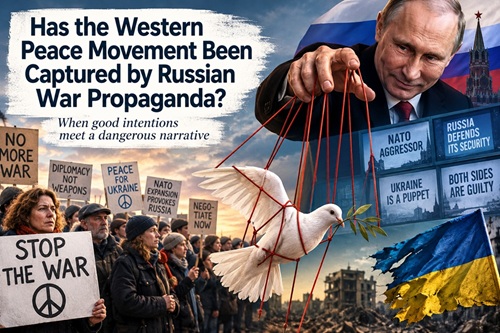 There is something deeply paradoxical about the Western peace movement over the war in Ukraine. A movement whose defining moral intuition is opposition to war has, in some cases, adopted arguments that closely resemble the information strategy of the state that started the war. That does not mean that Western pacifists are Russian agents. Nor does it mean that every criticism of NATO, the United States, Ukraine or Western arms deliveries is Russian propaganda. Quite the opposite: democracies need vigorous criticism of their own governments, and genuine pacifist arguments deserve to be taken seriously. The interesting question is therefore not, “Are peace activists Russian propagandists?” It is this: Why do some Western peace narratives converge so remarkably with Russian strategic narratives—and how can we tell the difference between independent pacifism and propaganda capture? That is a much harder question, and a much more useful one. The first mistake: equating peace with a particular settlement“Peace” sounds like an unambiguous moral good. Nobody wants more dead soldiers, destroyed cities, traumatized children or widows and orphans. But peace is not itself a description of a political settlement. A ceasefire is peace in one sense. So is an armistice. So is a frozen conflict. So is capitulation. So is the withdrawal of an invading army followed by a security agreement. These are radically different political outcomes. The word peace therefore conceals a question that cannot be avoided: Peace on whose terms? Russia can call for peace while demanding Ukrainian territorial concessions, restrictions on Ukrainian sovereignty, limits on Ukraine's military capabilities and a political transformation of Ukraine. Ukraine can call for peace while demanding the restoration of its territorial integrity and security guarantees. European governments can call for peace while seeking a settlement that prevents another Russian invasion. All three may sincerely use the word “peace.” The word itself tells us almost nothing. This is where parts of the Western peace discourse become vulnerable. The repeated demand to “negotiate” can sound eminently reasonable while leaving completely unspecified what happens if the two sides cannot agree. Negotiation is a method, not a solution. The pacifist argument is not the problemThere is a strong version of pacifism that should not be dismissed. Pacifists can ask uncomfortable questions about whether military force actually produces the desired political outcomes. They can challenge assumptions about deterrence, escalation and the supposedly inevitable effectiveness of violence. Recent academic work has explicitly defended the legitimacy of asking such questions about the Ukrainian war. There is also nothing inherently pro-Russian about arguing that Western governments made strategic mistakes before 2022, that NATO enlargement contributed to Russian threat perceptions, that diplomacy was underused, that negotiations should have been pursued earlier, or that Western weapons deliveries carry escalation risks. These are legitimate subjects of debate. The problem begins when a critique of Western policy quietly turns into an explanation of the war in which Russian agency disappears. That is the crucial boundary. From “NATO made mistakes” to “NATO caused the war”Consider the difference between two propositions. Proposition A: Western policy toward Russia and NATO expansion contributed to a deteriorating security environment and may have been strategically unwise. Proposition B: Russia invaded Ukraine because NATO forced it to, making the invasion essentially an act of Western self-provoked aggression. The first is a legitimate historical interpretation. The second requires a much larger evidentiary burden. Yet in some Western peace rhetoric the distinction disappears. NATO expansion becomes the explanation. Russian imperial ideology becomes secondary. Putin's repeated statements about Ukrainian sovereignty become irrelevant. The annexation of Crimea becomes a reaction. The invasion becomes a “proxy war.” Western military assistance becomes the principal cause of continued fighting. The causal arrow has effectively been reversed. Russia attacks Ukraine → the West arms Ukraine → therefore the West is prolonging the war. This reasoning contains an obvious problem. It can make the victim's resistance disappear as an independent cause of the conflict. The “proxy war” trapThe phrase “proxy war” is particularly revealing. There is certainly a geopolitical dimension to the conflict. The United States and European governments have strategic interests in its outcome. Western weapons, intelligence, training and financial assistance have become enormously important to Ukraine. But describing Ukraine primarily as a Western proxy can erase Ukrainian agency. Ukraine is not merely a chessboard on which Washington and Moscow play. Millions of Ukrainians have their own political interests, historical memories and conceptions of national sovereignty. They have repeatedly demonstrated that they do not regard their country as an American proxy state. This distinction matters because the Kremlin's preferred narrative also tends to transform Ukraine from a subject into an object. Ukraine is either a puppet of the West or a territory belonging naturally within Russia's sphere of influence. A Western movement committed to self-determination should be particularly suspicious of any narrative that leaves Ukrainians with no meaningful political agency. The curious asymmetry of Western pacifismThere is another revealing asymmetry. Some peace activists are extraordinarily sensitive to Western violence but surprisingly reluctant to discuss Russian violence as a source of independent political agency. The United States bombs another country: imperialism. NATO expands: provocation. Western weapons arrive in Ukraine: escalation. Ukraine attacks Russian territory: escalation. But Russia invades Ukraine: reaction. Russia mobilizes: response. Russia occupies territory: bargaining position. Russia threatens nuclear escalation: warning. Russia demands Ukrainian neutrality: security concern. The result is not necessarily conscious propaganda. It can arise from a perfectly understandable psychological mechanism. A movement formed primarily around opposition to Western militarism naturally looks for Western responsibility. It has developed a conceptual vocabulary for understanding American imperialism, NATO expansion and military-industrial interests. It has much less conceptual equipment for understanding Russian imperialism. The result can be a striking asymmetry of moral attention. The Kremlin does not need to invent the peace movementThis is where the idea of “propaganda capture” needs to be formulated carefully. Russian information warfare does not require Western peace activists to be secretly recruited by Moscow. That would be the least interesting model. A much more sophisticated information operation works by identifying existing divisions and reinforcing them. Russia does not need to manufacture Western skepticism about war from nothing. Western societies already contain powerful traditions of pacifism, anti-Americanism, anti-NATO sentiment, anti-imperialism and distrust of military establishments. Those traditions are genuine. The strategic opportunity lies in connecting them to narratives that serve Russian interests. European investigations have documented repeated Russian attempts to exploit precisely these social divisions. EU institutions describe Russian information manipulation as involving cross-platform amplification, information laundering, impersonation of institutional consensus and the exploitation of existing social tensions. The important word is amplification. Propaganda does not necessarily create the message. Sometimes it simply finds the message that already exists and gives it a much larger microphone. The “peace at any price” mechanismThe most vulnerable slogan is therefore not “Peace!” It is: “Peace now, whatever the consequences.” That sounds humane. But it implicitly assigns the cost of peace to someone. If Russia can obtain a ceasefire by keeping conquered territory, while Ukraine is denied the military capacity to recover it, then the ceasefire has a very different meaning for Moscow and Kyiv. If Ukraine is forced to accept territorial losses because continued resistance is described as “prolonging the war,” the aggressor's military gains become the starting point of diplomacy. And that creates a dangerous precedent: military aggression becomes a bargaining strategy. This is why the distinction between peace and peace on terms compatible with Ukrainian sovereignty is so important. The question is not whether Ukrainians should negotiate. The question is whether negotiations occur between political equals or under the pressure of military coercion. Russia has learned to speak the language of peaceThis is perhaps the most uncomfortable part. The Kremlin does not always present itself as the enemy of peace. Quite the opposite. Russian diplomacy frequently uses the vocabulary of negotiations, ceasefires, security guarantees and peace proposals. That does not automatically make those proposals insincere. But their political function has to be examined. Recent analyses of Russian negotiating positions have noted the coexistence of maximalist long-term demands with more limited ceasefire proposals, allowing Moscow to appear diplomatically constructive while retaining demands that would fundamentally constrain Ukrainian sovereignty. Russian proposals can therefore perform two functions simultaneously: diplomatic communication and information warfare. That is not a contradiction. A peace proposal can be both. The propaganda testHow, then, can an ordinary Western peace activist tell whether an argument has been captured by Russian propaganda? There is a useful test. Ask what the argument does with Russian agency. • Does it acknowledge that Russia made a sovereign decision to invade? • Does it take Russian imperial and nationalist ideas seriously? • Does it recognize that Ukraine possesses political agency independent of Washington? • Does it acknowledge Ukrainian objections to territorial concessions? • Does it distinguish between NATO's role in European security and responsibility for Russia's decision to invade? • Does it examine Russian propaganda as critically as Western propaganda? • Does it ask what happens if negotiations fail? • Does it specify what a proposed peace settlement actually looks like? And most importantly: • Would the argument still make sense if Russia were replaced by another great power? If the answer is no, something interesting may be happening. The “Russia test”Imagine that China invaded Taiwan and a Western peace movement responded: “Taiwan should stop accepting American weapons. China's security concerns must be understood. NATO-style alliances provoke authoritarian powers. Continuing resistance only produces more deaths. Taiwan needs to compromise.” Some people might regard this as a reasonable pacifist position. But now change the wording: “Ukraine should stop accepting Western weapons. Russia's security concerns must be understood. NATO expansion provoked Moscow. Continuing resistance only produces more deaths. Ukraine needs to compromise.” If one finds the second formulation intuitively more compelling merely because it fits one's existing anti-Western worldview, that is worth examining. Pacifism should be universal. Anti-Westernism is not pacifism. The other danger: dismissing all dissent as propagandaThere is, however, an equal and opposite danger. Once Russian propaganda becomes a serious concern, governments and commentators can start using “Russian disinformation” as a rhetorical shortcut for dismissing uncomfortable opinions. That would be a serious mistake. • A person can oppose weapons deliveries to Ukraine without being pro-Russian. • A person can oppose NATO without supporting Putin. • A person can believe that the West mishandled relations with Moscow without denying Russian responsibility for the invasion. • A person can believe negotiations should have begun earlier without being a Kremlin sympathizer. • And a person can be a principled pacifist while making arguments that are strategically disastrous. These categories must not be collapsed. The existence of Russian propaganda does not make every anti-war argument propaganda. Propaganda capture is a spectrumThe useful concept is therefore not “Russian agent.” It is propaganda capture. At one end is independent pacifism: a consistent opposition to violence regardless of who employs it. Next comes selective pacifism: intense opposition to Western military force but considerably less attention to Russian military agency. Then comes narrative convergence: Western arguments begin reproducing distinctive Kremlin frames—Ukraine as a puppet, NATO as the real aggressor, Russia as essentially reacting, Ukrainian sovereignty as negotiable. Further along the spectrum is information laundering: Western activists, politicians or commentators repeat claims originating in Russian state media without adequately checking their provenance. At the far end is conscious collaboration. These are not the same thing. Most people who repeat Kremlin-friendly narratives probably occupy the middle of this spectrum rather than the extreme end. That is precisely why the phenomenon is difficult to identify. The strange success of Russian propagandaThe most successful propaganda is not necessarily the propaganda that makes people love Russia. It can be propaganda that makes people distrust their own institutions, distrust their allies, distrust the media, distrust Ukraine, distrust NATO and distrust the possibility of distinguishing truth from propaganda. In that sense, the Kremlin does not necessarily need Westerners to become “pro-Russian.” It can be enough for them to become anti-Western, fatalistic and politically disengaged. The message becomes: Everybody lies. Both sides are equally guilty. We will never know what really happened. Ukraine is corrupt. Russia was provoked. NATO is just as bad. There is no good side. Nothing can be done. So let's stop supporting Ukraine and call that peace. This is an extraordinarily effective political dead end. What a genuinely independent peace movement would look likeA serious Western peace movement could occupy a much more interesting position. • It could condemn Russia's invasion without romanticizing NATO. • It could defend Ukrainian sovereignty without endorsing every decision of the Ukrainian government. • It could support negotiations without pretending that negotiations automatically produce peace. • It could oppose nuclear escalation without accepting nuclear blackmail. • It could criticize Western military policy while also criticizing Russian imperialism. • It could investigate war crimes on all sides without constructing false equivalence. • And it could insist that Ukrainian voices—not only Russian and Western voices—must be central to any settlement. That would be a genuinely independent peace politics. It would also be considerably harder to capture by propaganda. The ultimate ironyThere is a final irony here. The Western peace movement traditionally emerged from the conviction that powerful states should not be allowed to determine the fate of smaller peoples. That principle is perfectly applicable to Ukraine. If a great power can invade a neighboring country, occupy part of its territory and then demand that everyone else pressure the victim to compromise because continued resistance is inconvenient, the traditional anti-imperialist principle has been turned upside down. The question is therefore not whether the West should pursue peace. Of course it should. The question is whether peace is understood as the absence of fighting or as a political order in which smaller countries retain the right to determine their own future. Those are not necessarily the same thing. And this is where the Western peace movement faces its deepest intellectual challenge. It must decide whether its deepest principle is simply “stop the war” or something more demanding: “Stop the war without surrendering the principle that wars of aggression must not become a successful method of changing borders and subordinating nations.” The first principle can easily be exploited by either side. The second is much harder—but also much more genuinely universal. Peace needs a reality checkSo, has the Western peace movement been “captured” by Russian war propaganda? There is no single answer because there is no single Western peace movement. Some pacifist arguments are entirely independent; some contain legitimate criticisms of Western policy; some demonstrably reproduce Kremlin narratives; and some campaigns have been infiltrated, amplified or exploited by Russian information operations. Investigations have documented such attempts in several European countries. The more useful conclusion is therefore more modest—and more disturbing. Parts of the Western peace discourse have become vulnerable to Russian propaganda because some of its pre-existing assumptions provide ready-made channels through which Russian narratives can travel. That does not make pacifism Russian. It means pacifism, like every political ideal, needs its own critical self-examination. The ultimate test is simple: Can you condemn Western militarism without excusing Russian militarism? Can you demand negotiations without treating Ukrainian sovereignty as a bargaining chip? Can you oppose war without losing sight of who crossed the border? If the answer is yes, peace activism remains independent. If the answer is no, then “peace” may have quietly ceased to be a principle and become a geopolitical narrative. And that is precisely where propaganda begins.
Comment Form is loading comments...
|