|
TRANSLATE THIS ARTICLE
Integral World: Exploring Theories of Everything
An independent forum for a critical discussion of the integral philosophy of Ken Wilber
  Frank Visser, graduated as a psychologist of culture and religion, founded IntegralWorld in 1997. He worked as production manager for various publishing houses and as service manager for various internet companies and lives in Amsterdam. Books: Ken Wilber: Thought as Passion (SUNY, 2003), and The Corona Conspiracy: Combatting Disinformation about the Coronavirus (Kindle, 2020).
Check out my other conversations with ChatGPT
The Western Peace Movement:
Captured by Russian War Propaganda? The Peace Movement's Blind Spot Peace by Surrender? Where Are the Peace Protests in Russia? Everybody Wants Peace - But How? Peace by Surrender?If Russia stops fighting, the war is over. If Ukraine stops fighting, Ukraine is overFrank Visser / ChatGPT
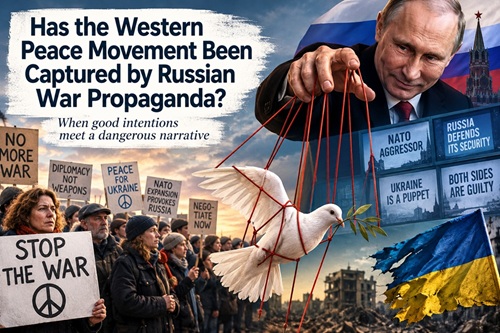 There is a brutally simple thought experiment that cuts through much of the Western debate about the war in Ukraine: What happens if Russia stops fighting? The war ends. Now ask the opposite question: What happens if Ukraine stops fighting? That depends on what “stops fighting” means. If Ukraine lays down its arms while Russian forces remain on Ukrainian territory, the result is not necessarily peace. It may be occupation, annexation, political subordination or the destruction of Ukraine as an independent state. This asymmetry is so obvious that it is almost embarrassing that it needs to be stated. And yet much of the Western peace discourse has managed to obscure it. The seductive simplicity of “stop the war”“Stop the war” is one of those slogans that seems to settle the argument before the argument has even begun. Who could be against stopping a war? But there are two radically different ways of stopping a war. The first is for the aggressor to stop attacking. The second is for the victim to stop resisting. Both can produce silence. Only one necessarily produces peace. The distinction is not merely rhetorical. The United Nations General Assembly's March 2022 resolution called on Russia to end its military operation and withdraw its forces from Ukraine, while reaffirming Ukraine's sovereignty and territorial integrity. In October 2022, the Assembly again condemned Russia's attempted annexation of four Ukrainian regions and demanded withdrawal. In other words, the international legal framework does not treat “stop fighting” as an instruction addressed equally to both parties. The party exercising unlawful force is not morally equivalent to the party exercising self-defence. The uncomfortable NATO formulationNATO Secretary General Jens Stoltenberg put the asymmetry bluntly in 2022: “If Russia stops fighting, there will be peace. If Ukraine stops fighting, it will cease to exist as an independent nation.” The wording was politically charged, and it came from the head of a military alliance supporting Ukraine. It should therefore not be treated as a neutral description of every possible future. But as a logical proposition it identifies something important. Ukraine is not fighting Russia because Ukrainians have an abstract attachment to warfare. Ukraine is fighting because Russian forces are on Ukrainian territory. If those forces disappear, the immediate war disappears with them. If Ukrainian forces disappear while Russian forces remain, the territorial problem remains. That is the asymmetry. And no amount of rhetorical symmetry can make it disappear. “Peace” can mean occupationThis is the problem with the phrase peace at any price. Suppose Ukraine agrees tomorrow to stop resisting. Russia keeps the territory it currently occupies. Ukrainian forces withdraw. Moscow receives guarantees restricting Ukraine's military capabilities. Ukraine agrees never to join certain alliances. Perhaps sanctions are lifted. Perhaps reconstruction begins. There would be less shooting. There might be fewer deaths. There might even be celebrations in some Western capitals. But what exactly would have happened? A war of aggression would have produced territorial and political gains for the aggressor. The conquered territory would become the starting point for negotiations. And the message to the international system would be unmistakable: Invade first, negotiate later. This is why “peace” cannot be evaluated merely by the number of bullets being fired. A frozen conflict can be less violent than an active war while still being profoundly unjust. The peace movement's semantic trickThis is where some Western peace rhetoric becomes problematic. “Ukraine must negotiate.” Of course. “Ukraine must make compromises.” Possibly. “Russia must receive security guarantees.” Perhaps. “Western governments should pursue diplomacy.” Certainly worth discussing. But notice how easily the subject of the sentence changes. Russia invaded Ukraine. Ukraine must negotiate. Russia occupies Ukrainian territory. Ukraine must compromise. Russia threatens further escalation. Ukraine must stop provoking Russia. Russia continues bombing Ukrainian cities. The West must stop sending weapons. The grammatical structure has quietly become a political structure. The victim is repeatedly instructed what it must do to make the aggressor stop. This is the psychology of appeasement in its most sophisticated form. It does not say: “Russia is right.” It says: “Ukraine must be realistic.” Realism for whom?“Be realistic” sounds like wisdom. But realism can conceal an extraordinary moral assumption. Realistic about what? That Russia is larger? Yes. That Russia possesses nuclear weapons? Yes. That Russia can inflict enormous destruction? Obviously. That Ukraine cannot recover every square kilometre at acceptable cost? Perhaps. But there is another kind of realism: What happens if aggression is rewarded? What happens if territorial conquest becomes the opening bid in negotiations? What happens if military occupation creates bargaining leverage? What happens if the victim's only route to peace is to accept the consequences of having been attacked? That is also realism. And it is precisely the reality that the “peace at any price” argument tends to avoid. The moral inversionThere is something deeply strange about treating Ukrainian resistance as the obstacle to peace. Russia attacks. Ukraine resists. The war continues. Therefore Ukraine is partly responsible for continuing the war. This is technically true in the most trivial sense: resistance means fighting continues. But it is morally misleading. If someone breaks into your house and you resist, your resistance contributes to the continuation of the physical confrontation. That does not make you jointly responsible for the confrontation in the same sense as the intruder. Causality has many layers. So does responsibility. This is why the phrase “both sides must stop fighting” can become morally deceptive when the two sides are not in equivalent positions. It transforms an aggressor's decision to attack into a shared conflict requiring symmetrical concessions. “But what about diplomacy?”Yes. Diplomacy. Always diplomacy. There is no contradiction between supporting Ukrainian self-defence and supporting negotiations. Indeed, diplomacy is eventually the only way wars normally end. The question is what happens before and during negotiations. A negotiated settlement does not become morally illegitimate because Ukraine makes concessions. Nor does it become legitimate simply because both parties sign a document. The important question is whether the settlement represents a genuine compromise or merely formalizes the results of coercion. And there is a crucial difference between: “We agree to this because we have reached a mutually acceptable settlement.” and: “We agree to this because otherwise the invading army will continue destroying our country.” Both are agreements. They are not necessarily equivalent forms of consent. The missing party at the peace tableThere is another strange feature of Western debates about peace. Everyone talks about what America should do. Everyone talks about what Russia wants. Everyone talks about what Europe should pay. Everyone talks about NATO. But the country whose territory is being fought over sometimes becomes the least important voice in the discussion. This is particularly visible whenever Western commentators propose that Ukraine should simply accept territorial losses. The question then becomes: Who gets to give Ukraine away? Washington? Moscow? Brussels? Berlin? The United Nations? The Western peace movement? None of them. Ukraine is a sovereign state. Its citizens have to live with the consequences. A peace imposed on Ukraine by external powers would reproduce the very great-power politics that anti-imperialists claim to oppose. The fantasy of frictionless surrenderThere is a particularly seductive Western fantasy that if Ukraine simply stopped receiving weapons, the fighting would naturally stop. Perhaps. But that proposition requires an additional assumption: Russia would accept the resulting Ukrainian vulnerability as an endpoint. That cannot simply be assumed. A military defeat of Ukraine is not automatically equivalent to a negotiated peace. It could instead create conditions for occupation, regime change, territorial annexation or further coercion. The current war is also not occurring in a static geopolitical environment. As recently as October 2026, Russia continued large-scale strikes against Ukrainian targets while diplomatic efforts were simultaneously being pursued. The United States is currently pressing for negotiations, while Ukrainian and European officials continue to seek security guarantees and a settlement that can hold. Diplomacy and deterrence are therefore not necessarily opposites. Sometimes diplomacy requires leverage. The “just surrender and save lives” argumentThis is perhaps the strongest version of the pacifist argument. If continued resistance produces tens of thousands of additional deaths, shouldn't Ukraine simply surrender? It is a serious question. But it has an uncomfortable implication. If surrender is always preferable to resistance because resistance causes casualties, then the moral burden of war shifts dramatically. The aggressor acquires a remarkably powerful weapon: the victim's compassion. Attack hard enough and long enough, and eventually Western public opinion may demand that the victim surrender in order to stop the suffering. The more brutal the attack, the stronger the argument for capitulation becomes. That is a perverse incentive. It means that humanitarian concern can accidentally reward brutality. The answer cannot simply be “fight forever.” Nor can it be “surrender whenever fighting becomes painful.” The real question is whether a political settlement can be reached that ends the violence without making aggression the mechanism by which the settlement was determined. The historical problemThis is why the distinction between peace and surrender has occupied political thought for centuries. A conquered people may experience peace. An occupied country may experience peace. A dictatorship may impose peace. A graveyard is peaceful. Peace is therefore not simply the absence of violence. Political peace usually means something more: a stable order in which people can live without being subjected to arbitrary coercion. If Russia ultimately withdraws and Ukraine remains sovereign, militarily defensible and politically independent, the war can end without Ukraine disappearing as a political subject. If Russia retains the ability to dictate Ukraine's political orientation through military force, the shooting may stop without the underlying problem being solved. The difference is everything. The uncomfortable question for pacifistsThis leaves the Western pacifist with a difficult choice. Is the highest value: the immediate cessation of violence? Or is it: the creation of a political order in which violence cannot successfully determine the fate of nations? These principles can conflict. The first may sometimes require surrender. The second may sometimes require resistance. There is no easy formula that resolves the tension. But pretending the tension does not exist is intellectually dishonest. “Peace by surrender?” is not an accusationThe phrase is deliberately provocative: Peace by surrender? It is not a claim that every person advocating negotiations wants Ukraine to surrender. Nor is it a claim that every territorial concession constitutes surrender. A negotiated territorial settlement could conceivably be part of a durable peace. The question is whether Ukraine chooses that settlement freely, with meaningful security guarantees, or whether military coercion determines the result. That distinction matters. A concession freely negotiated is not identical to a concession extracted under threat. The cruelest ironyThere is a final irony here. The Western peace movement has spent decades warning that great powers should not determine the political future of smaller nations. Yet if Western governments pressure Ukraine to accept a settlement primarily because Russia possesses the military power to make resistance unbearably expensive, the result may be precisely that: a great power determining the political future of a smaller nation. Only this time the great power is Russia. And the people doing the determining may congratulate themselves for having brought peace. That is the paradox. Peace must not become the name for capitulationThere is nothing noble about endless war. Ukraine should negotiate. Russia should negotiate. The United States and Europe should pursue diplomacy. Every possible route toward a durable settlement should be explored. But there is a fundamental difference between saying: “Find a negotiated way to stop this war.” and saying: “Stop helping Ukraine resist, and eventually the war will stop.” The first is diplomacy. The second risks making Ukrainian defeat the mechanism of peace. And that is the question the Western peace movement cannot evade: If Russia stops fighting, the war can end without Ukraine surrendering its sovereignty. If Ukraine stops fighting while Russian forces remain, what exactly has ended—the war, or Ukraine's resistance? Peace by surrender may indeed produce peace. But it may produce something else first: a successful war of conquest followed by a period of silence. And silence is not necessarily peace.
Widget is loading comments...
|