|
TRANSLATE THIS ARTICLE
Integral World: Exploring Theories of Everything
An independent forum for a critical discussion of the integral philosophy of Ken Wilber
  Frank Visser, graduated as a psychologist of culture and religion, founded IntegralWorld in 1997. He worked as production manager for various publishing houses and as service manager for various internet companies and lives in Amsterdam. Books: Ken Wilber: Thought as Passion (SUNY, 2003), and The Corona Conspiracy: Combatting Disinformation about the Coronavirus (Kindle, 2020).
Check out my other conversations with ChatGPT
The Western Peace Movement:
Captured by Russian War Propaganda? The Peace Movement's Blind Spot Peace by Surrender? Where Are the Peace Protests in Russia? Everybody Wants Peace - But How? Why Are There No Peace Protests in Russia?The uncomfortable question for the Western peace movementFrank Visser / ChatGPT
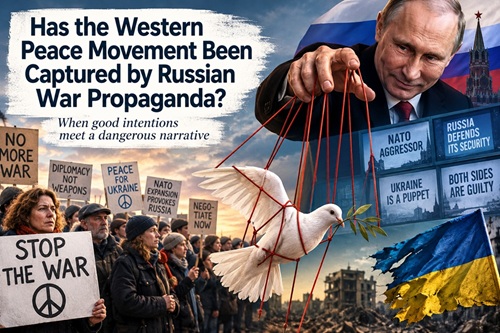
The protests we are told not to seeThere is a question that ought to trouble anyone who follows the Western peace movement's response to the war in Ukraine: Why are there so few visible peace protests in Russia, the country that launched the full-scale invasion? Why do we see Western activists marching against arms deliveries to Ukraine, denouncing NATO, demanding negotiations, and calling on their own governments to stop supporting Kyiv, while comparable mass demonstrations against the war are scarcely visible on Russian streets? The question needs to be framed carefully. It is not true that Russians have never protested against the war. They did so in large numbers immediately after the invasion began on February 24, 2022. According to the Russian human-rights organization OVD-Info, nearly 20,000 detentions connected to anti-war positions were recorded during the first year of the invasion, including arrests at demonstrations in hundreds of locations. People continued to oppose the war despite the risks. The disappearance of large-scale street protests was not evidence that Russian society had unanimously embraced the invasion. It was also the consequence of a government determined to suppress opposition. The relevant question, then, is not simply why Russians do not protest. It is why public anti-war resistance has been so difficult to sustain in Russia—and why some Western peace activists seem more comfortable confronting democratic governments that permit protest than confronting an authoritarian government that punishes it. Because protesting in Russia is dangerousThe most obvious answer is repression. In March 2022, the Russian authorities introduced laws that criminalized certain forms of reporting and public criticism of the military. Calling the invasion a war, rather than using the Kremlin's preferred euphemism of a "special military operation," could expose people to punishment. Public criticism of military conduct, including allegations of Russian war crimes, could lead to prosecution under laws concerning allegedly false information or the discrediting of the armed forces. The consequences have been substantial. OVD-Info recorded more than 20,000 detentions connected with anti-war positions between February 2022 and February 2025. Its reports document criminal prosecutions, police violence, intimidation, and pressure on the families and employers of people who speak out. In 2025, the organization continued to record prosecutions for anti-war expression, even as large public demonstrations became much less common. This is not the political environment in which citizens can casually organize a march, distribute leaflets, or establish an anti-war campaign. A Russian demonstrator may risk losing a job, being expelled from an educational institution, facing criminal charges, or going to prison. A person who knows that a photograph at a protest could become evidence in a prosecution has a powerful reason to stay home. We should therefore resist the lazy inference that silence equals consent. When the state punishes dissent, the absence of public opposition becomes an unreliable measure of private opinion. It may indicate approval, indifference, fear, resignation, or some combination of all four. But acknowledging repression does not settle every question. It explains why Russian protests are dangerous. It does not tell us how much support the war enjoys, how many Russians privately oppose it, or why some citizens actively support the invasion while others accommodate themselves to it. The authoritarian advantageAuthoritarian governments benefit from a particular asymmetry. They can mobilize public resources to promote their preferred account of events while making it costly to challenge that account. State television can repeat official narratives, schools can reproduce patriotic messaging, and public ceremonies can present the war as a defensive struggle against external enemies. Independent journalism and organized opposition, meanwhile, face severe restrictions. This does not mean every Russian who supports the war has been brainwashed. Nationalism, historical grievances, fear, conformity, perceived security interests, and genuine belief in official narratives can all contribute to public support. Nor does it mean that every Russian who remains silent secretly opposes Putin. Some approve of the war; others do not care enough to resist; still others have concluded that resistance is futile. Political passivity is not uniquely Russian. People in democratic societies also avoid political engagement, accept misleading narratives, and prioritize personal security over public principle. The difference is that in a democracy, the costs of dissent are generally lower and the institutional avenues for opposition are more extensive. Elections, independent media, courts, civic organizations, and public demonstrations can provide channels for resistance that are severely constrained in Russia. The distinction matters. A protest in Amsterdam against Dutch military assistance to Ukraine is not equivalent to a protest in Moscow against the Russian invasion. The first may invite disagreement, ridicule, or political criticism. The second can expose a participant to state punishment. To treat these as equivalent acts of courage—or equivalent tests of public opinion—is to ignore the political conditions that make protest possible. Where is the anti-imperialist opposition?Here the question becomes more pointed. Western peace activists frequently describe themselves as opponents of imperialism. They condemn American military interventions, criticize NATO, and warn against the domination of smaller nations by great powers. These are legitimate subjects for political criticism. The United States has a record of military interventions that deserves serious scrutiny, and NATO's policies can be debated without taboo. But what happens when the imperial power is Russia? Russia invaded a neighboring country, attempted to seize territory by force, and subsequently claimed to annex Ukrainian regions. The United Nations General Assembly overwhelmingly condemned the invasion and reaffirmed Ukraine's sovereignty and territorial integrity. These are not simply competing opinions about geopolitical history. They concern the basic principle that one state should not be entitled to determine another state's political future by military force. An anti-imperialism that becomes vociferous when Washington acts but evasive when Moscow acts is not universal anti-imperialism. It is a selective political allegiance. Its language may remain radical, but its application has become strangely accommodating toward one particular imperial power. The asymmetry can be seen in the questions activists choose to ask. How much responsibility does NATO bear for the deterioration of relations with Russia? What role did Western policy play in the years preceding the invasion? Were diplomatic opportunities missed? These are reasonable questions. But where are the equally insistent questions about Russian imperial ambitions, the Kremlin's rejection of Ukrainian sovereignty, the annexation of Ukrainian territory, and the coercive terms Moscow has demanded? Why is the history of Western misconduct often treated as indispensable context, while Russian agency is sometimes presented as a predictable response to Western behavior? Explaining a conflict is not the same as excusing the party that initiated a particular act of aggression. A serious anti-imperialist analysis should be able to hold both propositions in view: Western policy can be criticized, and Russia remains responsible for its decision to invade Ukraine. The peculiar geography of protestThere is also a geographical displacement in some Western peace campaigning. Instead of directing its demands primarily toward Moscow, it directs them toward Washington, London, Berlin, Paris, or The Hague. Western governments are urged to stop sending weapons, reduce military assistance, abandon certain sanctions, or compel Ukraine to negotiate. Again, these demands are not automatically illegitimate. Arms transfers have consequences; negotiations deserve consideration; sanctions should be evaluated for effectiveness and unintended effects. Democratic governments should be answerable for their policies. But the choice of target has political implications. If the practical demand is that Western governments withdraw support from Ukraine while Russian forces remain on Ukrainian territory, the immediate burden of that policy may fall not on the Kremlin but on Ukrainians defending themselves. The aggressor can continue to occupy territory while the victim is pressured to accept the military consequences. A protest can therefore call itself anti-war while advocating a policy that leaves the initiating power with greater freedom of action. Its participants may sincerely want to reduce suffering, but good intentions do not guarantee that the proposed remedy will distribute the costs fairly. Imagine an anti-war movement in a country invaded by a stronger neighbor. Suppose its foreign allies are told that supplying defensive weapons is immoral because it prolongs the fighting. Suppose the invading army faces no comparable pressure to withdraw, and the invaded population is told that further resistance is futile. Would the withdrawal of outside assistance necessarily produce peace? Or might it simply make conquest easier? That is the question the Western peace movement must answer. The moral status of a policy cannot be determined by the number of times it uses the word "peace." Why not demand that Russia stop?A genuinely independent peace movement should direct its demands toward all parties according to their responsibilities and capacities. It should demand that Russia end its invasion and withdraw its forces from Ukrainian territory. It should press the Ukrainian government and its allies to pursue feasible diplomatic options. It should scrutinize the terms of any proposed settlement, including the security guarantees needed to make a ceasefire durable. Most importantly, it should not treat pressure on Ukraine as a substitute for pressure on Russia. There are, of course, Western organizations and activists who explicitly oppose the Russian invasion, support Russian anti-war dissidents, and condemn repression in Russia. It would be unfair to pretend that the entire peace movement has ignored these issues. Nor should Western activists be expected to organize protests inside Russia, where they have neither the same access nor the same political leverage. But the contrast remains instructive. Western activists can demonstrate publicly, publish criticism, organize campaigns, and demand that their governments change course. Russian anti-war activists face a state that has systematically narrowed those possibilities. The very freedom that makes Western protest possible creates a corresponding responsibility to think carefully about its political effects. If activists are prepared to exercise their freedom against Western governments but rarely direct comparable moral scrutiny toward the Russian state, they should explain that asymmetry. It cannot be defended merely by pointing out that Western governments are easier to criticize. Ease of criticism is a practical fact, not a moral principle. The silence of the streets is not a mandate for warThere is a danger in asking why Russians do not protest: the question can easily turn into an accusation against ordinary Russian citizens. That would be both unjust and analytically weak. People living under repression should not be casually blamed for failing to undertake acts that could destroy their lives. Nor can the lack of demonstrations be used as proof that the Russian population uniformly supports the invasion. The opposite error, however, is to romanticize Russian society as universally opposed to the war but helpless to express its opposition. That claim also goes beyond the evidence. Some Russians have resisted; others have emigrated; some have remained silent; some have supported the war. A serious account must leave room for this variety rather than assigning an entire population a single moral identity. The political responsibility of the Russian government is clearer than the private opinions of millions of citizens. The state launched the full-scale invasion, suppressed anti-war opposition, and made public resistance dangerous. Those facts should be central to any discussion of the absence of mass protests. The appropriate response is solidarity with Russian dissenters, not contempt for Russians who are afraid. And it is a refusal to let the Kremlin's control over public space be mistaken for a democratic expression of national will. The real test of a peace movementThe absence of large-scale peace protests in Russia is not evidence that Russians are naturally obedient, that they all support the war, or that anti-war sentiment does not exist. It is evidence of how difficult collective resistance becomes when the state punishes dissent and dismantles the institutions through which opposition can organize. But the question also exposes a weakness in Western political discourse. A peace movement that concentrates its pressure on the governments supporting Ukraine, while failing to maintain an equally clear demand that Russia end its aggression, risks confusing the means of resistance with the cause of the war. It may end up asking the victim to make the decisive concession because the aggressor is harder to influence. The ultimate test is not whether a movement can denounce NATO, criticize Washington, or organize a demonstration in a Western capital. Those are ordinary exercises of political freedom. The test is whether it can apply its principles consistently when doing so becomes inconvenient for its preferred ideological narrative. If peace means opposing imperial domination, then Russian imperial domination must count. If peace means defending the sovereignty of small nations, then Ukraine's sovereignty must count. And if peace means ending a war rather than merely ending resistance to an invasion, then the demands placed on the aggressor and the victim cannot simply be treated as interchangeable. The question is not why Russian streets are empty of peace protesters. They were not always empty, and the state has worked hard to make them so. The deeper question is why some Western activists, who possess freedoms Russian dissidents lack, sometimes seem more eager to discipline their own governments than to articulate an unambiguous demand for Russian withdrawal. A peace movement worthy of the name should be able to do both.
Widget is loading comments...
|