|
TRANSLATE THIS ARTICLE
Integral World: Exploring Theories of Everything
An independent forum for a critical discussion of the integral philosophy of Ken Wilber
  Frank Visser, graduated as a psychologist of culture and religion, founded IntegralWorld in 1997. He worked as production manager for various publishing houses and as service manager for various internet companies and lives in Amsterdam. Books: Ken Wilber: Thought as Passion (SUNY, 2003), and The Corona Conspiracy: Combatting Disinformation about the Coronavirus (Kindle, 2020).
Check out my other conversations with ChatGPT
Wilber and the Epistemic Fallacy:
The Dog That Does Not Exist The Dog and the Worldspace Isaac the Dog Talks Back Further reflections: The Diamond That Does Not Exist When Reality Becomes Ideal Realities and Idealities Alderman's Meta-Realist Rescue of Wilber When Spirit Enters the World Wilber's strongest reply Habits Wilber Should Leave Behind Alderman's Meta-Realist Rescue of WilberFrom Enacted Worlds to Ontic RealityFrank Visser / ChatGPT
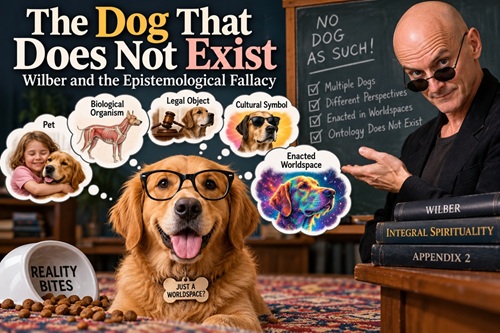 Bruce Alderman's “Integral Religious Pluralism: A metaRealist Inflection” is one of the more philosophically ambitious attempts to repair Ken Wilber's postmetaphysical project from within.[1] Rather than rejecting Wilber's pluralistic account of religion, Alderman asks whether it can actually sustain the “ontological weight” it wants to give religious and spiritual phenomena. His answer is essentially that it cannot—not without help from Roy Bhaskar's Critical Realism and metaReality. The result is an interesting and often penetrating paper. Its strongest contribution is its diagnosis of a genuine problem in Wilber's postmetaphysics: if reality is always reality-for a particular perspective, what prevents ontology from collapsing into epistemology? But Alderman's proposed solution creates a second problem. He wants to preserve Wilber's perspectival, enacted worlds while simultaneously restoring a realist “intransitive” reality behind or beneath those worlds. The paper therefore oscillates between two philosophical impulses: constructivist pluralism and realist ontology. It never quite explains how they can be reconciled without substantially revising Wilber's postmetaphysical project. The central problem: what does “real” mean?Alderman begins from an important observation. Wilber's postmetaphysical turn was intended to escape both naïve metaphysics and crude relativism. Religious realities are not simply discovered as pre-existing supernatural objects, but neither are they supposed to be dismissed as subjective fantasies or cultural inventions. Wilber therefore describes different spiritual realities as enacted within particular worldspaces, stages, states and perspectives. Alderman wants to preserve precisely this pluralism. But he notices a serious philosophical difficulty. If what exists is always what appears or “ex-ists” for a particular sentient being, then what happens to whatever exceeds that appearance? This is where Bhaskar enters. Critical Realism insists that reality cannot be reduced to what is experienced, observed, conceptualized or known. The real exceeds the empirical. A thing can have properties, causal powers or mechanisms that are not presently manifest and may never be directly observable. Alderman summarizes this as the irreducibility of being to our knowledge or access to being. That is a powerful criticism of Wilber. Indeed, it reaches deeper than many standard objections to Integral Theory. It does not simply ask whether Wilber has enough empirical evidence for his spiritual claims. It asks whether his conceptual architecture has left him with a coherent distinction between “what something is” and “how something appears to a knower.” That distinction is indispensable. Alderman's strongest point: epistemology is not ontologyThe most convincing section of the paper concerns Wilber's treatment of epistemology and ontology. Wilber repeatedly insists that epistemology and ontology cannot be separated. Consciousness and being, knowing and being, are said to be inseparable aspects of every occasion. Different epistemologies can therefore bring forth different ontologies. Alderman correctly points out that this is not really an argument about epistemology at all. It is an ontological claim about the relationship between consciousness and being. Ontology asks what exists, or what it means to be. Epistemology asks how we know what exists. The two obviously interact, but interaction is not identity. This distinction matters enormously for Wilber's famous “many worlds” thesis. Suppose a medieval Christian experiences Christ, a Buddhist experiences emptiness, and a shaman experiences spirits. There is an obvious epistemological difference between these experiences: different practices, languages, expectations, communities and developmental histories shape what becomes available to experience. But that does not automatically establish that three different ontological realities have thereby been brought into existence. This is exactly where Wilber's formulation becomes vulnerable. A different way of knowing may disclose a different aspect of reality. It may also organize experience differently. But it does not follow that the resulting experienced world is therefore an independently existing ontology. Alderman sees this danger when he writes that Wilber's formulation makes epistemology appear “enactive or generative of ontology,” while ontology becomes correlated with particular forms of consciousness. That is a serious criticism. The “no single dog” problemThe paper is especially relevant to Wilber's famous example that there is no single “dog,” but different dogs enacted by different sentient beings and developmental perspectives. Alderman recognizes what Wilber is trying to accomplish. Wilber wants to avoid the “myth of the given”: the assumption that the world simply presents itself to consciousness exactly as it is. There is no naïve, perspective-free access to reality. Fair enough. But Alderman asks the question Wilber's formulation tends to evade: does the fact that a dog is encountered differently by different beings mean that the dog itself is constituted by those encounters? This is where the distinction between reality and ideality becomes crucial. There can be many ways of representing, conceptualizing, experiencing and interpreting a dog. These are epistemic, phenomenological, linguistic and cultural constructions. But the dog also has its own causal powers. It has a nervous system, metabolism, evolutionary history, genetic organization and behavior. Those properties do not disappear because different observers enact different “dog-worlds.” Alderman's appeal to ontic excess is therefore philosophically well motivated. Whatever reality is, it cannot simply be exhausted by its appearances-for-us. In that respect, Alderman is pushing Wilber toward a fairly ordinary but important realism. From “enaction” to “actualism”One of the paper's most useful concepts is Alderman's suggestion that Wilber's postmetaphysics risks becoming “(en)actualism.” This is a clever diagnosis. Wilber wants to avoid naïve realism by saying that beings are always encountered through enactment. But if everything that exists is identified with what is enacted, then the enacted world becomes the real world. The distinction between epistemic access and ontological existence disappears. Alderman therefore argues for an additional dimension: withdrawal. A thing is not exhausted by its relations, appearances or manifestations. It possesses an excess that is never completely captured by any particular interaction with it. Drawing on Bhaskar, Levi Bryant and Object-Oriented Ontology, Alderman calls attention to this withdrawn dimension. This is arguably the paper's deepest philosophical contribution. It suggests that Wilber's “worldspaces” should be understood primarily as ways reality becomes available, rather than as separate ontologies produced by consciousness. That would be a substantial correction to Integral Theory. But does Bhaskar solve the problem?Here the paper becomes less convincing. Alderman wants to add Bhaskar's stratified ontology to Integral Theory while preserving Wilber's panpsychism and enactivism. He proposes distinguishing the empirical, the actual and the real, with the real including causal mechanisms that may not be directly observable. He then argues that Integral Theory could retain its multiple enacted worlds while recognizing an ontic domain that exceeds them. This sounds attractive, but there is a philosophical price. Once an intransitive reality is admitted that exists independently of particular acts of knowing or enactment, Wilber's radical ontological pluralism has already been substantially moderated. The “many worlds” are no longer many ontologies in the strongest sense. They become many perspectival, phenomenological, cultural or developmental manifestations of a reality that exceeds them. And that is much closer to critical realism than to Wilber's more radical postmetaphysical language. Alderman tries to preserve both sides by saying that ontology and epistemology “co-arise” while simultaneously insisting that reality cannot be reduced to epistemic access. But “co-arising” does not by itself solve the philosophical problem. Two things can be inseparable in practice without being identical in category. Indeed, Alderman's own argument implicitly establishes this. If reality exceeds knowledge, then reality and knowledge cannot simply be two names for the same thing. The spiritual question is harder stillThe philosophical argument becomes much more controversial when Alderman applies this framework to religion. His objective is not merely to establish that dogs, atoms or biological organisms possess ontic excess. He wants to establish that religious and spiritual phenomena deserve genuine ontological status. Here the argument becomes considerably more difficult. Suppose Buddhist practitioners experience emptiness, Christians experience divine presence, Hindus experience Brahman, and charismatic Christians experience the Holy Spirit. We can certainly say that these experiences are real experiences. They can transform people, alter behavior, create communities and generate ethical commitments. But that does not establish that the experienced spiritual objects are ontologically real in the same sense as the people experiencing them. Alderman sometimes seems to move too quickly from “religious phenomena cannot be reduced to subjective fantasy” to “religious phenomena have ontological reality.” Those are not equivalent propositions. A hallucination is ontologically real as an event in a nervous system. A vision is real as an experience. A ritual is real as a social practice. A religious institution is real as a historical organization. A belief can have enormous causal consequences. None of this by itself establishes the independent existence of the supernatural referent. This distinction is particularly important because Alderman is explicitly trying to give religious traditions “ontological weight.” There is a danger here of committing the reverse error of reductionism: instead of reducing spiritual phenomena to psychology or culture, one may inflate psychological, cultural and phenomenological phenomena into ontology. The Bhaskarian rescue becomes metaphysical againThe irony is that Alderman's criticism of Wilber eventually pushes his own proposal toward a fairly substantial metaphysics. Bhaskar's metaReality includes a “cosmic envelope,” ground-states, nonduality, co-presence, reciprocity and the claim that beings are implicitly present within one another. Alderman finds these concepts particularly promising for interreligious dialogue. But at this point the paper has moved a long way from merely correcting an epistemological mistake. We are now being asked to entertain claims about the fundamental structure of reality. The language may be postmetaphysical, critical-realist or nondual, but the questions are unmistakably metaphysical. This is one of the unresolved tensions of the paper. Alderman wants to retain Wilber's suspicion of traditional metaphysics while simultaneously recovering enough ontology to make religious realities genuinely real. Yet once one begins talking about the “ground-state” of all beings, cosmic co-presence and nondual structures of reality, one is no longer simply doing epistemology or phenomenology. One is doing metaphysics. The important question is therefore not whether metaphysics is allowed. It is whether the proposed metaphysics is warranted. Religious pluralism: a promising but speculative solutionAlderman's final proposal is perhaps the most interesting part of the paper. He combines Wilber's pluralism with Bhaskar's notion of “co-presence.” Different religious traditions can remain genuinely different while nevertheless participating in a deeper interconnectedness. Each tradition represents a particular realization of possibilities that are implicit within the wider whole. Interreligious encounter then becomes a way of discovering possibilities within oneself that another tradition has actualized. This is an attractive model of religious dialogue. It avoids the crude claim that “all religions are saying exactly the same thing,” while also avoiding the equally crude claim that one religion possesses the truth and everyone else is simply wrong. But again, there is a leap from a useful hermeneutic principle to an ontological one. It is entirely plausible to say: Other traditions reveal possibilities that my own tradition has neglected. It is much harder to establish: All beings ontologically contain the potentialities of all other beings. The former is a productive principle for comparative religion. The latter is a substantial metaphysical thesis. Alderman sometimes slides between these two levels. The hidden master ontologyThere is another excellent point in the paper that deserves even more emphasis than Alderman gives it. He observes that Wilber's supposed ontological pluralism itself requires a universal ontology. If there are infinitely many enacted worlds, there must still be something common to all of them: sentient beings, perspectives, enactment, consciousness, tetra-enaction and the Kosmos itself. This is a devastating observation for the strongest version of Wilber's pluralism. You cannot simply say “there are many ontologies” and stop there. You immediately need an ontology explaining what it means for there to be multiple ontologies. The result is a hierarchy: different enacted realities → different sentient perspectives → a common process of enactment → a common panpsychic Kosmos. So Wilber's pluralism turns out not to eliminate metaphysics. It merely relocates it to a higher level. There is therefore a hidden “master ontology” behind the supposedly plural ontologies. Alderman is entirely right to expose this. Where Alderman is too generous to WilberThe main weakness of the paper is that Alderman remains remarkably committed to rescuing Wilber. He repeatedly proposes that Critical Realism can “amend,” “deepen” and “re-contextualize” Integral Theory rather than replace it. But the problems he identifies may be more fundamental than that. If Wilber's postmetaphysical theory identifies reality with perspective-dependent enactment, and if Critical Realism insists that reality necessarily exceeds enactment, then this is not merely a missing ingredient. It is a disagreement about what “reality” means. Alderman effectively asks Wilber to retain his enactivism while giving up its most radical ontological implications. That may be a good revision of Integral Theory. But it should be recognized as such. In fact, the resulting position might be considerably more defensible if it were stated plainly: There is one reality, encountered through multiple embodied, developmental, cultural and linguistic perspectives, none of which exhausts it. That formulation would preserve pluralism without requiring multiple ontologies. It would also make the “no single dog” formulation considerably less problematic. There may be no single experience or concept of the dog, but there is still a dog. The empirical problem remainsThere is a further difficulty that neither Wilber nor Alderman can solve through ontology. Even if we accept that reality has an ontic depth beyond our perceptions, this does not tell us which religious claims are true. Critical Realism can tell us that the real exceeds the empirical. It cannot automatically tell us that Brahman exists, that God manifests differently through different traditions, that enlightenment reveals an ontological ground-state, or that spiritual worlds are co-created with a responsive divine Mystery. Those are additional hypotheses. Alderman's appeal to “judgmental rationality” is therefore important. Religious interpretations should remain open to rational inquiry and evaluation, including scrutiny of theory-practice inconsistencies. This principle should arguably be given much more weight than it receives. If religious pluralism is genuinely to be postmetaphysical, then the crucial distinction is not between “metaphysical” and “non-metaphysical” religion. It is between claims that remain corrigible under inquiry and claims that become insulated from criticism because they are declared to belong to some deeper ontological domain. A valuable paper with an unresolved destinationAlderman's paper is therefore simultaneously a critique of Wilber and an attempted rescue operation. Its critique is stronger than its rescue. He convincingly demonstrates that Wilber's postmetaphysical language can blur the distinction between ontology and epistemology. He also makes a persuasive case that enactment cannot exhaust reality. His discussion of withdrawal, ontic excess and the limitations of Whiteheadian actualism provides a valuable philosophical corrective to Integral Theory. But when Alderman turns from ontology to religious ontology, the argument becomes increasingly speculative. Bhaskar's metaReality supplies an impressive vocabulary for talking about nonduality, interconnectedness, spiritual development and religious pluralism, but vocabulary is not evidence. “Ground-state,” “cosmic envelope,” “co-presence” and “nondual reality” remain philosophical hypotheses unless independent reasons can be supplied for believing that reality actually has these structures. The irony is therefore striking. Alderman criticizes Wilber because Wilber's enacted realities threaten to become too epistemological. But Alderman's solution risks becoming too ontological: once the door to ontic depth is opened, increasingly elaborate claims about spiritual reality can enter through it. The best conclusion may lie between the two. We do need realism without naïve realism. We need to acknowledge that reality exceeds our descriptions, perceptions and conceptual schemes. But that ontological humility does not entitle us to populate the unknown with spiritual mechanisms, cosmic ground-states or differentiated divine realities. The distinction should be maintained between three propositions: Reality exceeds our knowledge of it. Our knowledge is perspectival and constructed. Therefore, particular religious metaphysical claims are true. The first is a powerful realist insight. The second is a powerful epistemological insight. The third does not follow automatically from either. That, ultimately, is where Alderman's fascinating paper leaves us. It successfully exposes a weakness in Wilber's postmetaphysical architecture, but its Bhaskarian repair risks replacing one speculative ontology with another. Its lasting contribution may therefore be less its proposed “metaRealist” synthesis than its demonstration that Integral Theory cannot simultaneously deny traditional ontology and make strong claims about the ontological reality of spiritual worlds. In that respect, Alderman's paper inadvertently points toward a more modest—and perhaps more genuinely postmetaphysical—Integral Theory: one that distinguishes reality from ideality, acknowledges perspectival access without turning perspectives into worlds, and treats spiritual experience as something profoundly real without prematurely deciding what, beyond the experience, must exist. NOTES[1] Written around 2014, posted on Integral World December 2019.
Widget is loading comments...
|