|
TRANSLATE THIS ARTICLE
Integral World: Exploring Theories of Everything
An independent forum for a critical discussion of the integral philosophy of Ken Wilber
  Frank Visser, graduated as a psychologist of culture and religion, founded IntegralWorld in 1997. He worked as production manager for various publishing houses and as service manager for various internet companies and lives in Amsterdam. Books: Ken Wilber: Thought as Passion (SUNY, 2003), and The Corona Conspiracy: Combatting Disinformation about the Coronavirus (Kindle, 2020).
Check out my other conversations with ChatGPT
Wilber and the Epistemic Fallacy:
The Dog That Does Not Exist The Dog and the Worldspace Isaac the Dog Talks Back Further reflections: The Diamond That Does Not Exist When Reality Becomes Ideal Realities and Idealities Alderman's Meta-Realist Rescue of Wilber When Spirit Enters the World Wilber's strongest reply Habits Wilber Should Leave Behind Reality, Ideality, and the Worldspaces of Ken WilberThe missing distinctionFrank Visser / ChatGPT
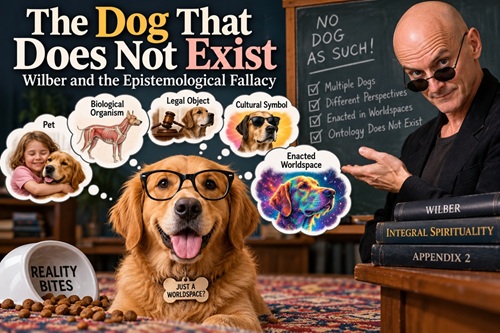 Ken Wilber's concept of different “worldspaces” rests on an important insight: human beings do not encounter the world in a completely unmediated fashion. What we perceive, recognize, conceptualize, value, and regard as significant depends partly on our developmental capacities, cultural background, language, and mode of consciousness. The difficulty begins when this insight is expressed by saying that different developmental stages inhabit different realities. That formulation threatens to erase a distinction that should instead be kept firmly in place: the distinction between reality and ideality. The distinction can be stated very simply: Reality concerns what is. Ideality concerns the form in which what is is conceived, organized, represented, valued, or disclosed. An ideality is not necessarily unreal. It is simply not identical with an independently existing object or process. This distinction provides a useful way of understanding what is genuinely valuable in Wilber's worldspace theory while avoiding its tendency toward ontological inflation. Reality: what existsReality, in the ontological sense, concerns what exists or obtains independently of a particular act of knowing. A tree is real. A dog is real. A bacterium is real. A mountain is real. The Earth's geological history is real. A neuronal process is real. Whether or not anyone has the concepts necessary to describe these things does not determine whether they exist. This does not commit us to a naïve realism in which objects simply present themselves to us exactly as they are. Scientific realism itself recognizes that our access to reality is mediated by instruments, theories, concepts, language, and observation. But mediation does not imply creation. A telescope mediates our access to a distant galaxy; it does not create the galaxy. A microscope mediates our access to bacteria; it does not create the bacteria. A scientific theory organizes our understanding of evolution; it does not create evolutionary history. This is the minimal realist intuition that must be preserved. Ideality: the structured form of understandingIdeality belongs to a different category. Consider a particular organism. The organism itself is one thing. The concept dog is another. The organism can exist without anyone possessing the concept “dog.” It can eat, sleep, reproduce, age, become ill, and die without being classified by a human observer. But the concept dog is an ideality. It is a cognitive and linguistic structure through which certain organisms are grouped and understood. This does not make the concept unreal. The concept has real consequences. It allows us to communicate, classify, make predictions, care for animals, conduct biological research, and organize our relationship with the living world. The crucial point is simply that the concept's mode of existence differs from the organism's. The dog is not an idea. “Dog” is an idea about dogs. That distinction may appear obvious, but it becomes philosophically important when applied to Wilber's developmental worldspaces. The reality of idealitiesCalling something an ideality should not be confused with calling it imaginary. Some of the most powerful things in human civilization are idealities. Money is an obvious example. A €100 note has physical properties: it has a certain mass, dimensions, chemical composition, and visual appearance. But its monetary value is not a physical property in the same sense. Its significance depends upon an institutional and intersubjective system. Nevertheless, money is unquestionably real in its consequences. The same applies to laws, corporations, nations, mathematical systems, social norms, moral concepts, languages, and religious traditions. A corporation is not a biological organism. A nation is not a giant animal. Justice cannot be weighed on a laboratory scale. Yet these are not simply fantasies. They structure human behavior and institutions. Their reality is therefore different from the reality of physical objects. This is precisely why “ideality” is useful. It avoids the false choice between saying that something is a brute physical object and saying that it is merely subjective. An ideality can be: psychologically real, culturally real, intersubjectively real, institutionally real, symbolically real, mathematically or logically real, without thereby becoming an independent ontological domain. Appearance, ideality, and realityWe can therefore distinguish at least three levels. First, there is reality: the thing, event, process, or structure that exists. Second, there is appearance: how that reality presents itself to a particular observer under particular conditions. Third, there is ideality: the conceptual, symbolic, classificatory, normative, or interpretive structure through which that appearance is organized and understood. Take the familiar example of a dog. There is the particular animal. There is the animal as it appears to me: furry, moving, barking, approaching me, perhaps wagging its tail. And there is the conceptual structure through which I recognize it as a “dog,” perhaps further interpreting it as a pet, a biological organism, a companion, a threat, or a symbol of loyalty. These are not interchangeable. The organism is not the concept. The appearance is not the organism in its entirety. And the interpretation is not the appearance itself. A useful philosophical formula therefore becomes possible: Reality is not the same thing as its disclosure; disclosure is not the same thing as its interpretation; and interpretation is not the same thing as the reality interpreted. Where Wilber's worldspaces fitThis distinction allows us to reinterpret Wilber's worldspaces in a much more defensible way. A developmental worldspace can certainly be real. It can shape what a person notices, what distinctions they can make, what explanations they find intelligible, what values they recognize, what experiences they can integrate, and what kind of world appears meaningful to them. A person operating within a magical worldview does not simply possess a different list of opinions from a modern scientist. Their entire field of significance may be organized differently. The magical worldview may contain spirits, omens, sacred forces, invisible intentions, and meaningful correspondences. The scientific worldview may contain genes, viruses, electromagnetic fields, evolutionary mechanisms, and statistical regularities. These are different meaning-worlds. But it does not follow that they are different ontological worlds. That is the critical distinction. The magical world and the scientific world may be different ways of organizing and interpreting one shared reality. Their difference is primarily a difference in ideality. The epistemic fallacy and its mirror imageThis becomes especially important in relation to Wilber's discussion of the epistemic fallacy. The epistemic fallacy, broadly understood, occurs when we confuse our knowledge of something with the thing itself. We mistake the structure of our representation for the structure of reality. Wilber wants to avoid this mistake. But his solution risks generating its mirror image. Instead of saying: “The world is nothing more than our concepts of it,” he can appear to say: “Our different conceptual structures disclose different realities.” The first position collapses ontology into epistemology. The second risks multiplying ontology according to epistemology. This is why simply saying that Wilber “unites epistemology and ontology” is not sufficient. One can unite the two by carefully showing how knowing is embodied, situated, and causally connected to what is known. But one can also unite them by allowing epistemological structures to acquire ontological status without adequately demonstrating why they deserve it. The latter move is the problem. Conditions of access are not conditions of existenceThe key distinction can be expressed in another way. A developmental stage may determine the conditions under which something becomes intelligible or perceptible. That does not establish that the developmental stage determines the conditions under which the thing exists. This is the crucial logical gap. Suppose a person at one stage interprets an illness as the result of a curse, while another interprets it as a viral infection. We can legitimately say that the two people inhabit different experiential and interpretive worlds. But the existence of the pathogen is not established by the scientific worldspace any more than the existence of the curse is established by the magical worldspace. The developmental structure explains something about the knower. It does not automatically explain the being of the known. To establish the stronger claim, Wilber would need an independent argument demonstrating that developmental structures actually participate in constituting ontological reality. Merely showing that they structure experience is insufficient. “Real for me” is not “real in itself”Another source of confusion is the word “real.” Something can be real for a person without being real in itself in the same ontological sense. A nightmare can be phenomenologically real. A religious vision can be psychologically and existentially real. A national identity can be socially real. A mathematical theorem can be formally real. A delusion can be experientially real. But none of these observations by themselves requires us to posit a corresponding independent object in the external world. We therefore need a vocabulary capable of distinguishing these different senses of reality. Instead of saying simply, “This is another reality,” we can say: “This is real as an experience.” “This is real as a cultural structure.” “This is real as an institution.” “This is real as an ideality.” “This is real as a physical process.” These formulations are more precise because they tell us what kind of reality is being claimed. Wilber's use of “worldspace” becomes problematic when these different senses are allowed to converge on the single word “reality.” The developmental inflation of ontologyThis ambiguity becomes particularly consequential when developmental stages are arranged hierarchically. If higher stages disclose more comprehensive realities, then development can begin to look like an ascent through levels of Being. The psychological hierarchy quietly becomes an ontological hierarchy. But why should greater cognitive complexity entail greater ontological access? A person who can understand several perspectives simultaneously may indeed possess greater cognitive complexity than someone who cannot. A scientist may possess a vastly more powerful explanatory framework than a premodern cosmologist. But these facts establish differences in epistemic adequacy. They do not automatically establish that the higher-level person literally inhabits a higher stratum of existence. This distinction is especially important because epistemic superiority can be demonstrated in relatively concrete ways. Scientific explanations can predict phenomena, survive experimental testing, unify observations, and generate successful technologies. Ontological superiority is a much stronger claim. To move from: “This worldview explains more” to: “This worldview discloses a higher level of Being” requires an additional metaphysical argument. That argument cannot simply be smuggled in through the word “reality.” The dog remains the crucial testWilber's dog example therefore becomes philosophically revealing. It is perfectly reasonable to say that the concept of a dog differs according to worldspace. A child, a biologist, a hunter, a Buddhist, and a developmental theorist may each encounter and interpret a dog differently. But the particular dog does not depend upon those interpretations in order to exist. Isaac the dog can sleep while humans debate whether “dog” is an ontological category, a biological classification, a linguistic construct, or a manifestation within a particular worldspace. He does not require our epistemology. His existence is not waiting for our conceptual scheme. This does not mean that humans encounter Isaac without mediation. Obviously they do not. But mediation is not constitution. The distinction is therefore: The concept “dog” is dependent upon a conceptual framework. The dog is not dependent upon that framework in the same way. That is precisely the distinction that gets endangered when an ideality is promoted into a “reality.” A modest critical realismThe alternative need not be naïve realism. A more defensible position is a modest form of critical realism. There is a world that exists independently of our descriptions, but our access to that world is always mediated by biological, perceptual, linguistic, cultural, historical, and developmental structures. We never encounter reality from nowhere. But neither does this mean that every mode of encounter constitutes its own reality. The relationship can be expressed simply: Reality constrains interpretation, while interpretation organizes our access to reality. Both directions matter. Reality pushes back. Some interpretations fail. Some predictions do not work. Some conceptual schemes encounter stubborn resistance from the world. This resistance is one of the strongest reasons not to collapse ontology into epistemology. Idealities without ontological inflationThe concept of ideality therefore gives us a useful middle position. It avoids the crude realism according to which our conceptual frameworks simply mirror reality exactly as it is. It also avoids relativism according to which every worldview constitutes its own equally valid reality. And it avoids Wilber's temptation to turn every sufficiently developed meaning-structure into a distinct ontological world. We can acknowledge that developmental structures genuinely transform human experience without claiming that they manufacture corresponding layers of Being. A magical worldspace can be real as an ideality. A rational worldspace can be real as an ideality. A pluralistic worldspace can be real as an ideality. An integral worldspace can be real as an ideality. But the existence of these idealities does not automatically establish four corresponding ontologies. They are different ways of organizing experience and meaning. They are not necessarily different universes. Conclusion: reality should remain stubbornThe strength of Wilber's worldspace theory lies in its recognition that human beings do not simply look at one transparent world from identical cognitive positions. Development changes the structure of experience. Culture changes meaning. Language changes categorization. Cognitive complexity changes what can be understood. All of that is important. But none of it requires us to multiply reality according to the number of available perspectives. The concept of ideality allows us to preserve the genuine insight while avoiding the metaphysical excess. An ideality can be profoundly real without being an independent entity. It can organize perception without creating the object perceived. It can shape behavior without becoming a separate ontological realm. It can constitute a meaning-world without constituting a different physical world. This gives us a much cleaner formulation of the problem with Wilber's “worldspaces”: A developmental worldspace is real as an ideality—a structured form of cognition, meaning, valuation, and experience. But its reality as an ideality does not establish its existence as an independent ontological world. That distinction also provides a sharper formulation of the epistemic fallacy. The error is not merely confusing knowledge with reality. It is confusing the conditions under which reality is disclosed with the conditions under which reality exists. Once those are separated, Wilber's “many realities” become much easier to understand. They are, in an important sense, many realities as experienced and interpreted. But that is precisely why ideality is the better term. There can be many idealities without there being many ontologies. There can be many worldspaces without there being many worlds. And there can be countless ways of seeing the world without the world itself having to multiply every time we change our way of seeing it.
Widget is loading comments...
|