|
TRANSLATE THIS ARTICLE
Integral World: Exploring Theories of Everything
An independent forum for a critical discussion of the integral philosophy of Ken Wilber
  Frank Visser, graduated as a psychologist of culture and religion, founded IntegralWorld in 1997. He worked as production manager for various publishing houses and as service manager for various internet companies and lives in Amsterdam. Books: Ken Wilber: Thought as Passion (SUNY, 2003), and The Corona Conspiracy: Combatting Disinformation about the Coronavirus (Kindle, 2020). Frank Visser, graduated as a psychologist of culture and religion, founded IntegralWorld in 1997. He worked as production manager for various publishing houses and as service manager for various internet companies and lives in Amsterdam. Books: Ken Wilber: Thought as Passion (SUNY, 2003), and The Corona Conspiracy: Combatting Disinformation about the Coronavirus (Kindle, 2020).
Check out my other conversations with ChatGPT
Ken Wilber and His Dog: The Dog That Does Not Exist The Dog and the Worldspace Isaac the Dog Talks Back The Dog and the WorldspaceWilber, Epistemology and the Return of OntologyFrank Visser / ChatGPT
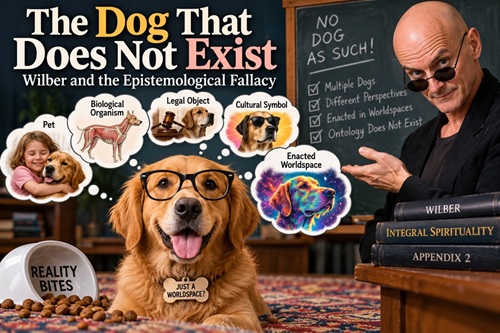 Introduction: a deceptively simple claimOne of the most consequential claims in Ken Wilber's Integral Spirituality (2006) occurs in Appendix 2, where he discusses what he calls "Kosmic addressing." The argument appears to solve a longstanding philosophical problem: how can different observers, cultures and developmental stages encounter what appears to be the same reality in radically different ways? Wilber's answer is that we should stop imagining that there is one pregiven object "out there" that different perspectives merely represent in different ways. There is no single "dog" behind the various ways in which dogs are experienced. Rather, different dogs are enacted within different worldspaces. This is an ambitious move. It draws on phenomenology, hermeneutics, developmental theory and the postmodern critique of naïve realism. It also contains an important insight: there is no God's-eye description of reality available to human beings. But Wilber then makes a much more controversial move. He effectively turns a claim about the conditions under which objects are known into a claim about what objects are. That is the epistemological fallacy. The issue is not whether knowledge is perspectival. It obviously is. The issue is whether perspectival knowledge entails a perspectival ontology. Kant, Husserl, Peirce, Searle and critical realism provide five different ways of showing why it does not. 1. Kant: conditions of experience are not conditions of existenceWilber's position initially sounds Kantian. Kant's great insight was that we never encounter reality without the contribution of the knower. Space, time and the categories of understanding structure human experience. We do not simply receive a world passively; the mind participates in making experience intelligible. But Kant was extremely careful about the distinction that Wilber tends to blur. The fact that objects of experience are constituted under particular conditions of cognition does not mean that nothing exists independently of those conditions. Kant distinguishes the phenomenal world—the world as experienced—from the noumenal, or things considered independently of our mode of cognition. Whatever one thinks of Kant's notoriously difficult noumenal concept, his basic warning remains important: The conditions under which we know something are not automatically the conditions under which that thing exists. This is exactly the inference Wilber needs to establish but does not establish. If I perceive a dog, my perception is structured by my sensory apparatus, conceptual capacities, linguistic categories and previous experience. But it does not follow that these structures create the animal. The Kantian lesson is therefore not: "There is no dog apart from the human worldspace." It is: "There is no human knowledge of the dog apart from the conditions under which humans know." Those are radically different propositions. Wilber's post-metaphysical formulation risks collapsing them. 2. Husserl: bracket the existence question—do not answer it by denying existenceHusserl provides an even more interesting comparison. Phenomenology begins by asking us to attend carefully to how things appear in consciousness. The phenomenological reduction, or epoché, brackets the natural assumption that objects simply exist exactly as we ordinarily assume them to exist. But "bracketing" is not "denying." This distinction is crucial. When Husserl brackets the existence of the external world, he does not announce: "There is no external world." He says, in effect: "Let us temporarily suspend our assumptions about its existence so that we can investigate the structures of experience itself." Wilber's discussion of worldspaces often sounds like phenomenology after the bracket has been removed and replaced by an ontological conclusion. Instead of: "This dog appears within a particular horizon of meaning," we get something closer to: "This particular dog is enacted within this horizon of meaning." The latter formulation subtly changes the philosophical game. Phenomenology tells us how the dog is given. It does not tell us that the dog is produced by being given. This distinction between constitution of meaning and constitution of being is absolutely central. A dog can be constituted as a meaningful object in consciousness without being constituted as a biological organism by consciousness. The distinction may sound pedantic until one remembers that the biological organism existed for millions of years before humans developed the concept "dog." 3. Peirce: the object exceeds the signCharles Sanders Peirce offers perhaps the most devastating challenge to Wilber's formulation because Peirce's semiotics already contains a sophisticated theory of mediated knowledge. For Peirce, a sign stands for an object to an interpretant. Knowledge is therefore intrinsically relational and interpretive. There is no naïve correspondence in which a mental picture simply copies an external thing. At first glance, this sounds remarkably compatible with Wilber. But Peirce makes an important distinction between the Immediate Object—the object as represented in the sign—and the Dynamical Object—the object that determines the sign in ways that exceed any particular representation. This distinction solves precisely the problem Wilber creates. We can acknowledge that every encounter with a dog is mediated by signs, concepts, habits and interpretants without concluding that there is no dog beyond those mediations. In fact, the very possibility of error depends upon such an object. Suppose I mistake a wolf for a dog. If the object is nothing beyond my enacted interpretation, then there is no objective difference between "dog" and "wolf" except that different worldspaces enact them differently. But this is not how inquiry works. I discover that I was wrong because something resisted my interpretation. The object pushes back. For Peirce, reality is not whatever a particular interpretive community happens to enact. Reality is what inquiry would ultimately tend toward under sufficiently sustained investigation. The world is not exhausted by any current sign. This gives us a much more convincing version of integral perspectivism: Every perspective gives us a partial sign of reality. None gives us the whole object. But there remains an object that constrains the signs. That is perspectivism without relativism. 4. Searle: the distinction between observer-relative and observer-independent realityJohn Searle makes the issue even more straightforward. His distinction between observer-independent and observer-relative phenomena is extremely useful here. Some things depend upon human institutions or interpretations for their existence in a particular sense. Money is an obvious example. A piece of paper is not intrinsically a banknote. Its status as money depends upon collective recognition and institutional structures. But the piece of paper itself does not depend upon those structures in the same way. And some phenomena are observer-independent altogether. Mountains, biological organisms, tectonic plates and gravitational processes do not require human recognition in order to exist. Searle's distinction allows us to preserve both sides of Wilber's insight. Some objects are indeed socially or conceptually constituted. Others are not. And even observer-relative objects generally depend upon an observer-independent physical substrate. This is precisely what Wilber's "dog" argument threatens to flatten. A dog can be understood as: • a biological organism, • a pet, • a cultural symbol, • a legal object, • a companion, • a scientific specimen, • or an object of aesthetic representation. These are different descriptions and different social relations. But the underlying organism does not thereby become six different ontological entities. 5. Critical realism: epistemic relativism without ontological relativismCritical realism provides perhaps the most direct alternative to Wilber's formulation. Roy Bhaskar's distinction between the epistemic and ontological dimensions of reality is particularly relevant. Critical realism accepts epistemic relativism: all knowledge is historically situated, theory-dependent, fallible and mediated by conceptual frameworks. But it rejects ontological relativism. In other words: Knowledge is relative to historical and cultural conditions. Reality is not thereby relative to those conditions. This is precisely the position that Wilber needs if his integral project is to retain its critical and scientific ambitions. Consider evolutionary biology. Different cultures have possessed radically different conceptions of biological life. Some interpreted species through creation myths; others through essentialist taxonomies; modern biology understands species through evolutionary descent, population genetics and ecological relations. The descriptions changed. The evolutionary processes did not. Homo sapiens did not suddenly acquire an evolutionary ancestry when Darwin formulated natural selection. The ancestry was there. Darwin discovered something about it. The distinction is almost embarrassingly obvious when stated this way. Yet it is precisely the distinction that disappears when "existence" is conflated with "existence-for-a-worldspace." 6. The epistemological fallacy in its simplest formWe can now formulate Wilber's apparent argument more precisely. Premise 1: Human beings encounter reality through perspectives. Premise 2: Different perspectives disclose different features, meanings and structures. Premise 3: There is therefore no perspective-free description of reality. So far, so good. But Wilber appears to add: Premise 4: Therefore there is no perspective-independent object. And this does not follow. The invalid inference is: "We cannot know X except through Y" therefore "X cannot exist independently of Y." That is the epistemological fallacy in its most elementary form. We can express the distinction with an analogy. A telescope is necessary for seeing distant galaxies. It does not follow that the telescope creates the galaxies. A microscope is necessary for seeing bacteria. It does not follow that microscopes bring bacteria into existence. A conceptual framework is necessary for identifying DNA as DNA. It does not follow that DNA began to exist when molecular biology discovered it. Likewise: A worldspace may be necessary for a certain kind of disclosure of the dog. It does not follow that the worldspace creates the dog. 7. Wilber's "enactment" ambiguityThe word "enactment" is particularly troublesome because it can mean several different things. In a weak sense, enactment means disclosure. A particular worldspace makes certain features of reality salient or intelligible. There is nothing objectionable here. In a stronger sense, enactment means construction. The object as experienced is partly constructed by the cognitive, cultural and linguistic structures of the observer. Again, this can be defended. But in its strongest sense, enactment becomes ontological constitution: The object itself exists only within the structures that enact it. This is where the argument becomes vulnerable. Wilber moves between these meanings without always clearly marking the transition. The result is an ambiguity that allows the argument to seem modest when challenged and radical when deployed theoretically. If "the dog" merely means "the dog as disclosed within a particular worldspace," then the thesis is largely unobjectionable. If "the dog" means the actual biological organism, then the thesis becomes highly controversial. The distinction should therefore be made explicit. 8. The scientific counterexampleThe history of science provides a simple empirical challenge to strong enactment theory. Before microscopes existed, microorganisms were not part of ordinary human experience. But microorganisms existed. Before telescopes, galaxies were not objects of astronomical knowledge. But galaxies existed. Before Darwin, natural selection was not part of human conceptual space. But natural selection occurred. Before plate tectonics, continental drift was not scientifically available as an explanatory framework. But continents moved. Scientific progress is difficult to understand if ontology is simply a function of worldspace. What happens in scientific discovery is often precisely the opposite. Reality surprises the existing worldspace. Something is encountered that does not fit the prevailing conceptual framework. A new theory is developed. The worldspace changes because reality resists it. This direction of explanation is important. It is not simply: worldspace → object. It is also: object → resistance → revision of worldspace. Without this second arrow, scientific discovery becomes difficult to explain. 9. The problem of errorThere is an even deeper philosophical difficulty. Wilber's model needs a robust distinction between more and less adequate knowledge. Otherwise his integral theory loses much of its critical force. Suppose a medieval physician believes that disease is caused by an imbalance of humors. A modern physician understands disease through pathogens, physiology, genetics, immune responses and other mechanisms. Wilber would presumably regard the modern understanding as more adequate. But "more adequate" means more than "enacted by a later worldspace." If adequacy merely means "appropriate to its worldspace," then the medieval physician was not wrong. He was simply operating within a different Kosmic Address. But that would empty the concept of error of much of its meaning. The same problem arises with astrology. One can say that astrology exists as a cultural practice, symbolic system or meaning-making framework. But if its claims about planetary influence are empirically false, we need to be able to say so. We need a reality that can adjudicate between competing interpretations. That reality cannot itself be merely an enactment of the interpretation. 10. The strange fate of realism in post-metaphysicsThis brings us to a paradox at the heart of Wilber's post-metaphysical project. Wilber wants to avoid naïve metaphysics. He does not want to declare that his own conceptual categories simply map an already completed cosmic structure. Yet he simultaneously wants Integral Theory to make substantive claims about reality. This produces a tension. If the AQAL framework is merely a perspective, why should anyone accept its categories as an adequate account of reality? If the categories correspond to real structures, then some form of ontology has returned. Wilber's solution is to say that reality is itself perspectival and enacted. But this does not solve the problem. It relocates it. The ontology becomes an ontology of enactment. The metaphysical question therefore has not disappeared. It has merely changed vocabulary. 11. "Ontology does not exist" is itself an ontological claimThere is an almost performative contradiction here. To assert: "Ontology does not exist" is already to make a claim about what exists—or, more precisely, about what reality is not like. If the statement means: "There is no perspective-free ontology available to human knowers," then it is an epistemological thesis and may be defensible. If it means: "There is no reality that exists independently of perspectives," then it is an ontological thesis. And if it means both, the argument needs to explain how the second proposition follows from the first. It does not. Wilber cannot escape ontology simply by declaring the traditional version of ontology inadequate. He must still answer the question: What exists independently of our descriptions? His answer appears to be that the question itself is misconceived. But that is not an answer. It is a philosophical position about the question. And philosophical positions about the nature of reality are ontology, whether or not they are called "post-metaphysics." 12. The irony of Integral TheoryThere is a final irony. Integral Theory's great promise is that it can integrate partial perspectives without reducing one perspective to another. But Wilber's dog argument risks doing precisely the opposite. It gives the perspective itself ontological priority. Instead of saying: "There are many perspectives on one reality," he risks saying: "There are many realities enacted through perspectives." The first gives us pluralism. The second threatens relativism. The distinction matters enormously. If there is one dog encountered through many perspectives, we can explain disagreement, error, learning and scientific progress. If there are many dogs enacted by different worldspaces, then disagreement becomes a difference between realities. At that point, the possibility of adjudicating between them becomes obscure. The integral project requires precisely such adjudication. It wants to tell us that some perspectives are more differentiated, more inclusive, more complex and more adequate than others. But "more adequate" requires something against which adequacy can be measured. The dog may be a useful philosophical test because it refuses to cooperate with the theory. Conclusion: keep the perspectives, restore the worldThe strongest version of Wilber's insight does not require his controversial ontology. We do not perceive reality from nowhere. Every act of knowing is embodied, situated, developmental, linguistic and cultural. Different worldspaces disclose different aspects of what is there. Our concepts participate in the constitution of meaningful objects. No finite perspective exhausts reality. All of that can be retained. What must be rejected is the unnecessary inference that because the dog is differently disclosed, there are therefore different dogs—or that there is no dog independently of its disclosure. Kant teaches us to distinguish the conditions of knowledge from the thing known. Husserl teaches us to distinguish phenomenological description from an ontological denial. Peirce teaches us that signs are mediated without exhausting their objects. Searle distinguishes observer-relative facts from observer-independent reality. Critical realism distinguishes the relativity of knowledge from the independence of reality. Together they point toward a much more modest and defensible position: There is no perspective-free knowledge of the dog. But there may be a perspective-independent dog. Indeed, without something that exists beyond our perspectives, the very concept of perspective loses its object. The worldspace is a window. It is not the world. And this is perhaps the simplest correction Integral Theory needs. We should not return to naïve realism. We should not pretend that reality simply presents itself to an unmediated observer. But neither should we confuse the unavoidable mediation of knowledge with the production of reality. There are many ways of seeing the dog. There is no need to invent many dogs. The dog remains. And it is precisely because the dog remains that our descriptions of it can be right or wrong, partial or comprehensive, adequate or inadequate. That is not a retreat from post-metaphysical philosophy. It is the minimum realism required to make epistemology possible in the first place.
Widget is loading comments...
|