|
TRANSLATE THIS ARTICLE
Integral World: Exploring Theories of Everything
An independent forum for a critical discussion of the integral philosophy of Ken Wilber
  Frank Visser, graduated as a psychologist of culture and religion, founded IntegralWorld in 1997. He worked as production manager for various publishing houses and as service manager for various internet companies and lives in Amsterdam. Books: Ken Wilber: Thought as Passion (SUNY, 2003), and The Corona Conspiracy: Combatting Disinformation about the Coronavirus (Kindle, 2020).
Check out my other conversations with ChatGPT
Wilber and the Epistemic Fallacy:
The Dog That Does Not Exist The Dog and the Worldspace Isaac the Dog Talks Back Further reflections: The Diamond That Does Not Exist When Reality Becomes Ideal Realities and Idealities Alderman's Meta-Realist Rescue of Wilber When Spirit Enters the World Wilber's strongest reply Habits Wilber Should Leave Behind When Reality Becomes IdealWilber's Epistemic Escape from the Epistemic FallacyFrank Visser / ChatGPT
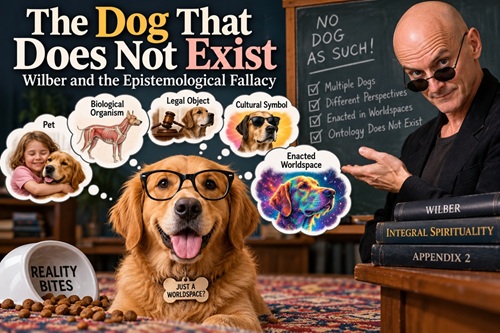 Introduction: the problem Wilber thinks he has solvedKen Wilber is well aware of the danger of confusing knowledge with reality. His response to what he calls the “epistemic fallacy” is not to deny that different observers construct different descriptions of the world. Rather, he attempts to incorporate both epistemology and ontology into a larger framework. Different stages, cultures, states, and perspectives disclose different aspects of reality, and these disclosures are said to constitute different “worldspaces,” each with its own kind of reality. This is an ingenious move. It is also deeply problematic. The central difficulty is that Wilber can avoid the epistemic fallacy only by radically redefining what counts as reality. Once “reality” is made dependent upon a particular worldspace, developmental stage, or mode of knowing, the distinction between what exists and how something is understood begins to disappear. Wilber has not necessarily united epistemology and ontology. He has blurred their boundary. The crucial question is therefore not whether different worldspaces contain different experiences or different interpretations. They obviously do. The question is whether those differences warrant the stronger claim that each worldspace possesses its own kind of reality. I would argue that they do not. What Wilber calls stage-dependent “realities” would more appropriately be called idealities: structured forms of meaning, interpretation, conceptualization, valuation and experience that are real as psychological, cultural or intersubjective phenomena, but not therefore different ontological domains. That distinction matters enormously. From perspectives to worldspacesWilber's mature integral theory makes extensive use of the idea that different developmental stages inhabit different “worldspaces.” A person at one stage does not merely possess a different opinion about the same world. According to Wilber, the world itself is disclosed differently through the structure of consciousness available at that stage. There is an important insight here. A medieval Christian, a modern scientist and a postmodern academic certainly do not inhabit the same meaning-world. They categorize experience differently. They recognize different entities, employ different explanatory concepts and attach different significance to events. A medieval person might interpret a comet as a divine portent; a modern astronomer understands it in terms of orbital mechanics and astrophysics. But from this it does not follow that the medieval comet and the scientific comet belong to two different ontological realities. There is one comet, while there are different ways of understanding it. This distinction is precisely where Wilber's formulation becomes unstable. He wants to say both that reality is perspectival and that perspectives are not merely subjective constructions. To accomplish this, he gives different perspectives their own ontological status. But this creates a category problem. A worldspace can certainly be real as a structure of consciousness or culture. The conceptual framework of medieval Christianity is historically real. The worldview of modern science is historically real. A child's magical interpretation of the world is psychologically real. A postmodern theory of discourse is intellectually and culturally real. But these are different kinds of facts about human beings and their ways of organizing experience. They are not automatically different kinds of being. The epistemic fallacy returns through the back doorWilber's objection to the epistemic fallacy is straightforward enough: we should not confuse the structures through which we know reality with reality itself. Yet his solution risks reproducing precisely this confusion. Suppose a person at developmental stage A experiences the world as populated by magical forces, while someone at stage B understands the same events naturalistically. We can say: “The two people have different realities.” But this expression is ambiguous. If “different realities” means that they possess different experiential and interpretive worlds, the statement is defensible. If it means that the world itself contains different ontological structures corresponding to these stages, the claim requires a much stronger argument. The first is an epistemological, psychological or phenomenological claim. The second is an ontological claim. Wilber often moves between these two meanings without adequately marking the transition. And that is precisely where the epistemic fallacy threatens to reappear. The fact that a developmental structure determines what an individual can perceive, conceptualize or interpret establishes something about the conditions of access to reality. It does not by itself establish that the structure creates or constitutes a corresponding layer of reality. That inference needs independent justification. “Both epistemology and ontology” does not automatically solve the problemWilber's ingenious response is that he does not choose between epistemology and ontology. He “unites” them. But simply assigning an ontological status to epistemological structures does not solve the problem. It may merely relocate it. Consider a simple example. Suppose two cultures have different concepts of justice. Culture A regards justice primarily as proportional punishment. Culture B understands justice primarily as restoration and reconciliation. Both systems are real. They influence institutions, behavior and subjective experience. They can even constitute different moral worlds for the people who inhabit them. But it would be strange to conclude that there are therefore two ontological realities of justice, one corresponding to Culture A and another corresponding to Culture B. More plausibly, there is an underlying problem of human cooperation, harm, responsibility and social order, about which different communities develop different idealities. The idealities are real. They are not therefore independently existing objects. This distinction allows us to acknowledge the reality of perspectives without confusing them with the objects, processes or structures those perspectives attempt to understand. Idealities: a better vocabularyThe word “ideality” is useful here because it occupies the middle ground Wilber's framework needs but does not consistently articulate. An ideality is not simply an arbitrary fantasy. Nor is it an independently existing object. Mathematics provides an obvious example. The number seven is not a physical object occupying seven cubic centimeters of space. Yet “seven” is hardly meaningless. Mathematical structures are extraordinarily real in their consequences and applications. Likewise, money is an ideality with enormous practical power. A bank balance can determine whether someone eats, travels or loses their house. But the numerical value displayed on a screen is not a physical substance equivalent to the neurons, buildings and electrical signals involved in the monetary system. Legal systems provide another example. A corporation is not a biological organism, yet it can own property, enter contracts and be sued. Its reality is institutional and intersubjective. These are different modes of reality without requiring us to posit separate ontological universes. Developmental stages can be understood similarly. A stage is a real structure of cognition, affect, valuation and meaning-making. The world as interpreted through that stage can therefore be called a meaning-world. But calling that meaning-world a separate “reality” risks turning an epistemological structure into an ontological domain. “Ideality” captures what is valuable in Wilber's intuition while avoiding this inflation. The dog problemThis becomes particularly clear with Wilber's famous dog example. Wilber argues in Integral Spirituality that a dog “as such” does not exist independently of a worldspace. Different worldspaces disclose different objects and meanings. What counts as a dog for one developmental structure may differ from what counts as a dog for another. There is an important philosophical point here. “Dog” is indeed a concept. Different cultures may classify animals differently. Scientific taxonomy is not identical to everyday language. A child, a biologist and a medieval hunter can attend to different aspects of the same animal. But Isaac the dog does not need our concept of “dog” in order to exist. He can sleep, eat, age, get sick and wag his tail independently of whether anyone possesses the appropriate developmental structure for recognizing these activities as manifestations of “dogness.” The concept is dependent on a knower. The organism is not dependent in the same way. This distinction does not require naïve realism. It requires only that we distinguish the object of cognition from the cognitive framework through which it is apprehended. Wilber's worldspace theory threatens to make the dog epistemically dependent upon the worldspace in which the dog appears. But that is precisely the kind of slide the epistemic fallacy warns us against. “Real for me” versus “real in itself”There is another ambiguity concealed in the phrase “different realities.” Something can be real for an individual without being real in itself in the same sense. A hallucinated monster can be phenomenologically real to a person. A dream can be emotionally real. A religious vision can transform a person's life. A nation can be institutionally real. A mathematical theorem can be formally real. None of these distinctions requires us to say that every such phenomenon corresponds to a distinct ontological world. This is where Wilber's pluralism can be retained without ontological inflation. We can say: “This is real as an experience.” “This is real as a cultural construction.” “This is real as an institutional fact.” “This is real as a psychological structure.” “This is real as a physical process.” These statements are much more informative than simply saying: “This is another reality.” The latter expression conceals the very distinctions that philosophical analysis needs to make. The ontological inflation of developmental stagesWilber's developmental theory becomes particularly vulnerable when stages are treated as increasingly adequate disclosures of reality. If different stages disclose different realities, then development begins to look like an ontological journey through progressively more comprehensive worlds. This is rhetorically powerful. It also introduces a serious problem. What makes the higher stage more ontologically true rather than merely more cognitively sophisticated? A scientific worldview can explain phenomena that a magical worldview cannot. That gives us good reasons to regard scientific explanations as epistemically superior in many domains. But epistemic superiority is not automatically ontological superiority. Likewise, a person capable of taking multiple perspectives may possess greater cognitive complexity than someone capable of taking only one. But that does not mean that the person literally occupies a higher stratum of Being. The distinction is important because otherwise developmental psychology quietly becomes metaphysics. A hierarchy of cognitive capacities becomes a hierarchy of realities. And once that happens, the developmental map risks becoming self-validating: the higher stage is higher because it sees more reality, while it sees more reality because it is higher. Wilber's strongest insight without the metaphysical excessThere is nevertheless something genuinely valuable in Wilber's proposal. He is right to resist the simplistic idea that there is a completely theory-free world presented to every observer in exactly the same form. Human beings encounter reality through nervous systems, languages, conceptual schemes, developmental capacities, cultural traditions and embodied practices. There is no view from nowhere available to ordinary human cognition. But acknowledging this does not require epistemological relativism, and it certainly does not require multiple ontologies corresponding to developmental stages. We can instead adopt a modest form of critical realism. There is a world independent of our descriptions, but our access to it is mediated by historically and developmentally situated cognitive structures. Reality constrains interpretation. Interpretation does not therefore create reality. That formulation preserves both sides of the problem. The paradox of Wilber's “unification”Wilber's attempt to unite epistemology and ontology therefore produces a curious paradox. He wants to prevent the epistemic fallacy by refusing to reduce reality to our knowledge of it. Yet he also refuses to separate our knowledge structures sharply from reality. Every worldspace becomes a legitimate mode of reality. The result is a conceptual continuum running from: object → perception → interpretation → meaning → worldview → worldspace → reality. The farther we move along this sequence, the more dependent the concept becomes upon a knower or community of knowers. Yet Wilber's terminology allows the final term—“reality”—to be attached to the entire sequence. That is where the philosophical trouble begins. A useful distinction has effectively disappeared: Reality is what our representations are about; ideality is the structured form those representations take. The two interact, but they are not identical. From epistemic fallacy to ontological inflationThere is therefore a delicious irony in Wilber's position. He accuses reductionist approaches of committing the epistemic fallacy because they confuse a perspective on reality with reality itself. But his own theory can commit a reverse error: ontological inflation. Instead of reducing every perspective to subjective opinion, he risks promoting every sufficiently structured perspective into a mode of Being. The first error says: “Only my description is real.” The second says: “Every sufficiently developed description constitutes its own reality.” Neither is satisfactory. A better position is: “Descriptions are real phenomena, and some descriptions are better than others, but the reality they describe is not thereby multiplied into a separate ontology for every perspective.” That is a much more defensible form of perspectival realism. Conclusion: let reality remain stubbornWilber's great contribution was to insist that human beings encounter the world through multiple dimensions of experience, cognition, culture and development. His mistake is to give these differentiated modes of access too much ontological weight. Different developmental stages certainly produce different idealities: different conceptual worlds, value structures, interpretive frameworks, symbolic systems and experiential organizations. These idealities can be profoundly real. They can shape institutions, behavior, perception and even the course of history. But they do not thereby become separate ontological realities. This distinction also rescues the very realism Wilber wants to defend. A dog remains a dog—or, more precisely, a particular living organism—whether a medieval peasant calls it a creature of God, a child calls it a furry friend, a biologist classifies it as Canis lupus familiaris, or an integral theorist places it in a particular worldspace. The descriptions change. The organism changes only according to the biological processes actually occurring within it. That is precisely why we need a distinction between epistemology and ontology in the first place. Wilber's “many realities” can therefore be retained, if at all, only by changing what the phrase means. They are not necessarily many realities out there. They are many realities as lived, interpreted and organized by human beings. And those are better called idealities. The philosophical lesson is simple but consequential: perspectival access to reality is not the same thing as perspectival creation of reality. Once that distinction is respected, Wilber's worldspaces become much less metaphysically mysterious—and much more plausibly understood as what they primarily are: sophisticated structures of meaning-making through which finite creatures attempt to make sense of one stubborn, shared world.
Widget is loading comments...
|