|
TRANSLATE THIS ARTICLE
Integral World: Exploring Theories of Everything
An independent forum for a critical discussion of the integral philosophy of Ken Wilber
  Frank Visser, graduated as a psychologist of culture and religion, founded IntegralWorld in 1997. He worked as production manager for various publishing houses and as service manager for various internet companies and lives in Amsterdam. Books: Ken Wilber: Thought as Passion (SUNY, 2003), and The Corona Conspiracy: Combatting Disinformation about the Coronavirus (Kindle, 2020). Frank Visser, graduated as a psychologist of culture and religion, founded IntegralWorld in 1997. He worked as production manager for various publishing houses and as service manager for various internet companies and lives in Amsterdam. Books: Ken Wilber: Thought as Passion (SUNY, 2003), and The Corona Conspiracy: Combatting Disinformation about the Coronavirus (Kindle, 2020).
Check out my other conversations with ChatGPT
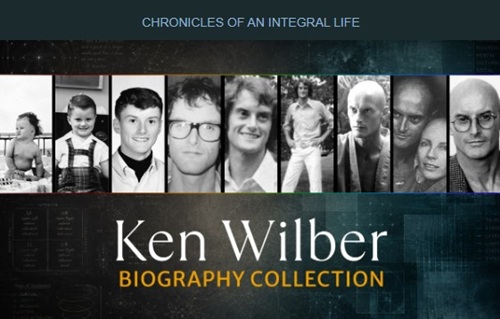
The Wilber "Biography": The Biography as Hagiography The Shadow Biography The Subject Takes Control of His Biography The Biography as HagiographyKen Wilber's New Integral Life CollectionFrank Visser / ChatGPT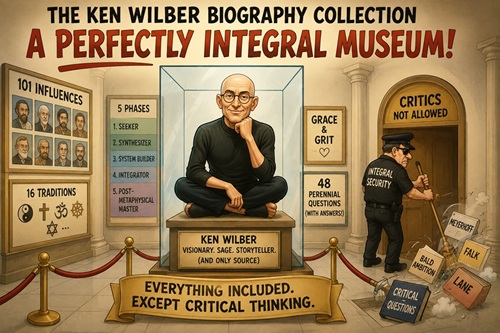 If the Wilber debate were to become simply "the world according to Ken Wilber", however fascinating and edifying that might be, it might well mean that Wilber would ultimately be interred in the gallery of the great, undoubtably surrounded by a multitude of followers. Yet, someone of Wilber's stature deserves more than that. The ideas that he has presented deserve to be examined in any academic and social discussions of culture, politics, religion and mental health." (Frank Visser, Ken Wilber: Thought as Passion, p. 241) Integral Life has just unveiled a substantially revamped version of its Ken Wilber Biography Collection. It is an impressive production: 126 videos, 72 of them newly released, organized across eleven interactive pages, five major phases of Wilber's intellectual development, a timeline stretching from 1949 to 2024, an “Integral Lineage” featuring 101 thinkers, a dedicated section on Grace and Grit, a new collection of 48 videos on “Perennial Questions” and the 2013 A Tribute to Ken Wilber, featuring 35 admirers.[1] There is clearly a lot here. And for anyone interested in Ken Wilber, the opportunity to hear him tell the story of his own life and work at such length is potentially valuable. The problem is not that the collection is insufficiently admiring. The problem is that it apparently wants to function as a biography without seriously confronting the distinction between biography and hagiography. The new collection tells us that it wants us to “meet the life that made” Wilber's maps possible. But whose version of that life are we meeting? Almost entirely Wilber's own. That is a serious limitation. A biography without the biographerThe promotional language gives the game away. The collection is described as “Ken Wilber's life told from the inside,” and Wilber himself is presented as the “masterful storyteller” who gives us the intimate story of the biochemistry student, the dishwasher, the solitary writer, the husband of Treya, and the aging philosopher. There is nothing inherently wrong with an autobiographical perspective. In fact, first-person testimony can be enormously valuable. But autobiography is not biography. A person's recollection of his own intellectual development is one source among others, and often a highly interested source. The distinction matters especially in the case of an intellectual figure whose personal mythology has become inseparable from his intellectual authority. Wilber has always been an unusually gifted narrator of Wilber. He is exceptionally good at turning intellectual history into a dramatic story: the young man dissatisfied with conventional science; the discovery of Eastern wisdom; the solitary thinker who works out a grand synthesis; the succession of books; the emergence of Integral Theory; the eventual refinement into AQAL and post-metaphysics. The danger is obvious. The more successfully the subject narrates his own life, the more necessary independent perspectives become. A critical biography should therefore ask not merely, “What does Wilber say happened?” but also: What happened according to other participants? Which claims can be independently corroborated? Which episodes have competing interpretations? What did Wilber misunderstand about his own intellectual development? Which relationships influenced him in ways he did not recognize? Which claims about his importance have been exaggerated? Which failures, controversies and intellectual reversals belong in the story? The new collection appears to ask very few of those questions. The missing second voiceThis is particularly striking because Wilber's career has generated an unusually extensive critical literature. There is no shortage of material to work with. Critics have challenged his scholarship, his interpretation of science, his treatment of evolutionary theory, his developmental hierarchy, his appropriation of philosophical traditions, his relationship to academia, his handling of dissent, and the institutional culture surrounding Integral Institute. There is even a substantial historical record of criticism extending back to the 1980s.[2] Jeff Meyerhoff's Bald Ambition, for example, subjected Wilber's intellectual apparatus to detailed philosophical and scholarly scrutiny. Geoffrey Falk approached Wilber from a much more polemical and skeptical direction. David Lane questioned the epistemological and spiritual claims made by Wilber. Others—including Mark Edwards, Ray Harris, Andy Smith, Elliot Benjamin and many more—have examined particular dimensions of Integral Theory. And then there is the independent Integral World archive, which for decades has functioned as something of a counter-history to the official Integral narrative. That history is conspicuously absent from the promotional architecture of the new collection. The “Integral Lineage,” we are told, contains 101 thinkers across sixteen traditions who influenced Wilber's work. That sounds wonderfully comprehensive. But there is a revealing asymmetry here. The collection seems eager to document those who contributed to Wilber's intellectual formation, while leaving out those who subsequently challenged his interpretation of them—or challenged Wilber himself. A lineage without critics is not an intellectual history. It is an intellectual ancestry. One hundred and one influences—but no critical interlocutors?The omission becomes even more conspicuous when one considers what the word “lineage” normally implies. If Wilber's work really represents a synthesis of 101 thinkers and sixteen traditions, then the obvious scholarly question is whether he interpreted those thinkers correctly. Did he represent their positions accurately? Did he select some aspects while ignoring others? Did he reconcile positions that were actually incompatible? Did he retrofit earlier thinkers into an AQAL framework they never endorsed? These are not hostile questions. They are the ordinary questions of intellectual history. Indeed, they have been asked repeatedly by Wilber's critics. Meyerhoff's critique, for instance, focuses substantially on the way Wilber constructs his intellectual synthesis and presents contested interpretations as though they were established generalizations. The new collection therefore risks producing a peculiar effect. The larger the intellectual lineage becomes, the more impressive Wilber's synthesis appears—because the viewer is shown an ever-expanding constellation of intellectual ancestors without being invited to examine the accuracy of the synthesis itself. The result is cumulative prestige. And cumulative prestige is not the same thing as cumulative evidence. The five phases: intellectual history or developmental mythology?The division of Wilber's career into five major phases is potentially one of the most useful features of the new collection. It provides a chronological structure for understanding how The Spectrum of Consciousness, The Atman Project, Up from Eden, Eye to Eye, Sex, Ecology, Spirituality, AQAL and the later post-metaphysical writings emerged. Integral Life itself has long presented Wilber's career in this developmental fashion. The new collection makes the structure more elaborate and visually accessible. But chronology is not explanation. The danger is that the five phases become a story of inevitable intellectual evolution: early Romantic Wilber gives way to a more mature Wilber; the old spectrum model becomes developmental theory; developmental theory becomes AQAL; AQAL becomes post-metaphysics. That is a neat story. It may even be substantially true. But a critical history would also investigate the discontinuities, mistakes and unresolved contradictions. Why did Wilber abandon certain positions? Which criticisms caused him to change course? Which changes were genuine theoretical improvements and which were terminological repackaging? Which elements of earlier theories survived under new names? What happened to claims that were once presented confidently but later disappeared? And crucially: did the later Wilber actually solve the problems identified by critics of the earlier Wilber? That is where intellectual history becomes interesting. It is also where the celebratory narrative tends to become uncomfortable. The science problemThe absence of critical engagement is particularly problematic when the collection presents Wilber's intellectual contributions without adequately contextualizing his relationship to science. Evolution is not a peripheral topic in Wilber's thought. It runs through his work from the earliest writings to his recent discussions of Eros, creativity and the Kosmos. Yet Wilber's treatment of evolutionary science has been extensively criticized. My own detailed examination of this subject has argued that Wilber repeatedly claims more scientific support for his evolutionary metaphysics than the evidence warrants, while presenting his own account of evolution in terms that sound considerably more scientific than they actually are.[3] That criticism does not require rejecting Wilber's philosophy wholesale. One can find his evolutionary vision philosophically interesting while questioning whether it constitutes a scientific theory. But if you are producing the definitive multimedia history of a thinker who repeatedly presents himself as integrating science and spirituality, this is precisely the sort of controversy that should be addressed. Instead, the viewer appears to be offered the evolution of Wilber's ideas without the evolution of the arguments surrounding those ideas. That is a major difference. And what happened to the critics?Perhaps the most striking omission is not one particular criticism but the absence of criticism as a historical phenomenon. The Integral community has had critics for decades. Some were sympathetic. Some were hostile. Some were former insiders. Some concentrated on science; others on philosophy; others on psychology, developmental theory or institutional culture. Their existence is part of the history of Wilber's movement. A biography that leaves them out produces a distorted picture—not necessarily because every criticism is correct, but because the intellectual controversies themselves helped shape Wilber's public identity. Consider Jeff Meyerhoff. His criticisms of Wilber were sufficiently extensive to produce an entire book, Bald Ambition. Yet Wilber never engaged Meyerhoff's arguments in the sustained way one would expect from a thinker who regards himself as participating in serious intellectual discourse. This absence has itself become part of the history of Integral Theory.[4] Or consider the notorious 2006 “Wyatt Earp” episode, when Wilber reacted angrily to his critics. Whatever one's ultimate judgment of that episode, it is surely relevant to a biography of Wilber's intellectual and institutional life. It illustrates the complicated relationship between the movement's charismatic founder and those who challenged him.[5] A serious biography would not have to condemn Wilber over such incidents. It would simply have to investigate them. That is what biographies are supposed to do. The mythology of the misunderstood geniusThe collection's promotional language repeatedly elevates Wilber's status. He is described as “one of the most important philosophers in the world today,” while the older material continues to invoke the “Einstein of consciousness” comparison. Wilber himself is quoted calling Integral Theory “one of the first believable world philosophies.” These formulations are not neutral biographical descriptions. They are claims about historical significance. And historical significance is something that has to be demonstrated, not simply announced. The fact that Wilber has written twenty-six books, been translated into many languages, inspired a substantial international movement and influenced thousands of readers is indisputable. The fact that his work constitutes a major intellectual experiment is also hard to deny. But “important philosopher” is an evaluative judgment. “Einstein of consciousness” is an even stronger one. A biography should distinguish between the subject's self-understanding, the admiration of followers, and the judgment of independent scholarship. The new collection appears to blur those categories. The Treya story requires special careThe section on Grace and Grit is potentially the most emotionally powerful part of the collection. The new version gives Treya's story a prominent place, including her illness, marriage and death, with readings from the book threaded through the narrative. This is important material, and Wilber's account of Treya has deeply affected many readers. But precisely because it is so emotionally powerful, it requires unusual biographical care. Grace and Grit is not simply a neutral historical document. It is Wilber's interpretation of an intensely personal experience. It combines memoir, spiritual interpretation, psychological reflection and philosophical meaning-making. A critical biography should therefore preserve the emotional truth of the story while also asking questions about perspective, reconstruction and interpretation. What did Treya herself believe? How did she understand her illness? How did others close to the couple perceive the events? Where does Wilber's retrospective spiritual interpretation begin? The point would not be to diminish the tragedy. Quite the opposite. It would be to treat it seriously enough to resist turning it into another chapter in the mythology of the great thinker. “Perennial Questions” and the problem of controlled framingThe new collection also introduces 48 newly released videos addressing questions ranging from reincarnation and enlightenment to artificial intelligence. Again, this sounds valuable. But the structure reinforces the central problem: Wilber gets to define the questions, formulate the answers, interpret the history and explain his own intellectual evolution. There is no obvious mechanism by which an independent voice can interrupt the narrative. The viewer therefore encounters not a debate but a guided tour. And guided tours have their place. They are excellent for orientation. But orientation is not criticism. A museum without the skepticsThe most useful analogy may be a museum. Imagine a museum devoted to a major historical figure. It contains his manuscripts, photographs, interviews, intellectual influences, personal memorabilia, friends' recollections and retrospective commentary. Everything is beautifully arranged. The subject's development is explained. His achievements are highlighted. But there is no room devoted to his critics. No display explains the major controversies. No wall presents competing interpretations. No section asks which of his claims survived serious scrutiny. No scholar is invited to say, “This part of the story is disputed.” Such a museum could be fascinating. It could also be propaganda. The new Biography Collection comes dangerously close to this model. It is not propaganda in the crude sense. There is no need to suppose deliberate deception. Rather, it is what happens when an institution becomes the custodian of a founder's legacy and then tells that founder's story almost entirely through the founder's own voice. The institutional structure itself produces the bias. The irony of Integral TheoryThere is an especially deep irony here. Integral Theory prides itself on “including” multiple perspectives. Its central vocabulary is built around differentiation and integration, interior and exterior, individual and collective, multiple methodologies and multiple ways of knowing. Yet when it comes to the history of Integral Theory itself, the perspective that seems least welcome is the critical one. The new collection contains 101 intellectual influences. Why not ten major critics? It contains a timeline. Why not a timeline of the major controversies? It contains five phases of Wilber's intellectual development. Why not a parallel history of the criticisms that prompted, accompanied or followed those developments? It contains 35 friends, students and colleagues offering a tribute to Wilber. Why not five critics offering their best case against him? That would be genuinely integral. It would also be much more interesting. What a truly integral biography would look likeA genuinely comprehensive biography would not have to be hostile to Wilber. It could be deeply appreciative. It could acknowledge his extraordinary intellectual productivity, his ability to synthesize disparate traditions, his influence on contemporary spirituality, his role in developing integral metatheory and his unusual ability to communicate abstract ideas to a popular audience. But alongside those achievements it would document the objections. • Meyerhoff's methodological criticisms. • Falk's attacks on Wilberian authority and guru culture. • The scientific objections to Wilber's evolutionary metaphysics. • The disputes over developmental hierarchies. • The controversies surrounding Integral Institute. • The Wyatt Earp episode. • The question of Wilber's relationship to academia. • The charge that his “integral” framework sometimes functions less as an open system than as a conceptual machine capable of assimilating almost every criticism into itself. • And, yes, the long-running critical work of Integral World. Not because critics are necessarily right. But because they exist. A biography that includes only the voices that affirm the subject is not comprehensive. It is curated admiration. The missing dialecticThere is an old irony here. Wilber's own philosophy repeatedly emphasizes the importance of integrating perspectives. Yet the Biography Collection does not seem to integrate the perspective of those who think Wilber is wrong. That is the real missed opportunity. The collection could have become something much more significant than a fan-oriented archive. With its enormous quantity of primary-source material, it could have provided the raw material for a genuinely serious intellectual biography. Instead, it largely asks us to enter Wilber's world on Wilber's terms. The result may be an excellent introduction to Ken Wilber. It may be an excellent piece of Integral Life's archival work. It may even become an invaluable source for future historians. But it is not yet the critical biography that Wilber's importance deserves. Indeed, the larger and more elaborate the collection becomes, the more conspicuous its silence about criticism becomes. The irony is almost too perfect: a movement devoted to integration has produced a biography that leaves out one of the most important perspectives required for genuine integration. The critics are not an embarrassing footnote to the Wilber story. They are part of the Wilber story. Until they are allowed into the room, this “Biography Collection” remains less a biography of Ken Wilber than an extended autobiography with production values. And perhaps that is precisely why it feels so complete. Everything fits. Except the things that don't. NOTES[1] IntegralLife mailing announcing the Ken Wilber Biography Collection, August 29 2026.
A wig-less portrait gallery of Ken Wilber.
[2] Frank Visser, "Criticism of the writings of Ken Wilber" and "A Spectrum of Wilber Critics" on Integral World. [3] Frank Visser, "Ken Wilber's Problematic Relationship to Science", Integral Review, vol. 16, nr. 2, August 2020. [4] Jeff Meyerhoff, "Dismissal vs. Debate, A Reply to Ken Wilber's Audio Rebuttal", www.integralworld.net [5] Frank Visser, "The Wyatt Earp Episode", www.integralworld.net
Widget is loading comments...
|