|
TRANSLATE THIS ARTICLE
Integral World: Exploring Theories of Everything
An independent forum for a critical discussion of the integral philosophy of Ken Wilber
  Frank Visser, graduated as a psychologist of culture and religion, founded IntegralWorld in 1997. He worked as production manager for various publishing houses and as service manager for various internet companies and lives in Amsterdam. Books: Ken Wilber: Thought as Passion (SUNY, 2003), and The Corona Conspiracy: Combatting Disinformation about the Coronavirus (Kindle, 2020). Frank Visser, graduated as a psychologist of culture and religion, founded IntegralWorld in 1997. He worked as production manager for various publishing houses and as service manager for various internet companies and lives in Amsterdam. Books: Ken Wilber: Thought as Passion (SUNY, 2003), and The Corona Conspiracy: Combatting Disinformation about the Coronavirus (Kindle, 2020).
Check out my other conversations with ChatGPT
The Wilber "Biography": The Biography as Hagiography The Shadow Biography The Subject Takes Control of His Biography Ken WilberThe Shadow Behind the Integral VisionFrank Visser / ChatGPT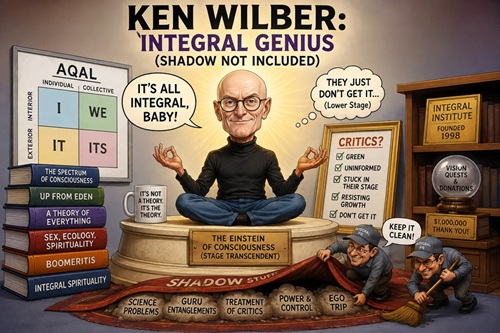 Ken Wilber's biography has increasingly become part of the Wilber phenomenon itself. The official story is by now familiar: a brilliant and unusually wide-ranging young man abandons conventional academia, immerses himself in Eastern and Western philosophy, publishes The Spectrum of Consciousness at the age of twenty-eight, develops an increasingly comprehensive theory of consciousness and evolution, founds Integral Institute, and eventually becomes the principal architect of what is presented as the world's first genuinely comprehensive philosophy. The latest biography collection from Integral Life promises an unusually intimate encounter with this life, including Wilber's childhood, college years, spiritual development, marriages, writing career, and personal reflections. There is nothing inherently wrong with telling such a story. The problem is what happens when biography becomes hagiography: when the subject's own interpretation of his life is allowed to become the dominant interpretation, and when the contradictions, failures, conflicts and less flattering episodes are treated as peripheral rather than constitutive. A biography of Ken Wilber needs a shadow biography. Not a character assassination, and certainly not a catalogue of gossip. Rather, it needs to ask a more uncomfortable question: what aspects of Wilber's personality, intellectual development and institutional career disappear when the story is told almost entirely from Wilber's own perspective? The answer is revealing. The shadow of Ken Wilber is not simply the opposite of his public image. In many cases, it is the distorted underside of his greatest strengths. The genius narrativeWilber's official biography begins with exceptionalism. Integral Life describes him as "one of the most important philosophers in the world today," the originator of "the first truly comprehensive or integrative philosophy," while other official sources have called him the "Einstein of consciousness studies." Such language is not merely promotional decoration. It creates the interpretive frame through which everything else is understood. Wilber's intellectual ambition becomes evidence of greatness. His breadth becomes evidence of comprehensiveness. His confidence becomes evidence of insight. His independence from academia becomes evidence that academia failed to recognize him. His conflicts with critics become evidence that critics failed to understand him. And here the shadow begins. For the more exceptional the thinker is presented as being, the more difficult it becomes to distinguish genuine intellectual originality from intellectual self-mythologizing. A biography should therefore ask not only what Wilber accomplished, but how he came to understand himself as someone uniquely qualified to accomplish it. That question becomes especially important because Wilber did not merely produce an intellectual system. Over time he became the central personality around which an intellectual and spiritual movement organized itself. The outsider who became an authorityWilber's withdrawal from conventional academia is one of the foundational episodes of the story. He began at Duke University intending to study medicine, became interested in psychology and philosophy, returned to Nebraska to study biochemistry, and eventually abandoned academic education in order to pursue his own curriculum and writing. This can certainly be interpreted as intellectual courage. But there is another interpretation. Wilber escaped the institutional mechanisms that ordinarily constrain intellectual authority: academic specialization, peer review, disciplinary competence, professional criticism and the requirement to establish expertise within a particular field. This gave him extraordinary freedom. It also removed many of the checks that accompany that freedom. Wilber could move from developmental psychology to evolutionary biology, from Buddhism to systems theory, from physics to sociology, and from mysticism to cultural criticism without being fully accountable to any one discipline. His genius was precisely his ability to synthesize across boundaries. But the shadow of synthesis is superficiality: the possibility of knowing a little about many fields while presenting the resulting synthesis as superior to the specialists who actually work in them. This tension has remained central to the reception of Integral Theory. Critics have repeatedly questioned Wilber's engagement with science, particularly evolutionary science. My own later analysis argued that his claims about evolution required considerably greater scientific engagement and openness to criticism than he had demonstrated. The biographical question, then, is not simply why Wilber left academia. It is what kind of intellectual personality is produced when a thinker becomes accountable primarily to himself. The guru problemThere is another shadow running through Wilber's spiritual biography: his relationship to spiritual teachers and guru culture. Wilber's involvement with Adi Da is particularly significant. Elliot Benjamin, who personally met Wilber in 2003, described Wilber's account of his involvement as relatively limited and said that Wilber explained that he withdrew when Adi Da's behavior became increasingly bizarre and suspicious. Benjamin nevertheless questioned whether Wilber had sufficiently appreciated the dangers inherent in guru-centered spiritual organizations. This is not a trivial biographical detail. Wilber's later work repeatedly attempts to reconcile spiritual realization with psychological development, ethics and institutional structures. Yet his own history contains an unresolved tension between admiration for extraordinary spiritual figures and suspicion of the abuses that can accompany spiritual authority. That tension becomes particularly important once Wilber himself becomes the authoritative center of an intellectual-spiritual movement. The irony is hard to miss. The critic of conventional spiritual movements became the subject of a movement of his own. From philosopher to movement leaderThe founding of Integral Institute marks a decisive transformation. According to the institute's own history, Wilber was approached in 1997 by philanthropists interested in establishing an organization devoted to comprehensive approaches to complex problems. Hundreds of integral thinkers were invited to meetings, and a million-dollar donation helped launch the organization. Integral Institute was formally incorporated in 1998. Wilber's biography therefore changes at this point. He is no longer simply an author writing books. He becomes a founder, symbolic leader, intellectual authority and movement figure. That transformation creates a new set of psychological pressures. A philosopher can revise his theory. A movement leader has an identity invested in the theory's success. Criticism consequently becomes more threatening. This may help explain an increasingly pronounced feature of Wilber's later career: his tendency to divide critics into those who understand Integral Theory and those who do not. There is an obvious circularity here. If criticism is dismissed because the critic has failed to understand the theory, and understanding the theory is defined partly by accepting its basic architecture, the system becomes unusually resistant to external correction. The shadow is epistemic self-protection. The war against "Green"Perhaps nowhere is this more visible than in Wilber's treatment of what he called the "Mean Green Meme" and "Boomeritis." Wilber's developmental model allowed him to interpret ideological disagreement through the vocabulary of stages. This was potentially illuminating. It also created a powerful rhetorical weapon. Instead of saying simply that someone was mistaken, Wilber could suggest that the person's mistake was structurally located at a particular developmental level. The critic could therefore be diagnosed rather than answered. This is one of the darker possibilities inherent in Integral Theory: developmental psychology can become a hierarchy of credibility. If I disagree with you, perhaps I have an argument. But if I disagree with you because I am supposedly at a lower developmental stage, then my disagreement itself becomes evidence of my deficiency. That is an extraordinarily effective way of insulating a theory from criticism. It is also precisely the kind of shadow phenomenon that a genuinely integral approach ought to investigate in itself. The critic becomes the enemyWilber's rhetorical treatment of critics has long been one of the least attractive aspects of his intellectual persona. Benjamin noted the "aggressive and condescending" remarks directed toward critics in Sex, Ecology, Spirituality and Boomeritis. This matters because Wilber's theory places enormous emphasis on perspective-taking, interiority, developmental understanding and the integration of multiple viewpoints. Yet the rhetoric sometimes becomes surprisingly non-integral. Critics are not always treated as potential sources of information about weaknesses in the theory. They can become representatives of lower development, failed understanding, ideological pathology or "green" resistance. The resulting contradiction is profound. The theorist who tells us that every perspective contains partial truth can become remarkably selective about the perspectives he is willing to grant epistemic legitimacy. The strange relationship with scienceThe shadow becomes even clearer when we examine Wilber's relationship with science. Evolution is indispensable to his worldview. His entire Kosmos is developmental and evolutionary. Yet when evolutionary biology conflicts with his metaphysical interpretation of evolution, the hierarchy of authority can become inverted. Wilber has argued that contemporary science cannot adequately explain major evolutionary transformations and has presented his own conception of spiritual evolution as an answer to these mysteries. At one point he characterized his approach as "the only theory that can actually explain the mysteries of evolution."[1] This is a remarkably strong claim. But the problem is that a metaphysical interpretation of evolution is not thereby transformed into a scientific theory. The shadow here is not simply ignorance of science. It is something more subtle: the appropriation of scientific language and scientific prestige to strengthen metaphysical conclusions. This is particularly ironic for a thinker who repeatedly presents Integral Theory as an integration of science and spirituality. The unresolved question is whether science is genuinely being integrated—or whether scientific findings are being selectively recruited into a pre-existing spiritual worldview. The politics of being "integral"There is another biographical shadow: the relationship between Wilber's intellectual system and his political instincts. Integral Theory presents itself as a framework capable of transcending ideological polarization. Wilber has emphasized that conservatives, liberals, traditionalists and progressives may each possess partial truths. But the very act of assigning political positions to developmental stages creates a hierarchy of political legitimacy. Wilber's political commentary therefore tends to be strongest when he identifies genuine limitations in ideological camps and weakest when the developmental model is used as an explanation for why his preferred synthesis should occupy a higher level. The danger is that "integral" becomes less a method for examining one's own assumptions than a privileged position from which to diagnose everybody else's. That is another version of the shadow: transcendence masquerading as neutrality. The personality behind the systemThe official biography understandably emphasizes Wilber's intellectual productivity, humor, spiritual practice and perseverance. The new Biography Collection promises an even more personal portrait, including intimate stories and previously unpublished material. But intimacy is not the same as critical biography. A person can reveal embarrassing anecdotes about himself and still control the larger narrative. Indeed, self-disclosure can strengthen a myth. It makes the hero appear more human without necessarily challenging the heroic interpretation. What is missing is not necessarily more confession. It is contradiction. A critical biography would place Wilber's self-understanding alongside the accounts of former associates, critics, students, colleagues and independent observers. It would ask where the stories diverge. It would investigate the institutional history of Integral Institute, the changing relationships within the integral movement, the controversies surrounding Wilber's treatment of critics, and the intellectual disputes over his claims about science, evolution and spirituality. Most importantly, it would resist the temptation to explain every contradiction within Wilber's own vocabulary. The Frank Visser paradoxThere is an especially revealing irony in my own relationship to Wilber. I wrote Ken Wilber: Thought as Passion, published by SUNY Press in 2003, as a comprehensive account of his life and intellectual development. SUNY describes it as the first comprehensive overview of Wilber's life and thought. At the time, I was not interested in destroying Wilber's reputation. Quite the opposite. I was deeply engaged with his work and regarded it as intellectually important enough to deserve serious study. Wilber himself wrote the foreword. Later, however, our relationship changed. Wilber asked me to serve as a European Devil's Advocate for the newly formed Integral Institute, with the explicit responsibility of identifying moments when the organization was "less than integral." He also asked me to collect online criticism of his work for a projected book. I took that assignment seriously and eventually assembled a substantial collection of critical material. This is perhaps the most revealing biographical episode of all. Wilber wanted a critic—until criticism became genuinely inconvenient. The story illustrates something larger than a personal disagreement. It exposes a structural problem in the Wilber project. The system formally welcomes criticism, but the culture surrounding the system can become increasingly defensive when criticism challenges foundational assumptions. The shadow is therefore not simply that Wilber had critics. Every major thinker has critics. The shadow is what happened to criticism when it moved from the margins toward the center. The unintegrated WilberThere is a final irony. Wilber's central intellectual project has always been integration. • Mind and body. • Science and spirituality. • East and West. • Individual and collective. • Agency and communion. • States and stages. But integration is hardest where it matters most: in the self-understanding of the theorist. The public Wilber is the great integrator. The shadow Wilber is the man who sometimes struggles to integrate criticism, fallibility, scientific uncertainty, institutional power and the possibility that his own framework may be less comprehensive than he believes. This does not make him a fraud. Nor does it make Integral Theory worthless. It makes Wilber human. And that may actually be the more interesting story. Beyond hagiographyA critical biography should therefore not attempt to replace one Ken Wilber with another. It should resist both hagiography and demonology. The fascinating Wilber is neither the "Einstein of consciousness" nor the caricature of a self-important guru. He is a remarkably gifted synthesizer whose intellectual ambition sometimes exceeds his empirical foundations; a spiritual thinker who has struggled with the implications of spiritual authority; an advocate of perspective-taking who can become surprisingly dismissive of opposing perspectives; an admirer of science whose evolutionary metaphysics repeatedly outruns evolutionary science; and a philosopher of integration whose own intellectual biography contains unresolved fractures. That is the biography worth writing. The shadow is not something hidden behind Ken Wilber's biography. It is produced by the very things that the official biography celebrates. • His ambition casts the shadow of grandiosity. • His independence casts the shadow of intellectual isolation. • His comprehensiveness casts the shadow of dilettantism. • His developmental theory casts the shadow of hierarchy. • His spiritual interests cast the shadow of guru culture. • His movement-building casts the shadow of authority. • His confidence casts the shadow of defensiveness. • And his doctrine of integration casts perhaps the largest shadow of all: the difficulty of integrating the possibility that Ken Wilber himself might be wrong. That is the missing chapter in the official story. Not a scandal sheet. A shadow biography. NOTES[1] Ken Wilber, The Religion of Tomorrow, Boulder, Shambhala, 2017, p. 14.
Widget is loading comments...
|