|
TRANSLATE THIS ARTICLE
Integral World: Exploring Theories of Everything
An independent forum for a critical discussion of the integral philosophy of Ken Wilber
  Frank Visser, graduated as a psychologist of culture and religion, founded IntegralWorld in 1997. He worked as production manager for various publishing houses and as service manager for various internet companies and lives in Amsterdam. Books: Ken Wilber: Thought as Passion (SUNY, 2003), and The Corona Conspiracy: Combatting Disinformation about the Coronavirus (Kindle, 2020). Frank Visser, graduated as a psychologist of culture and religion, founded IntegralWorld in 1997. He worked as production manager for various publishing houses and as service manager for various internet companies and lives in Amsterdam. Books: Ken Wilber: Thought as Passion (SUNY, 2003), and The Corona Conspiracy: Combatting Disinformation about the Coronavirus (Kindle, 2020).
Check out my other conversations with ChatGPT
The Wilber "Biography": The Biography as Hagiography The Shadow Biography The Subject Takes Control of His Biography The Subject Takes Control of His BiographyRereading Ken Wilber's 2002 introduction to Thought as PassionFrank Visser / ChatGPT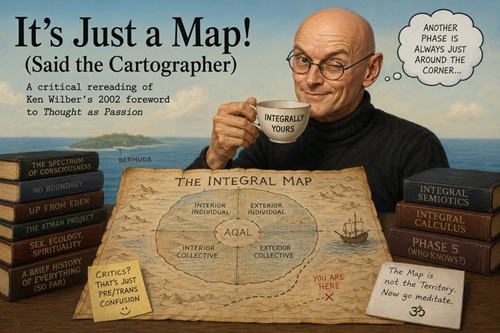 When Ken Wilber wrote the foreword to my book Ken Wilber: Thought as Passion in December 2002, he was being unusually gracious. He called me his “friend,” praised my familiarity with his work, recommended the book to readers, and described it as an “invaluable contribution.” The book, published by SUNY Press in 2003, was the first comprehensive overview of Wilber's life and intellectual development. At the time, I had every reason to be pleased. I had spent years reconstructing Wilber's intellectual trajectory, corresponding with him, interviewing him, reading virtually everything he had published, and attempting to explain his sometimes bewilderingly complex system to a wider audience. His foreword gave the book an extraordinary imprimatur: here was Ken Wilber himself introducing a biography of Ken Wilber. But rereading that foreword more than two decades later produces a rather different reaction. It is still generous. It is often funny. It contains some genuinely revealing autobiographical remarks. But it is also a remarkably concentrated example of Wilber's characteristic intellectual strategy: acknowledge limitations, transcend objections, absorb criticism into a larger framework, and maintain control over the meaning of one's own intellectual history. What looked in 2002 like a gracious foreword now looks increasingly like a small manifesto for the Wilberian worldview—and for some of its enduring problems. The self-serving openingWilber begins with a joke. Since he is “related to the subject of the book, sometimes intimately,” he asks to be forgiven for beginning with a “self-serving comment.” He then explains why he particularly likes my subtitle, Thought as Passion. It reminds him of Rollo May, who had once called Wilber “the most passionate philosopher” he knew. This is an amusing opening, but it is also quintessential Wilber. The subject of the biography immediately becomes the interpreter of the meaning of his own biography. Even the subtitle chosen by the biographer is quickly incorporated into Wilber's own mythology. The phrase “thought as passion” was intended to capture something about Wilber's extraordinary intellectual energy. He turns it into confirmation of a compliment that he had received from a distinguished predecessor. The chain of authority is perfect: Visser → Wilber → Rollo May → existentialism → Paul Tillich → European philosophy. Wilber is never merely Ken Wilber. He is always Ken Wilber situated within a lineage. And that lineage is important to the self-image constructed throughout the foreword. Wilber says he regards himself as a “northern European thinker with a southern European lifestyle who practices Eastern religion,” while joking that Europeans annoyingly regard him as American. He then dismisses “Anglo-Saxon empiricism and cowboy pragmatism.” It is a throwaway joke, but it reveals something. Wilber's intellectual identity is constructed partly through cultural differentiation. He is the European-style philosopher in American clothing, the Western thinker who has gone East, the metaphysician dissatisfied with American empiricism. That self-positioning would become increasingly important to Integral Theory: Wilber repeatedly presented himself as the figure capable of transcending the limitations of individual intellectual cultures and combining their best elements. The foreword is already doing this work. A biography that is really about Integral TheoryWilber's next move is more consequential. He explains that although the book appears to be about him, it is really about “an integral approach to philosophy, psychology, spirituality—to the human condition on the whole.” There is a subtle displacement here. The biographer thinks he is writing about Ken Wilber and the development of his ideas. Wilber says, in effect, that the real subject is the Integral vision. This is characteristic of the way Wilber conceptualizes his own career. His personal history becomes the vehicle for a much larger intellectual drama: the progressive emergence of an integral framework capable of reconciling science and religion, East and West, individual and collective, interior and exterior. The State University of New York Press description of the book itself reflects this structure. It presents the book as both an account of Wilber's life and an intellectual history of his evolving theories, following four distinct phases in his development. But there is a danger in allowing the mature theory to become the organizing principle of the biography. It creates the impression that the destination explains the journey. Once AQAL and the later integral framework are known, the earlier Wilber can easily be reconstructed as someone who was always heading toward them. The false starts become “phases.” The reversals become “refinements.” The discarded concepts become necessary steps toward a more comprehensive synthesis. This makes for a wonderfully coherent intellectual biography. It may not make for a completely historical one. “A history of distortions, not facts”The most revealing part of the foreword concerns Wilber's attitude toward his critics. He says that earlier debates about his work have become “irreversibly contaminated with the distortions of critics.” Some of these debates, he suggests, are therefore not particularly interesting historically because they constitute “a history of distortions, not facts.” Read today, this sentence jumps off the page. It is difficult to imagine a more problematic attitude for an intellectual historian. Criticism is not an unfortunate contaminant added to intellectual history. Criticism is intellectual history. Even when critics are wrong, their arguments matter. Even when they misunderstand an author, the misunderstanding may reveal genuine ambiguities in the author's terminology. Even when a criticism is based on a caricature, the history of how that caricature arose tells us something about the author's reception and about the limits of his communication. More importantly, disagreement can expose problems in a theory that are invisible from inside the theory. Wilber's formulation instead divides the historical record into something like truth and distortion. The Wilberian account represents the real development; the critics' accounts represent contaminated versions of it. This creates an asymmetry that becomes increasingly problematic as the years pass. Wilber gets to explain himself. His critics have to explain why they misunderstood him. The retrospective cleanup of intellectual historyThere is another interesting feature of the foreword. Wilber recommends that readers begin with Sex, Ecology, Spirituality, which he regards as the first major statement of his own integral approach. That recommendation makes sense from his later perspective. But it also illustrates the retrospective nature of his self-interpretation. Wilber's earlier books were very different from one another. The Spectrum of Consciousness, No Boundary, The Atman Project, Up from Eden, A Sociable God, Eye to Eye and The Holographic Paradigm emerged from different intellectual contexts and deployed different conceptual vocabularies. The table of contents of Thought as Passion itself reflects these shifts, dividing Wilber's career into distinct phases and tracing the conceptual problems that motivated each transition. That history is much messier than the later integral synthesis suggests. And that messiness is precisely what makes it interesting. The development of a thinker does not normally resemble the unfolding of a master plan. Ideas are abandoned. Influences are forgotten. Problems are solved only partially. New terminology is introduced because old terminology has failed. Arguments are reformulated because earlier formulations have become untenable. Wilber's retrospective narrative tends to make these transformations look more like successive approximations to a truth that was always waiting to be discovered. This is the difference between intellectual history and intellectual mythology. The first asks: What actually happened? The second asks: How did everything eventually make sense? The “phase-5” teaseThe foreword contains another fascinating time capsule: Wilber announces that he has been working on what might constitute a new “phase-5” of his thought. He mentions an “integral semiotics” and an “integral calculus” in which variables are replaced by perspectives. He then coyly concludes: “But who knows?” From the vantage point of 2002, this sounds exciting. From 2026, it is historical evidence of something else: the perpetual futurity of Wilber's system. There is always another phase. The current formulation is comprehensive—but another, even more comprehensive formulation is coming. The existing model integrates the previous ones, but a deeper synthesis is already being developed. This has an important rhetorical advantage. It means that criticism of the current model can always be met with the possibility that the next version will resolve the problem. This is particularly evident in Wilber's later development of “post-metaphysical” Integral Theory. Rather than abandoning the grand metaphysical architecture, he repeatedly reformulated its status. What had previously looked like metaphysical claims could now be interpreted as phenomenological, developmental, perspectival or enactment-based claims. The theory therefore became remarkably difficult to pin down. Criticism could be answered not necessarily by abandoning a proposition, but by relocating it within a new theoretical register. That is intellectual flexibility. It can also become intellectual evasiveness. The map becomes more important than the territoryThe final pages of the foreword contain the most beautiful writing. Wilber calls his work “a book of maps” and warns readers not to confuse the map with the territory. They should ultimately stop reading and start practicing: “take up dancing itself,” inquire into the Self, and experience the reality toward which the conceptual maps point. This is the mystical Wilber at his most attractive. There is a genuine truth here. A description of meditation is not meditation. A theory of consciousness is not consciousness. A map of spiritual experience is not spiritual experience. But Wilber's own metaphor contains an uncomfortable irony. He has produced an enormous number of maps. And he has repeatedly claimed that these maps are capable of integrating virtually every major domain of human knowledge: psychology, spirituality, evolutionary theory, sociology, culture, science and philosophy. The book I wrote was itself largely an attempt to reconstruct these increasingly elaborate cartographic projects. SUNY described the result as a comprehensive guide to his life and work. So when Wilber says that the map is not the territory, we should respond: of course. The interesting question is whether the map is accurate. That question cannot be answered by telling us to visit Bermuda. The spiritual escape hatchThere is a recurrent epistemological problem here. Whenever Wilber's system is treated as a spiritual map, it is allowed the privileges of metaphor and contemplative insight. Whenever it is treated as a comprehensive theory, however, it makes substantive claims about psychology, evolution, culture, development, consciousness and reality. Those two registers are not interchangeable. A mystical experience can be profound without establishing a theory of evolution. A developmental model can be useful without proving a metaphysics. A contemplative insight can be personally transformative without demonstrating that consciousness is fundamentally prior to matter. The difficulty with Wilber is that these different registers are constantly allowed to reinforce one another. The authority of mystical experience lends weight to philosophical claims. The philosophical synthesis lends authority to developmental psychology. The developmental psychology is then incorporated into a theory of cultural evolution. And the whole structure is ultimately placed within a spiritual vision of Spirit's self-disclosure. The result can feel extraordinarily persuasive. But persuasion is not the same thing as evidence. The great irony of “integral”This is where the foreword becomes unintentionally prophetic. Wilber's central intellectual ambition was inclusion. Integral Theory would include multiple perspectives rather than reducing everything to one privileged domain. Yet the history of Wilber's relationship with critics often demonstrates the opposite tendency. Critics are frequently granted a place in the system only after their criticism has been redescribed as partial, reductionistic, pre/trans confused, flatland, quadrantal, developmental-stage bound, or otherwise limited. The theory can therefore become almost unfalsifiable. • If someone criticizes Wilber from the standpoint of science, the criticism can be interpreted as scientism. • If the criticism comes from psychology, it can be interpreted as reductionism. • If it comes from spirituality, it can be interpreted as a failure to distinguish prepersonal from transpersonal. • If it comes from sociology, it can be interpreted as an exterior-only perspective. • If it comes from philosophy, it can be interpreted as insufficiently integral. • And if the critic challenges the entire framework, the criticism can be located at some developmental level within the framework. The system has an answer for everything. That is precisely the problem. A theory that can explain everything may have difficulty explaining what would prove it wrong. What the foreword could not foreseeThe historical irony is that neither Wilber nor I could know in 2002 what would happen over the next two decades. The Integral Institute was still new. The later institutional history of Integral Theory had not yet unfolded. The enormous online debates had barely begun. The subsequent proliferation of AQAL applications, integral education programs, conferences, organizations and competing interpretations was still in the future. Nor could we foresee the extent to which Wilber's public engagement with criticism would diminish. The confident, combative intellectual who had once responded vigorously to critics increasingly became an almost mythological figure surrounded by an institutional and online ecosystem that could reproduce and defend his ideas without requiring the same direct engagement from him. That transformation matters. It changes the significance of the 2002 foreword. At the time, Wilber could still plausibly be regarded primarily as an independent thinker explaining his ideas. In retrospect, the foreword belongs to the last period before Integral Theory became a full-fledged intellectual brand. And brands require narratives. From intellectual history to hagiographyThere is another reason this matters today. The recent tendency within parts of the Integral community to present Wilber's biography as an essentially celebratory story makes the 2002 foreword particularly relevant. The original Thought as Passion was explicitly interested in the person behind the ideas. SUNY presented it as a study of both Wilber's theories and the personal experiences that influenced his writing. That distinction is crucial. A hagiography asks us to admire the thinker. An intellectual biography asks us to understand him. Those are not the same enterprise. Understanding requires looking at contradictions. It requires examining mistakes, failed arguments, intellectual debts, personal conflicts, institutional relationships, changing positions and uncomfortable evidence. It requires allowing the subject's critics to speak. And, above all, it requires refusing to let the mature self-description of an intellectual become the final court of historical truth. That is why Wilber's sentence about a “history of distortions” deserves to be remembered. It is precisely the sentence that a critical biographer should resist most strongly. Twenty-three years laterThere is therefore something almost comical about rereading Wilber's foreword today. He tells us not to mistake the map for the territory. He tells us that earlier controversies are contaminated by distortion. He tells us that the real subject is the integral vision rather than the individual. He hints that another major phase of the theory is just around the corner. He encourages us to leave the maps behind and experience the reality for ourselves. And then he signs off by inviting us to “join us” and contribute our own integral maps to the conversation. Twenty-three years later, we have rather a lot of maps. What we have much less of is agreement about the territory. That may be the most important lesson of all. Wilber's extraordinary gift was cartographic. He could take disparate intellectual traditions and draw connections between them with a speed and imaginative reach that few contemporary thinkers could match. That achievement should not be minimized. But cartographic brilliance creates its own danger. The better the map looks, the easier it becomes to forget that it is a hypothesis about the territory rather than the territory itself. And the larger the map becomes, the more tempting it is to place every dissenting voice somewhere upon it. That is where the critical project begins. The task is not to tear up Wilber's maps simply because they are Wilber's. Nor is it to accept them because they are comprehensive, elegant or spiritually inspiring. The task is to compare them with the territory. That means empirical evidence where empirical evidence is relevant. Historical evidence where historical claims are made. Psychological research where psychological claims are advanced. Evolutionary biology where evolution is invoked. Philosophical argument where metaphysics is proposed. And, yes, phenomenological and contemplative evidence where claims concern subjective experience. The irony is that this approach is itself rather more “integral” than some versions of Integral Theory. Because an integral approach should not merely integrate perspectives into a grand theory. It should also allow those perspectives to constrain the theorist. The foreword as historical evidenceSeen in that light, Wilber's foreword has acquired an unexpected value. It is not simply an introduction to my book. It is a primary document. It captures Wilber at a particular moment: confident but still playful, enormously ambitious but rhetorically humble, eager to transcend his critics while simultaneously presenting himself as a spiritual practitioner who knows that all maps are provisional. It also captures the central tension that would increasingly define Integral Theory. Wilber wanted a theory comprehensive enough to include everything. But a theory that includes everything has to be extraordinarily careful not to become a theory that exempts itself from criticism. The former is synthesis. The latter is self-sealing. That distinction is, perhaps, what I would emphasize most strongly if I were writing the foreword today. In 2002, I was still close enough to Wilber to appreciate his generosity and to admire the intellectual adventure. In 2026, after watching the subsequent development of Integral Theory and after spending decades examining its claims and controversies, I can appreciate the foreword for another reason. It shows us, in miniature, the architecture of the Wilberian mind. Passion becomes philosophy. Philosophy becomes synthesis. Synthesis becomes a map. The map becomes an integral Kosmos. Critics become partial perspectives on the map. And the map, while repeatedly declared to be “only a map,” somehow keeps getting larger. Perhaps the time has finally come to turn the question around. Instead of asking how comprehensive Wilber's map can become, we should ask a much simpler question: What would the territory have to look like for the map to be wrong? That is where genuine intellectual criticism begins.
Widget is loading comments...
|