|
TRANSLATE THIS ARTICLE
Integral World: Exploring Theories of Everything
An independent forum for a critical discussion of the integral philosophy of Ken Wilber
  Frank Visser, graduated as a psychologist of culture and religion, founded IntegralWorld in 1997. He worked as production manager for various publishing houses and as service manager for various internet companies and lives in Amsterdam. Books: Ken Wilber: Thought as Passion (SUNY, 2003), and The Corona Conspiracy: Combatting Disinformation about the Coronavirus (Kindle, 2020). Frank Visser, graduated as a psychologist of culture and religion, founded IntegralWorld in 1997. He worked as production manager for various publishing houses and as service manager for various internet companies and lives in Amsterdam. Books: Ken Wilber: Thought as Passion (SUNY, 2003), and The Corona Conspiracy: Combatting Disinformation about the Coronavirus (Kindle, 2020).
Check out my other conversations with ChatGPT
The Basic Problem:
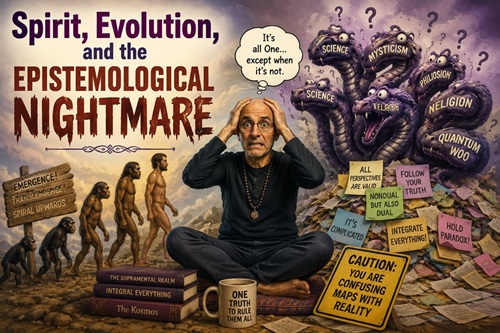
Energy or Eros? Eros vs. Natural Selection The Evolution Controversy: Spirit, Evolution, and the Epistemological Nightmare The Reynolds-Visser Controversy Wilber's Neo-Perennialism Hegel, Schelling, Marx, Darwin—and Wilber Hegel Got His Marx, Schelling Got His DarwinHas Materialism Won the Day?Frank Visser / ChatGPT
There is a wonderfully provocative way of summarizing the philosophical drama of the nineteenth century: Hegel got his Marx, Schelling got his Darwin. Hegel gave history a metaphysical engine called Spirit; Marx turned that dialectical engine upside down and replaced Spirit with material conditions, class conflict and the organization of production. Schelling, meanwhile, sought a dynamic philosophy of nature in which nature was not a dead mechanism but a productive, self-organizing process—and Darwin eventually gave natural history a mechanism that could explain the appearance of design without invoking a cosmic designer. The slogan is historically too neat to be taken literally. Marx was not simply Hegel with the word “Spirit” crossed out, and Darwin was not simply Schelling translated into biology. The intellectual genealogy is considerably messier. Yet as a philosophical contrast the slogan captures something important. Hegelian idealism and German Naturphilosophie were trying to understand reality as an internally developing whole. Materialist and naturalistic science eventually demonstrated that at least some of that apparent purposiveness could be explained without invoking an intrinsically spiritual principle. And that raises an uncomfortable question for neo-perennialism and for Wilber in particular: has history already conducted the experiment for us? Hegel's Spirit enters historyHegel's great achievement was to transform “Spirit” from something primarily transcendent into something that could be understood as unfolding through history. Reality was not a static collection of substances. It was a developmental process in which contradictions generated transformations and Spirit progressively came to know itself. This was an extraordinarily powerful intellectual vision. It gave history a structure and direction. Human societies were not merely succeeding one another randomly; they could be interpreted as stages in the development of freedom and self-consciousness. But Hegel's philosophy also illustrates the danger of turning a developmental pattern into an ontological mechanism. Once history is interpreted as the unfolding of Spirit, historical events can begin to look as though they were produced by that Spirit. The interpretation of history becomes an explanation of history. And because virtually any historical event can be incorporated into the dialectical narrative, the theory acquires enormous interpretive flexibility. Marx inherited the machinery but changed the engine. The famous inversion was not simply that Marx became a materialist and Hegel remained an idealist. Marx retained something distinctly Hegelian: history still had structure, contradiction still mattered, social formations still developed through conflict, and human beings still transformed themselves through historical activity. What Marx rejected was the idea that these processes were fundamentally expressions of an autonomous Spirit. The motor of history became material production and social relations. That was a decisive intellectual move. It did not necessarily make Marx correct about every historical development, but it demonstrated something important: one could retain a developmental conception of history while removing Spirit from the causal machinery. That is precisely the possibility that becomes uncomfortable for Wilber. Schelling's living natureSchelling is even more interesting in the present context because his philosophy of nature bears a striking resemblance to some of the intuitions later expressed by evolutionary spiritual thinkers. Schelling rejected the picture of nature as merely inert matter pushed around by external forces. Nature was productive. It contained dynamic tensions and generated increasingly organized forms. Mind was not simply an alien substance dropped into an otherwise meaningless material universe; mind emerged from a nature that already possessed an extraordinary generative power. This was Naturphilosophie at its most ambitious. And here we encounter an intellectual ancestor of a familiar integral intuition: matter is not dead, evolution is not merely mechanical, and nature possesses an intrinsic creativity. One can almost hear the later language of Eros approaching. But there is a crucial difference between saying that nature is dynamically self-organizing and saying that nature contains a spiritual force directing evolution. The former can potentially become a naturalistic research program. The latter introduces an additional metaphysical entity. This distinction became decisive once empirical science acquired the tools to investigate nature in detail. Darwin's great demystificationDarwin did something philosophically astonishing. He showed how the appearance of design could arise without requiring design as an explanatory principle. That is the crucial point. Darwin did not discover that evolution was random. He did not show that organisms were meaningless collections of atoms. And he certainly did not demonstrate that nature lacks all direction in every conceivable sense. What he demonstrated was something much more specific and much more consequential: adaptation does not require foresight. Once hereditary variation and differential reproductive success are combined over generations, cumulative adaptation becomes possible without a conscious designer and without an intrinsic cosmic intention. This was a devastating blow to one particular form of natural theology. It was also a devastating blow to any philosophy that assumed that the extraordinary organization of living things required a corresponding organizing intelligence. Darwin effectively separated the appearance of purpose from the existence of purpose. That distinction is still at the heart of the Wilber debate. And then the material world became strangely successfulThe nineteenth and twentieth centuries produced an extraordinary expansion of naturalistic explanation. Physics explained phenomena once attributed to occult qualities through increasingly precise laws. Chemistry became a quantitative science. Geology reconstructed an ancient Earth. Biology explained adaptation through evolution. Genetics eventually supplied mechanisms of heredity. Molecular biology connected biological inheritance to DNA and protein synthesis. Neuroscience increasingly connected mental functions to nervous systems. None of this proved metaphysical materialism. That distinction is essential. Science does not contain an experiment called “The Nonexistence of Spirit.” It cannot establish that reality is ultimately nothing but matter, because “matter” itself is already a metaphysical category when used as a description of ultimate reality. What science did establish was something more limited but arguably more important: A remarkable amount of what once seemed to require spiritual, vitalistic or teleological explanation can be investigated without those concepts. That is a very different proposition from “materialism has proved everything.” But it is also much harder to dismiss. Has materialism therefore won?If by materialism we mean the metaphysical proposition that nothing exists except matter, the verdict is clearly not in. Modern physics itself has made “matter” a much stranger concept than the nineteenth-century materialists could have imagined. Fields, quantum states, spacetime, symmetries and probabilistic structures do not fit comfortably into the old picture of solid little pieces of stuff moving through empty space. Furthermore, consciousness remains philosophically difficult. Subjective experience, intentionality and first-person awareness continue to raise questions that cannot simply be dissolved by declaring them brain processes. And even if neuroscience eventually gives us a complete causal account of consciousness, the metaphysical question of why physical processes should be accompanied by subjective experience would not automatically disappear. So materialism has not won the metaphysical argument simply by accumulating scientific victories. But something more subtle has happened. Naturalism has won an extraordinary number of explanatory contests. That is the point that idealists should take seriously. When confronted with a phenomenon that appears to require a special metaphysical principle, science repeatedly asks whether ordinary causal processes might suffice. Sometimes they do. Sometimes they do not. But the presumption has shifted. The burden of proof has moved. If you propose an additional cosmic principle, you cannot simply point to the mystery of the phenomenon and say, “There must be something more.” You have to show what that something more actually contributes. The fate of vitalism is instructiveThe history of vitalism provides perhaps the most relevant precedent. For centuries it seemed perfectly reasonable to suppose that living organisms required a special vital principle absent from ordinary matter. Life was qualitatively different from chemistry and physics. Perhaps some elan vital, life force or organizing principle was required. Then biochemistry advanced. The fact that living systems are extraordinarily organized did not disappear. Life remained astonishing. But increasingly, phenomena once attributed to a special vital force could be investigated through chemistry, molecular biology, genetics and thermodynamics. Vitalism did not become logically impossible. It became explanatorily unnecessary. That distinction is devastatingly relevant to Wilber's Eros. Perhaps Eros is not logically impossible. Perhaps there really is some deeper spiritual dimension to nature. But if biological evolution can be explained through variation, heredity, selection, drift, developmental constraint, ecological interaction, self-organization and other natural processes, what exactly does Eros add? This is the question that neo-perennialism still struggles to answer. The strange fate of Schelling's intuitionThere is, however, an important irony. Schelling's intuition that nature is not merely dead mechanism has not necessarily been defeated by modern science. In some respects it has returned in a completely different vocabulary. Complex systems science, developmental biology, nonequilibrium thermodynamics and theories of self-organization have shown that simple local interactions can generate astonishingly rich global structures. Nature is capable of producing order without an external organizer. This is profoundly interesting. But notice what has happened. The naturalistic sciences have taken the intuition that nature is creative and found mechanisms by which creativity can occur. They did not necessarily recover Schelling's metaphysics. This may be the most instructive lesson of all. An intuition can survive while the metaphysical explanation attached to it disappears. Nature really is generative. Evolution really does produce novelty. Complexity really can emerge. Order really can arise spontaneously under appropriate conditions. None of these facts establishes that Nature possesses a spiritual intention. The phenomenon survives. The metaphysical surplus may not. Marx provides the parallel on the historical sideSomething similar happened to Hegel. The idea that history has structure survived the collapse of Hegel's metaphysics. Marx retained developmental conflict but grounded it in material production. Later historians retained various ideas of social transformation without believing that an Absolute Spirit was progressively realizing itself. Again, the pattern is striking. The insight survived the ontology. Development survived Spirit. Historical structure survived the Absolute. Conflict survived dialectical metaphysics. One can argue endlessly about whether Marx's own historical theory was correct, but the philosophical transformation remains significant. The world did not have to be animated by Hegelian Spirit for history to exhibit patterns, structures and developmental transformations. And this brings us directly back to Wilber. Wilber wants to save both sidesWilber's ambition is essentially to prevent the modern victory of naturalism from becoming the final word. He wants to retain the evolutionary achievements of modern science while restoring the spiritual meaning that, in his view, modernity discarded. Evolution is real, but it is also the unfolding of Spirit. Complexity is real, but it expresses Eros. Consciousness emerges biologically, but it also represents the progressive manifestation of an already-present spiritual dimension. This is why Wilber's project is so attractive. He promises the best of both worlds. We do not have to return to pre-Darwinian creationism. We can accept evolution. We do not have to abandon science. We can integrate science. We do not have to abandon spirituality. We can reinterpret evolution as the scientific expression of a deeper spiritual process. But there is a catch. The first two moves are empirical and philosophical. The third is metaphysical. And the third does not automatically follow from the first two. The problem of the missing experimentSuppose Darwinian evolution explains a biological phenomenon adequately. Wilber says that Eros is nevertheless operating within the process. How would we know? Suppose evolution produces another remarkable increase in complexity. That confirms Eros. Suppose evolution produces mass extinction and enormous amounts of evolutionary waste. Eros can presumably accommodate that too. Suppose a lineage becomes simpler. Eros can explain that as an adaptive or context-dependent manifestation. Suppose evolution takes a radically contingent path that never reaches intelligence. Eros can presumably be reinterpreted as having operated in a different way. This is where the hypothesis becomes difficult to distinguish from an interpretation. And this is exactly what happened to many older philosophies of nature. Their problem was not necessarily that they were absurd. Their problem was that they were too accommodating. A good scientific explanation has to risk being wrong. A metaphysical narrative can often survive anything. That is why the historical success of naturalism matters so much. But does this mean idealism is a lost cause?No. That conclusion would be premature—and philosophically rather boring. The failure of particular idealist explanations does not establish the failure of idealism as a philosophical position. Idealism comes in many forms. Berkeleyan idealism, German idealism, absolute idealism, phenomenological idealism, objective idealism, panpsychism and contemporary forms of analytic idealism are not interchangeable. Some do not even claim that a cosmic Spirit actively drives evolution. The central idealist insight can be stated much more modestly: perhaps consciousness, experience or subjectivity cannot ultimately be reduced to descriptions of an observer-independent physical world. That question remains open. Indeed, the philosophy of mind has revived versions of precisely this problem. If physics describes the structural and relational properties of the physical world, where does subjective experience fit? Why is there something it is like to be a conscious organism? Is consciousness emergent, fundamental, ubiquitous, relational or something else altogether? These are not questions that Darwin settled. Nor did Marx. Nor did neuroscience settle them merely by demonstrating correlations between brain states and mental states. So idealism is certainly not dead. But this does not rescue Wilber's evolutionary Eros. That is the crucial distinction. The strongest idealism may actually abandon ErosThere is an intriguing possibility here. Perhaps the most philosophically defensible form of idealism is not the one that says Spirit is pushing evolution toward consciousness. Perhaps it is the one that says something much more radical and much more modest: Our scientific description of the physical world may not exhaust the ontology of reality. That position does not require a cosmic evolutionary force. It does not require that evolution be heading toward enlightenment. It does not require that the universe “want” consciousness. It does not require that every increase in complexity be evidence of Spirit. And it certainly does not require replacing Darwinian mechanisms with Eros. In other words, an idealist could accept virtually all of modern evolutionary biology and still challenge the metaphysical interpretation of what that biology ultimately means. That would be a far more formidable opponent to materialism than an unsupported “fifth force.” Perhaps the real winner is not materialism but methodological naturalismThis suggests that the historical lesson is not quite “materialism has won.” Something subtler has won: methodological naturalism. When scientists investigate nature, they normally seek natural causes first. This is not necessarily because they have proved that nothing supernatural or spiritual exists. It is because natural explanations can be tested, compared, refined and sometimes falsified. This methodological discipline has been spectacularly successful. The mistake is to turn its success into the metaphysical proposition that naturalism must therefore be true in the ultimate sense. But the opposite mistake is equally serious: to assume that because naturalism does not answer every metaphysical question, some spiritual force must therefore be operating. The mature position lies between these two errors. Science has earned enormous authority concerning empirical mechanisms. It has not earned a monopoly over metaphysics. But metaphysics has not earned the right to manufacture mechanisms merely because science leaves philosophical questions unanswered. That is the epistemological settlement we have been looking for throughout these appendices. Hegel, Schelling, Marx, Darwin—and WilberSeen from this perspective, the nineteenth-century drama becomes almost a rehearsal for the Wilber controversy. Hegel says: development expresses Spirit. Marx says: development can be understood through material social relations. Schelling says: nature is intrinsically productive. Darwin says: biological adaptation can arise without intrinsic purpose. Wilber comes along much later and says, in effect: perhaps we were too quick to throw Spirit overboard; perhaps evolution really does have an intrinsic spiritual direction. That is a fascinating proposal. But history gives us reason to be cautious. Again and again, phenomena that once appeared to require an organizing metaphysical principle have acquired naturalistic explanations. The fact that this has happened repeatedly does not prove that it will always happen. But it establishes a strong methodological precedent. If Wilber wants to reintroduce Spirit into evolutionary theory, therefore, he needs more than a philosophical lineage. He needs an explanatory argument. And if he wants Eros to be “as real a force as gravity,” he needs considerably more than an explanatory argument. He needs evidence. The real lesson of the nineteenth centuryPerhaps the most profound lesson is that idealism and materialism are not simply rival teams, one destined to win and the other to lose. They are two recurring temptations in philosophy. Idealism reminds us that descriptions of matter may not exhaust reality, that consciousness is not easily eliminated, that meaning and value cannot simply be read off equations, and that the universe can be approached from perspectives other than the third-person scientific view. Materialism reminds us that we should not turn those legitimate mysteries into invisible substances and then congratulate ourselves for having explained them. The history of science has repeatedly vindicated the second warning. The continuing mystery of consciousness keeps the first one alive. That is a much more interesting philosophical situation than declaring either side victorious. So has materialism won the day? As a scientific methodology, naturalism has won an astonishing number of battles. As an ultimate metaphysics, materialism has certainly not won the war. And is idealism a lost cause? Only if idealism insists on disguising metaphysical intuitions as scientific mechanisms. That may be the final lesson for Wilber's neo-perennialism. Spirit does not need to be a fifth force in order to remain philosophically interesting. Eros does not need to drive natural selection in order for evolution to raise profound questions about consciousness, value and meaning. And idealism does not need to defeat Darwin in order to challenge the claim that Darwin has explained everything that ultimately matters. The great philosophical opportunity lies precisely there: accept the explanatory victories of naturalism without turning them into a metaphysical dogma, while refusing to turn the remaining mysteries of existence into evidence for an evolutionary Spirit that has never been independently demonstrated. Perhaps the future of idealism is therefore not to resurrect the old cosmic Spirit. Perhaps it is to become more modest, more rigorous—and much harder to refute.
Widget is loading comments...
|