|
TRANSLATE THIS ARTICLE
Integral World: Exploring Theories of Everything
An independent forum for a critical discussion of the integral philosophy of Ken Wilber
  Frank Visser, graduated as a psychologist of culture and religion, founded IntegralWorld in 1997. He worked as production manager for various publishing houses and as service manager for various internet companies and lives in Amsterdam. Books: Ken Wilber: Thought as Passion (SUNY, 2003), and The Corona Conspiracy: Combatting Disinformation about the Coronavirus (Kindle, 2020). Frank Visser, graduated as a psychologist of culture and religion, founded IntegralWorld in 1997. He worked as production manager for various publishing houses and as service manager for various internet companies and lives in Amsterdam. Books: Ken Wilber: Thought as Passion (SUNY, 2003), and The Corona Conspiracy: Combatting Disinformation about the Coronavirus (Kindle, 2020).
Check out my other conversations with ChatGPT
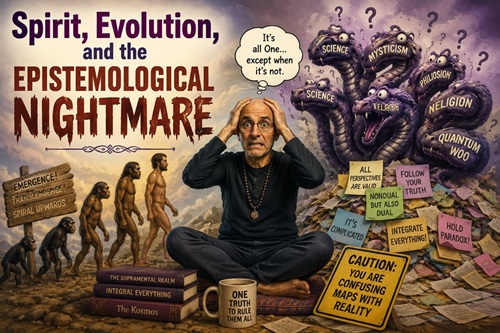
The Evolution Controversy: Spirit, Evolution, and the Epistemological Nightmare The Reynolds-Visser Controversy Wilber's Neo-Perennialism Hegel, Schelling, Marx, Darwin—and Wilber Wilber's Neo-PerennialismThe Philosophical Lineage of an Active SpiritFrank Visser / ChatGPT
There is another piece of the Reynolds-Visser puzzle that deserves to be brought into the discussion: Wilber himself claims that his idea of an active, evolutionary Spirit has a philosophical lineage. He does not present Eros as an eccentric invention that accidentally slipped into his system through a few careless formulations. He places it within what he calls neo-perennialism. That is an important distinction. If Wilber had simply said, once or twice, that evolution is “driven” by Spirit, Brad Reynolds could reasonably respond that Visser was exploiting an unfortunate metaphor. But Wilber's own historical reconstruction tells a different story. He explicitly contrasts traditional perennialism, in which Spirit is primarily the timeless Ground of Being, with a newer evolutionary perennialism in which Spirit is simultaneously transcendent and active within the world-process. One scholarly discussion of Wilber's position summarizes the distinction this way: traditional perennialism treats Spirit as the passive Ground, whereas neo-perennialism understands Spirit as both “passive-transcendent as World Ground” and “active-immanent as World Process.” In other words, the activity of Spirit is not an accidental feature of Wilber's evolutionary theory. It is part of what he thinks makes his version of perennial philosophy “neo.” From perennialism to evolutionary perennialismTraditional perennial philosophy, in the form popularized in the twentieth century by thinkers such as Aldous Huxley, emphasizes the recurring mystical insight that beneath the diversity of religions lies a deeper unity. Reality ultimately has a spiritual or transcendent ground, and mystical realization consists in recognizing or directly experiencing that ground. Evolution creates a problem for this picture. If Spirit is the timeless Absolute and the phenomenal world is merely its manifestation, what exactly is evolution doing? Why should the universe move from matter to life to mind to self-reflective consciousness if the ultimate truth is already present timelessly? One answer is to say that nothing is really evolving at the level of Spirit. Spirit is already complete. Only manifestation changes. That is a perfectly respectable metaphysical position, but it does not provide Wilber with the evolutionary philosophy he wants. Wilber therefore modifies perennialism. He retains the timeless Absolute, but adds a developmental story to manifestation. The Absolute is not evolving—but the world of manifestation is. Spirit is therefore both already fully present and increasingly realized through evolutionary development. This is the conceptual move that produces neo-perennialism. Wilber has described his version of perennialism as incorporating cosmic evolution, in contrast with traditional perennialism's tendency to portray history as a fall or degeneration from an earlier Golden Age. In his formulation, Spirit remains the timeless Absolute, but manifestation is not simply moving away from Spirit; it is evolving toward an increasingly conscious realization of Spirit. A scholarly discussion of Wilber's position quotes his formulation that “God lies in our collective future,” rather than simply in our collective past. That is not a minor adjustment. It changes the role of Spirit from a purely transcendent ground into something that is also implicated in the direction of evolutionary history. The Aurobindo connectionThe most obvious intellectual predecessor is Sri Aurobindo. Wilber has long acknowledged Aurobindo as one of his major influences, and the comparison is not superficial. Aurobindo's philosophy explicitly combines spiritual metaphysics with evolutionary development. Matter, life, mind and higher consciousness are understood within a larger movement in which the Divine progressively manifests itself through the evolutionary process. The basic pattern is therefore: Spirit → involution → matter → evolution → increasing consciousness → Spirit consciously realized. This is profoundly different from conventional Darwinism. Darwinian evolution does not begin with Spirit and does not have Spirit as its destination. Aurobindo's evolutionary metaphysics does. Wilber adopts a closely related architecture, although he translates it into his own language of involution, evolution, levels, holons, consciousness and Eros. His “Great Nest” or developmental hierarchy is therefore not merely a neutral description of increasingly complex biological organisms. It is embedded in a cosmological picture in which Spirit is simultaneously the ground from which manifestation arises and the direction toward which development moves. Wilber's relationship to Aurobindo is well documented, and Wilber repeatedly acknowledges him as an important source for his conception of spiritual evolution. The connection is particularly revealing because it shows that Wilber's evolutionary metaphysics did not arise by simply adding “spirituality” to Darwin. It arose by spiritualizing evolution itself. Teilhard adds another ingredientA second major figure in this lineage is Pierre Teilhard de Chardin. Teilhard's evolutionary vision similarly interprets the history of the cosmos as a movement toward increasing complexity and consciousness, culminating in the Omega Point. His famous “law of complexity-consciousness” gives evolution a direction that goes far beyond ordinary biological adaptation. Again, the resemblance to Wilber is striking. Evolution does not merely produce different organisms. It progressively generates greater complexity and interiority. Consciousness is not an accidental side effect of an otherwise directionless process. It is intimately connected with the trajectory of cosmic development. The difference is largely theological and conceptual. Teilhard interprets the process through a Christian framework culminating in Christ and Omega. Aurobindo interprets it through Vedantic and yogic categories. Wilber attempts to synthesize these and other traditions into a trans-traditional integral framework. The family resemblance is unmistakable. This is why it is useful to speak of evolutionary perennialism or neo-perennialism rather than simply “perennial philosophy.” Wilber's distinctive contribution is not the claim that Spirit exists. That claim is ancient. His distinctive claim is that the timeless spiritual Absolute can be combined with a developmental account of manifestation. Hegel enters the pictureWilber's genealogy is broader still. The scholarly literature on his neo-perennialism points to Hegel and Schelling, followed by Herbert Spencer and Darwin, as part of a modern intellectual movement in which the static conception of reality begins to give way to a dynamic conception of development. This is important because it reveals that Wilber's “active Spirit” is not simply Eastern spirituality dressed up in Western clothes. There is also a distinctly Western philosophical lineage behind it. Hegel's Absolute is not simply an inert metaphysical substance sitting eternally behind history. Reality comes to itself through historical development. Spirit unfolds through increasingly complex forms of self-consciousness. That idea becomes extremely important for later evolutionary philosophies. Once Spirit is conceived as something that unfolds through history, the temptation to describe it as an active principle of development becomes almost irresistible. Wilber's neo-perennialism sits at precisely this intersection: the perennial mystical intuition of an ultimate spiritual ground combined with the modern evolutionary intuition that reality develops through time. The result is a peculiar hybrid. Spirit is timeless. Spirit is already everything. And yet Spirit is also becoming progressively manifest. That is the conceptual knot at the heart of the system. The crucial distinction: Spirit is both ground and processThis brings us directly back to the Reynolds-Visser controversy. Brad Reynolds emphasizes the first half of the equation. Spirit is the ground of everything. Therefore it cannot sensibly be treated as an additional force competing with natural causes. Frank Visser emphasizes the second half. Wilber explicitly says that his neo-perennialism differs from older perennialism precisely because Spirit is not merely a passive ground. It is also active in the world-process. This means that both men are responding to something genuinely present in Wilber. The disagreement concerns which half should control our interpretation. Reynolds effectively says: Spirit is the ground, therefore “force” cannot be meant literally. Visser replies: But Wilber introduced neo-perennialism precisely to make Spirit active within evolution. And suddenly the word “sloppy” becomes much less satisfactory as an explanation. If Wilber himself presents the active dimension of Spirit as a defining feature of his philosophical innovation, then the active Spirit cannot simply be dismissed as a few unfortunate turns of phrase. Why this matters for the Darwinian questionThis historical lineage also clarifies why Wilber's evolutionary theory repeatedly collides with Darwinism. The disagreement is not really about whether evolution happens. Wilber obviously accepts evolution. The disagreement concerns what evolution means. Darwinian evolution is fundamentally historical and population-based. It explains how inherited variation, differential reproduction, selection, drift, gene flow and other processes produce changes in populations over generations. There is no requirement that evolution possess an intrinsic cosmic destination. Neo-perennialist evolution begins somewhere else. It starts with Spirit and asks how Spirit becomes increasingly manifest in the world. Those are fundamentally different narratives. The Darwinian story begins with populations and historical processes. The neo-perennialist story begins with metaphysics. Darwin asks how biological forms diversify and adapt. The neo-perennialist asks how Spirit progressively manifests itself through matter, life, mind and consciousness. One can certainly place the two narratives alongside each other. The problem arises when the second is presented as though it were a missing scientific mechanism in the first. That is where Visser's criticism becomes unavoidable. Eros is the bridge—and also the problemEros performs a very specific function in Wilber's architecture. It bridges the gap between the timeless Spirit of perennial metaphysics and the temporal process of evolution. Without Eros, the system faces a serious problem. If Spirit is already fully present, why does anything need to evolve toward Spirit? Eros provides the answer: Spirit is already present as the ground, but it is also active as a tendency toward greater manifestation, complexity, consciousness and realization. The same Spirit therefore has two aspects. It is the destination and the drive toward the destination. It is the ground and the evolutionary impulse. It is already here and not yet fully realized. This is elegant as metaphysics. But it creates an obvious explanatory problem. If Eros is merely a metaphor for the fact that evolution has produced increasing complexity, it does not explain evolution. If Eros is a genuine causal principle producing that directionality, we need evidence for it. And if Eros is neither metaphor nor scientific force but some third kind of metaphysical causality, then Wilber needs to explain what kind of causality that is and how we could know that it exists. The problem has not disappeared. It has simply acquired a venerable philosophical pedigree. The pedigree does not prove the propositionThis is perhaps the most important caution. Showing that Aurobindo, Teilhard, Hegel, Schelling and others anticipated some version of evolutionary Spirit does not establish that evolutionary Spirit actually exists. A philosophical lineage explains where an idea came from. It does not establish whether the idea is true. This distinction is easily lost in integral discussions because Wilber's genealogical argument can create an impression of cumulative confirmation. If great thinkers across cultures and centuries have recognized an evolutionary Spirit, perhaps modern science is finally catching up with them. But historical recurrence is not empirical confirmation. Aurobindo's spiritual evolution may be profound. Teilhard's Omega may be inspiring. Hegel's Spirit may be philosophically sophisticated. Wilber's neo-perennial synthesis may be intellectually ambitious. None of this turns Eros into a fifth force of nature. The lineage establishes that the idea is respectable as a philosophical tradition. It does not establish it as a scientific mechanism. And here the epistemological nightmare returnsWe can now see why the Reynolds-Visser dispute is so persistent. There are actually three different questions being conflated. First: Does Spirit exist? Second: Does Spirit manifest progressively through evolution? Third: Does Spirit function as an actual causal force within evolution? The first is metaphysical. The second is an evolutionary metaphysics. The third starts looking like a scientific claim. Neo-perennialism provides a philosophical tradition for moving from the first to the second. It does not automatically justify the move from the second to the third. That last step requires something entirely different. It requires evidence that an additional causal principle is operating in evolutionary history. And that is exactly where Visser keeps putting his finger. The curious status of “active Spirit”There is therefore a revealing ambiguity in Wilber's formulation. When he says that Spirit is active, this can mean at least three things. Spirit can be “active” in the weak metaphysical sense that everything that happens is an expression of the ultimate ground of reality. It can be “active” in the phenomenological sense that spiritual realization changes the way consciousness participates in the world. Or it can be “active” in the strong evolutionary sense that Spirit contributes a directional causal tendency to cosmic development. The first is metaphysics. The second is phenomenology. The third is an evolutionary hypothesis. Wilber frequently moves between them. That is the real source of the confusion. And this is why Reynolds's defense is simultaneously understandable and insufficient. He is often defending interpretation number one when Visser is criticizing interpretation number three. They are talking past each other because the word Spirit changes meaning during the argument. The final irony: Wilber's “neo” gives Visser his openingThere is an amusing irony here. If Wilber had remained a conventional perennialist, Reynolds would have had an easier case. Spirit could simply be the timeless ground of being. Evolution could be left to science. But Wilber explicitly wanted something more. He wanted to reconcile perennial spirituality with the modern discovery of evolution. That required him to reinterpret perennialism itself. Hence neo-perennialism. And the decisive innovation was precisely the addition of evolutionary development. Once Spirit becomes an active participant in the world-process, however, the question of causal agency inevitably arises. Wilber opened that door himself. Visser did not invent the question. He merely walked through it. The fairest conclusionThe philosophical lineage therefore strengthens rather than weakens the case for taking Wilber's active-Spirit language seriously. It does not prove that Eros exists. It does not prove that evolution is teleological. And it certainly does not demonstrate that Darwinian evolutionary theory is scientifically incomplete. But it does show that Wilber's language about an active Spirit has a coherent intellectual ancestry. Aurobindo, Teilhard, Hegel and others provide important precedents for understanding evolution as the progressive manifestation of Spirit or Absolute. Wilber's neo-perennialism is explicitly designed to incorporate this evolutionary dimension into perennial philosophy. So the Reynolds-Visser dispute should perhaps be reformulated one final time. Brad says: “You are mistaking Wilber's metaphor for his metaphysics.” Frank replies: “No. Wilber's metaphysics deliberately contains an active evolutionary Spirit.” And the historical record gives Frank a rather uncomfortable piece of ammunition: that active dimension is not an accidental feature of Wilber's system. It is part of what Wilber himself presents as his neo-perennial innovation. The real question, therefore, is no longer whether Wilber ever meant Spirit to be active. He clearly did. The interesting question is whether an idea that has a respectable philosophical pedigree thereby acquires explanatory power over biological evolution. And here the answer is much less flattering to neo-perennialism. A lineage can explain why we believe in an idea. It cannot, by itself, explain why the idea is true. That is precisely where philosophy has to stop borrowing the authority of evolutionary science—and where evolutionary science has no obligation to make room for an additional cosmic force merely because Hegel, Aurobindo, Teilhard, Wilber, or anyone else found one metaphysically attractive.
Widget is loading comments...
|