|
TRANSLATE THIS ARTICLE
Integral World: Exploring Theories of Everything
An independent forum for a critical discussion of the integral philosophy of Ken Wilber
  Frank Visser, graduated as a psychologist of culture and religion, founded IntegralWorld in 1997. He worked as production manager for various publishing houses and as service manager for various internet companies and lives in Amsterdam. Books: Ken Wilber: Thought as Passion (SUNY, 2003), and The Corona Conspiracy: Combatting Disinformation about the Coronavirus (Kindle, 2020). Frank Visser, graduated as a psychologist of culture and religion, founded IntegralWorld in 1997. He worked as production manager for various publishing houses and as service manager for various internet companies and lives in Amsterdam. Books: Ken Wilber: Thought as Passion (SUNY, 2003), and The Corona Conspiracy: Combatting Disinformation about the Coronavirus (Kindle, 2020).
Check out my other conversations with ChatGPT
The Basic Problem:
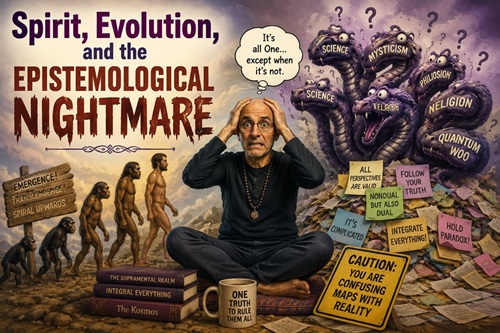
Energy or Eros? Eros vs. Natural Selection The Evolution Controversy: Spirit, Evolution, and the Epistemological Nightmare The Reynolds-Visser Controversy Wilber's Neo-Perennialism Hegel, Schelling, Marx, Darwin—and Wilber Spirit, Evolution, and the Epistemological NightmareFrank Visser / ChatGPT
There is a wonderfully compact philosophical landscape hidden in the long-running debate about evolution on Integral World. Four positions can almost be placed next to each other like signposts marking different stages of an increasingly complicated metaphysical journey:
At first sight these might seem like four variations on essentially the same integral worldview. But they actually represent very different answers to a more fundamental question: what exactly do we mean by “Spirit,” how could we know that it exists, and what explanatory work is it supposed to perform? Once those questions are asked explicitly, the apparent simplicity of the debate begins to dissolve. We discover that the real disagreement is not merely about evolution. It is about epistemology—about what counts as knowledge, what counts as explanation, and when we are entitled to move from an observed phenomenon to an ontological conclusion about the nature of reality. That is where the fun begins. The word “Spirit” does an extraordinary amount of workWilber's evolutionary philosophy starts from a powerful intuition: evolution does not look like a random walk through possibility space. It has generated increasingly elaborate forms of organization, eventually producing nervous systems, brains, language, self-reflection and apparently conscious beings capable of contemplating the universe that produced them. Wilber takes this remarkable history as evidence for something deeper than the mechanisms described by evolutionary biology. His preferred term is Eros: an intrinsic evolutionary impulse toward greater complexity, consciousness, depth and interiority. The important point is that this is not simply a poetic description of evolution. Wilber has repeatedly treated Eros or Spirit as something ontologically real, even as a “force” within the Kosmos. The universe is therefore not merely undergoing evolutionary change; it possesses an inherent tendency toward higher forms. Evolution is, in this picture, not simply what organisms do under particular ecological and historical circumstances. It is part of a much larger cosmic movement toward greater consciousness and realization. This is a perfectly legitimate metaphysical proposal. The problem begins when the proposal is presented as though the scientific facts of evolution themselves establish it. Evolution undoubtedly produces extraordinary novelty and complexity. But creativity is not itself evidence for a creative force. A process can generate remarkable outcomes without containing an intention to generate those outcomes. Natural selection does not need to “want” complexity in order to produce complexity, just as gravity does not need to “want” planets in order to produce planetary orbits. The distinction is easy to state but surprisingly difficult to maintain in integral discussions: an observed tendency is not automatically evidence for an underlying agency. We observe the historical outcome and then infer a force that supposedly produced the outcome. But unless that force makes some additional explanatory contribution, we have not necessarily discovered a mechanism. We may simply have given the outcome a metaphysical interpretation. Reynolds: Spirit is everythingBrad Reynolds pushes the metaphysical argument in another direction. If Spirit is not merely a force acting within the universe but is, in some sense, everything, then we no longer have to imagine Spirit as something pushing matter from behind the scenes. Matter itself becomes an expression of Spirit. Life is Spirit. Consciousness is Spirit. Evolution is Spirit unfolding through form. This is philosophically more sophisticated than the picture of a supernatural force interfering with Darwinian processes. It brings the integral position closer to forms of idealism, panpsychism, cosmopsychism and nondual metaphysics. There is no need for Spirit to reach down from some transcendent realm and manipulate mutations or selection pressures. Spirit is already immanent in everything. But a new epistemological problem immediately appears. If Spirit is everything, then what possible observation could count against the proposition? Bacteria are Spirit. Humans are Spirit. Stars are Spirit. Natural selection is Spirit. Consciousness is Spirit. The absence of consciousness would presumably also have to be some expression of Spirit. Whatever we discover, therefore, can be incorporated into the theory. But this creates an uncomfortable possibility: a proposition that accommodates every conceivable observation may have enormous metaphysical scope while having very little explanatory specificity. “Everything is Spirit” may be a coherent ontological interpretation of reality. But it does not by itself explain why a particular mutation spreads through a population, why one species becomes extinct, why another survives, why developmental pathways constrain evolutionary possibilities, or why a particular ecological transition occurs. Those questions require mechanisms. Calling the whole process Spirit does not automatically provide them. The crucial distinction is between saying what everything ultimately is and explaining how something happens. Integral discourse often slides between those two questions without noticing the change. Alderman's more modest solutionBruce Alderman's suggestion that Spirit has its own domain offers a potentially more fruitful escape. Instead of making Spirit compete directly with evolutionary biology, one can argue that reality can legitimately be approached through different domains or modes of inquiry. Biology investigates organisms from a third-person perspective. Psychology investigates behavior and mental processes. Sociology investigates social structures and cultural patterns. Phenomenology investigates lived experience. Contemplative traditions investigate particular forms of consciousness. On this view, Spirit does not have to be another biological mechanism. It belongs to a different domain of inquiry. Darwinian evolution can explain adaptation without having to explain away mystical experience, while spiritual practice can investigate unusual or transformative states of consciousness without pretending to replace population genetics. This move has considerable merit because it prevents a needless scientific turf war. There is no reason to demand that evolutionary biology answer every question that human beings can ask about existence. But the epistemological problem has merely moved one level upward. If Spirit constitutes a genuinely distinct domain of reality, how do we know that? And how do we distinguish the existence of such a domain from the existence of particular human experiences that have been interpreted spiritually? That distinction is crucial. Someone may have an overwhelming experience of unity, transcendence or nonduality. The experience is real as an experience. But the proposition that “ultimate reality is Spirit” is not identical to the experience itself. The first is a phenomenological statement; the second is a metaphysical interpretation. The gap between the two may be small in the lived experience of a mystic. Epistemologically, however, it is enormous. And then comes the heretical fourth positionThis is where the deliberately provocative Visserian position enters: Spirit is not needed. That statement is frequently misunderstood as a crude materialist declaration. It is nothing of the sort. It does not say that spirituality is meaningless, that mystical experiences are unreal, that consciousness is unimportant, or that metaphysical idealism is impossible. It says something considerably narrower: the existence of biological evolution does not require us to posit an evolutionary force called Spirit. That is an important distinction. Natural selection does not explain everything about reality. But it explains a great deal about biological adaptation without requiring cosmic intentionality. Mutation does not require a purpose. Selection does not require foresight. Complexity does not require a cosmic desire to become complex. And the fact that consciousness eventually appeared does not, by itself, demonstrate that evolution was striving toward consciousness from the beginning. The point is not that Spirit has been disproved. The point is that it has not been demonstrated to be necessary. This distinction between ontological possibility and explanatory necessity is perhaps the most important one in the entire debate. Spirit might exist. But the mere fact that evolution is remarkable does not establish that it does. Why “why?” causes so much troubleA surprising amount of integral confusion disappears once we notice that the word “why” can mean several entirely different things. Why did this particular organism survive? That is a biological question. Why does consciousness exist? That takes us into evolutionary biology, neuroscience and philosophy of mind. Why does anything exist at all? Now we are doing metaphysics. Why does existence have meaning? That is an existential and axiological question. Why do contemplative practices produce certain transformations in consciousness? That is partly a phenomenological and psychological question. These are all legitimate questions. The mistake is to turn them into one giant question called Evolution and then demand that evolutionary theory provide the answer to all of them. This is precisely what happens when biological evolution becomes the central organizing narrative of an integral cosmology. Biology is asked to explain consciousness; consciousness is taken as evidence for Spirit; Spirit is projected backwards into cosmic history; cosmic history is then interpreted as evidence that evolution possesses direction; and that direction is used to argue that Darwinian explanations must be incomplete. The reasoning becomes circular. Evolution produces consciousness, therefore evolution must have been directed toward consciousness. Evolution was directed toward consciousness, therefore Spirit must have been present in evolution. Spirit was present in evolution, therefore the emergence of consciousness confirms the spiritual nature of evolution. At each stage the interpretation is fed back into the observation from which it was supposedly derived. The real problem is epistemologicalThe deepest problem, then, is not whether Spirit exists. It is the failure to distinguish different epistemic registers. Scientific claims are constrained by observation, experiment, mathematical modeling, prediction and intersubjective replication. Phenomenological claims are constrained by disciplined first-person investigation and comparative analysis of experience. Philosophical claims are assessed through conceptual clarity, argument and coherence. Metaphysical claims concern ultimate ontology and therefore cannot simply borrow the evidential authority of science. Spiritual claims are particularly complicated because they often begin with genuine experiences but end with very strong ontological conclusions. Consider the progression. Someone experiences profound nonduality. That experience is real as an experience. The person concludes that consciousness is fundamental. That is already an interpretation. The person then concludes that consciousness therefore existed before matter. That is a stronger metaphysical proposition. Finally, the person concludes that evolution is driven by Spirit toward greater consciousness. That is stronger still. Nothing in the original experience automatically guarantees the truth of the final proposition. This is not an argument against mystical experience. It is an argument for epistemological hygiene. The explanatory surplus problemThe most powerful criticism of Wilber's evolutionary Eros may therefore be surprisingly simple: What does it explain that the existing evolutionary framework cannot explain? Suppose a population acquires a trait because genetic variation, inheritance, developmental constraints, ecological circumstances and differential reproductive success cause that trait to spread. We have an evolutionary explanation. Now add Spirit. Did Spirit produce the mutation? If so, how? Did it alter the selection pressure? Did it somehow bias the reproductive process? If so, what evidence would reveal this? Does it make predictions that differ from standard evolutionary theory? If the answer to all of these questions is no, then Spirit has not become an evolutionary mechanism. It has become a metaphysical interpretation layered on top of the mechanism. That does not make it meaningless. It does, however, make it unnecessary as an explanation of the evolutionary process. This is why the phrase explanatory surplus is useful. A concept can be philosophically interesting while being scientifically redundant. There is no contradiction in saying that Spirit might have metaphysical significance while simultaneously saying that biology does not need it. The danger of filling gaps with metaphysicsThere is another recurring problem here: the tendency to mistake an explanatory gap for evidence in favor of one's preferred metaphysics. Evolution is astonishing. Therefore Spirit. Consciousness is mysterious. Therefore Spirit. The origin of life is unresolved. Therefore Spirit. The universe is strange. Therefore Spirit. But mystery has no preferred metaphysical direction. An unanswered question is simply an unanswered question. It does not come pre-filled with Wilber's Kosmos. This is particularly important because scientific explanations are almost always incomplete. Science does not need to provide an ultimate explanation of everything in order to provide a successful explanation of something. The fact that evolutionary biology leaves deeper philosophical questions unanswered is not evidence that those questions have already been answered by integral metaphysics. An incomplete explanation is not automatically evidence for one's favorite alternative explanation. A way out of the nightmareThere is, fortunately, a way out. We do not need to choose between an aggressively reductionist materialism and an all-encompassing spiritual cosmology. What we need is a disciplined form of explanatory pluralism. Biology should explain biological evolution. Developmental biology should investigate the constraints imposed by development. Ecology should investigate organism-environment interactions. Neuroscience should investigate the biological basis of cognition and consciousness. Psychology should investigate mental development and transformation. Sociology should investigate cultural evolution. Phenomenology should investigate lived experience. Contemplative traditions can contribute to the investigation of unusual and transformative states of consciousness. Philosophy can examine the conceptual and ontological implications of all these findings. And metaphysics can speculate about the ultimate nature of reality—but should clearly identify speculation as speculation. This does not diminish the importance of any of these domains. Quite the opposite. It prevents one domain from being asked to do work for which it was never designed. The corresponding principle could be stated very simply: Do not introduce an additional ontological entity merely because an existing explanation leaves deeper questions unanswered. Natural selection does not explain why there is something rather than nothing. Fine. That does not mean Spirit explains why there is something rather than nothing. Neuroscience does not yet explain consciousness completely. Fine. That does not mean Spirit explains consciousness. Evolutionary biology does not explain why human beings seek transcendence. Fine. That does not mean Spirit drove evolution toward transcendence. The missing explanation is not automatically evidence for a particular metaphysical explanation. So what becomes of Spirit?Interestingly, quite a lot survives once Spirit is relieved of the burden of being an evolutionary mechanism. Spirit can remain a powerful term for a family of human experiences and aspirations: transcendence, nonduality, sacredness, existential depth, compassion, self-transformation and the intuition that ordinary egoic consciousness does not exhaust human possibility. Those are real subjects of investigation, whether or not one accepts the metaphysical vocabulary traditionally attached to them. Spirit can even remain a metaphysical hypothesis. There is nothing intellectually illegitimate about asking whether consciousness is fundamental, whether reality possesses an irreducibly experiential dimension, or whether some form of idealism or cosmopsychism provides a better account of existence than materialism. But then we should call these what they are: metaphysical hypotheses. The crucial step is to stop pretending that the biological history of life has already established them. That modest change would actually make the spiritual position stronger. Instead of claiming that Darwinian evolution secretly proves Spirit, one could ask whether the totality of scientific, phenomenological and philosophical evidence supports a broader metaphysical interpretation of reality. That is a much more difficult question, but also a much more interesting one. A new map of the landscapeThe four positions can therefore be reconstructed in a more illuminating way. Wilber says that Spirit is causally active: evolution contains an intrinsic drive toward greater complexity, consciousness and realization. Reynolds says that Spirit is ontologically universal: everything is ultimately an expression or manifestation of Spirit. Alderman says that Spirit has its own domain: spiritual realities and experiences should not simply be reduced to the categories of physical science. Visser says that none of these propositions is required to explain biological evolution. Notice what the fourth position actually does. It does not logically disprove the first three. It simply changes the burden of proof. If Spirit is a force, show what it does. If Spirit is everything, explain what the proposition actually predicts or distinguishes. If Spirit constitutes a separate domain, show how that domain is identified and investigated. And if none of these questions can be answered satisfactorily, perhaps Spirit should remain a philosophical or spiritual interpretation rather than being smuggled into evolutionary biology as an additional causal mechanism. From metaphysical warfare to epistemic hygieneThis could transform the character of the Integral World debate. Instead of endlessly asking whether Darwinism is “too reductionistic” or whether Spirit is “really there,” we could ask much more precise questions. What phenomenon are we trying to explain? What evidence do we possess? What mechanism is being proposed? What does the proposed mechanism predict? What would distinguish the hypothesis from its competitors? Which claims belong to empirical science? Which belong to phenomenology? Which belong to philosophy? And which belong to metaphysical speculation? These questions may sound less grand than a cosmic theory of evolution. They are also far more productive. The alternative to integral metaphysics is therefore not necessarily crude materialism. It is epistemological pluralism disciplined by explanatory modesty. We can remain open to dimensions of reality that science has not settled without prematurely baptizing every unexplained phenomenon as Spirit. We can take mystical experience seriously without treating its metaphysical interpretation as established fact. We can admire evolution without converting it into a cosmic morality play. Most importantly, we can recognize that the universe has produced beings capable of wondering about Spirit without concluding that the universe therefore contained a Spirit-driven plan to produce them. Perhaps that is the real escape from the epistemological nightmare. We do not have to choose between “Spirit explains everything” and “nothing spiritual is real.” There is a much more interesting middle position: let every claim earn its epistemic status. Biology gets biology. Phenomenology gets phenomenology. Philosophy gets philosophy. Metaphysics gets metaphysics. And Spirit, if it wants a place at the table, should not be allowed to sneak into the kitchen and rearrange the evolutionary machinery before anyone has established that it is actually there.
Widget is loading comments...
|