|
TRANSLATE THIS ARTICLE
Integral World: Exploring Theories of Everything
An independent forum for a critical discussion of the integral philosophy of Ken Wilber
  Frank Visser, graduated as a psychologist of culture and religion, founded IntegralWorld in 1997. He worked as production manager for various publishing houses and as service manager for various internet companies and lives in Amsterdam. Books: Ken Wilber: Thought as Passion (SUNY, 2003), and The Corona Conspiracy: Combatting Disinformation about the Coronavirus (Kindle, 2020). Frank Visser, graduated as a psychologist of culture and religion, founded IntegralWorld in 1997. He worked as production manager for various publishing houses and as service manager for various internet companies and lives in Amsterdam. Books: Ken Wilber: Thought as Passion (SUNY, 2003), and The Corona Conspiracy: Combatting Disinformation about the Coronavirus (Kindle, 2020).
Check out my other conversations with ChatGPT
The Basic Problem:
Energy or Eros? Eros vs. Natural Selection The Evolution Controversy: Spirit, Evolution, and the Epistemological Nightmare The Reynolds-Visser Controversy Wilber's Neo-Perennialism Hegel, Schelling, Marx, Darwin—and Wilber Energy or Eros?Why Integral Theory Invents a Cosmic Drive That Science Doesn't NeedFrank Visser / ChatGPT
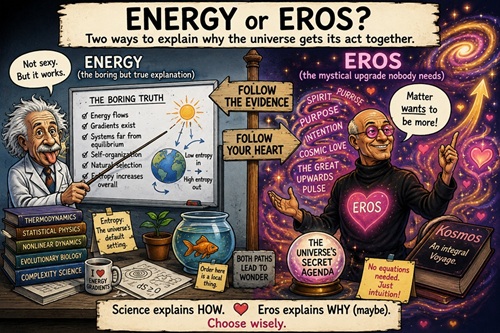
One of Ken Wilber's favorite rhetorical flourishes is his declaration that "the universe isn't winding down—that's ridiculous! It's winding UP!" It is a memorable line, perfectly crafted to challenge what he sees as the bleak worldview of modern science. Instead of a cosmos condemned to decay, Wilber presents a universe animated by Eros: an intrinsic drive toward greater complexity, consciousness, and ultimately Spirit. It is an inspiring vision. It is also unnecessary. Modern science already has a powerful explanation for why complexity arises. It does not require an additional cosmic principle pushing evolution upward. The real disagreement is therefore not between entropy and complexity, but between two radically different ways of explaining complexity itself. The False ChoiceIntegral presentations often invite us to choose between two pictures of reality. On one side stands conventional science, allegedly teaching that the universe is simply winding down toward maximum entropy. On the other stands Integral Theory, proclaiming that evolution is actually winding upward toward increasing consciousness. It is an appealing contrast, but it is also a false one. Physics has never denied that complexity increases locally. Indeed, modern thermodynamics, complexity theory, systems biology, and evolutionary science are largely devoted to understanding how remarkable forms of order emerge from seemingly simple beginnings. Scientists do not dispute the existence of complexity. They seek to explain it. The real question has never been whether evolution produces novelty. It plainly does. The real question is why. The Scientific AnswerThe scientific explanation begins with a fact that is almost too obvious to notice: the Earth is not a closed system. Every second our planet receives an enormous influx of low-entropy energy from the Sun while simultaneously radiating higher-entropy heat back into space. This continual throughput of energy keeps the Earth far from thermodynamic equilibrium. Under precisely such conditions, matter often organizes itself into increasingly complex structures. Convection cells appear spontaneously in heated fluids. Snowflakes crystallize from water vapor. Hurricanes organize themselves from atmospheric energy flows. Chemical reactions become self-sustaining. Living cells emerge. Evolution explores ever more elaborate ecological possibilities. None of these developments contradict the Second Law of Thermodynamics. Quite the opposite. They occur because the Second Law is operating. The increasing entropy of the Sun creates the energy gradients that make local increases in order possible on Earth. Complexity is not an exception to thermodynamics. It is one of thermodynamics' most remarkable consequences. Entropy Is the Rule, Complexity the ExceptionThis point is often blurred in popular discussions, including Wilber's. Entropy is universal.
Entropy is the rule.
Every tree that grows, every bird that flies, every human brain that thinks owes its existence to the continual degradation of energy elsewhere. Living organisms maintain their internal order only by exporting greater disorder into their surroundings. As Erwin Schrödinger explained in What Is Life?, organisms survive by exploiting energy gradients while increasing the total entropy of the larger system. This is why the common opposition between entropy and evolution is misleading. Complexity does not compete with entropy. It depends upon it. One sometimes hears a more moderate formulation, even among integral thinkers, that "the universe is both winding down and winding up." This is certainly closer to the scientific picture than Wilber's famous dismissal of entropy. But even this formulation suggests a symmetry that does not exist. The universe is not governed by two equal and opposite principles, entropy and complexity. Complexity is not a cosmic force balancing entropy. It is a local, contingent consequence of entropy operating in open systems sustained by continuous energy flows. That asymmetry is fundamental. Wilber's Different ExplanationWilber tells a different story. Instead of asking how energy flow generates complexity, he asks why matter repeatedly organizes itself into higher forms. His answer is Eros: an intrinsic drive toward greater complexity and consciousness built into the fabric of reality itself. His well-known illustration captures this perfectly. Put matter in a closed box, he says, and it runs down because you are not giving it room to do what it "really wants to do." That final phrase changes everything. A physicist would explain the behavior of the closed box by pointing out that energy can no longer flow through the system. Wilber explains it by attributing an intrinsic tendency to matter itself. Matter "wants" to become more organized. The box frustrates that natural impulse. These are not two ways of saying the same thing. They are entirely different explanations. The first appeals to energy gradients, nonlinear dynamics, chemistry, and natural selection. The second appeals to an immanent purposiveness woven into reality. Why Eros Becomes NecessaryThis, I believe, explains why Wilber introduces Eros in the first place. Because he largely overlooks the explanatory role of energy flow, increasing complexity continues to appear mysterious. Why should matter ever organize itself into galaxies, living cells, nervous systems, and civilizations? Surely something must be pulling evolution upward. Enter Eros. But once open-system thermodynamics is taken seriously, the mystery largely disappears. Energy gradients, far-from-equilibrium dynamics, self-organization, and natural selection already explain why local complexity emerges. There is no explanatory vacuum demanding an additional cosmic force. Wilber treats complexity as the phenomenon requiring explanation and invents Eros to explain it. Modern thermodynamics treats energy flow as the explanation. That makes Eros scientifically redundant. "Energy Is Eros"At this point many integral thinkers attempt a reconciliation. Energy itself, they suggest, is Eros. It is an attractive slogan. It is also an empty equation. Energy is one of the most precisely defined concepts in physics. It is measurable, conserved, mathematically describable, and experimentally testable. It performs work according to well-understood laws. Eros does none of these things. Eros is said to possess direction, creativity, intentionality, and a tendency toward higher forms. These are not physical properties. They are metaphysical ones. Simply renaming energy "Eros" explains nothing. One might equally decide that gravity is love or electromagnetism is compassion. Such metaphors may carry spiritual significance, but they add no explanatory value to science. The Retreat to MetaphorInterestingly, some recent defenders of Wilber appear to recognize this difficulty. They now concede that complexity science does not provide positive evidence for Eros and that expressions such as "matter wants to..." exceed what physics can justify. This is an important clarification. It acknowledges that Prigogine, Kauffman, and complexity theory do not demonstrate a cosmic interior drive. They explain how increasing complexity emerges under appropriate physical conditions. But once these mechanisms are allowed to do the explanatory work assigned to them by science, Eros quietly retreats from science into metaphysics. It becomes an interpretation rather than an explanation. There is nothing illegitimate about metaphysical interpretation. Human beings have always sought deeper meanings behind the workings of nature. The mistake arises only when those interpretations are presented as though science itself had discovered them. Science Doesn't Need ErosNone of this diminishes the wonder of evolution. If anything, the scientific story is even more astonishing. Stars forge the elements from which planets are formed. Energy streaming across those planets gives rise to chemistry. Chemistry becomes biology. Natural selection generates adaptation. Brains evolve. Consciousness emerges. Culture transforms the world. No hidden cosmic intention needs to be inserted into this story. Its creativity arises from the lawful interaction of matter, energy, and time. This is precisely why scientists such as Prigogine, Stuart Kauffman, Nick Lane, Jeremy England, and many others never conclude that complexity demonstrates an immanent spiritual force. They regard increasing complexity as an emergent consequence of physical processes, not as evidence for cosmic purpose. Conclusion: Explanations MatterThe genuine disagreement is therefore not whether complexity exists. Everyone agrees that it does. Nor is it whether evolution has produced astonishing novelty. The disagreement concerns explanation. Science explains increasing complexity through energy gradients acting within the laws of physics, chemistry, and biology. Wilber explains it through Eros. That is the real divide. Once the explanatory role of energy flow is fully appreciated, Eros ceases to function as a scientific hypothesis. It becomes what it always was: a metaphysical interpretation layered upon an already adequate scientific account. There is nothing wrong with metaphysical interpretations, provided they are recognized as such. But they should not be presented as though they complete an otherwise inadequate science. Science does not lack an explanation for increasing complexity. Wilber thought it did. That, perhaps more than anything else, explains why he felt compelled to invent Eros.
Widget is loading comments...
|