|
TRANSLATE THIS ARTICLE
Integral World: Exploring Theories of Everything
An independent forum for a critical discussion of the integral philosophy of Ken Wilber
  Frank Visser, graduated as a psychologist of culture and religion, founded IntegralWorld in 1997. He worked as production manager for various publishing houses and as service manager for various internet companies and lives in Amsterdam. Books: Ken Wilber: Thought as Passion (SUNY, 2003), and The Corona Conspiracy: Combatting Disinformation about the Coronavirus (Kindle, 2020). Frank Visser, graduated as a psychologist of culture and religion, founded IntegralWorld in 1997. He worked as production manager for various publishing houses and as service manager for various internet companies and lives in Amsterdam. Books: Ken Wilber: Thought as Passion (SUNY, 2003), and The Corona Conspiracy: Combatting Disinformation about the Coronavirus (Kindle, 2020).
Check out my other conversations with ChatGPT
CONTROVERSIAL COVID EXPERTS: Shi Zhengli: the Bat Woman Christian Drosten: the PCR Test Marion Koopmans: the Lab Leak Peter Daszak: Gain-of-Function Research Ron Fouchier: Creating a Dangerous Virus Robert Garry: On Scientific Certainty Robert GarryAnd the Politics of Scientific CertaintyThe Virologist Who Helped Define the Origin StoryFrank Visser / ChatGPT
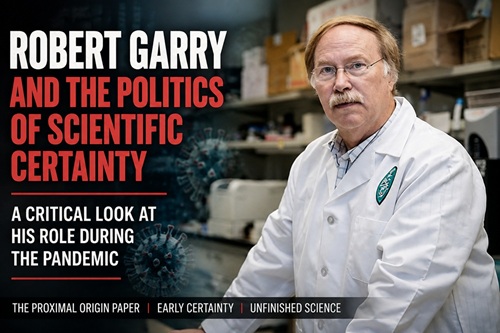
Few scientists became as closely associated with the early public narrative about the origins of COVID-19 as Robert F. Garry. A professor of microbiology and immunology at Tulane University and an experienced virologist whose work has included Ebola, Lassa fever, Marburg virus, and other pathogens, Garry was not an outsider wandering into the origin debate. He was a serious scientist with decades of experience in virology and emerging infectious diseases. Precisely for that reason, his role in the SARS-CoV-2 origin controversy deserves careful scrutiny. Garry's importance rests above all on his participation in the small group of scientists who produced The Proximal Origin of SARS-CoV-2, published in Nature Medicine in March 2020. Co-authored with Kristian Andersen, Andrew Rambaut, Edward Holmes, and Ian Lipkin, the paper became one of the most influential scientific publications of the pandemic. Its central argument was that the genetic structure of SARS-CoV-2 did not bear the hallmarks expected of a deliberately engineered virus and that a laboratory-based scenario was therefore implausible. Garry was one of the five authors, and his affiliation with Tulane and Zalgen Labs gave the paper considerable scientific credibility. There was nothing inherently unreasonable about publishing such an analysis. The problem is not that Garry and his colleagues considered a natural origin more likely. The problem is the extraordinary degree of certainty that rapidly became attached to their conclusion, especially when the underlying evidence was still sparse and the distinction between "not genetically engineered" and "not leaked from a laboratory" was easily blurred. That distinction would become central to the controversy. From "Not Engineered" to "Not a Lab Leak"The most important criticism of Garry's role is not that he was wrong to reject the idea that SARS-CoV-2 was a deliberately constructed biological weapon. There was, and remains, little convincing evidence that the virus was purpose-built as a weapon. Nor is there compelling evidence that the virus was assembled through some crude form of genetic engineering. But a laboratory origin is a much broader proposition. A virus can emerge naturally in animals, be collected by researchers, studied in a laboratory, and subsequently escape through an accident. It can also be adapted through serial passage or other experimental procedures without leaving the kind of obvious genetic fingerprints that conventional genetic engineering might leave. The question "Was SARS-CoV-2 engineered?" is therefore not identical to the question "Could SARS-CoV-2 have been associated with laboratory research?" Yet the public impact of Proximal Origin was considerably broader than its narrowest genetic claims. Its conclusion that "we do not believe that any type of laboratory-based scenario is plausible" became a foundational statement in the emerging public consensus. The paper was frequently treated as if it had demonstrated a natural origin, when in reality it primarily argued against particular mechanisms of artificial construction. This distinction matters because the scientific evidence available in early 2020 did not permit anyone to reconstruct the full history of SARS-CoV-2. The authors could analyze the genome they had. They could compare it with known coronaviruses. They could assess whether specific features looked engineered. But they did not have access to the complete universe of viruses that might have been held in Chinese laboratories, nor to laboratory notebooks, databases, unpublished sequences, or comprehensive records of research activities in Wuhan. Genomic analysis can tell us a great deal. It cannot, by itself, tell us whether an unknown virus was present in a laboratory before the pandemic. The Problem of the Early EmailsThe later release of correspondence surrounding the production of Proximal Origin complicated the simple public narrative. The early discussions among Andersen, Garry, Holmes, and others show that the scientists initially considered the possibility of a laboratory-associated origin seriously. They were confronted with a novel virus emerging in Wuhan, a city that was home to a major coronavirus research center, at a moment when the scientific community knew relatively little about the virus's evolutionary history. This is not evidence of a cover-up. Scientists are supposed to entertain competing hypotheses when confronted with an unexplained event. Indeed, the fact that Garry and his colleagues initially discussed laboratory scenarios is entirely compatible with normal scientific reasoning. But it does create an important epistemic question: how did a hypothesis that was sufficiently plausible to warrant urgent private investigation become publicly characterized as essentially implausible within a matter of weeks? That transition deserves examination. The released correspondence shows scientists wrestling with the unusual genomic features of SARS-CoV-2 and considering whether they were compatible with natural evolution. The eventual paper, however, presented a much cleaner and more decisive conclusion. The scientific process is often messy, and published papers necessarily compress uncertainty. Yet in this case the compression had enormous consequences. Proximal Origin did not merely contribute to a scientific discussion; it helped establish the boundaries of acceptable public discourse. The laboratory-origin hypothesis subsequently became associated, in many public discussions, with conspiracy theories, political extremism, or anti-scientific thinking. This was an unfortunate development. A hypothesis can be weak without being absurd. And an accidental laboratory escape is not remotely the same proposition as a claim that SARS-CoV-2 was deliberately created as a biological weapon. Garry and his colleagues cannot be held responsible for every excess committed by journalists, politicians, or social-media commentators. But their early paper contributed to a climate in which these distinctions were often lost. The Missing Evidence ProblemThe central weakness in Garry's position is therefore not necessarily the conclusion itself but the confidence with which it was expressed. The natural-origin hypothesis has genuine supporting evidence. The spatial concentration of early cases around the Huanan market, the later analyses of environmental samples, and the presence of susceptible wildlife in the market provide reasons to take zoonotic emergence seriously. Some evolutionary analyses have argued that the early distribution of viral lineages is consistent with multiple spillover events associated with the market. A 2023 Journal of Virology analysis likewise concluded that the available scientific evidence favored a zoonotic origin, while acknowledging that some alternative hypotheses could not be definitively ruled out. But this is different from saying that natural origin has been conclusively demonstrated. The uncomfortable fact is that the definitive intermediate animal host has never been identified. No direct ancestral virus has been recovered from the market. The chain of transmission from an ancestral bat coronavirus to the first human cases remains incomplete. At the same time, the Chinese government's restrictions on access to relevant laboratory and epidemiological data have prevented an exhaustive investigation of the alternative hypothesis. Even years later, the origin remains officially unresolved, with different scientific and intelligence assessments assigning different probabilities to the competing scenarios. This is precisely where Garry's early certainty becomes problematic. Science is not simply a contest between the hypothesis that has the most evidence and the hypothesis that has none. It is also about recognizing the limits of available evidence. If one hypothesis has circumstantial evidence pointing toward it and the competing hypothesis also has circumstantial evidence, the responsible position is not necessarily to declare one "implausible" but to state clearly what is known, what is inferred, and what remains unknown. The origin debate became so polarized partly because scientists and their critics repeatedly conflated these levels. Garry's Later Public RoleGarry did not disappear after Proximal Origin. He became one of the most visible scientific defenders of the natural-origin interpretation and subsequently participated in congressional scrutiny of the origins debate. In July 2023, Garry appeared before the U.S. House Select Subcommittee on the Coronavirus Pandemic alongside Kristian Andersen in a hearing explicitly devoted to investigating the origins of the Proximal Origin paper. The very existence of such a hearing demonstrated how far the controversy had evolved: the paper was no longer merely a scientific publication but an object of political and institutional investigation. In June 2024, Garry again testified before the Senate Homeland Security and Governmental Affairs Committee at a hearing examining the available evidence on COVID-19 origins. He appeared alongside scientists holding sharply different views, including Richard Ebright and Steven Quay. Garry continued to defend the natural-origin interpretation, while the hearing illustrated just how unresolved the question had become. There is something admirable in Garry's willingness to defend his scientific judgment publicly. Scientists should not retreat from controversial conclusions merely because those conclusions have become politically inconvenient. But the reverse is also true: scientific authority should not become a substitute for evidence. Garry's position has sometimes seemed to carry an implicit message that because he is an experienced virologist and because he participated in the original analysis, his interpretation deserves special deference. That is understandable psychologically, but it is not how science should work. Expertise matters enormously, but experts can also become invested in their earlier conclusions. The longer a scientist publicly defends a position, the more difficult it can become to acknowledge that the evidentiary landscape has changed. The Furin Cleavage Site and the Limits of Genomic InferenceThe furin cleavage site has become the most famous molecular feature in the origin controversy, although its significance has frequently been exaggerated by both sides. The presence of a furin cleavage site in SARS-CoV-2 does not prove laboratory manipulation. Coronaviruses can acquire such features through natural evolutionary processes, and the mere presence of the site is therefore not a smoking gun. But the opposite argument is equally problematic. Demonstrating that a feature could evolve naturally does not demonstrate that it did evolve naturally in this particular case. That distinction is fundamental. The question is not whether natural evolution can produce a furin cleavage site. It plainly can. The question is whether the totality of the genomic, epidemiological, ecological, and laboratory evidence makes a natural emergence more likely than a research-associated accident. The answer to that question cannot be obtained by pointing to one genomic feature and declaring the case closed. The same applies to the entire logic of Proximal Origin. Showing that the genome does not look like the product of a known genetic-engineering method is valuable evidence against deliberate construction. But it does not eliminate every possible laboratory scenario. The danger is that a negative finding can be rhetorically transformed into a positive conclusion. "We found no evidence of engineering" quietly becomes "therefore it came from nature." That is not a valid logical inference. The Real Lesson of Robert GarryRobert Garry's role during the pandemic is therefore more complicated than either his defenders or his fiercest critics usually acknowledge. He was not a fraud. He was not an irrelevant outsider. He was an experienced virologist who participated in an important early scientific analysis at a moment when the world desperately needed answers. His contribution to understanding viral genomes and emerging infectious diseases is real. Nor is there evidence that Proximal Origin was simply fabricated to protect Anthony Fauci, the NIH, or the Wuhan Institute of Virology. The scientific reasoning behind the paper was genuine, and many qualified scientists continue to believe that the evidence favors a zoonotic origin. Indeed, the subsequent literature has produced substantial arguments supporting natural emergence. But it is equally difficult to defend the idea that the paper settled the question. The most serious criticism of Garry and his colleagues is that they helped create an atmosphere of premature closure. Their conclusion became more definitive in the public sphere than the evidence justified. A scientific hypothesis that deserved investigation was too quickly transformed into a proposition that was treated as virtually discredited. The distinction between "not engineered" and "not a laboratory accident" was insufficiently emphasized. And the fact that the evidence was incomplete was overshadowed by the authority of the scientists making the pronouncement. That is an important lesson for science in a crisis. Experts have enormous influence when society is frightened and information is scarce. Their responsibility is therefore not merely to reach the best conclusion they can, but to communicate the uncertainty surrounding that conclusion. The public deserves to know not only what scientists think is most likely, but also what they do not know and what evidence could change their minds. Garry's subsequent defense of the natural-origin hypothesis may ultimately prove correct. The available scientific literature continues to give serious weight to zoonotic emergence, and several analyses have argued that the market evidence is more consistent with such an origin than with a laboratory accident. But correctness in the end does not retroactively justify excessive certainty at the beginning. The history of COVID-19 will not be judged only by whether SARS-CoV-2 came from an animal or a laboratory. It will also be judged by how scientists handled uncertainty when the answer was not yet known. Robert Garry occupies an important place in that history because he was simultaneously a participant in the scientific investigation and one of the scientists whose conclusions helped shape the boundaries of the investigation itself. That is the paradox at the heart of his pandemic role. He helped investigate the origin question—but he also helped close it down. And when the evidence is incomplete, the difference between those two things matters enormously.
Widget is loading comments...
|