|
TRANSLATE THIS ARTICLE
Integral World: Exploring Theories of Everything
An independent forum for a critical discussion of the integral philosophy of Ken Wilber
  Frank Visser, graduated as a psychologist of culture and religion, founded IntegralWorld in 1997. He worked as production manager for various publishing houses and as service manager for various internet companies and lives in Amsterdam. Books: Ken Wilber: Thought as Passion (SUNY, 2003), and The Corona Conspiracy: Combatting Disinformation about the Coronavirus (Kindle, 2020). Frank Visser, graduated as a psychologist of culture and religion, founded IntegralWorld in 1997. He worked as production manager for various publishing houses and as service manager for various internet companies and lives in Amsterdam. Books: Ken Wilber: Thought as Passion (SUNY, 2003), and The Corona Conspiracy: Combatting Disinformation about the Coronavirus (Kindle, 2020).
Check out my other conversations with ChatGPT
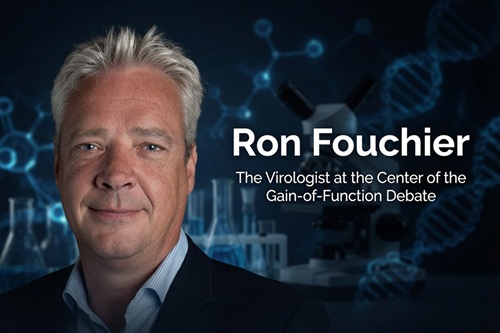
CONTROVERSIAL COVID EXPERTS: Shi Zhengli: the Bat Woman Christian Drosten: the PCR Test Marion Koopmans: the Lab Leak Peter Daszak: Gain-of-Function Research Ron Fouchier: Creating a Dangerous Virus Robert Garry: On Scientific Certainty Ron FouchierThe Virologist at the Center of the Gain-of-Function DebateFrank Visser / ChatGPT
IntroductionFew virologists have become as internationally controversial as Ron Fouchier. A leading influenza researcher at Erasmus MC in Rotterdam, Fouchier earned worldwide recognition—and notoriety—for experiments that deliberately modified the H5N1 avian influenza virus to make it transmissible between ferrets, the standard animal model for human influenza transmission. Those experiments transformed an obscure scientific question into an international debate about biosafety, biosecurity, and the limits of scientific freedom. During the COVID-19 pandemic, Fouchier again found himself in the public spotlight. As a prominent advocate for virology research, he defended the scientific establishment against claims that gain-of-function research had caused the pandemic. Critics, however, argued that his own history made him an interested party in the debate. Whether regarded as a courageous scientist or an embodiment of excessive scientific risk-taking, Fouchier remains one of the defining figures in modern virology. Engineering a More Dangerous VirusFouchier's scientific reputation was established long before COVID-19. His laboratory specialized in influenza viruses, particularly the highly pathogenic H5N1 avian influenza virus. Although H5N1 kills a large proportion of infected humans, it historically spreads poorly between people. In 2011, Fouchier announced that his team had identified a small number of mutations that enabled H5N1 to spread through the air between ferrets. He famously described the resulting virus as "probably one of the most dangerous viruses you can make," a remark that immediately captured global attention. The work was intended to answer an important scientific question: how easily could H5N1 evolve into a pandemic virus? By forcing evolution in the laboratory, Fouchier hoped to identify mutations that public health agencies could monitor in nature. The experiment succeeded scientifically—but also ignited one of the largest biosecurity controversies in modern biology. The Gain-of-Function ControversyThe controversy centered not on whether the experiments worked, but whether they should ever have been performed. Supporters argued that the research offered several potential benefits: improving pandemic preparedness; identifying dangerous mutations before they emerge naturally; informing vaccine development; improving influenza surveillance. Critics questioned whether these promised benefits were realistic while emphasizing the potentially catastrophic consequences of an accidental laboratory release. They argued that creating pathogens with enhanced transmissibility represented an unacceptable global risk. The debate became so intense that the U.S. National Science Advisory Board for Biosecurity initially recommended that crucial methodological details be withheld from publication. After months of international discussion, the papers were eventually published largely in full, and researchers voluntarily paused similar work for a period. The episode fundamentally changed how governments regulate so-called dual-use research—science that can be used for both beneficial and harmful purposes. A Polarizing Public FigureFouchier never retreated from his position. He consistently argued that critics exaggerated the risks while underestimating the public-health value of the research. According to Fouchier, understanding how viruses adapt is essential if society wishes to stay ahead of future pandemics. Restricting such work, he argued, would leave humanity less prepared rather than safer. His critics remained unconvinced. Epidemiologists such as Marc Lipsitch and Alison Galvani argued that many of the claimed benefits could be achieved using safer experimental approaches that do not require engineering potentially pandemic pathogens. They questioned whether the knowledge gained justified even a tiny probability of accidental release. Importantly, this disagreement has never been purely scientific. It also reflects different philosophies of risk management. Fouchier tends to emphasize scientific preparedness; his critics emphasize catastrophic risk. COVID-19 and Renewed ScrutinyWhen COVID-19 emerged, the gain-of-function debate returned with unprecedented intensity. Although there is no established evidence that Fouchier or his laboratory had any involvement in SARS-CoV-2, his earlier H5N1 work became a touchstone in wider arguments about laboratory safety. Critics pointed to the 2011 experiments as evidence that the scientific community had already crossed dangerous ethical boundaries years before the pandemic. Supporters replied that the H5N1 studies had been openly debated, carefully regulated, and conducted precisely to improve pandemic preparedness—not to create biological weapons. Fouchier became an outspoken defender of mainstream virology during the COVID era. He rejected many claims surrounding the lab-leak debate, criticized what he regarded as misinformation, and maintained that virology research should not become a political scapegoat. This stance, however, did little to convince critics, who argued that leading virologists faced an inherent conflict of interest when evaluating research practices they had long defended. Scientific Achievement Versus Public TrustEven many scientists who support virology research acknowledge that the H5N1 controversy exposed weaknesses in how high-risk biological research is governed. One lesson was that laboratory biosafety cannot be treated as an internal matter for scientists alone. Research capable of creating pandemic-capable pathogens has societal consequences extending far beyond individual laboratories. Another lesson concerned transparency. The intense public reaction reflected not only fear of the experiments themselves but also concern that scientists appeared to be evaluating the risks of their own work with limited external oversight. Fouchier has generally argued that existing biosafety systems are robust and that professional scientists understand these risks better than outside critics. Yet the COVID pandemic fundamentally altered public attitudes. Confidence in expert self-regulation declined sharply, making calls for independent oversight considerably stronger than before. Communication StyleFouchier has often been described as outspoken and combative. His willingness to dismiss critics as misunderstanding the science has won admiration among supporters who appreciate his directness. Others believe this style has been counterproductive, reinforcing perceptions that parts of the virology community have been reluctant to engage seriously with legitimate ethical concerns. Scientific authority alone is often insufficient in controversies involving public risk. Trust also depends on openness, humility, and a willingness to acknowledge uncertainty. LegacyRon Fouchier's legacy will likely extend well beyond influenza research. Scientifically, his work substantially advanced understanding of how influenza viruses adapt to mammalian hosts. Even many critics acknowledge the technical brilliance of the experiments. Ethically and politically, however, his work became the defining case study in the risks of gain-of-function research. The controversy reshaped international discussions about dual-use science, laboratory biosafety, publication policy, and governmental oversight. Whether history ultimately views Fouchier as a visionary whose research improved pandemic preparedness or as a scientist who normalized unnecessary biological risks will depend partly on how future pandemics—and future laboratory accidents—are understood. One conclusion is already difficult to dispute: few individual scientists have done more to force society to confront the question of where scientific freedom should end and collective responsibility begin.
Widget is loading comments...
|