|
TRANSLATE THIS ARTICLE
Integral World: Exploring Theories of Everything
An independent forum for a critical discussion of the integral philosophy of Ken Wilber
  Frank Visser, graduated as a psychologist of culture and religion, founded IntegralWorld in 1997. He worked as production manager for various publishing houses and as service manager for various internet companies and lives in Amsterdam. Books: Ken Wilber: Thought as Passion (SUNY, 2003), and The Corona Conspiracy: Combatting Disinformation about the Coronavirus (Kindle, 2020). Frank Visser, graduated as a psychologist of culture and religion, founded IntegralWorld in 1997. He worked as production manager for various publishing houses and as service manager for various internet companies and lives in Amsterdam. Books: Ken Wilber: Thought as Passion (SUNY, 2003), and The Corona Conspiracy: Combatting Disinformation about the Coronavirus (Kindle, 2020).
Check out my other conversations with ChatGPT
CONTROVERSIAL COVID EXPERTS: Shi Zhengli: the Bat Woman Christian Drosten: the PCR Test Marion Koopmans: the Lab Leak Peter Daszak: Gain-of-Function Research Ron Fouchier: Creating a Dangerous Virus Robert Garry: On Scientific Certainty Marion KoopmansScience Under PressureThe Netherlands' Most Prominent Virologist and One of Its Most ControversialFrank Visser / ChatGPT
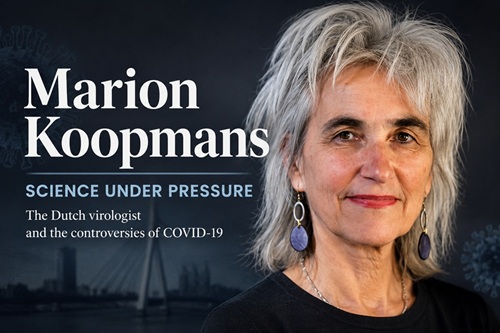
During the COVID-19 pandemic, few Dutch scientists became as publicly visible as Marion Koopmans. As a virologist at Erasmus MC in Rotterdam and a member of several influential advisory bodies, she emerged as one of the country's leading scientific voices. She appeared frequently in the media, advised governments, collaborated internationally, and participated in the World Health Organization's investigation into the origins of SARS-CoV-2. Yet with that visibility came intense criticism. To supporters, Koopmans represented evidence-based science under enormous political and public pressure. To critics, she embodied an overly close relationship between science, government, and public communication, raising questions about transparency, conflicts of interest, and scientific independence. Like many prominent figures during the pandemic, her reputation became deeply polarized. Understanding Marion Koopmans requires separating legitimate scientific disagreements from politically motivated accusations, while recognizing that some criticisms raise genuine questions about how science should function during a global crisis. A Career Built on Emerging VirusesLong before COVID-19, Koopmans had established herself as one of Europe's leading experts on emerging infectious diseases. Her research covered influenza, SARS, MERS, Ebola, and zoonotic spillovers—the transmission of viruses from animals to humans. This expertise made her an obvious choice when SARS-CoV-2 emerged in late 2019. Throughout the pandemic she served on the Dutch Outbreak Management Team (OMT), frequently explained developments to the public, and collaborated closely with international organizations. Her scientific credentials have rarely been questioned. The controversy has centered less on her virological expertise than on her public role and institutional positions. Science and Public CommunicationKoopmans became one of the most recognizable scientific faces on Dutch television. She explained infection rates, variants, vaccines, and public-health measures in accessible language. Many appreciated this visibility. During a rapidly evolving crisis, the public needed experts capable of communicating complex science clearly. Others, however, argued that repeated appearances by the same experts created the impression that scientific consensus was far stronger than it actually was. Science normally thrives on uncertainty, competing hypotheses, and continuous revision. Television interviews, by contrast, reward concise and confident statements. Critics felt that Koopmans sometimes appeared more as a spokesperson for government policy than as an independent scientist. Defenders responded that communicating evolving evidence during an emergency inevitably requires clear recommendations, even when uncertainty remains. The tension illustrates a broader dilemma: scientists advising governments may struggle to maintain a visible distinction between explaining evidence and defending policy. The WHO Mission to WuhanPerhaps the most internationally controversial episode of Koopmans' career was her participation in the WHO-China mission that investigated the origins of SARS-CoV-2 in early 2021. The mission concluded that a natural animal-to-human spillover remained the most likely explanation, while describing a laboratory accident as "extremely unlikely." That conclusion quickly became controversial. Critics argued that the investigation lacked sufficient independence because Chinese authorities tightly controlled access to data, personnel, and facilities. Several members of the WHO team later acknowledged that access had indeed been limited. Koopmans defended the mission as the best investigation that was politically possible under the circumstances. She emphasized that important scientific information had been gathered despite obvious constraints. As the lab-leak hypothesis gained increasing mainstream attention during 2021 and beyond, critics accused members of the WHO mission—including Koopmans—of dismissing alternative hypotheses too quickly. Supporters counter that the mission reflected the evidence available at the time rather than ideological commitment. Science necessarily updates conclusions as new information becomes available. The Lab-Leak DebateThe origin of COVID-19 has become one of the most contentious scientific questions of the twenty-first century. Koopmans consistently regarded zoonotic spillover as the more plausible explanation, based on previous coronavirus outbreaks and available epidemiological evidence. Her critics argue that she underestimated the significance of Wuhan's unique concentration of coronavirus research laboratories, biosafety questions, and the absence of an identified intermediate animal host. Some have suggested that leading virologists—including Koopmans—were reluctant to consider a laboratory accident because it could undermine public trust in virological research. Such claims remain speculative unless supported by concrete evidence. Conversely, defenders note that many scientists initially viewed natural spillover as the more parsimonious hypothesis because it resembled earlier outbreaks such as SARS in 2002 and MERS in 2012. Today, no definitive evidence has conclusively resolved the question. Both natural spillover and accidental laboratory release remain under discussion, although governments and intelligence agencies have reached differing assessments based on varying confidence levels. Gain-of-Function ResearchAnother recurring criticism concerns research on highly pathogenic viruses. Koopmans has defended carefully regulated experiments designed to understand viral evolution and pandemic risks. Critics argue that such research carries inherent biosafety dangers that may outweigh its scientific benefits. The broader debate extends far beyond Koopmans herself. It involves international disagreements about biosafety standards, oversight mechanisms, and acceptable levels of scientific risk. COVID-19 intensified these concerns dramatically. If even a small possibility exists that laboratory work contributed to the pandemic, public scrutiny of such research inevitably increases. Consensus Versus Scientific DebateOne of the more philosophical criticisms concerns the nature of scientific consensus. Throughout the pandemic, governments often emphasized "following the science." Yet science rarely speaks with one voice. Dissenting epidemiologists, statisticians, immunologists, and public-health experts sometimes argued that alternative strategies deserved greater consideration. Critics accused advisory structures like the Dutch OMT of becoming relatively homogeneous, limiting intellectual diversity. Whether this criticism fairly applies to Koopmans personally is difficult to establish. Advisory committees necessarily seek consensus to produce actionable recommendations. Nevertheless, the pandemic exposed an enduring challenge: governments need clear advice, whereas science advances through ongoing disagreement. Public Trust and PolarizationKoopmans also became a lightning rod for broader frustrations. For many citizens unhappy with lockdowns, mask mandates, vaccine campaigns, or school closures, prominent virologists became symbolic representatives of pandemic restrictions. Some criticism remained constructive and focused on scientific questions. Other attacks became personal, conspiratorial, or abusive. Like many public-facing scientists worldwide, Koopmans received threats and harassment that have no place in scientific or democratic debate. Distinguishing legitimate criticism from personal vilification is essential. Public scientists should expect rigorous scrutiny of their ideas but should not become targets of intimidation. Lessons Beyond One ScientistThe controversy surrounding Marion Koopmans ultimately reflects larger questions about science during emergencies. How independent can scientific advisers remain when working closely with governments? How should uncertainty be communicated without undermining public confidence? How should competing scientific perspectives be represented in advisory bodies? How much transparency is possible during rapidly evolving crises? These institutional questions extend far beyond any individual scientist. ConclusionMarion Koopmans remains one of Europe's most respected virologists, but also one of the most debated scientific figures to emerge from the COVID-19 pandemic. Her involvement in Dutch policymaking, public communication, the WHO's Wuhan mission, and debates over pandemic origins ensured that she occupied the intersection of science, politics, and public opinion. Some criticisms directed at her have relied on speculation or personal attacks rather than evidence. Others—particularly regarding transparency, the WHO investigation, advisory independence, and the communication of scientific uncertainty—raise important questions that deserve continued examination. The pandemic demonstrated that scientific expertise alone cannot resolve crises that also involve political judgment, ethical trade-offs, and public trust. Marion Koopmans' career illustrates both the indispensable role of scientific advisers and the difficulties they face when scientific authority becomes inseparable from political decision-making.
Widget is loading comments...
|