|
TRANSLATE THIS ARTICLE
Integral World: Exploring Theories of Everything
An independent forum for a critical discussion of the integral philosophy of Ken Wilber
  Frank Visser, graduated as a psychologist of culture and religion, founded IntegralWorld in 1997. He worked as production manager for various publishing houses and as service manager for various internet companies and lives in Amsterdam. Books: Ken Wilber: Thought as Passion (SUNY, 2003), and The Corona Conspiracy: Combatting Disinformation about the Coronavirus (Kindle, 2020). Frank Visser, graduated as a psychologist of culture and religion, founded IntegralWorld in 1997. He worked as production manager for various publishing houses and as service manager for various internet companies and lives in Amsterdam. Books: Ken Wilber: Thought as Passion (SUNY, 2003), and The Corona Conspiracy: Combatting Disinformation about the Coronavirus (Kindle, 2020).
Check out my other conversations with ChatGPT
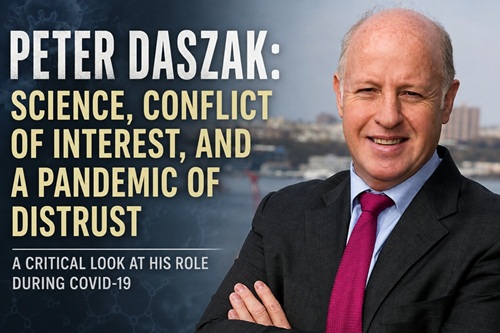
CONTROVERSIAL COVID EXPERTS: Shi Zhengli: the Bat Woman Christian Drosten: the PCR Test Marion Koopmans: the Lab Leak Peter Daszak: Gain-of-Function Research Ron Fouchier: Creating a Dangerous Virus Robert Garry: On Scientific Certainty Peter DaszakScience, Conflict of Interest, and the Crisis of TrustHow One Scientist Became a Symbol of the Pandemic's Transparency ProblemFrank Visser / ChatGPT
Peter Daszak is not a household name in the way Anthony Fauci or Christian Drosten became during the COVID-19 pandemic. Yet few scientists played a more consequential—and controversial—role in shaping the early public narrative about the origins of SARS-CoV-2. As president of the nonprofit organization EcoHealth Alliance, Daszak spent years funding research on bat coronaviruses in collaboration with the Wuhan Institute of Virology. When questions emerged about whether the pandemic might have resulted from a laboratory accident, he became one of the strongest advocates for dismissing that possibility. The controversy surrounding Daszak is not merely about whether the virus emerged naturally or from a laboratory. It concerns conflicts of interest, scientific transparency, and the responsibilities of researchers when investigating events in which they themselves may have had indirect involvement. His case illustrates how scientific credibility depends not only on expertise but also on openness and impartiality. Building EcoHealth AllianceBefore COVID-19, Daszak was widely respected in the field of zoonotic diseases—the study of pathogens that jump from animals to humans. His central argument was straightforward: by identifying dangerous viruses circulating in wildlife before they spill over into human populations, scientists could better prepare for future pandemics. EcoHealth Alliance received substantial funding from the U.S. government, particularly from the National Institutes of Health, to support international collaborations. One of its most important partners was the Wuhan Institute of Virology, where virologist Shi Zhengli had become internationally known for her extensive work on bat coronaviruses. These collaborations included collecting thousands of bat samples throughout China and sequencing numerous novel coronaviruses. Some projects also involved laboratory experiments designed to understand how these viruses might infect human cells. Although the precise scope of these experiments has remained disputed, the existence of extensive U.S.-Chinese collaborations later became central to debates over possible laboratory involvement. The Lancet StatementPerhaps Daszak's most controversial action occurred in February 2020. He organized and drafted a statement published in the prestigious medical journal The Lancet. The statement condemned what it described as "conspiracy theories" suggesting that COVID-19 did not have a natural origin. At the time, relatively little evidence existed regarding the pandemic's origins. Nevertheless, the statement projected remarkable certainty, asserting overwhelming scientific support for a natural spillover. What readers were not told was that Daszak himself had organized the statement while having longstanding professional relationships with the Wuhan Institute of Virology and its researchers. His role in coordinating the letter became public only later through released emails. Critics argued that the issue was not whether Daszak believed a natural origin to be most likely. Rather, they questioned whether someone with such direct institutional ties should have been orchestrating a declaration presented as an independent scientific consensus. The Lancet eventually added a conflict-of-interest disclosure regarding Daszak's involvement, though the journal never formally retracted the statement. WHO Origins InvestigationThe controversy deepened in early 2021 when the World Health Organization assembled an international team to investigate the pandemic's origins. Daszak was selected as one of the experts. To many observers, this appointment appeared problematic. EcoHealth Alliance had funded research at the very laboratory whose possible role was under investigation. From the standpoint of research ethics, even the appearance of a conflict of interest can undermine public confidence. Critics argued that investigators should be entirely independent of the institutions being examined. The WHO mission ultimately concluded that a laboratory accident was "extremely unlikely," while favoring natural spillover. Yet the investigation faced immediate criticism for limited access to raw laboratory records, restricted interviews, and heavy involvement of Chinese authorities. Even WHO Director-General Tedros Adhanom Ghebreyesus later stated that the laboratory hypothesis had been dismissed prematurely and called for additional investigations. Congressional ScrutinyAs more documents emerged through Freedom of Information Act requests and congressional investigations, Daszak's activities came under increasing scrutiny. Critics questioned whether EcoHealth Alliance had adequately monitored federally funded research conducted in Wuhan and whether reporting requirements had been fully satisfied. Several U.S. government agencies temporarily suspended or restricted federal funding to EcoHealth Alliance pending further review. Congressional hearings became highly polarized. Some critics portrayed Daszak as responsible for creating the pandemic—an accusation unsupported by available evidence. Others argued more narrowly that he had failed to disclose conflicts, resisted transparency, and helped shape an overly confident public narrative before sufficient evidence existed. These are importantly different claims. No conclusive evidence demonstrates that Daszak caused the pandemic. The central criticisms concern governance, oversight, and public communication rather than deliberate misconduct in creating SARS-CoV-2. Gain-of-Function DebateDaszak also became closely associated with the broader controversy over so-called gain-of-function research. The terminology itself remains contentious. Some experiments involved modifying viruses to understand which genetic changes might increase infectivity or host range, while researchers often preferred narrower technical definitions such as "enhanced potential pandemic pathogen" research. Supporters argue that such experiments improve pandemic preparedness by revealing future risks before they occur. Critics counter that creating more dangerous viruses—even for defensive purposes—introduces biosafety risks that may outweigh the scientific benefits. Daszak consistently defended this research as essential for public health. His critics saw this as further evidence that he had institutional incentives to minimize concerns about laboratory risks. The Trust ProblemPerhaps Daszak's greatest impact on the pandemic was neither scientific nor political but psychological. During the early months of COVID-19, many scientists understandably wished to counter unfounded conspiracy theories. However, by treating every laboratory-origin hypothesis as scientifically illegitimate rather than carefully distinguishing plausible scenarios from speculative claims, some scientific leaders inadvertently undermined public trust. As additional information emerged—including previously undisclosed collaborations, grant documents, internal communications, and recognition that a laboratory accident remained scientifically possible—many observers concluded that scientific institutions had appeared more concerned with protecting reputations than pursuing complete transparency. Daszak became the personification of that perception. A Balanced AssessmentPeter Daszak should not be caricatured as either a villain or a hero. His decades of work documenting emerging viruses have contributed substantially to our understanding of zoonotic disease ecology. His central warning—that increasing human contact with wildlife creates opportunities for new pandemics—remains well supported. At the same time, his handling of the origins debate revealed serious shortcomings. Organizing influential public statements without fully disclosing conflicts of interest, participating in investigations involving close collaborators, and projecting greater certainty than the available evidence justified all weakened confidence in scientific institutions. Ironically, attempts to defend science may have contributed to growing public skepticism toward science itself. ConclusionThe Peter Daszak controversy ultimately extends far beyond one scientist. It illustrates how modern science operates through complex international collaborations involving governments, funding agencies, universities, and nonprofit organizations. These networks generate remarkable advances but also create conflicts that become especially problematic during crises. The COVID-19 origins debate remains unresolved in many respects. Natural spillover continues to be regarded by many virologists as the leading explanation, while a laboratory accident remains a plausible hypothesis that has not been definitively excluded. In such circumstances, transparency is not a luxury but a necessity. Whether history judges Daszak primarily as a dedicated scientist caught in an unprecedented political storm or as someone whose conflicts compromised public confidence will depend less on the eventual answer to the origins question than on evolving standards of openness and accountability in scientific research.
Widget is loading comments...
|