|
TRANSLATE THIS ARTICLE
Integral World: Exploring Theories of Everything
An independent forum for a critical discussion of the integral philosophy of Ken Wilber
  Frank Visser, graduated as a psychologist of culture and religion, founded IntegralWorld in 1997. He worked as production manager for various publishing houses and as service manager for various internet companies and lives in Amsterdam. Books: Ken Wilber: Thought as Passion (SUNY, 2003), and The Corona Conspiracy: Combatting Disinformation about the Coronavirus (Kindle, 2020). Frank Visser, graduated as a psychologist of culture and religion, founded IntegralWorld in 1997. He worked as production manager for various publishing houses and as service manager for various internet companies and lives in Amsterdam. Books: Ken Wilber: Thought as Passion (SUNY, 2003), and The Corona Conspiracy: Combatting Disinformation about the Coronavirus (Kindle, 2020).
Check out my other conversations with ChatGPT
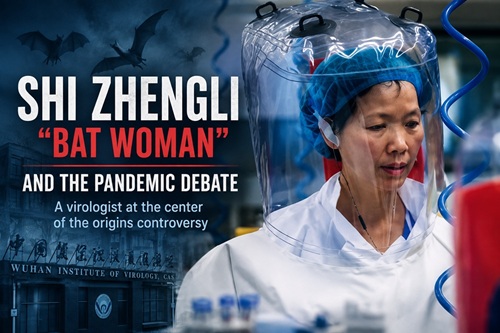
CONTROVERSIAL COVID EXPERTS: Shi Zhengli: the Bat Woman Christian Drosten: the PCR Test Marion Koopmans: the Lab Leak Peter Daszak: Gain-of-Function Research Ron Fouchier: Creating a Dangerous Virus Robert Garry: On Scientific Certainty Shi ZhengliThe "Bat Woman" and the Pandemic DebateFrank Visser / ChatGPT
When the COVID-19 pandemic erupted in early 2020, few scientists were thrust into the global spotlight as dramatically as Chinese virologist Shi Zhengli. Long known within virology circles as China's "Bat Woman" for her decades of research on bat coronaviruses, Shi suddenly found herself at the center of an intense international debate over the origins of SARS-CoV-2. Admirers portrayed her as a pioneering scientist unfairly targeted by conspiracy theories. Critics argued that her research program, conducted at the Wuhan Institute of Virology, deserved far greater scrutiny than it initially received. Years after the pandemic began, the evidence remains incomplete, but the controversy surrounding Shi Zhengli illustrates broader questions about scientific transparency, biosafety, international collaboration, and the risks of researching potentially pandemic pathogens. China's leading coronavirus hunterShi Zhengli built an impressive scientific reputation long before COVID-19. After the SARS outbreak of 2002-2003, she devoted her career to identifying coronaviruses circulating in bats throughout China. Together with her colleagues, she collected thousands of bat samples from caves, particularly in Yunnan Province, identifying numerous SARS-related coronaviruses. Her work substantially advanced scientific understanding of coronavirus diversity. Shi's team demonstrated that horseshoe bats serve as natural reservoirs for many SARS-like viruses and published influential papers tracing the evolutionary relationships among these viruses. This research was widely praised internationally. Western scientists collaborated extensively with Shi, and she became one of the world's foremost experts on bat coronaviruses. Ironically, this expertise would later place her under unprecedented scrutiny. The Wuhan coincidenceThe central controversy surrounding Shi Zhengli stems from a striking geographical coincidence. The Wuhan Institute of Virology housed China's premier coronavirus laboratory. It possessed one of the world's largest collections of bat coronaviruses, including viruses genetically related to SARS-CoV-2. Meanwhile, the first known outbreak of COVID-19 occurred in Wuhan—a city of over ten million people located hundreds of kilometers from the bat caves where many of these viruses had been collected. This coincidence does not, by itself, demonstrate a laboratory origin. Cities often contain research institutes studying diseases that occur elsewhere. Nevertheless, the overlap inevitably raised questions. • Had a researcher become infected during fieldwork? • Could a laboratory accident have occurred? • Was an undiscovered virus stored within the institute? These questions remain unanswered, largely because independent investigators have never received unrestricted access to laboratory records, virus databases, personnel health records, or sample inventories. The lack of transparency has fueled suspicion rather than dispelled it. Gain-of-function researchOne of the most controversial aspects of Shi Zhengli's work involved experiments examining whether bat coronaviruses could infect human cells. Working with international collaborators, including researchers from the United States, Shi co-authored studies creating chimeric coronaviruses by combining genetic elements from different viruses. The stated goal was to assess pandemic potential before natural spillovers occurred. Supporters argue these experiments improved preparedness by identifying viruses capable of infecting humans. Critics counter that engineering novel viruses inherently increases biosafety risks while providing uncertain practical benefits. The debate intensified after it became public that some research had received funding routed through the EcoHealth Alliance, led by Peter Daszak, with grants originating from the U.S. government. Although there remains no public evidence that SARS-CoV-2 itself was engineered in Shi's laboratory, the controversy transformed gain-of-function research from an obscure scientific issue into an international political debate. RaTG13 and questions of transparencyOne of the most debated episodes concerns the virus known as RaTG13. In February 2020, Shi's team reported that RaTG13 was the closest known relative of SARS-CoV-2, sharing approximately 96 percent genome identity. While this represented a major scientific finding, it also raised new questions. Researchers later learned that RaTG13 originated from samples collected years earlier in a mine in Mojiang, Yunnan, where several miners had developed severe pneumonia after clearing bat guano. Critics questioned why this virus had not been discussed more prominently before the pandemic and why aspects of its history emerged only gradually. Shi has consistently maintained that RaTG13 was merely one among many stored research samples and that it was never cultured as a live virus. Whether this explanation fully resolves concerns remains disputed. The episode nevertheless highlighted how incomplete disclosure can undermine public confidence, even absent evidence of wrongdoing. Public denialsSoon after learning of the outbreak, Shi reportedly feared that the virus might have escaped from her own laboratory. According to interviews, she reviewed the institute's virus databases and concluded that none matched SARS-CoV-2. She has repeatedly denied that the Wuhan Institute possessed the pandemic virus before the outbreak or that any laboratory accident occurred. These denials may be entirely accurate. However, because they cannot be independently verified, critics argue they cannot substitute for transparent investigation. Science ultimately depends not merely on trust but on verifiable evidence. Politics overwhelms scienceThe debate surrounding Shi Zhengli quickly became entangled in geopolitics. Early in the pandemic, some public figures dismissed any laboratory-origin hypothesis as misinformation or conspiracy theory. Others asserted with equal confidence that a laboratory leak had already been proven. Neither position reflected the available evidence. Over time, several intelligence agencies and scientific bodies concluded that both natural spillover and laboratory accident remained plausible scenarios, though with varying degrees of confidence. The result has been a polarized discussion in which Shi herself has become both hero and villain, depending largely on political perspective rather than scientific evidence. Scientific achievements deserve recognitionAny balanced assessment should acknowledge Shi Zhengli's genuine scientific accomplishments. Her decades of fieldwork vastly expanded knowledge of bat coronaviruses. Her publications have significantly influenced virology. She trained numerous researchers and helped establish China as a major contributor to coronavirus research. These achievements remain important regardless of the ultimate origin of SARS-CoV-2. But difficult questions remainRecognition of Shi's scientific contributions does not eliminate legitimate concerns. Several questions remain unresolved: • Why were important virus databases taken offline shortly before international investigators sought access? • Why has independent inspection of laboratory records remained so limited? • Were biosafety practices always adequate for the type of research being conducted? • Could international oversight of research involving potential pandemic pathogens have reduced uncertainty? These questions extend beyond Shi Zhengli personally. They concern how modern science manages research carrying potentially global consequences. Lessons for future pandemic researchThe Shi Zhengli controversy illustrates the growing tension between scientific openness and national security. Research on emerging viruses is essential for pandemic preparedness. Yet the same research may generate risks if biosafety standards fail or transparency is lacking. Regardless of whether COVID-19 ultimately proves to have arisen through natural spillover or laboratory accident, the pandemic has exposed weaknesses in international oversight. Future research involving highly transmissible pathogens may require stronger international standards for biosafety, more robust independent auditing, rapid sharing of virus databases, and greater openness when outbreaks occur. ConclusionShi Zhengli occupies a unique place in the history of the COVID-19 pandemic. She is neither the caricature of a reckless scientist portrayed by some critics nor simply an innocent victim of political attacks, as some defenders suggest. Rather, she represents the complex intersection of cutting-edge virology, international collaboration, Chinese state secrecy, and geopolitical rivalry. No conclusive evidence has shown that Shi Zhengli or the Wuhan Institute of Virology caused the pandemic. At the same time, the limited transparency surrounding the institute has prevented many legitimate questions from being answered conclusively. Perhaps the most enduring lesson is that scientific credibility depends not only on technical excellence but also on openness. In an age when laboratory research can have global implications, transparency is no longer merely an academic virtue—it is a public necessity.
Widget is loading comments...
|