|
TRANSLATE THIS ARTICLE
Integral World: Exploring Theories of Everything
An independent forum for a critical discussion of the integral philosophy of Ken Wilber
  Frank Visser, graduated as a psychologist of culture and religion, founded IntegralWorld in 1997. He worked as production manager for various publishing houses and as service manager for various internet companies and lives in Amsterdam. Books: Ken Wilber: Thought as Passion (SUNY, 2003), and The Corona Conspiracy: Combatting Disinformation about the Coronavirus (Kindle, 2020). Frank Visser, graduated as a psychologist of culture and religion, founded IntegralWorld in 1997. He worked as production manager for various publishing houses and as service manager for various internet companies and lives in Amsterdam. Books: Ken Wilber: Thought as Passion (SUNY, 2003), and The Corona Conspiracy: Combatting Disinformation about the Coronavirus (Kindle, 2020).
Check out my other conversations with ChatGPT
CONTROVERSIAL COVID EXPERTS: Shi Zhengli: the Bat Woman Christian Drosten: the PCR Test Marion Koopmans: the Lab Leak Peter Daszak: Gain-of-Function Research Ron Fouchier: Creating a Dangerous Virus Robert Garry: On Scientific Certainty Christian DrostenGermany's Leading Virologist and One of Its Most ControversialFrank Visser / ChatGPT
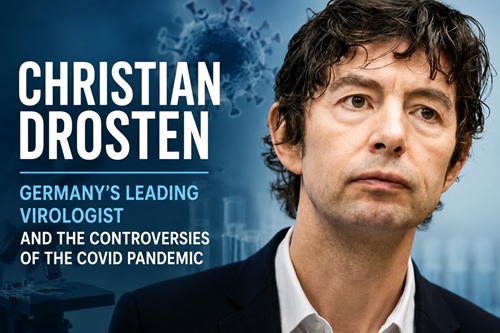
Few scientists became as publicly recognizable during the COVID-19 pandemic as German virologist Christian Drosten. As director of the Institute of Virology at Charité - Universitätsmedizin Berlin and one of Germany's leading coronavirus experts, Drosten quickly emerged as the country's scientific voice during the unfolding crisis. Through countless media appearances, government consultations, and his enormously popular podcast, he helped shape Germany's public understanding of COVID-19. To supporters, Drosten represented science at its best: cautious, data-driven, and willing to revise conclusions as evidence accumulated. To critics, however, he became the embodiment of an increasingly politicized scientific establishment whose influence over public policy often exceeded the certainty of the available evidence. His role in developing the first PCR test, his early dismissal of the laboratory-leak hypothesis, and his prominent advocacy of public health restrictions made him one of the most polarizing scientific figures of the pandemic. An Early Coronavirus ExpertLong before SARS-CoV-2 emerged, Drosten had established an international reputation in virology. He helped identify the SARS coronavirus in 2003 and became an expert on emerging respiratory viruses, including MERS. By early January 2020, when only a handful of unexplained pneumonia cases had been reported in Wuhan, his laboratory had already begun developing a diagnostic PCR assay. This extraordinary speed proved crucial. At a time when no commercial tests existed, laboratories worldwide urgently needed a reliable method for detecting the new virus. Drosten's protocol, developed together with an international team, was rapidly adopted through the World Health Organization and became one of the first globally available diagnostic tests. The speed of this achievement also planted the seeds of later controversy.[1] The Corman-Drosten PCR PaperThe PCR protocol was published in January 2020 in a paper led by Victor Corman, with Drosten among the authors. The publication appeared in the journal Eurosurveillance after an unusually rapid peer-review process, reflecting the urgency of the unfolding emergency. During the pandemic, critics argued that the paper suffered from methodological shortcomings. Among the objections were claims regarding primer design, validation procedures, statistical analysis, and the speed of review. In late 2020, a group of scientists submitted a formal request for retraction, arguing that these issues rendered the paper scientifically unreliable. The journal rejected the retraction request after obtaining additional expert reviews, concluding that although improvements and clarifications could have been made, the paper remained scientifically sound for its intended emergency purpose. Most virologists likewise maintained that the PCR protocol was fit for detecting SARS-CoV-2, even if individual laboratories later optimized or modified aspects of the assay. Some critics nevertheless continued to portray the paper as evidence of systemic failures in pandemic science. Others argued that the controversy reflected unrealistic expectations about a paper produced under extraordinary time pressure during the earliest days of an emerging outbreak. PCR Testing and Public ConfusionPerhaps no scientific topic generated more misunderstanding than PCR testing. Drosten consistently emphasized that PCR detects viral RNA rather than infectious virus itself. He also acknowledged that very high cycle threshold (Ct) values required careful interpretation, particularly late in infection. Nevertheless, public messaging often simplified PCR results into a binary positive-or-negative framework. Critics accused governments—and sometimes Drosten himself—of encouraging excessive reliance on case counts without sufficiently distinguishing between active infection, residual viral fragments, and clinical disease. In reality, many of these simplifications originated not from Drosten's scientific publications but from how governments and media translated laboratory diagnostics into public policy. Even so, because he became closely associated with PCR testing, he absorbed much of the public criticism directed at testing strategies. Close Ties Between Science and PolicyUnlike many academic researchers, Drosten became deeply involved in advising political leaders. Throughout 2020 and 2021, German policymakers frequently relied on his assessments regarding lockdowns, school closures, masking, and emerging variants. His podcast reached millions of listeners and often influenced public debate more directly than official government communications. This prominence created an unusual situation in which one scientist came to symbolize "the science" for many Germans. Critics argued that scientific advisors should remain more clearly separated from political decision-making. Once scientists become central public figures, they inevitably risk appearing responsible not only for scientific advice but also for the social, economic, and psychological consequences of the resulting policies. Supporters countered that governments urgently needed expert guidance during a rapidly evolving emergency and that Drosten repeatedly emphasized uncertainty rather than certainty. The Laboratory-Leak DebateOne of the most enduring controversies concerns the origin of SARS-CoV-2. Early in 2020, Drosten regarded a natural zoonotic origin as overwhelmingly more likely than a laboratory accident. This position reflected the prevailing view among many virologists, who pointed to previous coronavirus spillovers and genetic evidence consistent with natural evolution. Critics later argued that leading scientists, including Drosten, were too quick to dismiss the laboratory-leak hypothesis. As evidence accumulated regarding biosafety concerns, gain-of-function research, and the extensive coronavirus work conducted in Wuhan, many observers concluded that an accidental laboratory release deserved more serious investigation. Importantly, the debate shifted over time. By 2023-2025, several governmental agencies and expert panels acknowledged that both zoonotic emergence and laboratory accident remained plausible scenarios, although no definitive evidence established either explanation conclusively. Drosten himself later accepted that a laboratory accident could not be ruled out, though he continued to regard natural spillover as the more likely explanation. Scientific Uncertainty in PublicOne aspect of Drosten's career deserves recognition even from critics: he frequently revised his public statements as new evidence emerged. For example, his views on asymptomatic transmission, children's role in viral spread, and masking evolved during the pandemic. Critics interpreted these changes as inconsistency or error. Others viewed them as normal scientific practice under rapidly changing conditions. The pandemic exposed an inherent tension between science and politics. Science advances through provisional conclusions, continual revision, and open debate. Governments, by contrast, require timely decisions and clear recommendations. Scientists thrust into public leadership must therefore communicate uncertainty while simultaneously providing practical guidance—a difficult balance that inevitably invites criticism. Public BacklashAs Germany's most visible virologist, Drosten became the target of intense personal attacks. He received threats, harassment, and online abuse far beyond normal scientific disagreement. Some critics questioned his integrity or accused him of participating in conspiracies without credible evidence. Such attacks often obscured legitimate scientific disagreements about testing policy, lockdowns, school closures, or risk communication. A healthy scientific culture depends upon robust criticism of ideas while avoiding personal vilification. A Mixed LegacyChristian Drosten's legacy will likely remain contested. His rapid development of one of the first SARS-CoV-2 PCR assays undoubtedly accelerated global diagnostic capacity during a critical period. His scientific expertise and public communication helped many people understand an unfamiliar virus. At the same time, his unusually prominent advisory role blurred the boundaries between scientific expertise and public policy, making him a lightning rod for broader dissatisfaction with pandemic restrictions. The controversy surrounding Drosten illustrates a broader lesson about modern crises. Scientific experts increasingly operate in an environment where their findings are immediately translated into political decisions, media narratives, and social conflicts. Under such conditions, even careful scientists risk becoming symbols in debates that extend far beyond their research. Whether history remembers Christian Drosten primarily as an exemplary public scientist or as an overly influential policy advisor will depend less on the quality of his virological research than on how future generations judge the successes and failures of the pandemic response as a whole. NOTES[1] For an extensive coverage in three parts of this controversy see: Frank Visser, "PCR-Gate: A Storm in a Petri-Dish?", www.integralworld.net, December 2020.
Widget is loading comments...
|