|
TRANSLATE THIS ARTICLE
Integral World: Exploring Theories of Everything
An independent forum for a critical discussion of the integral philosophy of Ken Wilber
  Frank Visser, graduated as a psychologist of culture and religion, founded IntegralWorld in 1997. He worked as production manager for various publishing houses and as service manager for various internet companies and lives in Amsterdam. Books: Ken Wilber: Thought as Passion (SUNY, 2003), and The Corona Conspiracy: Combatting Disinformation about the Coronavirus (Kindle, 2020). Frank Visser, graduated as a psychologist of culture and religion, founded IntegralWorld in 1997. He worked as production manager for various publishing houses and as service manager for various internet companies and lives in Amsterdam. Books: Ken Wilber: Thought as Passion (SUNY, 2003), and The Corona Conspiracy: Combatting Disinformation about the Coronavirus (Kindle, 2020).
Check out my other conversations with ChatGPT
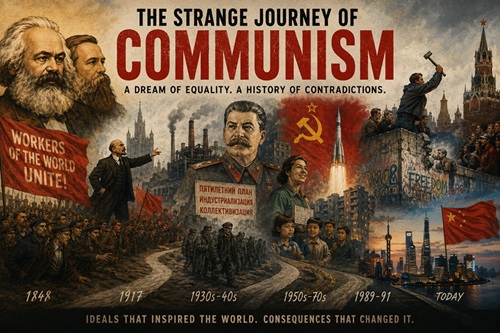
THE CONTEMPORARY EMPIRES: How Big Lies Destroy Countries The Rise or the Return of China? The History Russia Actually Had The True Greatness of America The Strange Journey of Communism The Strange Journey of CommunismFrom a dream of human emancipation to a history of revolutions, dictatorships, reforms, and collapseFrank Visser / ChatGPT
Communism is one of the great political stories of modern history. Few ideas have inspired such intense hope, devotion, sacrifice, and intellectual commitment—and few have produced such a dramatic mixture of liberation and oppression, economic transformation and economic failure, idealism and terror. Born in nineteenth-century Europe as a radical critique of industrial capitalism, communism eventually became the official ideology of states stretching from Central Europe to East Asia and from the Caribbean to Southeast Asia. At its height, roughly one-third of humanity lived under governments that called themselves communist. Yet by the end of the twentieth century, the communist world had largely collapsed, leaving behind a complicated legacy that cannot be reduced either to heroic revolution or to simple historical failure. The story of communism is therefore full of twists and turns. It begins with a vision of equality and human emancipation, passes through revolution and civil war, hardens into one-party dictatorship, achieves remarkable feats of industrialization and social transformation, suffers devastating economic and political crises, experiments with reform, and finally fragments into different historical paths. In some places communism disappeared almost entirely. In others, it survived by abandoning much of its original economic doctrine while retaining political authoritarianism. And in still others, communist ideas continue to influence democratic politics, social movements, and debates about inequality. To understand this extraordinary history, we have to begin with the dream. The dream of equalityThe intellectual roots of communism are older than Marx. Throughout history, religious movements, peasant rebellions, and radical thinkers imagined societies in which private wealth and social hierarchy would disappear. Early Christian communities, Thomas More's *Utopia*, and various egalitarian sects all contained elements that later generations would recognize as proto-communist. But modern communism emerged from the social upheavals of the nineteenth century. The Industrial Revolution created enormous wealth while also producing poverty, overcrowded cities, dangerous factories, and a new class of wage laborers whose lives were often precarious. The contrast between the wealth of industrialists and the conditions of workers became a central political question. Among the many socialist thinkers of the period, Karl Marx and Friedrich Engels became the most influential. Marx did not merely condemn capitalism morally. He attempted to explain it scientifically, as he understood the term, through a theory of history driven by conflicts between social classes. Capitalism, he argued, had revolutionized production and destroyed older feudal structures, but it had also created a new antagonism between the bourgeoisie, who owned the means of production, and the proletariat, who had to sell their labor. Marx believed capitalism contained contradictions that would eventually undermine it. Competition would concentrate capital. Workers would become increasingly organized. Economic crises would expose the instability of the system. Ultimately, the working class would overthrow capitalism and establish a transitional socialist society, which would eventually develop into communism: a classless society in which the state itself would supposedly become unnecessary. This was a radical vision. Communism promised not merely a change of government but the end of exploitation and, ultimately, the transformation of human society itself. Yet there was an enormous gap between Marx's theory and the revolutions that later claimed his name. The unexpected revolutionMarx expected socialism to emerge first in advanced industrial societies. Instead, the first successful communist revolution occurred in one of Europe's least developed major powers. Russia in 1917 was an autocratic empire with a relatively small industrial working class, a vast peasant population, and a government weakened by war and internal crisis. The February Revolution brought down the tsar, but the provisional government continued fighting the First World War. In October, the Bolsheviks, led by Vladimir Lenin, seized power. The Bolsheviks were a highly disciplined revolutionary party. They believed that a revolutionary vanguard was necessary to guide the working class and overthrow the existing order. Their slogan—"peace, land, and bread"—captured the immediate demands of a population exhausted by war. The revolution quickly became a civil war. The Bolsheviks faced a collection of opponents known as the Whites, supported in varying degrees by foreign powers. The resulting conflict was brutal. Millions died from combat, famine, disease, and political violence. The new Soviet state survived, but it did not resemble the peaceful workers' democracy imagined by many nineteenth-century socialists. Political pluralism disappeared. The Bolsheviks established a one-party state, justified by the need to defend the revolution. This was the first great twist in communism's history. A doctrine that promised the eventual disappearance of political coercion created a state that exercised extraordinary coercive power. Stalin and the construction of a superpowerAfter Lenin's death in 1924, Joseph Stalin gradually defeated his rivals and became the dominant leader of the Soviet Union. Under Stalin, the Soviet experiment entered its most extreme phase. The New Economic Policy introduced under Lenin had allowed a limited return to private economic activity. Stalin abandoned this compromise. Beginning in the late 1920s, he launched forced collectivization of agriculture and rapid industrialization through a series of Five-Year Plans. The results were devastating and impressive at the same time. Collectivization caused immense suffering. Millions died in famines, including the catastrophic famine in Soviet Ukraine, known as the Holodomor, whose causes and historical interpretation remain deeply contested. Peasants resisted collectivization, and the state responded with extraordinary brutality. At the same time, the Soviet Union underwent rapid industrial transformation. New factories, cities, railways, and military industries were constructed on a massive scale. A predominantly agrarian country became an industrial power within a generation. This transformation came at an enormous human cost. Stalin's regime created a vast system of political repression. The Great Purge eliminated real and imagined enemies. Millions passed through the Gulag labor camp system. Intellectuals, military officers, officials, ordinary citizens, and entire ethnic populations could become targets of state violence. The Soviet Union therefore embodied one of communism's deepest paradoxes. It demonstrated that a state could mobilize resources with extraordinary speed and transform an economy from above. It also demonstrated the terrible dangers of concentrating political and economic power in a single party and, ultimately, around one leader. Then came the Second World War. Communism defeats fascism—and expandsThe Nazi invasion of the Soviet Union in 1941 nearly destroyed the communist state. The German attack became one of the most devastating military campaigns in history. The Soviet victory at Stalingrad and the subsequent Red Army advance toward Berlin turned the Soviet Union into the decisive military power on the Eastern Front. The war transformed communism's international standing. The Soviet Union had survived an existential attack and emerged as one of the world's two superpowers. But victory came with a new contradiction. The Soviet Union had fought alongside the Western democracies against Nazi Germany, yet after the war it established communist governments throughout much of Eastern Europe. Poland, East Germany, Czechoslovakia, Hungary, Romania, Bulgaria, and other countries fell within Moscow's sphere of influence. The Cold War had begun. The world was now divided between two competing systems. The United States and its allies defended liberal capitalism and political pluralism. The Soviet Union and its allies defended socialism and one-party communist rule. Each side presented itself as the future of humanity. The golden age of communist expansionThe decades after 1945 were the high point of communism's global expansion. In 1949, the Chinese Communist Party, led by Mao Zedong, defeated the Nationalists in the Chinese Civil War. The People's Republic of China was established, dramatically altering the balance of global power. Communist movements also came to power in North Korea, Vietnam, Cuba, and eventually parts of Southeast Asia. Revolutionary movements inspired by Marxism, Leninism, Maoism, or local adaptations of socialism spread throughout the developing world. For many people, communism represented more than ideology. It represented modernization. Communist governments often achieved remarkable improvements in literacy, public health, education, and industrial capacity. The Soviet Union turned itself into a nuclear superpower and launched the first satellite, Sputnik, as well as the first human into space. Cuba developed impressive achievements in healthcare and education. China dramatically increased literacy and life expectancy over the second half of the twentieth century. Communist systems also offered an alternative to colonialism. In countries emerging from European imperial rule, the Soviet Union could appear as a model of national independence and rapid development. Yet the political price was usually high. One-party rule eliminated meaningful political competition. Censorship restricted freedom of expression. Secret police monitored society. Independent trade unions and civil organizations were suppressed. Dissidents could be imprisoned, exiled, or placed in psychiatric institutions. The communist world was therefore neither simply a success nor simply a failure. It was capable of remarkable social achievements while imposing enormous restrictions on political freedom. Mao's revolution goes wrongChina's communist revolution followed its own extraordinary trajectory. Mao initially pursued Soviet-style economic development, but in 1958 he launched the Great Leap Forward, an attempt to accelerate China's transformation into a modern industrial society. Agricultural collectivization was intensified, rural communities were reorganized, and unrealistic production targets were imposed. The result was catastrophic. Agricultural production collapsed, famine spread, and tens of millions of people died. The Great Leap Forward became one of the greatest man-made disasters in modern history. Yet Mao remained politically powerful. In the 1960s he launched the Cultural Revolution, mobilizing young people against alleged enemies within the Communist Party and society. Schools and universities were disrupted. Intellectuals were persecuted. Cultural heritage was attacked. Political struggle became a permanent feature of everyday life. The Cultural Revolution eventually exhausted the country. After Mao's death in 1976, China took another extraordinary turn. The capitalist revolution inside communismDeng Xiaoping emerged as China's dominant leader and initiated a series of reforms that transformed the country. The irony was profound. The Communist Party did not abandon political power, but it increasingly abandoned the economic model associated with classical communism. Collective agriculture was dismantled. Private enterprise expanded. Foreign investment was welcomed. Markets became central to economic life. China's leaders described this as "socialism with Chinese characteristics." The results were extraordinary. Hundreds of millions of people were lifted from extreme poverty. China became the world's manufacturing center and eventually a technological and economic superpower. But the political system remained authoritarian. The Communist Party retained a monopoly on power, and the suppression of the Tiananmen Square protests in 1989 demonstrated that economic liberalization did not necessarily imply political liberalization. China thus produced another great twist in the story of communism: perhaps the world's most successful surviving communist party achieved its economic transformation precisely by moving away from traditional communist economics. The Soviet model begins to crackWhile China was experimenting with markets, the Soviet Union was struggling with stagnation. By the 1970s and early 1980s, the Soviet economy was increasingly inefficient. Central planning could mobilize resources, but it struggled to respond to consumer demand, technological change, and the complexity of a modern economy. The system had succeeded spectacularly at producing steel, tanks, missiles, and space technology. It was far less successful at producing attractive consumer goods and efficiently allocating everyday resources. The Soviet Union also faced an enormous military burden. The Cold War arms race consumed resources. The invasion of Afghanistan in 1979 became a costly and unpopular conflict. When Mikhail Gorbachev became Soviet leader in 1985, he attempted to reform the system through *glasnost*—greater openness—and *perestroika*—economic and political restructuring. But reform created an unexpected consequence. Once people were allowed to criticize the system, the system became increasingly difficult to defend. Nationalist movements grew in the Soviet republics. Eastern European governments began to lose their grip. In 1989, the Berlin Wall fell. Communist regimes across Eastern Europe collapsed with astonishing speed. In 1991, the Soviet Union itself dissolved. The great communist experiment in Europe had ended. The collapse—and the question of whyThe collapse of Soviet communism was not caused by one factor alone. Economic stagnation played a major role. The centralized planning system had become increasingly rigid. Political repression had produced a culture of conformity rather than innovation. The arms race placed enormous pressure on the economy. National identities within the Soviet Union remained powerful. And the communist ideology itself had lost much of its credibility among large sections of the population. But there was also a deeper problem. Communist systems were often built on the assumption that political power could be concentrated temporarily in order to achieve revolutionary transformation. In practice, temporary emergency measures frequently became permanent institutions. The party became the state. The state became the economy. The leadership became increasingly insulated from criticism. Without independent institutions capable of correcting mistakes, errors could become disasters. Without free media, failures could be concealed. Without political competition, leaders could remain in power long after their policies had failed. The Soviet Union's collapse was therefore not simply an economic failure. It was also an institutional failure. The survivorsYet communism did not disappear. China remained under Communist Party rule. So did Cuba, Vietnam, Laos, and North Korea, although these countries followed increasingly different paths. Vietnam introduced market reforms known as Đổi Mới. Laos adopted its own market-oriented reforms. Cuba cautiously opened parts of its economy. North Korea remained the extreme exception, developing an intensely centralized and isolated system. The surviving communist states demonstrated that communism was not one thing. China became a hybrid system combining authoritarian party rule with extensive market economics and private enterprise. Vietnam followed a similar path. Cuba retained a much more state-controlled economy. North Korea developed a highly personalized and hereditary dictatorship that bears little resemblance to Marx's vision of a classless society. The word "communist" therefore became increasingly ambiguous. It could refer to an ideology, a historical movement, a one-party state, a planned economy, a revolutionary tradition, or simply the political identity of a ruling party. The legacy of communismThe historical balance sheet remains deeply contested. The critics point to the enormous death toll associated with communist regimes: the victims of Stalin's purges and famines, Mao's Great Leap Forward and Cultural Revolution, Cambodia under the Khmer Rouge, and political repression elsewhere. They argue that the concentration of political and economic power created structural incentives for authoritarianism and mass violence. Defenders respond that communism must be judged in historical context. They point to the poverty and exploitation of pre-revolutionary societies, the achievements of communist governments in literacy, healthcare, industrialization, and social mobility, and the role of communist movements in anti-colonial struggles. They also argue that many of the worst disasters resulted from particular dictatorships rather than from every possible form of socialism. Both perspectives contain important truths. It is impossible to understand the appeal of communism without understanding the inequalities and injustices that gave rise to it. But it is equally impossible to understand its failures without confronting the consequences of political monopoly and concentrated power. Perhaps the most important lesson is that economic justice and political freedom cannot safely be treated as alternatives. The historical record suggests that societies need both. Equality without freedom can become oppressive. Freedom without sufficient social justice can become hollow, particularly when economic power becomes so concentrated that formal political rights lose practical meaning. The twentieth century therefore did not simply prove that capitalism was right and communism was wrong. Nor did it prove the reverse. Instead, it produced a complicated historical synthesis. Western capitalism gradually incorporated many ideas that had once been associated with socialism: universal education, public healthcare, social insurance, labor rights, progressive taxation, and welfare states. At the same time, communist China adopted markets, private enterprise, international trade, and capitalist methods of production. The two systems influenced each other, competed with each other, and changed each other. The strange afterlife of a failed dreamCommunism began as a dream of emancipation. It imagined a world in which human beings would no longer be divided into classes and exploited for profit. That dream attracted intellectuals, workers, revolutionaries, and millions of ordinary people who experienced poverty, colonialism, and inequality. But the attempt to create that world produced a remarkable paradox. In seeking to abolish domination, communist revolutions often created new forms of domination. In seeking to liberate the working class, they established states that frequently denied workers political freedom. In seeking to create rational economies, they sometimes produced extraordinary inefficiencies. In seeking to build a classless society, they created powerful new elites within the party and state. And yet the story does not end with simple defeat. Communism changed the world even where it failed. It forced capitalism to confront its own inequalities. It inspired the creation of welfare states. It accelerated decolonization. It shaped the politics of the twentieth century. It helped produce the Cold War and the nuclear arms race. It transformed Russia and China from relatively backward empires into global powers. It inspired revolutions, wars, liberation movements, and counter-revolutions across the planet. Today, communism survives in only a handful of states, and nowhere does it exist in the pure form imagined by Marx. But the questions it raised have not disappeared. Who should own wealth? How unequal can a society become before it becomes unstable? Can economic freedom coexist with political equality? How much should markets determine? How much should the state provide? And can a society pursue greater equality without sacrificing individual liberty? These questions remain as relevant as ever. The history of communism is ultimately not the story of a single ideology marching inevitably toward triumph or collapse. It is the story of a grand experiment that repeatedly changed shape under the pressure of reality. It began with Marx's critique of capitalism, became Lenin's revolutionary vanguard, Stalin's industrial dictatorship, Mao's radical utopianism, and eventually China's peculiar combination of Communist Party rule and market capitalism. Its greatest achievement may have been to demonstrate the power of collective action and state-led transformation. Its greatest failure was to underestimate the dangers of concentrated power and the importance of institutions capable of correcting their own mistakes. The dream of equality survived the collapse of the Soviet Union. The lesson of the twentieth century is that realizing that dream requires something the great communist experiments too often lacked: not only economic justice, but also pluralism, accountability, freedom, and the humility to admit when the revolution has gone wrong.
Widget is loading comments...
|