|
TRANSLATE THIS ARTICLE
Integral World: Exploring Theories of Everything
An independent forum for a critical discussion of the integral philosophy of Ken Wilber
  Frank Visser, graduated as a psychologist of culture and religion, founded IntegralWorld in 1997. He worked as production manager for various publishing houses and as service manager for various internet companies and lives in Amsterdam. Books: Ken Wilber: Thought as Passion (SUNY, 2003), and The Corona Conspiracy: Combatting Disinformation about the Coronavirus (Kindle, 2020). Frank Visser, graduated as a psychologist of culture and religion, founded IntegralWorld in 1997. He worked as production manager for various publishing houses and as service manager for various internet companies and lives in Amsterdam. Books: Ken Wilber: Thought as Passion (SUNY, 2003), and The Corona Conspiracy: Combatting Disinformation about the Coronavirus (Kindle, 2020).
Check out my other conversations with ChatGPT
THE CONTEMPORARY EMPIRES: How Big Lies Destroy Countries The Rise or the Return of China? The History Russia Actually Had The True Greatness of America The Strange Journey of Communism The Rise or the Return of China?How the Middle Kingdom Became a Global Power AgainFrank Visser / ChatGPT
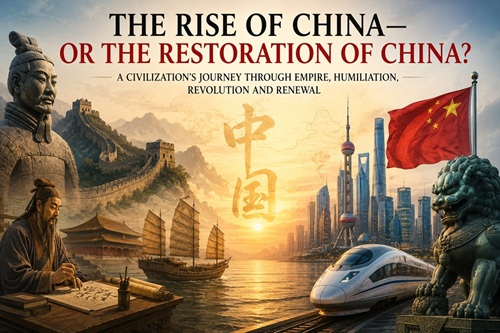
The West often speaks of the "rise of China" as if a new power were suddenly appearing on the world stage. The phrase is understandable. In little more than four decades, the People's Republic of China has transformed itself from a relatively poor, largely agrarian country into the world's second-largest economy, a manufacturing superpower, a technological competitor, and a major military and diplomatic force. But from the Chinese perspective, this is not necessarily a story of rise. It is a story of return. The Chinese Communist Party frequently presents contemporary China as recovering from a long period of humiliation and weakness, restoring the country's rightful place in the world after what Chinese historians call the "century of humiliation"—the period from the Opium Wars in the nineteenth century through the establishment of the People's Republic in 1949. The deeper historical claim is even more ambitious: China is not becoming powerful for the first time. It is becoming powerful again. That distinction matters. It helps explain why China's leaders think differently about history, sovereignty, territorial integrity, and international order than many Western observers do. It also explains why the modern Chinese state draws so heavily on the country's imperial past, even though it is officially governed by a Communist Party. To understand China today, therefore, one has to look backward—not merely to Mao Zedong, but to the long history of the Chinese empire. The First Empire: Unifying the Chinese WorldThe Chinese imperial tradition begins conventionally with the Qin dynasty in 221 BCE. Before Qin, the territory we now call China was divided among competing states. The Warring States period was violent, but it also produced some of the most important political and philosophical ideas in Chinese history. Confucianism, Daoism, and Legalism emerged from this era of intense competition. The ruler of Qin defeated his rivals and proclaimed himself Qin Shi Huangdi, the First Emperor. His achievement was not simply military. He created a centralized political system that would become the template for much of Chinese history. Weights and measures were standardized. Writing was regularized. Roads and infrastructure were built. The state was organized through a bureaucracy that penetrated far beyond the personal household of the ruler. The Qin dynasty itself lasted only a short time. Its harsh rule provoked rebellion, and the dynasty collapsed after the emperor's death. But the imperial idea survived. The succeeding Han dynasty (206 BCE–220 CE) created a more durable synthesis. The authoritarian machinery inherited from Qin was softened and legitimized by Confucian political philosophy. The emperor became the guardian of a moral and cosmic order, while a growing bureaucracy administered the empire. This combination—centralized state power plus Confucian moral legitimacy—would dominate Chinese political thought for two millennia. The Han also established something resembling a Chinese geopolitical identity. The empire expanded into Central Asia, Korea, and Vietnam, while trade routes connected it to the wider Eurasian world. The Silk Road was not simply a commercial highway. It was an early conduit for the movement of goods, technologies, religions, ideas, and people. The Chinese empire had already become something more than a state. It was becoming a civilizational system. The Mandate of HeavenChinese imperial rule was never based entirely on the idea that the emperor had an absolute and unconditional right to rule. The crucial concept was the Mandate of Heaven. According to this idea, Heaven granted legitimacy to a ruler who governed well. If the emperor became corrupt, incompetent, or cruel, Heaven could withdraw its mandate. Natural disasters, famine, rebellion, and social disorder could be interpreted as evidence that the dynasty had lost its legitimacy. This created a remarkable political paradox. On the one hand, Chinese civilization developed an extraordinarily strong tradition of centralized authority. The emperor stood at the apex of an enormous hierarchy. On the other hand, Chinese political culture contained an implicit theory of conditional legitimacy. A dynasty that failed could—and historically did—fall. This helped produce the characteristic Chinese pattern of history: dynastic cycles. A new dynasty would establish order. It would prosper, expand, and accumulate wealth. Over generations, corruption and fiscal problems would grow. Natural disasters and rebellions would intensify. The central government would weaken. Eventually the dynasty would collapse, and a new ruling house would claim the Mandate of Heaven. The names of the dynasties changed, but the basic political civilization remained remarkably continuous. The Golden Age of the TangThe Tang dynasty (618–907) is often regarded as one of the great high points of Chinese civilization. Its capital, Chang'an, was one of the largest cities in the world. The empire was cosmopolitan, connected to Central Asia and the Middle East. Foreign merchants, diplomats, monks, and artists passed through its gates. The Tang state combined military power with cultural sophistication. Buddhism flourished alongside Confucianism and Daoism. Poetry reached extraordinary heights. The famous poet Li Bai became an almost mythological figure. The Tang also demonstrated one of the recurring features of Chinese history: the capacity to absorb foreign influences without losing a strong sense of Chinese civilizational identity. China was never culturally isolated. It was repeatedly transformed by contact with outsiders. Yet those influences were often incorporated into an existing Chinese framework. The empire itself eventually fragmented, but the Tang left a cultural legacy so powerful that later Chinese dynasties looked back upon it as a model of imperial greatness. The Song Revolution: China's Economic MiracleIf the Tang represented the cosmopolitan grandeur of imperial China, the Song dynasty (960–1279) represented something perhaps even more remarkable: an economic and technological transformation. The Song period has sometimes been described by historians as an early economic revolution. China's population grew dramatically. Cities expanded. Commercial markets became more sophisticated. Paper money emerged. Maritime trade flourished. The government developed sophisticated taxation and administrative systems. Technological innovation accelerated. China pioneered or greatly developed technologies including: printing, gunpowder, the compass, advanced iron production, sophisticated hydraulic engineering, large-scale shipbuilding. The Song economy was increasingly monetized and commercialized. Chinese merchants participated in extensive maritime networks stretching across Southeast Asia and the Indian Ocean. The political structure was also distinctive. The Song relied heavily on a civilian bureaucracy recruited through the imperial examination system. The examinations were theoretically open to men who could master the Confucian classics, although in practice wealth and social background mattered greatly. Nevertheless, the system created something unusual in world history: a state bureaucracy whose legitimacy rested substantially on education and literary competence. This produced a powerful connection between culture and government. To become a successful official, one needed to master the cultural canon. The educated elite therefore became both the guardians of civilization and the administrators of the state. China's political order was thus deeply meritocratic in aspiration, even when imperfect in practice. The Mongol InterludeThe Mongol conquest disrupted the Chinese imperial tradition. Under Kublai Khan, grandson of Genghis Khan, the Mongols established the Yuan dynasty (1271–1368). The Yuan was part of a much larger Mongol imperial world stretching across Eurasia. For the first time, China was ruled by a conquering dynasty whose origins lay outside the traditional Chinese political elite. Yet the Mongols eventually adopted many Chinese institutions. Kublai Khan ruled as a Chinese emperor as well as a Mongol khan. This episode illustrates an important feature of Chinese history: the distinction between China as a political civilization and China as a nation-state is not always clear. Foreign conquerors could become Chinese emperors. They could adopt Chinese institutions, patronize Chinese culture, and claim the Mandate of Heaven. In the Chinese historical imagination, the civilization was ultimately larger and more enduring than any particular ethnic ruling dynasty. The Ming and the Return of Chinese RuleThe Ming dynasty (1368–1644) overthrew the Mongols and restored Han Chinese rule. The Ming period saw enormous state-building projects. The Great Wall was expanded. Beijing became the imperial capital. The Forbidden City was constructed as the symbolic center of imperial power. The early Ming also witnessed spectacular maritime expeditions under the admiral Zheng He, whose enormous fleets sailed through Southeast Asia and across the Indian Ocean as far as East Africa. These voyages demonstrate that China was not inherently hostile to international trade or maritime expansion. But the Ming eventually withdrew from large-scale state-sponsored maritime exploration. The empire became more inward-looking, although private trade continued and China remained deeply integrated into Asian commercial networks. This is one of the great historical "what ifs." Had China maintained its maritime expansion, might it have developed a global empire comparable to those later created by European powers? Perhaps. But history took another direction. The European powers were beginning their own global expansion. The Qing: The Last EmpireIn 1644, the Manchu conquered China and established the Qing dynasty, the final imperial dynasty. Again, a foreign people ruled China. Again, they adopted Chinese institutions while maintaining their own identity. The Qing presided over a period of enormous territorial expansion. The empire incorporated Tibet, Xinjiang, Mongolia, and other frontier regions into a vast imperial structure. This history remains politically important today. Modern Chinese claims regarding territories such as Tibet, Xinjiang, and Taiwan are deeply intertwined with interpretations of Qing history. Beijing generally presents these territories as historically integral parts of China. Others argue that the relationship was more complicated, varying between direct administration, tributary relations, military influence, and imperial frontier management. The historical record is therefore not simply a matter of geography. It is part of contemporary politics. The Qing reached its height in the eighteenth century under emperors such as Kangxi, Yongzheng, and Qianlong. China was then one of the world's great economic powers. And this brings us to an essential point. China Was Once the World's Economic CenterThe modern Western narrative sometimes assumes that industrialization transformed China from a backward civilization into a modern economic power. The historical picture is more complicated. For much of the eighteenth century, China possessed one of the world's largest economies. Its population was enormous. Its agricultural production was highly productive. Its handicraft industries were sophisticated. Chinese porcelain, silk, tea, and other goods were in enormous demand. Europeans wanted Chinese products. The problem was that China had relatively little need for European manufactured goods. This created a persistent trade imbalance. European merchants needed to pay China in silver. Eventually, British merchants found a solution: opium. The British East India Company and associated traders expanded the opium trade into China, creating enormous social and economic problems while reversing the flow of silver. When the Qing government attempted to suppress the trade, Britain went to war. The result was the First Opium War (1839–1842). China lost. The consequences were profound. The Century of HumiliationThe Opium Wars marked the beginning of what modern Chinese political discourse calls the Century of Humiliation. China was forced to sign unequal treaties. Foreign powers obtained commercial privileges and territorial concessions. European states, the United States, and Japan established spheres of influence. Hong Kong was ceded to Britain. The Qing government weakened. Foreign powers increasingly interfered in Chinese affairs. Then came the Second Opium War, the Sino-Japanese War, the Boxer Uprising, and further foreign intervention. The most humiliating development was arguably the rise of Japan. Japan had also encountered Western imperialism. But instead of being colonized, it modernized rapidly during the Meiji Restoration and became an imperial power itself. China, by contrast, suffered military defeats and internal fragmentation. The old imperial order was collapsing. In 1911, the Qing dynasty fell. After more than two thousand years, imperial China had ended. Republic, Revolution, and Civil WarThe Republic of China was founded in 1912. But political stability proved elusive. China experienced warlordism, political fragmentation, Japanese invasion, and civil war between the Chinese Nationalist Party (Kuomintang) and the Chinese Communist Party. The Japanese invasion during the 1930s and 1940s was catastrophic. The Second World War devastated China. After Japan's defeat in 1945, the Chinese Civil War resumed. In 1949, Mao Zedong proclaimed the People's Republic of China. The Nationalists retreated to Taiwan. From Beijing's perspective, this was not merely the victory of a communist revolution. It was the culmination of a much longer historical process: the restoration of Chinese sovereignty after decades of foreign domination and internal chaos. This is where the modern Chinese narrative of "restoration" becomes especially powerful. Mao's Revolution: Rebuilding the State at Enormous CostMao inherited a country that had suffered extraordinary destruction. His government reunified the mainland and restored a strong central state. But the economic and human costs of Maoist policies were enormous. The Great Leap Forward attempted to accelerate industrialization through radical collectivization and mass mobilization. It ended in catastrophic famine. The Cultural Revolution then attacked much of China's own cultural and institutional inheritance. Intellectuals were persecuted. Universities were disrupted. Historical artifacts and traditions were attacked. There is an extraordinary irony here. The Communist Party claimed to be restoring China's greatness while simultaneously attempting to destroy many elements of the civilization that had produced that greatness. Yet the Communist state did accomplish one crucial thing: it rebuilt political unity. The old warlord era was gone. Foreign powers no longer dictated China's internal affairs. China had become a sovereign state again. Deng Xiaoping and the Great Economic TransformationThe decisive transformation came after Mao. Under Deng Xiaoping, China began moving away from Maoist economic orthodoxy. The reforms launched in the late 1970s gradually introduced market mechanisms, private enterprise, foreign investment, and international trade. China did not simply adopt Western capitalism. Instead, it created something hybrid: a state-directed market economy. The Communist Party retained political control while allowing enormous economic experimentation. The results were extraordinary. Hundreds of millions of people were lifted from extreme poverty. Chinese cities transformed. Infrastructure expanded at unprecedented speed. Factories supplied the world. China became deeply integrated into global supply chains. The country that had once been the victim of foreign economic coercion became one of the central engines of global commerce. The restoration had entered a new phase. The Chinese Economic ModelChina's contemporary economic system is difficult to classify using traditional Western categories. It is not a centrally planned economy in the Maoist sense. Nor is it a liberal capitalist economy. It is better described as state capitalism under Communist Party leadership. The state maintains control over strategic sectors. Large state-owned enterprises dominate areas such as energy, finance, telecommunications, and infrastructure. At the same time, private companies have become enormously important. The government uses industrial policy to promote strategic sectors, including electric vehicles, batteries, renewable energy, artificial intelligence, robotics, and advanced manufacturing. This reflects an old Chinese tradition: the state as an active organizer of national economic power. The difference is that the modern Chinese state operates within a highly commercialized economy. China has therefore combined two forces that Western political theory often treats as opposites: centralized political authority and market competition. Whether this model can remain successful indefinitely is one of the great questions of the twenty-first century. The Cultural Dimension: Civilization as IdentityChina's rise cannot be understood economically alone. Chinese leaders increasingly speak of civilization. This is important. The modern Chinese state is not simply saying: "We want to become rich." It is saying: "We want to recover our historical status." The Chinese Communist Party has increasingly incorporated traditional cultural themes into its political narrative. Confucius, once denounced during the Cultural Revolution, has returned as a symbol of Chinese civilization. Traditional festivals, historical sites, classical literature, and philosophical traditions are increasingly celebrated. The message is clear. China is not merely a modern state. It is one of the world's oldest continuous civilizations. This gives Chinese nationalism a distinctive character. Western nationalism is often built around ethnicity, language, territory, or political institutions. Chinese nationalism frequently draws upon something broader: civilizational continuity. The central story is not simply that Chinese people inhabit a country called China. It is that Chinese civilization has endured for thousands of years despite dynastic collapse, invasion, civil war, foreign imperialism, and revolution. The Communist Party presents itself as the latest custodian of that civilization. The Return of the Middle KingdomThe traditional Chinese worldview was sometimes described through the idea of Tianxia, "all under heaven." This should not be reduced to a simple doctrine of Chinese world domination. Historically, Chinese foreign relations were complicated and varied enormously across periods. But there was a recurring assumption that China occupied a central position in the civilized world. The name "Zhongguo"—usually translated as China—can be understood as "central state" or "middle kingdom." The modern Chinese state is not literally trying to recreate the Qing Empire. But it is seeking something that resembles the restoration of centrality. The Belt and Road Initiative, China's expanding trade relationships, its investments in infrastructure abroad, its growing diplomatic presence, and its technological ambitions all reflect a desire to build a world in which China is no longer peripheral. The goal is not necessarily to become another United States. It is to become China again—a major center of global power whose interests cannot be ignored. The Great Paradox of Chinese RestorationThe great paradox is that China is simultaneously ancient and modern. It is governed by a Communist Party but increasingly invokes Confucian traditions. It has a huge market economy but maintains extensive state control. It is deeply integrated into global capitalism while emphasizing national sovereignty. It uses cutting-edge technologies while drawing legitimacy from thousands of years of history. And it is simultaneously a nation-state and the political expression of a much older civilization. This makes China difficult to understand from a purely Western historical perspective. Western political history often tells a story of modernization: tradition → revolution → liberalization → democracy → capitalism. China has followed a different trajectory. Its story is closer to: imperial civilization → fragmentation → revolution → centralization → economic modernization → civilizational restoration. The Communist Party has not abandoned the imperial tradition so much as transformed it. The emperor is gone. The bureaucracy remains. The examination system is gone. The emphasis on educated state administrators remains. The Mandate of Heaven is gone officially. But the idea that political legitimacy depends on maintaining order, prosperity, and national strength remains remarkably recognizable. The dynastic cycle has been replaced by the Party-state. The Great Question of the Twenty-First CenturyThe West therefore sees a rising China. China sees something different. It sees a country that was once among the world's greatest economic and cultural powers, suffered a prolonged period of weakness and foreign domination, rebuilt political unity, and is now returning to the center of global affairs. Both perspectives contain truth. China is rising in the sense that its economic and geopolitical weight has increased dramatically in recent decades. But it is also restoring something in the Chinese historical imagination: sovereignty, prosperity, national dignity, and a position of centrality. The question is what kind of restoration this will be. Will China become a more confident participant in a pluralistic international system? Will it seek to reshape that system around its own preferences? Will it recreate a hierarchical regional order reminiscent of earlier eras? Or will the pressures of demography, debt, technological competition, environmental challenges, and political centralization constrain its ambitions? The answers remain uncertain. But one thing is clear. To see China merely as a new superpower emerging from nowhere is to misunderstand the historical depth of the Chinese experience. China's modern power rests upon factories, universities, technology, ports, financial reserves, and military capabilities. But beneath these lies something older: a civilization with an extraordinarily long memory. For centuries, China was one of the world's great centers of wealth, administration, technology, and culture. The nineteenth and twentieth centuries interrupted that position with unusual violence. The Chinese Communist Party's greatest political achievement may therefore be understood not simply as making China communist, or even making China rich. It was to restore a strong Chinese state. The great historical question now is whether that restoration will stop at national revival or evolve into something more ambitious: the restoration of China as the central power of Asia and perhaps one of the defining powers of the world. The West calls this the rise of China. The Chinese story is more emotionally charged. It is the story of a civilization that believes it is coming home. Appendix: The Truth About the US–China Trade WarThe phrase "trade war" suggests a relatively simple story: two countries impose tariffs on each other's goods, businesses suffer, and eventually one side wins or both sides compromise. The reality is much more complicated. The conflict between the United States and China is not fundamentally about tariffs. Tariffs are merely the most visible weapon in a much larger struggle over technology, industrial capacity, supply chains, geopolitical influence, and the future structure of the global economy. The deeper truth is that the United States and China are competing over something bigger than trade. They are competing over who gets to define the economic and technological order of the twenty-first century. It Began with a Genuine Economic GrievanceThe American complaints about China are not invented. For decades, American companies have faced significant barriers in accessing the Chinese market. Foreign firms have complained about intellectual-property theft, forced technology transfers, discriminatory regulation, state subsidies, and preferential treatment for Chinese companies. China's economic system is fundamentally different from the liberal market model that dominates the United States and Europe. The Chinese state plays a much larger role in directing investment and protecting strategic industries. This has produced enormous economic successes. But it has also created tensions with countries that expect international trade to operate according to more symmetrical rules. The United States therefore had legitimate reasons to challenge China's economic practices. The question is whether the methods chosen were effective. Trump Turned the Dispute into a Trade WarThe conflict became explicit under President Donald Trump. Beginning in 2018, the United States imposed tariffs on hundreds of billions of dollars' worth of Chinese goods. China responded with tariffs of its own. The logic was straightforward: make Chinese exports more expensive, pressure Beijing into changing its behavior, and reduce America's trade deficit. But trade deficits do not work quite that way. A country's trade balance reflects much more than tariff policy. It depends on savings, investment, consumption, exchange rates, fiscal policy, and the structure of the global economy. Tariffs can alter trade flows, but they cannot simply command a country to stop running a deficit. And they often produce an unexpected result. The economic cost of tariffs is frequently borne not by the foreign country being punished, but by domestic consumers and companies that buy the imported goods. The American importer pays the tariff at the border. The cost may then be passed on through higher prices. This does not mean China suffers no consequences. Chinese exporters can lose market share, investment can move elsewhere, and economic growth can be affected. But the simplistic idea that China simply "pays" American tariffs is misleading. The reality is shared pain. The Trade War Became a Technology WarThe real transformation occurred when the dispute moved beyond tariffs. The United States increasingly targeted Chinese access to advanced technologies, particularly semiconductors and the equipment required to manufacture them. This was a much more serious development. Tariffs can make a product more expensive. Technology restrictions can prevent a country from obtaining the tools necessary to produce the next generation of products. The conflict therefore shifted from: "Who sells what to whom?" to: "Who controls the technologies that determine what can be produced in the future?" This is a much larger question. Artificial intelligence, advanced semiconductors, quantum computing, robotics, biotechnology, telecommunications, and military technologies are increasingly interconnected. The United States has recognized that China's economic rise has given it technological capabilities that could eventually challenge American strategic dominance. China, meanwhile, has recognized the danger of depending on foreign technology. The result is a powerful incentive for technological self-sufficiency. The trade war thus helped accelerate precisely the process Washington wanted to prevent: China's determination to build its own technological ecosystem. The Great Irony of DecouplingThe United States increasingly wants to reduce its dependence on China. China increasingly wants to reduce its dependence on the United States. But complete economic separation is extremely difficult. The two economies became deeply intertwined over several decades. American companies depend on Chinese manufacturing. Chinese companies depend on American technology, software, machinery, and access to global markets. Consumers in both countries benefit from the relationship. The global economy itself has been constructed around these connections. This creates an awkward paradox. Washington talks about decoupling, but in practice the process is more often one of de-risking. The goal is not necessarily to end all economic relations with China. It is to prevent excessive dependence on China in strategically sensitive areas. This is why Western countries are attempting to diversify supply chains, move some manufacturing to countries such as Vietnam, India, and Mexico, and develop domestic production of critical technologies. China, meanwhile, is pursuing its own version of economic security. The result is not the end of globalization. It is the emergence of a more fragmented globalization. China Has Not Simply Been a VictimThere is a temptation in some Western discussions to portray China as an innocent victim of American aggression. That is also too simple. China has pursued its own form of economic nationalism. It has heavily subsidized strategic industries. It has used state power to promote national champions. It has restricted foreign companies in important sectors. It has aggressively pursued technological development. And it has sometimes been accused of using unfair commercial practices. China's economic system is not simply a passive participant in a neutral global marketplace. It is a state-directed strategy for national development. This has been enormously successful. But it inevitably creates friction with other major economies. The United States is not the only country concerned about Chinese industrial policy. Europe, Japan, South Korea, and other countries have also struggled with the implications of China's enormous manufacturing capacity. The conflict is therefore not simply "America versus China." It is also a conflict between different models of economic organization. The Manufacturing ProblemOne of the most important truths about the trade war is that America cannot simply replace China overnight. China became the world's manufacturing center because it developed an enormous ecosystem of suppliers, logistics networks, skilled labor, infrastructure, ports, and specialized industrial clusters. Moving a factory is relatively easy. Recreating an industrial ecosystem is much harder. This is why the United States can impose tariffs and restrictions, but cannot simply decree that manufacturing will return to America. Some production will move elsewhere. Some will return to the United States. But much will remain in China. The trade war therefore exposed an uncomfortable reality: America had become dependent on China's industrial capacity, while China had become dependent on American technology and markets. The interdependence runs in both directions. The Chip WarThe semiconductor struggle is arguably the most consequential part of the conflict. Advanced chips are the infrastructure of modern civilization. They power smartphones, data centers, artificial intelligence, weapons systems, automobiles, and countless industrial processes. The United States therefore sees control over advanced semiconductor technology as a matter of national security. China sees restrictions on semiconductor access as an attempt to contain its rise. Both interpretations contain some truth. The United States is indeed attempting to slow China's access to certain advanced technologies. But China is also genuinely vulnerable because it remains dependent on foreign technologies in parts of the semiconductor supply chain. This is why Beijing is investing enormous resources in domestic chip production. The contest is no longer primarily about who sells more goods. It is about who possesses the technological foundations of future power. The Geopolitical DimensionThe trade war cannot be separated from the strategic rivalry between the two countries. China's growing power has transformed the balance of power in Asia. The United States has responded by strengthening alliances and partnerships with countries such as Japan, South Korea, Australia, the Philippines, and India. China sees this network with suspicion. From Beijing's perspective, the United States is attempting to contain China's legitimate rise. From Washington's perspective, China is attempting to reshape the regional order and potentially displace American influence. The dispute over Taiwan makes the situation even more dangerous. Taiwan is not merely a political issue. It is also central to the global semiconductor industry and to the strategic geography of East Asia. A military conflict there would have consequences far beyond China and the United States. The trade war therefore exists within a much larger geopolitical competition. Who Is Winning?The answer depends on what counts as winning. If the goal was to force China to abandon its entire economic model, the United States has not succeeded. China remains a state-directed economy. If the goal was to eliminate the American trade deficit, that has also not happened. If the goal was to prevent China from becoming a technological power, that too appears unrealistic. China has demonstrated remarkable capacity for technological adaptation and indigenous innovation. But the United States has also achieved important objectives. It has forced the world to pay greater attention to China's economic practices. It has encouraged companies to diversify supply chains. It has strengthened domestic investment in strategic technologies. It has persuaded allies to take economic security more seriously. Most importantly, it has made clear that access to the American market and advanced Western technology is not unconditional. China, for its part, has responded by accelerating its own drive for technological independence. In this sense, both sides have succeeded in changing the relationship—but neither has achieved decisive victory. The Hidden Winner: The Rest of the WorldThere is another dimension to the story. Countries outside the United States and China may benefit from the rivalry. Manufacturing is moving into countries such as Vietnam, India, Mexico, and elsewhere. Companies are seeking alternative supply chains. Governments are competing for investment. This creates opportunities. But it also creates risks. The world economy benefits enormously from integrated markets. If the global economy divides into competing technological and financial blocs, efficiency will decline. The world could become more resilient in some respects—but also more expensive. The great economic advantage of globalization was that countries specialized in what they did best. The new era may require countries to produce things domestically that they could once import more cheaply. Security is replacing efficiency as the overriding principle. That is an expensive transition. The Deeper TruthThe deepest truth about the US–China trade war is that it is not really a trade war anymore. It is a struggle over the consequences of China's restoration. The United States became the dominant global power after the Second World War and remained the central economic and technological power after the collapse of the Soviet Union. China's return challenges that position. For Washington, the question is whether China's rise can occur without undermining the international system that the United States helped build. For Beijing, the question is whether China can regain its historical centrality without once again becoming vulnerable to foreign domination. This is why the language used by both sides is so emotionally charged. The United States speaks of competition, unfair practices, national security, and economic coercion. China speaks of containment, humiliation, sovereignty, and national rejuvenation. Both countries believe they are responding defensively. That is precisely what makes the conflict so difficult to resolve. The New Cold War?Calling the US–China rivalry a new Cold War is tempting, but imperfect. The United States and Soviet Union had almost no economic integration. The United States and China remain deeply connected. The Soviet Union represented an ideological alternative to capitalism. China, by contrast, participates extensively in global capitalism while maintaining authoritarian one-party rule. The relationship is therefore more complicated. Perhaps the best description is a competitive interdependence. The two countries need each other. They distrust each other. They compete with each other. And they increasingly prepare for the possibility that cooperation may fail. This is an unstable equilibrium. Restoration Versus ContainmentSeen from Beijing, the story of the trade war is therefore part of the much larger historical narrative of China's restoration. China believes it is recovering from the extraordinary weakness of the nineteenth and twentieth centuries. The United States sees a rising power challenging an international order in which American leadership has been central. These two narratives collide. And here lies the central danger. If Washington sees China's restoration as inherently illegitimate, it may attempt to contain China so aggressively that Beijing concludes that peaceful development is impossible. If Beijing interprets every American defensive measure as proof of an American conspiracy to prevent China's rise, it may respond more aggressively and confirm Washington's fears. The result could become a self-fulfilling prophecy. The United States fears China will become a hegemon. China fears the United States will prevent its restoration. Each side then behaves in ways that make the other's fears appear justified. That is how great-power conflicts become dangerous. The truth about the US–China trade war, then, is neither that America is simply bullying China nor that China is simply victimized by American protectionism. The truth is more uncomfortable. America is trying to preserve its strategic position. China is trying to recover its historical position. The trade war is the economic expression of that deeper collision. And the final outcome will probably not be decided by tariffs. It will be decided by technology, productivity, innovation, demographics, alliances, political stability, military power—and the ability of each side to convince the rest of the world that its vision of the future is the more attractive one. The real question is therefore not who wins the trade war. It is whether the United States and China can accommodate each other's ambitions without turning the twenty-first century into a prolonged struggle for global primacy. That may be the greatest test of both countries' political wisdom.
Widget is loading comments...
|