|
TRANSLATE THIS ARTICLE
Integral World: Exploring Theories of Everything
An independent forum for a critical discussion of the integral philosophy of Ken Wilber
  Frank Visser, graduated as a psychologist of culture and religion, founded IntegralWorld in 1997. He worked as production manager for various publishing houses and as service manager for various internet companies and lives in Amsterdam. Books: Ken Wilber: Thought as Passion (SUNY, 2003), and The Corona Conspiracy: Combatting Disinformation about the Coronavirus (Kindle, 2020). Frank Visser, graduated as a psychologist of culture and religion, founded IntegralWorld in 1997. He worked as production manager for various publishing houses and as service manager for various internet companies and lives in Amsterdam. Books: Ken Wilber: Thought as Passion (SUNY, 2003), and The Corona Conspiracy: Combatting Disinformation about the Coronavirus (Kindle, 2020).
Check out my other conversations with ChatGPT
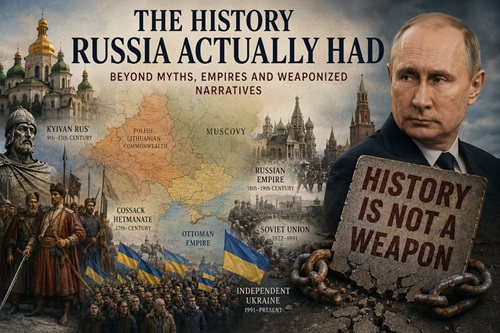
THE CONTEMPORARY EMPIRES: How Big Lies Destroy Countries The Rise or the Return of China? The History Russia Actually Had The True Greatness of America The Strange Journey of Communism The History Russia Actually HadFrom Kyivan Rus' to Putin: How a Complex Past Became a Political WeaponFrank Visser / ChatGPT
History is never merely about the past. It is also about who has the right to define the present. Few contemporary political conflicts demonstrate this more dramatically than the war between Russia and Ukraine. Vladimir Putin has repeatedly invoked history to argue that Russians and Ukrainians are essentially one people, that Ukraine is an artificial creation, and that the separation of the two countries is a historical aberration imposed by foreign powers. In his 2021 essay "On the Historical Unity of Russians and Ukrainians", Putin presented a sweeping historical narrative in which the two peoples share a common origin and were subsequently divided by outsiders and political accidents. He described Russians and Ukrainians as "one people—a single whole," while arguing that modern Ukrainian statehood had been manipulated by external forces. There is, of course, some truth in the historical background Putin invokes. Russians, Ukrainians and Belarusians do share deep linguistic, religious and cultural connections. Their histories intersect repeatedly. They emerged from overlapping medieval political and cultural worlds, and millions of families have connections across the modern Russian-Ukrainian border. But this is precisely where the historical argument must become more—not less—careful. Shared origins do not entail political identity. Cultural kinship does not abolish national sovereignty. And a common medieval past does not give one modern state the right to rule another. The actual history of Russia and Ukraine is considerably more complicated than Putin's narrative. It is a history not of one eternal people temporarily separated, but of multiple peoples, political centres, dynasties, empires, languages and identities that interacted, overlapped and diverged over many centuries. The real history is therefore not a refutation of Russian history. It is a refutation of the idea that Russian history has only one possible political conclusion. The First Problem: There Was No Russia in the BeginningThe story usually begins with Kyivan Rus', the medieval East Slavic polity centred on Kyiv. It emerged in the ninth century and became one of the major political and cultural formations of medieval Eastern Europe. Its rulers belonged to the Rurikid dynasty, and its population included a mixture of East Slavic and other peoples. Christianity was adopted under Vladimir the Great in 988, tying the polity to the Byzantine Christian world. Kyivan Rus' is unquestionably part of the historical inheritance of both Russia and Ukraine. But it is misleading to describe it as simply "Russia before Russia." The very name is important. The medieval state was known as Rus', not "Russia" in the modern national sense. Modern Russia did not yet exist. Nor did modern Ukraine. Nor did modern Belarus. The political and national categories familiar to us today had not yet crystallized. This matters because the medieval past cannot simply be mapped backward onto the modern political map. The Library of Congress's historical account of Russia notes that Kyivan Rus' was not a homogeneous political, cultural or ethnic entity. Its fragmentation had already begun before the Mongol invasions, and the Mongol conquest accelerated a process of political differentiation. The northeastern territories that eventually produced Muscovy followed one historical trajectory, while the lands around Kyiv and western Rus' followed others. The later Russian claim to exclusive ownership of Kyivan Rus' is therefore historically problematic. So, for that matter, would be an exclusive Ukrainian claim. Kyivan Rus' belongs to a shared East European medieval inheritance—but a shared inheritance is not the same thing as exclusive ownership. The crucial point is that Russia did not simply exist first and then temporarily lose Ukraine. Rather, the modern Russian and Ukrainian nations emerged much later from a complicated common and divergent history. The Mongol Invasion and the Divergence of the Rus' LandsThe Mongol invasion of the thirteenth century was one of the great turning points. Kyiv was devastated in 1240, and the political world of the old Rus' fragmented. The territories of the former Kyivan polity increasingly developed along different paths. In the northeast, the principalities of Vladimir-Suzdal and eventually Moscow became increasingly important. Muscovy emerged under the political shadow of the Mongol Golden Horde and gradually expanded its power. In the southwest and west, the lands of Rus' became incorporated into the Grand Duchy of Lithuania and later the Polish-Lithuanian Commonwealth. This created a very different political, legal and cultural environment from that of Muscovy. The modern Russian state therefore did not simply inherit the whole of Kyivan Rus' intact. Its political centre shifted northward and eastward. Moscow gradually constructed a new state whose rulers eventually claimed the legacy of Rus'. This was a process of historical succession and political appropriation, not a simple continuation. The distinction is crucial. Many modern states claim the inheritance of ancient civilizations without therefore possessing a perpetual right to the territories of all other states that share that inheritance. Modern Greece is not entitled to rule Italy because both inherit aspects of the ancient Mediterranean world. Modern Italy cannot claim Greece because Rome once ruled it. Shared civilization creates historical connections; it does not create contemporary sovereignty. The same principle applies to Russia and Ukraine. Moscow RisesFrom the fourteenth century onward, Moscow grew in power. The Muscovite princes expanded their territories, accumulated wealth and developed increasingly centralized institutions. The eventual weakening of Mongol authority enabled Moscow to assert greater independence. By the late fifteenth century, the Grand Duchy of Moscow had become the dominant political power in northeastern Rus'. This was the beginning of the historical formation of the Russian state as we know it. The Russian state was therefore not simply the old Kyivan state resurrected. It was a new political formation that emerged from the northeastern Rus' principalities, shaped by the Mongol experience, Orthodox Christianity, dynastic politics, territorial expansion and increasingly centralized rule. The Moscow state then expanded dramatically. Its rulers absorbed neighbouring territories and eventually built one of the world's largest empires. By the seventeenth century, Russian expansion had reached across Siberia to the Pacific. The history of Russia thus became, above all, a history of state expansion—sometimes through diplomacy and dynastic arrangements, but very often through military conquest and colonization. This is not an accusation. It is a description of how empires historically developed. But it complicates the modern idea that all territories once connected to Rus' naturally belong to Moscow. The Ukrainian Lands Followed Another PathWhile Muscovy was becoming increasingly centralized, much of the territory of present-day Ukraine followed a different trajectory. The lands around Kyiv, Volhynia and Galicia experienced Lithuanian and Polish rule. They participated in political, legal and cultural systems different from those developing in Muscovy. The Ukrainian Cossack phenomenon then became particularly important. The Cossacks were not simply Russian peasants waiting to be reunited with their natural homeland. They developed distinctive military, social and political institutions. In the seventeenth century, the Cossack revolt led by Bohdan Khmelnytsky produced the Hetman state, a Ukrainian Cossack polity that existed from 1648 into the eighteenth century. Its territories were divided between Polish and Muscovite spheres, with Left-Bank Ukraine coming under Muscovite control while Right-Bank Ukraine remained under Polish domination for a period. The relationship between the Ukrainian Cossacks and Moscow is particularly revealing because it demonstrates how difficult it is to impose a modern nationalist narrative on the past. The Treaty of Pereiaslav of 1654, often invoked in Russian historical narratives as a voluntary "reunification" of Ukraine with Russia, remains historically contested. The precise nature of the agreement and the intentions of the parties have been debated by historians. What followed, however, is clearer: Moscow's political influence over Ukrainian territories increased, and over subsequent decades the autonomy of the Cossack political order was progressively reduced. By the eighteenth century, the Russian Empire had absorbed the Ukrainian Cossack territories and dismantled their autonomous institutions. This is not the story of a single people simply returning to its natural political home. It is the story of an expanding empire incorporating a neighbouring political society. Empire and the Invention of "Little Russia"The Russian Empire developed its own vocabulary for governing Ukraine. One of the most important terms was Malorossiya, or "Little Russia." The term originally had complex historical meanings and was not necessarily intended as an insult. But within the imperial framework it gradually became part of a hierarchy: Great Russia at the centre, Little Russia as a related but subordinate region. This is precisely the sort of historical language that later nationalist narratives can obscure. The imperial state could acknowledge that Ukrainians were culturally related to Russians while simultaneously denying them a separate political identity. This was not unusual in nineteenth-century Europe. Empires frequently argued that the peoples they ruled were really part of a larger historical nation and therefore did not require independent political institutions. The Habsburg Empire did this in various ways. The Ottoman Empire did it. The British Empire did it. The Russian Empire did it. The underlying logic was always similar: You are part of us; therefore, you do not need to govern yourselves. During the nineteenth century, Ukrainian cultural and national movements increasingly challenged this logic. Ukrainian writers, intellectuals and political activists developed a distinct modern Ukrainian national identity. The imperial response was frequently repressive. Ukrainian-language publications were restricted, and the imperial government sought to discourage the development of a separate Ukrainian political consciousness. The result was paradoxical. The more the empire insisted that Ukrainians were simply Russians with a regional accent, the more Ukrainian nationalism developed in opposition to that imperial definition. The Nineteenth Century Creates the Modern NationsThis is perhaps the most important historical point that Putin's narrative tends to flatten. The nations of Europe as we know them today are largely modern constructions. The Russian nation, the Ukrainian nation and the Belarusian nation did not exist in their contemporary forms in the time of Vladimir of Kyiv. They emerged gradually through the nineteenth and twentieth centuries. National identity is produced by language, education, literature, religion, institutions, political movements and historical memory. The same medieval ancestor can therefore become the ancestor of different modern nations. That is exactly what happened with Kyivan Rus'. Russian historians could interpret it as the beginning of Russian statehood. Ukrainian historians could interpret it as the medieval foundation of Ukrainian history. Both perspectives are understandable. The problem arises when one interpretation is transformed into a legal or moral claim over the other nation's territory. The history of Russia is therefore not simply a straight line from Kyivan Rus' to Moscow to the Russian Federation. It is better understood as a branching tree. The roots are partly shared. The branches diverge. Revolution, Civil War and the Ukrainian QuestionThe collapse of the Russian Empire in 1917 opened a new chapter. For a brief period, Ukraine attempted to establish its own statehood. The Ukrainian People's Republic emerged during the revolutionary upheavals of 1917–1921. The period was chaotic, violent and politically fragmented, involving Ukrainian nationalists, Bolsheviks, White Russians, Polish forces and various other armed groups. Eventually, most Ukrainian territory was incorporated into the Soviet Union as the Ukrainian Soviet Socialist Republic. The Soviet Union formally recognized Ukraine as a constituent republic, complete with nominal sovereignty and the constitutional right to secede. In practice, however, the Soviet system was highly centralized and real political independence was absent. This is an important distinction. Putin has sometimes portrayed the Soviet creation of republic borders as an artificial arrangement that planted the seeds of future dissolution. Yet the Soviet Union itself recognized Ukraine as a distinct republic. When the USSR collapsed in 1991, Ukraine did not suddenly invent its independence out of nothing. It inherited the institutional boundaries of an existing Soviet republic and declared independence within the framework of the Soviet system's own constitutional dissolution. The borders of independent Ukraine were then internationally recognized—including by Russia. That fact is historically and politically decisive. Whatever arguments may be made about medieval history, imperial borders or Soviet administrative decisions, the modern Russian Federation recognized Ukraine as a sovereign state. The Soviet Experience: Unity and TraumaThe Soviet period further complicates any simple story of Russian-Ukrainian unity. Ukrainians and Russians lived within the same political system, but they did not experience it identically. Ukraine suffered enormously under Stalinist policies, including collectivization and the Holodomor, the catastrophic famine of 1932–33, whose causes, intentionality and classification remain subjects of historical debate but whose devastating human consequences are beyond dispute. Ukraine also experienced the purges, forced collectivization, wartime destruction and postwar repression that affected the Soviet Union more broadly. The Second World War created another layer of contradictory memory. Ukraine was both a major battlefield and a site of extraordinary suffering. Ukrainians fought in the Red Army, while others fought against Soviet rule or collaborated with Nazi Germany. The history is morally complicated and cannot be reduced to a single national narrative. The Soviet Union nevertheless created an important common space in which Russian became a lingua franca, populations migrated across republic borders and millions of Russians and Ukrainians formed families. This shared Soviet experience is real. But again, shared experience does not erase difference. It is entirely possible for two peoples to share centuries of history and still develop separate national identities. Indeed, that is one of the most common phenomena in world history. 1991: The Moment History Became Political RealityThe collapse of the Soviet Union transformed historical relationships into international borders. Ukraine became independent. The Russian Federation became the internationally recognized successor state of the Soviet Union. This was not merely an administrative event. It represented the emergence of a new geopolitical reality. Ukraine was now a sovereign state. The borders of the new state were internationally recognized, and Russia itself entered into agreements acknowledging Ukraine's territorial integrity. Whatever one thinks of the wisdom of particular Ukrainian governments, the country now possessed the same fundamental right as Russia: the right to determine its own political future. This is where history encounters the modern international order. History can explain why two countries are related. It cannot determine that one country has the right to dominate the other. The Past Does Not Have a Single OwnerThe deepest mistake in Putin's historical argument is therefore not that every historical fact he mentions is false. Many are true. Russians and Ukrainians do share a long history. They do share religious and cultural traditions. Kyivan Rus' is part of the ancestry of both modern Russian and Ukrainian historical identities. The Russian and Ukrainian peoples have lived together for centuries. But the conclusion Putin draws from these facts does not follow. If shared history created political ownership, the world map would be impossible. The history of Europe is a vast network of overlapping inheritances. France and Germany share Charlemagne. Italy and many other European countries share Rome. Hungary and Romania share Transylvania. Poland, Lithuania, Belarus and Ukraine share the history of the Polish-Lithuanian Commonwealth. Britain and Ireland share centuries of political history. Yet none of this means that one modern nation has a permanent right to rule another. History explains relationships. It does not confer property rights over peoples. That distinction is the dividing line between historical scholarship and historical nationalism. Appendix: The Weaponization of HistoryThe most dangerous use of history is not forgetting it. It is turning it into a weapon. A healthy society studies the past to understand how the present came into being. A political regime studies the past to prove that the present was inevitable. The difference is enormous. Putin's historical narrative is powerful precisely because it contains substantial truths. Propaganda rarely consists entirely of inventions. More often, it takes genuine historical connections, selects some facts, ignores others, and then draws a political conclusion that the evidence itself does not compel. The shared history of Russians and Ukrainians becomes evidence that they are "one people." The existence of Kyivan Rus' becomes evidence that Ukraine's historical identity belongs to Russia. The Soviet creation of republican borders becomes evidence that Ukrainian independence was an artificial mistake. The presence of Russian speakers in Ukraine becomes evidence that Russia has a special responsibility to protect them. And finally, the existence of NATO and Western influence becomes evidence that Ukraine's sovereignty is really a geopolitical threat to Russia. Each step contains a fragment of reality. The completed narrative, however, transforms historical complexity into political entitlement. This is how history becomes weaponized. History as a Claim of OwnershipThe central rhetorical trick is subtle. First, a political leader says: We share a history. That statement is true. Then: We share a culture. Also true. Then: We are historically one people. Now the statement becomes contestable. Then: Therefore, separation is unnatural. Now we have moved from history into political philosophy. And finally: Therefore, we have the right to determine your future. At that point, we are no longer discussing history at all. We are discussing power. The entire argument depends on silently moving from one proposition to another without acknowledging the enormous logical gaps between them. A family may share ancestors without sharing a household. Two siblings may share parents without one possessing the other. Two nations may share a civilization without one being subordinate to the other. The analogy is not perfect, but the principle is. Kinship is not sovereignty. The Dangerous Phrase "One People"The phrase "one people" is especially dangerous because it sounds descriptive while functioning politically. People can share identity at multiple levels. A person can simultaneously be European, Dutch, Frisian, Christian, secular, liberal, conservative, and a citizen of a particular municipality. These identities overlap. Likewise, Russians and Ukrainians can share a civilizational heritage while belonging to distinct political nations. The problem arises when one level of identity is declared the only legitimate one. If Ukrainians are told that their Ukrainian identity is merely a regional variation of Russian identity, then Ukrainian sovereignty can be portrayed as an artificial obstacle to an allegedly natural unity. This is the logic of imperial nationalism. The empire does not necessarily say: You are foreigners. It can say something more powerful: You are really us. The political implication is that your independence is therefore illegitimate. The Selective Memory of EmpiresEvery empire constructs a flattering history of itself. The Russian Empire remembered its expansion as the gathering of Russian lands. The British Empire spoke of civilization. The French Empire spoke of universal values. The Soviet Union spoke of historical progress. Empires rarely describe themselves as empires while they are expanding. They speak instead of liberation, protection, unity, modernization or historical destiny. This does not mean that every Russian historical claim is imperial propaganda. It means that historical interpretation must always be examined in relation to political power. Who is telling the story? Which events are emphasized? Which are forgotten? Who is given agency? Who is portrayed as naturally belonging to whom? These questions become especially important when history is being invoked to justify military action. The Ultimate TestThere is a simple test for whether history is being used responsibly. Ask: Does the historical narrative allow the people being discussed to speak for themselves? If Russians and Ukrainians share a history, then Ukrainians must have an equal right to interpret that history. If Russians and Ukrainians are culturally related, Ukrainians must have the right to decide what that relationship means. If Russia and Ukraine once formed part of the same political entity, that does not mean Ukrainians are permanently obligated to recreate that political entity. Historical memory must be compatible with human agency. Otherwise, the dead are being used to command the living. The Final IronyThere is a profound irony in the Russian invocation of history. The more Putin insists that Russia and Ukraine are inseparable because of their shared past, the more he risks creating precisely the opposite result. The invasion of Ukraine has strengthened Ukrainian national identity. It has encouraged millions of Ukrainians to distinguish themselves more sharply from Russia. A population that once contained many people comfortable with a dual Russian-Ukrainian identity has been pushed toward a more emphatic Ukrainian identity. History, in other words, is not a fixed inheritance. It is something people continually reinterpret in response to their circumstances. The great lesson of Russian and Ukrainian history is therefore not that the two peoples must be politically united. It is that identities are complex, borders change, empires rise and fall, and political communities evolve. The history of Russia is magnificent, tragic, creative and violent. It includes medieval state-building, Orthodox Christianity, Mongol domination, Muscovite centralization, imperial expansion, extraordinary cultural achievements, serfdom, revolution, communism, Stalinism, the Second World War, the Soviet experience and the collapse of an empire. Ukraine's history is equally complex: Kyivan Rus', Lithuanian and Polish rule, Cossack statehood, imperial incorporation, national revival, revolution, Sovietization, famine, war, independence and the struggle to consolidate a democratic state. These histories intersect. They cannot be reduced to one another. The honest historical conclusion is therefore neither that Russia and Ukraine have nothing in common nor that they are politically one people. It is that they have been deeply connected without ever being permanently identical. That distinction is not a minor academic qualification. It is the difference between remembering history and weaponizing it.
Widget is loading comments...
|