|
TRANSLATE THIS ARTICLE
Integral World: Exploring Theories of Everything
An independent forum for a critical discussion of the integral philosophy of Ken Wilber
  Frank Visser, graduated as a psychologist of culture and religion, founded IntegralWorld in 1997. He worked as production manager for various publishing houses and as service manager for various internet companies and lives in Amsterdam. Books: Ken Wilber: Thought as Passion (SUNY, 2003), and The Corona Conspiracy: Combatting Disinformation about the Coronavirus (Kindle, 2020). Frank Visser, graduated as a psychologist of culture and religion, founded IntegralWorld in 1997. He worked as production manager for various publishing houses and as service manager for various internet companies and lives in Amsterdam. Books: Ken Wilber: Thought as Passion (SUNY, 2003), and The Corona Conspiracy: Combatting Disinformation about the Coronavirus (Kindle, 2020).
Check out my other conversations with ChatGPT
Check out my other conversations with ChatGPT How Big Lies Destroy CountriesHitler's Germany, Putin's Russia, and Trump's America through the lens of Timothy Snyder's On FreedomFrank Visser / ChatGPT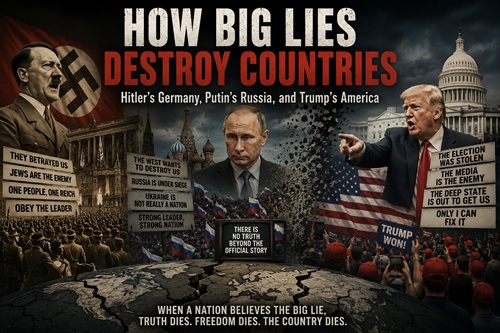 Timothy Snyder's On Freedom (2024) is not primarily a book about propaganda. It is a meditation on what freedom actually requires: the ability of human beings to act meaningfully in the world, to imagine alternatives, and to participate in a shared reality with others. Yet one of the most important implications of Snyder's argument concerns the destructive power of the Big Lie. A Big Lie is more than an ordinary falsehood. It is a comprehensive narrative that attempts to reorganize reality itself. It tells people not merely that one fact is wrong, but that the entire world they thought they knew is an illusion. It identifies enemies, invents betrayals, simplifies history, and offers a single explanation for all misfortune. Its power lies precisely in its scale. Once accepted, the Big Lie becomes a framework through which every new fact is interpreted. This is why Big Lies can destroy countries. They destroy not simply because people are deceived, but because the capacity for collective judgment is destroyed along with the truth. Citizens can no longer agree on what has happened, who is responsible, or what should be done. Institutions lose legitimacy. Expertise becomes suspect. Independent journalism becomes "propaganda." Political opponents become enemies of the nation. Eventually, the very distinction between truth and falsehood can become politically irrelevant. The examples of Hitler's Germany, Putin's Russia, and Trump's America are not identical. The first produced one of history's most murderous totalitarian regimes; the second has developed into an authoritarian state built around imperial nationalism; the third remains a functioning constitutional democracy, however severely strained. The comparison should therefore not be understood as an equation of regimes. The deeper comparison concerns a mechanism: what happens when a political movement constructs a powerful alternative reality and persuades enough people that loyalty to the story matters more than loyalty to facts? Hitler's Germany: The Big Lie as Total RealityThe Nazi regime offers perhaps the clearest historical example of the Big Lie becoming the organizing principle of an entire society. Hitler's propaganda did not consist of one false claim. It was a vast interconnected mythology. Germany had been betrayed in 1918. The First World War had not really been lost militarily but had been sabotaged from within. Jews were supposedly responsible for Germany's political and economic problems. Communists were portrayed as part of a vast international conspiracy. Versailles was presented as an intolerable national humiliation. The German people were promised national rebirth through racial unity and territorial expansion. The individual claims were false or wildly distorted, but their political power came from their combination. Together they formed a closed explanatory system. If Germany was weak, the Jews were responsible. If democracy failed, traitors were responsible. If Germany faced economic hardship, enemies were responsible. If Germany was criticized abroad, that criticism itself became evidence of an international conspiracy. The system was therefore almost impossible to falsify. Every fact could be absorbed into the mythology. This is one of the most dangerous characteristics of the Big Lie. A normal lie can be disproved by evidence. A Big Lie can incorporate evidence against it as proof of the conspiracy. The more strongly reality contradicts the narrative, the more the believer may conclude that the forces of deception must be even more powerful than previously imagined. The consequence was catastrophic. The Nazi regime did not merely deceive Germans about politics. It systematically destroyed the institutions through which reality could be independently examined. The press was controlled. Political opposition was eliminated. Universities and cultural institutions were brought into line. Independent organizations were dismantled or subordinated. The state itself became an instrument for enforcing the official narrative. The result was a society in which truth became increasingly inseparable from power. Snyder's conception of freedom helps illuminate what was lost. Freedom requires more than the absence of physical coercion. It requires the capacity to perceive possibilities and to act upon them. But if citizens are deprived of access to reliable information, their freedom of judgment is crippled before any political decision is made. The Nazi achievement was therefore not simply to tell Germans lies. It was to create an environment in which alternative accounts of reality became increasingly impossible to sustain. The Big Lie prepared the psychological ground for the destruction of the country itself. Once the nation was defined through racial mythology and permanent struggle, compromise became treason. Peace became weakness. Opponents became existential enemies. The state became subordinated to an imagined historical mission. Germany did not become stronger by believing these lies. It became progressively less capable of correcting its own mistakes. The ultimate irony is that the regime that promised national greatness led Germany to physical ruin, moral catastrophe, military defeat, division, and international disgrace. The Big Lie destroyed the country precisely because it made self-correction impossible. Putin's Russia: The Big Lie as Imperial NostalgiaVladimir Putin's Russia presents a different but related phenomenon. Putin's propaganda does not reproduce Hitler's racial ideology in identical form, nor does contemporary Russia operate as a carbon copy of Nazi Germany. But the political mechanism of constructing an alternative reality has become increasingly central to the Russian state. The foundational narrative is that Russia is surrounded by hostile forces seeking its destruction. The West is supposedly determined to weaken Russia, NATO is portrayed as an existential threat, and Ukraine is denied the full legitimacy of an independent national identity. Russian military aggression is reframed as defensive action. The invasion of Ukraine is presented as a necessary response to Western expansion, while the Russian government portrays itself as the defender of historical truth and traditional values. Again, the power of the narrative lies in its comprehensiveness. Russia is not responsible for its isolation; the West is. Russia is not invading Ukraine; Russia is defending itself. Russia is not suppressing dissent; it is protecting national unity. Russia is not restricting independent journalism; it is fighting foreign propaganda. Russia is not an authoritarian state; it is defending its sovereignty against hostile liberalism. The narrative turns reality upside down. The tragedy is that such narratives can be politically effective even when they are demonstrably false. They provide citizens with a coherent story in which national humiliation is transformed into national victimhood and aggression becomes self-defense. This is where Snyder's argument about freedom becomes especially relevant. A population does not need to be convinced of one specific falsehood to lose its freedom. It can also be trapped in a political atmosphere in which truth itself becomes inaccessible or irrelevant. When independent media disappear, when critics are imprisoned or forced into exile, and when the state controls the dominant narrative, citizens lose the ability to make informed judgments about their own government. The result is not simply ignorance. It is political helplessness. The Big Lie tells citizens that nothing they can do will change the basic story. The state is surrounded by enemies. The leader alone understands the danger. Criticism is collaboration with the enemy. Defeat is impossible because admitting defeat would undermine the entire mythology. Such a system can become extraordinarily dangerous because it creates a feedback loop between propaganda and policy. The leader tells the country that an external threat exists. The country responds to that threat. The government's actions then provoke international opposition. That opposition is presented as proof that the original claim was correct. The lie becomes self-reinforcing. The danger for Russia is therefore not merely that propaganda deceives its citizens. It is that the leadership itself may become trapped inside the narrative it has created. When a government surrounds itself with loyalists and suppresses inconvenient information, it becomes progressively harder for reality to reach the top. A country can then begin making decisions based on the world as it is imagined rather than the world as it exists. That is one of the ways Big Lies destroy states: they eventually deceive the deceivers. Trump's America: The Big Lie and the Fracturing of Democratic RealityThe American case is fundamentally different. The United States has not become Nazi Germany, and it is not Putin's Russia. Its constitutional institutions remain substantially intact, political opposition remains legal, independent media continue to operate, and power remains contested through elections and courts. But this difference should not obscure the significance of what has happened. Donald Trump's political movement demonstrated the extraordinary power of a Big Lie within a modern democracy. The clearest example is the false claim that the 2020 presidential election was stolen. The claim was repeatedly rejected by courts, election officials, recounts, and investigations. Yet for millions of Americans, the narrative persisted. The important point is not simply that a false claim was made. Politicians have always lied. The deeper problem was the creation of a parallel political reality in which any evidence contradicting the claim could itself be dismissed as part of the conspiracy. The election was stolen. The courts were corrupt. Election officials were corrupt. The media were corrupt. The vote-counting machines were corrupt. Republican officials who rejected the claim were traitors or cowards. The absence of evidence became evidence of a cover-up. This is the architecture of the Big Lie. The political danger was therefore greater than the original falsehood. The claim attacked the mechanism through which democratic societies correct falsehoods. If elections cannot be trusted, why accept their results? If courts cannot be trusted, why accept their judgments? If journalists cannot be trusted, how can citizens know what happened? If experts cannot be trusted, how can complex problems be solved? Once these questions become dominant, democracy begins to lose its shared epistemic foundation. Democracy depends upon disagreement, but it cannot survive unlimited disagreement about reality itself. Citizens can reasonably disagree about taxes, immigration, abortion, climate policy, or foreign affairs. They can debate what the facts mean. But if they cannot agree that certain facts are facts, democratic deliberation becomes increasingly difficult. This is where the American experience connects directly with Snyder's argument. Freedom requires the possibility of acting together without requiring everyone to think alike. A democratic society does not need consensus. It needs a shared enough reality to permit disagreement within a common political world. The Big Lie attacks precisely that common world. Its ultimate objective need not be the establishment of a dictatorship. It can be enough to make democratic government permanently dysfunctional. If half the population believes every election is fraudulent whenever their side loses, peaceful transfers of power become increasingly fragile. The danger is therefore not only authoritarianism. It is epistemic civil war. A country can remain formally democratic while its citizens inhabit radically incompatible realities. From Falsehood to Institutional CollapseThe three examples reveal a common progression. First comes the story. Then comes the enemy. Then comes the rejection of independent sources of information. Then comes the delegitimization of institutions. Finally, the political movement claims that only it can be trusted to save the nation. At this point, the Big Lie has become more than propaganda. It has become a political technology. The leader does not merely say, "Believe me." The message becomes: "Believe me, because everyone else is lying." This is an extraordinarily powerful rhetorical move. It allows the leader to survive any contradiction. If journalists expose a falsehood, they are part of the conspiracy. If courts reject the claim, the courts are corrupt. If scientists disagree, they are bought. If election officials contradict the leader, they are enemies of the people. The result is a political system in which the leader becomes the ultimate arbiter of reality. That is fundamentally incompatible with freedom. A free society requires distributed authority. No single person should possess the power to determine what is true for everyone else. Truth must remain open to investigation, criticism, correction, and revision. The Big Lie reverses this principle. It concentrates reality itself in the hands of political power. The Three Countries, Three OutcomesThe comparison between Germany, Russia, and America should therefore be made carefully. Hitler's Germany demonstrates the extreme endpoint: the Big Lie became the foundation of a totalitarian state that ultimately led its own country into catastrophe. Putin's Russia demonstrates how an authoritarian regime can use historical mythology, nationalism, and controlled information to justify repression and external aggression while progressively isolating itself from corrective reality. Trump's America demonstrates the danger within a democratic system: the Big Lie can weaken institutions and fracture the shared reality on which democratic self-government depends, even without immediately abolishing democracy itself. These are different stages and different political systems. But they illuminate the same underlying vulnerability. Countries do not survive through institutions alone. They also require a minimum of shared trust in reality. When citizens disagree about values, democracy can function. When citizens disagree about policies, democracy can function. When citizens disagree about interpretations of history, democracy can still function. But when citizens lose the ability to distinguish between evidence and invention, democracy becomes dangerously unstable. The Freedom to Live in RealityPerhaps the deepest lesson to draw from Snyder is that freedom depends upon truth in a way that is often underestimated. Freedom is not simply the right to say whatever one wants. Nor is it merely the absence of government coercion. Freedom requires the ability to orient oneself in the world and to make meaningful choices. A person who is systematically deceived is not fully free, even if no one is physically forcing that person to act. The same is true of societies. A nation that cannot distinguish between reality and political mythology loses its capacity for collective self-government. It cannot learn from mistakes because mistakes are denied. It cannot correct bad policies because criticism is treated as betrayal. It cannot peacefully resolve disagreements because opponents are no longer regarded as fellow citizens but as enemies. This is why Big Lies can destroy countries. They do not necessarily destroy them overnight. They corrode the mechanisms of correction. They make failure impossible to admit. They make compromise immoral. They make criticism treasonous. They make facts partisan. And eventually they make reality itself the enemy. The ultimate defense against the Big Lie is therefore not simply fact-checking, though fact-checking matters enormously. It is the preservation of a culture in which no political leader is allowed to become the sole authority on truth. A free society must cultivate independent institutions, a free press, intellectual pluralism, scientific integrity, historical memory, and citizens capable of changing their minds. The opposite of the Big Lie is not merely the "correct story." It is a society in which no story is beyond question. That may be one of the most important implications of Snyder's On Freedom. Freedom requires not only the right to choose. It requires the intellectual and institutional conditions that allow people to choose in contact with reality. Hitler's Germany shows what happens when a nation surrenders reality to mythology. Putin's Russia shows what happens when mythology becomes the permanent language of power. Trump's America shows that even a democracy can become vulnerable when a significant part of its population is persuaded that reality itself is a partisan conspiracy. The Big Lie is therefore ultimately a war against freedom. It is a war against the freedom to know, the freedom to question, the freedom to correct, and the freedom to imagine that things might be otherwise. And once a country loses those freedoms, recovering them can be far harder than losing them.
Widget is loading comments...
|