|
TRANSLATE THIS ARTICLE
Integral World: Exploring Theories of Everything
An independent forum for a critical discussion of the integral philosophy of Ken Wilber
  Frank Visser, graduated as a psychologist of culture and religion, founded IntegralWorld in 1997. He worked as production manager for various publishing houses and as service manager for various internet companies and lives in Amsterdam. Books: Ken Wilber: Thought as Passion (SUNY, 2003), and The Corona Conspiracy: Combatting Disinformation about the Coronavirus (Kindle, 2020). Frank Visser, graduated as a psychologist of culture and religion, founded IntegralWorld in 1997. He worked as production manager for various publishing houses and as service manager for various internet companies and lives in Amsterdam. Books: Ken Wilber: Thought as Passion (SUNY, 2003), and The Corona Conspiracy: Combatting Disinformation about the Coronavirus (Kindle, 2020).
Check out my other conversations with ChatGPT
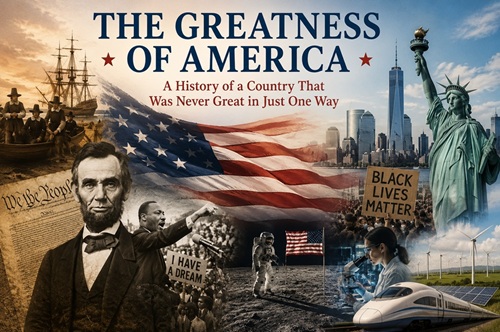
THE CONTEMPORARY EMPIRES: How Big Lies Destroy Countries The Rise or the Return of China? The History Russia Actually Had The True Greatness of America The Strange Journey of Communism The Greatness of AmericaA History of a Country That Was Never Great in Just One WayFrank Visser / ChatGPT
The phrase “Make America Great Again” sounds simple enough. It promises a return to something that once existed: a golden age in which America was supposedly stronger, richer, safer, more respected, and more united than it is today. But the slogan conceals a fundamental question. When, exactly, was America great? The answer depends entirely on whom one asks. For enslaved African Americans, the antebellum South was hardly a golden age. For Indigenous peoples, the westward expansion of the United States meant dispossession, warfare, and cultural destruction. For women, political equality arrived only after a long struggle. For immigrants, America could be both a land of opportunity and a place of exclusion. For workers, the great industrial boom brought both prosperity and brutal exploitation. For religious and sexual minorities, much of America's past was anything but liberating. And yet, despite this complicated history—or perhaps because of it—America really has achieved something remarkable. Its greatness is real. But it is not the greatness of racial purity, permanent military dominance, or nostalgic national mythology. America's deepest greatness lies in the fact that it has repeatedly expanded the meaning of who counts as an American. That story is unfinished. A Revolution Built on a ContradictionThe United States was born from an extraordinary contradiction. The Declaration of Independence proclaimed that "all men are created equal" and endowed with "unalienable Rights." The Constitution established a new republican system based on popular government and institutional checks on power. The American Revolution became a landmark in the history of modern democracy. But the new republic was also a society in which millions of people were enslaved, Indigenous nations were pushed from their lands, and women were excluded from political participation. The contradiction was not a minor flaw in an otherwise completed project. It was built into the foundation. This is one of the most important facts about American history. The United States did not begin as a perfect democracy that subsequently declined. It began as an unfinished experiment. Its founding ideals were more universal than the society that proclaimed them. That gap between principle and reality would become one of the great engines of American history. The Declaration could be used by abolitionists against slavery. The Constitution could become an instrument of constitutional reform. The language of equality could be invoked by women, workers, immigrants, African Americans, and later by LGBTQ citizens. The very ideals that the founding generation only partially realized could be turned against the limitations of their own society. This is where America's greatness begins—not in perfection, but in self-correction. Expansion and the Price of the American DreamDuring the nineteenth century, the United States expanded across the continent. The Louisiana Purchase, the conquest of territory from Mexico, and the doctrine of Manifest Destiny transformed the country into a continental power. The expansion brought enormous economic opportunities. Land, agriculture, commerce, and eventually industrialization helped create one of the world's most dynamic economies. But expansion also came at an immense human cost. Native American nations were displaced through war, coercion, broken treaties, and forced removals. The Trail of Tears became one of the most infamous episodes in this history. The Mexican-American War added vast territories to the United States while intensifying the unresolved conflict over slavery. At the same time, slavery expanded with the cotton economy. The United States became increasingly prosperous while millions of African Americans remained legally enslaved. The American paradox became sharper: a republic dedicated to liberty depended in part on the denial of liberty. The Civil War eventually forced the country to confront this contradiction. The Civil War and the Second FoundingThe Civil War was the most devastating conflict in American history. More Americans died than in any other war the country has fought. But the war also transformed the meaning of the republic. The abolition of slavery through the Thirteenth Amendment was followed by the Fourteenth Amendment's guarantee of citizenship and equal protection, and the Fifteenth Amendment's protection of voting rights for Black men. The United States had, in effect, a second founding. Abraham Lincoln's Gettysburg Address captured this transformation with extraordinary economy. The war, he suggested, would determine whether a nation "conceived in Liberty" and dedicated to equality could survive. The answer was yes—but only partially. Reconstruction failed to establish lasting racial equality. White supremacist violence, segregation, voter suppression, and discriminatory laws created a new system of racial domination. America had abolished slavery, but it had not abolished racism. Again, however, the story did not end there. The Immigrant NationOne of America's greatest strengths has always been its capacity to absorb newcomers. The United States became a destination for millions of immigrants from Europe, Asia, Latin America, and elsewhere. They arrived for different reasons: economic opportunity, political freedom, religious refuge, or simple survival. The immigrant experience was never uniformly welcoming. Anti-Irish prejudice, antisemitism, anti-Catholicism, the Chinese Exclusion Act, immigration quotas, and other forms of discrimination reveal a long history of exclusion. Yet immigrants repeatedly transformed the country. They built railways, factories, farms, universities, laboratories, businesses, neighborhoods, and cultural institutions. They brought languages, cuisines, religions, music, literature, scientific knowledge, and entrepreneurial energy. The America that many people imagine as "traditional" is itself largely the product of immigration. The irony is unavoidable: those who claim to defend an authentic America often defend an America that never existed. There has never been one fixed American identity. The country has always been a mixture. The Industrial GiantBy the late nineteenth and early twentieth centuries, America was becoming an industrial superpower. The rise of mass production, railroads, electricity, petroleum, steel, and modern corporations transformed the economy. American capitalism produced extraordinary wealth, but it also created enormous inequality. Workers often labored under dangerous conditions for long hours and low wages. Child labor was widespread. Industrial accidents were common. The great fortunes of the Gilded Age existed alongside profound poverty. The response was the Progressive Era and the rise of organized labor. The American story here is again one of conflict and adjustment. The country did not simply become prosperous through the genius of businessmen. It also became more prosperous because workers organized, reformers challenged monopolies, governments regulated corporations, and citizens demanded social protections. The New Deal later expanded this transformation. After the catastrophe of the Great Depression, Franklin Roosevelt's administration created a new relationship between government, markets, and citizens. Social Security, financial regulation, public works, and labor protections helped establish the foundations of the modern welfare state. This was not socialism. It was American capitalism learning that it could not survive indefinitely without rules. The American CenturyThe twentieth century brought the United States to the center of world affairs. Two world wars, the Great Depression, the defeat of fascism, and the emergence of the Cold War transformed America into a global superpower. The United States possessed extraordinary economic and military power. But its international influence was not based on military strength alone. America also projected an image of openness, innovation, education, science, popular culture, and constitutional democracy. Its universities attracted students from around the world. Its laboratories produced scientific breakthroughs. Its companies transformed communications, transportation, computing, and medicine. Its cultural influence spread through jazz, cinema, rock music, literature, television, and later the internet. The American model was never universally admired, and American foreign policy often contradicted its democratic ideals. The country supported authoritarian regimes, conducted controversial interventions, and sometimes sacrificed democratic principles in the name of strategic interests. The United States, like every great power, has a record of hypocrisy. But hypocrisy itself reveals something important: America repeatedly claimed universal principles that could be used to judge America's own behavior. That is a source of both weakness and strength. The Long Struggle for Civil RightsPerhaps the clearest example of American greatness is the civil rights movement. For generations, African Americans fought against slavery, segregation, disenfranchisement, and racial violence. The struggle culminated in the great civil rights campaigns of the twentieth century. Figures such as Martin Luther King Jr. appealed not merely to Black identity but to the deepest principles of American democracy. The civil rights movement effectively said: America, become what you claim to be. That demand changed the country. The Civil Rights Act of 1964, the Voting Rights Act of 1965, and other reforms transformed American law and society. The movement's greatness was not that America had suddenly become free of racism. It was that citizens used the country's own constitutional ideals to expose the distance between rhetoric and reality. This pattern has repeated itself throughout American history. America advances when its citizens insist that the promises of the republic apply to everyone. The American AchievementSo what, then, is America's true greatness? It is not simply its military. It is not its wealth. It is not Hollywood. It is not Wall Street. It is not the size of its territory. It is not even the Constitution by itself. America's deepest achievement is the creation of a political culture in which the nation's ideals can be used to criticize the nation itself. The Declaration of Independence can be read against slavery. The Constitution can be invoked against government abuse. The Fourteenth Amendment can be used to challenge discrimination. The First Amendment protects the right to criticize the government. The press can investigate presidents. Courts can overturn laws. Citizens can protest. Opposition parties can replace governments without civil war. These mechanisms have never worked perfectly. They have often failed. They have sometimes been manipulated. But they represent a remarkable historical invention: a political system that theoretically allows a country to admit that it is wrong and change itself. That is a different kind of greatness from imperial glory. Appendix: Trump and the Commercialization of America's GreatnessDonald Trump did not invent American nostalgia. Political movements have always romanticized the past. What distinguishes Trump's use of "Make America Great Again" is the extent to which the slogan turns national greatness into a commercial and political brand. The phrase sounds like a patriotic promise. But it also functions as a remarkably successful marketing device. Trump's genius, as a political communicator, is to transform a complex historical question into a personal transaction: America was great. America has been betrayed. I alone can restore it. This formula has enormous emotional power. But it rests on a fictional simplicity. Which America Are We Returning To?Trump's rhetoric rarely specifies exactly which America he wants to restore. Is it the America of the Founding Fathers? That was a country with slavery and without universal suffrage. Is it the America of the 1950s? That was a period of economic growth, but also of segregation, McCarthyism, and limited rights for many groups. Is it the America of the 1980s? That era brought economic dynamism but also deindustrialization, growing inequality, and the beginning of a dramatic concentration of wealth. Is it the America of the postwar years? That was a period in which the United States benefited from an unusually favorable global economic position that cannot simply be recreated through political slogans. The nostalgic past is therefore less a historical reality than a political projection screen. People can imagine whatever golden age they want. Trump's slogan succeeds precisely because it leaves the object of nostalgia undefined. From Patriotism to BrandingTrump has an unusual relationship with branding. His name became a global commercial identity long before his political career. The Trump brand was associated with luxury, wealth, real estate, celebrity, and personal success. When Trump entered politics, he transferred this commercial logic into the realm of national identity. The country itself became a brand. "America" became the product. "Great Again" became the promise. And Trump positioned himself as the CEO capable of delivering the product. This is a profound shift in political rhetoric. Traditional democratic politics asks citizens to participate in governing a common republic. Trump's political style often asks them to buy into a personal brand. The distinction matters. A republic is an institution. A brand is a marketable identity. The first belongs to everyone. The second belongs, ultimately, to its owner. The Politics of Personal ProfitThe question of profit is particularly important because Trump's political career has repeatedly blurred the boundaries between public office and private commercial interests. Trump entered politics as a wealthy businessman whose name itself had commercial value. His political movement subsequently became associated with fundraising appeals, merchandise, media ventures, and various commercial enterprises. The danger here is not that politicians should be forbidden from being wealthy or commercially successful. The deeper danger is that patriotism itself can become monetized. When political loyalty is expressed through merchandise, donations, branded products, and repeated fundraising appeals, the emotional bond between citizen and nation can become entangled with the financial interests of a political entrepreneur. The patriotic consumer is invited to demonstrate loyalty by purchasing something. The political supporter becomes a customer. The national flag becomes a logo. The slogan becomes intellectual property. The leader becomes the brand. This is not unique to Trump, but he has perfected the technique to an extraordinary degree. The Greatness of the Past as a Political WeaponTrump's most consequential use of history is not historical scholarship. It is selective memory. He emphasizes periods of American strength while minimizing the conflicts and exclusions that accompanied them. He celebrates economic prosperity while often overlooking the institutions and public investments that made that prosperity possible. He invokes national unity while using highly polarizing rhetoric. He praises American greatness while attacking many of the institutions—courts, universities, journalists, civil servants, electoral officials—that have historically contributed to the stability of American democracy. This produces a curious paradox. The slogan promises to restore the greatness of the American republic while sometimes weakening the very institutional traditions that make republican government possible. The real American legacy is not obedience to a leader. It is resistance to concentrated power. The Founding Fathers were deeply suspicious of political power becoming personal power. The Constitution was designed around separation of powers precisely because the founders understood that even leaders who claimed to act for the nation could become dangerous. The American tradition therefore contains a built-in warning against political messianism. No president is America. No political party is America. No billionaire is America. No slogan is America. The Greatness That Cannot Be OwnedThe most important distinction between Trump's version of American greatness and the historical reality is this: America's greatest achievements belong to no individual. The Constitution belongs to the public. The abolition of slavery belongs to generations of abolitionists, soldiers, activists, and citizens. The civil rights movement belongs to millions of people. The moon landing belongs to scientists, engineers, astronauts, technicians, and taxpayers. American scientific achievements belong to universities, laboratories, researchers, and generations of students. The country's cultural achievements belong to countless artists, musicians, writers, filmmakers, immigrants, and outsiders. The greatness of America is therefore fundamentally collective. It is the accumulated work of millions of people, many of whom were never famous and never wealthy. That is precisely why it is misleading when a political leader presents national greatness as something that can be restored through his personal leadership. The country is not a corporation. Citizens are not shareholders. The president is not the CEO. And history is not a marketing department. The Real Way to Make America GreatIf America is to become "great again," the most historically authentic way would be to recover not some imaginary golden age but the country's capacity for renewal. America's true greatness lies in its ability to expand democracy rather than contract it; to welcome talent rather than fear difference; to invest in science and education; to protect constitutional institutions; to accept peaceful transfers of power; to confront injustice rather than romanticize it; and to recognize that patriotism can include criticism. The country has been great whenever Americans have enlarged the circle of freedom. It was great when slavery was abolished. It was great when women won the vote. It was great when workers gained rights. It was great when segregation was dismantled. It was great when immigrants were welcomed and became citizens. It was great when scientists reached the moon. It was great when journalists exposed corruption. It was great when citizens protested peacefully against their own government. It was great when presidents accepted constitutional limits. And it was great whenever ordinary people insisted that the words written in America's founding documents should apply to them too. The greatest America, in other words, has never been a finished America. It has always been an America in progress. Trump's slogan looks backward. The real American tradition looks forward. The country does not need to return to a mythical past to be great. It needs to live up to its unfinished promise. That promise is demanding enough. It does not require mythology, nostalgia, or a political brand. It requires democracy.
Widget is loading comments...
|