|
TRANSLATE THIS ARTICLE
Integral World: Exploring Theories of Everything
An independent forum for a critical discussion of the integral philosophy of Ken Wilber
  Frank Visser, graduated as a psychologist of culture and religion, founded IntegralWorld in 1997. He worked as production manager for various publishing houses and as service manager for various internet companies and lives in Amsterdam. Books: Ken Wilber: Thought as Passion (SUNY, 2003), and The Corona Conspiracy: Combatting Disinformation about the Coronavirus (Kindle, 2020). Frank Visser, graduated as a psychologist of culture and religion, founded IntegralWorld in 1997. He worked as production manager for various publishing houses and as service manager for various internet companies and lives in Amsterdam. Books: Ken Wilber: Thought as Passion (SUNY, 2003), and The Corona Conspiracy: Combatting Disinformation about the Coronavirus (Kindle, 2020).
Check out my other conversations with ChatGPT
THE INTEGRAL ECHO CHAMBER
The Psychology of the 'Shadow' Defense Why Integral Theory Rarely Corrects Itself Charismatic Authority versus Scientific Culture Integral as an Echo Chamber? A Habermasian Integral Community What Would a Habermasian Integral Community Look Like?The Culture of Rational AccountabilityFrank Visser / ChatGPT
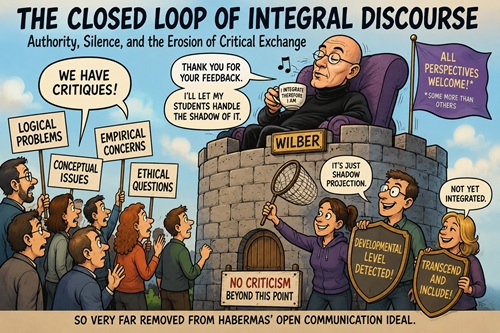 A Habermasian Integral Community would be, in essence, a disciplined experiment in communicative rationality embedded inside a broader developmental philosophy. It would not be “integral” in the Wilberian sense of a metaphysical synthesis of all domains into Spirit, but rather integral in a procedural sense: integrating multiple perspectives through justified discourse, institutionalized reflexivity, and norm-governed critique. To understand what such a community would look like, it helps to anchor it in Jürgen Habermas's core ideas: communicative action, discourse ethics, the ideal speech situation, and the differentiation of lifeworld and system. A Habermasian integral community would operationalize these not as abstract philosophy, but as lived social architecture. The primacy of communicative rationalityAt the center would be the principle that validity claims must be redeemable through argument rather than authority, charisma, or tradition. Every assertion would be implicitly open to challenge on three fronts: truth (does it correspond to facts?), rightness (is it normatively justified?), and sincerity (is the speaker genuinely expressing their intention?). Unlike charismatic integral communities, where developmental hierarchies or spiritual insight can function as implicit authority, a Habermasian version would structurally prevent any participant from occupying a permanently privileged epistemic position. Expertise would matter, but only insofar as it survives public justification under conditions of critique. Institutions would be designed around this. Meetings, publications, and decision-making forums would be structured as discourse arenas rather than affirmation spaces. The goal is not consensus at any cost, but what Habermas calls “rationally motivated agreement” or, more realistically, “rationally motivated disagreement with clarified grounds.” Discourse as infrastructureA Habermasian integral community would resemble less a “movement” and more a layered deliberative ecology. There would be multiple tiers of discourse: informal exploratory exchanges, structured debates, peer-reviewed interpretive work, and meta-discourse about the rules of discourse itself. Importantly, there would be institutionalized mechanisms for critique of the community's own assumptions. Any dominant framework—whether scientific, philosophical, spiritual, or ideological—would remain revisable under conditions of argumentation. This includes the community's own commitment to Habermas himself, which would not be treated as doctrine but as a fallible methodological orientation. The difference from many “integral” communities is that no privileged ontological synthesis (such as a grand theory of consciousness or evolution) would be allowed to stabilize beyond criticism. The community would resist metaphysical closure by design. The role of expertise and asymmetryHabermas does not deny asymmetries in knowledge. A physicist knows more physics than a layperson; a historian knows more archival context. A Habermasian integral community would preserve epistemic specialization, but it would translate expertise into publicly criticizable claims rather than deference structures. This is crucial: authority would be procedural, not substantive. Experts would have no final say; they would only have the obligation to present arguments that can survive scrutiny in a rational forum. This is quite different from integral hierarchies where “higher stages” or “wider perspectives” are sometimes treated as intrinsically more valid. In practice, this would produce a culture where disagreement with experts is not only permitted but institutionally expected—provided the disagreement is argumentatively serious rather than merely expressive. Lifeworld protection against system colonizationA key Habermasian concern is the colonization of the lifeworld by system imperatives such as money and power. A Habermasian integral community would therefore be highly sensitive to how economic incentives, institutional prestige, and media dynamics distort discourse. For example, if such a community developed a publishing platform, it would need safeguards against algorithmic amplification of sensational claims. Likewise, funding structures would have to be insulated from domination by a small group of donors whose preferences could silently steer discourse. This makes such communities fragile in real-world conditions. Pure communicative rationality is difficult to sustain in environments shaped by attention economies and institutional competition. Relation to “integral” frameworksCompared to Wilber-style Integral Theory, a Habermasian version would be dramatically less metaphysical and far more procedural. It would not assume that reality is structured by developmental “levels” culminating in spiritual realization. Instead, it would assume that validity emerges through argument under idealized conditions. Where integral theory often seeks synthesis, Habermasian discourse seeks ongoing revision. Where integral theory tends to privilege transpersonal or “higher” perspectives, Habermas flattens epistemic authority into intersubjective accountability. If there is anything “integral” in this version, it is the attempt to hold together multiple forms of rationality—scientific, moral, aesthetic, interpretive—without collapsing them into a single ontological hierarchy. The lived culture of such a communitySocially, one might expect a distinctive ethos: low tolerance for rhetorical inflation, skepticism toward metaphysical totalization, and a preference for slow, explicit reasoning over inspirational synthesis. Conversations would likely feel more like extended seminars or critical workshops than spiritual gatherings or ideological forums. Disagreement would be normal and not necessarily seen as failure; rather, it would be treated as a resource for clarifying validity claims. At the same time, this can produce a certain emotional austerity. Habermasian spaces tend to be cognitively rich but affectively restrained. This is one of the well-known criticisms: that pure communicative rationality risks draining the existential or existentially motivating dimensions of community life. Tensions and limitationsA Habermasian integral community faces several structural tensions. First, the ideal speech situation is counterfactual; it cannot be fully realized. Power asymmetries, linguistic inequalities, and cognitive differences persist. The community would therefore always be engaged in approximating an ideal it can never fully instantiate. Second, the requirement of rational justification can itself become exclusionary. Not all forms of human meaning—myth, ritual, poetic resonance—translate cleanly into argument. A strict Habermasian environment risks marginalizing non-propositional forms of understanding. Third, such communities can become procedurally correct but existentially thin: excellent at critique, weaker at meaning-generation or motivation. ConclusionA Habermasian integral community would be best understood not as a spiritual or philosophical synthesis project, but as a deliberative infrastructure for managing pluralism under conditions of rational accountability. It would replace metaphysical integration with procedural integration, and replace hierarchical “levels of consciousness” with egalitarian yet expertise-sensitive discourse ethics. In short, it would be less about ascending to higher visions of reality and more about building institutions where no vision can escape the requirement of justification.
Widget is loading comments...
|