|
TRANSLATE THIS ARTICLE
Integral World: Exploring Theories of Everything
An independent forum for a critical discussion of the integral philosophy of Ken Wilber
  Frank Visser, graduated as a psychologist of culture and religion, founded IntegralWorld in 1997. He worked as production manager for various publishing houses and as service manager for various internet companies and lives in Amsterdam. Books: Ken Wilber: Thought as Passion (SUNY, 2003), and The Corona Conspiracy: Combatting Disinformation about the Coronavirus (Kindle, 2020). Frank Visser, graduated as a psychologist of culture and religion, founded IntegralWorld in 1997. He worked as production manager for various publishing houses and as service manager for various internet companies and lives in Amsterdam. Books: Ken Wilber: Thought as Passion (SUNY, 2003), and The Corona Conspiracy: Combatting Disinformation about the Coronavirus (Kindle, 2020).
Check out my other conversations with ChatGPT
THE INTEGRAL ECHO CHAMBER
The Psychology of the 'Shadow' Defense Why Integral Theory Rarely Corrects Itself Charismatic Authority versus Scientific Culture Integral as an Echo Chamber? A Habermasian Integral Community Why Integral Theory Rarely Corrects ItselfSelf-Sealing Systems and the Missing Mechanism of Error CorrectionFrank Visser / ChatGPT
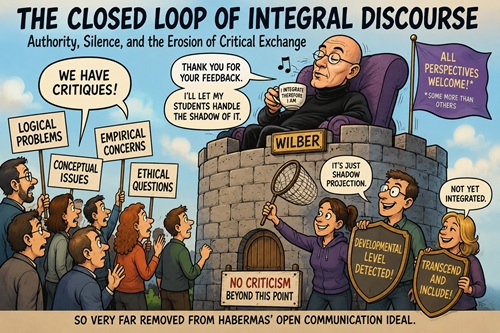 One of the hallmarks of a healthy intellectual tradition is not that it avoids mistakes, but that it develops reliable mechanisms for correcting them. Science, despite its many flaws, progresses because it institutionalizes criticism. Philosophy advances through argument and counterargument. Even democratic societies depend on procedures for exposing and revising error. Integral Theory, despite its sweeping ambition to integrate all forms of knowledge, appears to possess surprisingly weak mechanisms for self-correction. This is not merely a matter of Ken Wilber's personality or his reluctance to engage critics. It reflects deeper structural features of the integral movement itself. The question is therefore not simply why Wilber rarely changes his mind. It is why the intellectual ecosystem surrounding Integral Theory makes genuine revision so difficult. Science Advances by Organized SkepticismScience has no final authority. Every theory, however successful, remains provisional. Einstein corrected Newton without rendering him useless. Molecular biology transformed classical genetics. Plate tectonics revolutionized geology. These changes were often resisted, but eventually evidence prevailed over authority. The sociologist Robert Merton described organized skepticism as one of science's defining norms. Claims are expected to survive criticism from informed peers. Reputation offers no immunity. Error correction is therefore built into the system itself. Scientists often dislike criticism. Science depends upon it. Integral Theory Has No Comparable InstitutionIntegral Theory has conferences, online communities, books, and training programs. What it largely lacks is a recognized process through which foundational claims can be revised. There is no independent peer review capable of overturning Wilber's conclusions. No formal debates over disputed doctrines. No accepted procedure for distinguishing between obsolete and enduring elements of the system. Instead, revisions typically originate with Wilber himself. When the principal architect also remains the principal authority, correction becomes highly centralized. That arrangement works well if the architect actively revises his work. It works less well when revision becomes increasingly rare. The Cost of a Grand SynthesisIntegral Theory aspires to explain psychology, philosophy, religion, evolution, politics, sociology, anthropology, and spirituality within a single overarching framework. Such ambition has obvious appeal. It also creates unusual resistance to modification. In a specialized scientific theory, correcting one component usually leaves the rest intact. In a grand synthesis, however, changing one major assumption may require adjustments across dozens of interconnected concepts. If Spirit is removed from evolution... • What happens to Eros? • What happens to developmental cosmology? • What becomes of mystical insight into evolutionary direction? The larger the conceptual architecture becomes, the more difficult structural renovation becomes. Every Challenge Becomes SystemicThis helps explain why relatively narrow criticisms often provoke disproportionately broad defenses. Suppose someone questions Wilber's interpretation of evolutionary biology. From the critic's perspective, this concerns a specific empirical issue. From within the integral framework, however, evolution supports many larger themes: • development, • increasing complexity, • spiritual emergence, • cosmic direction, • and the unfolding of consciousness. A challenge to one element therefore feels like a challenge to the whole. The system encourages holistic defense rather than localized correction. The Role of Charismatic AuthorityAnother obstacle is the influence of charismatic authority. Wilber is not merely an academic author. For many readers he functions as philosopher, spiritual guide, cultural visionary, and synthesizer of modern knowledge. These roles create a relationship that differs from ordinary scholarly disagreement. When respected authorities are criticized, followers often experience the criticism personally. Defending the teacher becomes intertwined with defending one's own intellectual identity. This is hardly unique to Integral Theory. It occurs in religious traditions, political movements, psychoanalytic schools, and even scientific revolutions. But Integral Theory's combination of philosophy and spirituality makes the effect particularly strong. Internal Criticism Has Narrow BoundariesIntegral discussions certainly contain disagreement. Participants debate applications. Interpretations differ. New terminology appears. Fresh perspectives emerge. Yet these disagreements often occur within accepted boundaries. Questions such as these are welcomed: How should AQAL apply to education? What developmental stage best explains contemporary politics? How should meditation be integrated with psychotherapy? Less welcome are questions about the framework itself: Is developmental hierarchy overstated? Does mystical experience justify metaphysical conclusions? Has evolutionary science been accurately represented? These questions challenge foundations rather than applications. Foundational criticism is inherently more difficult to assimilate. The Vocabulary of ContainmentIntegral Theory possesses an unusually rich vocabulary for absorbing disagreement. • Critics may be described as reductionistic. • Or flatland thinkers. • Or stuck at a particular developmental altitude. • Or operating from an inadequate worldview. • Or expressing unresolved shadow. Each concept may occasionally be appropriate. Collectively, however, they create a remarkably effective containment system. Almost any criticism can be interpreted without requiring significant revision of the theory itself. The framework remains intact because the explanation shifts from the argument to the critic. The Missing Feedback LoopHealthy intellectual traditions possess recursive feedback. Criticism produces revision. Revision produces new criticism. The cycle continues indefinitely. Integral Theory often interrupts this cycle. Criticism enters. Discussion occurs among followers and critics. But relatively little returns to reshape the framework itself. Instead of a feedback loop, one observes something closer to a filter. Arguments are acknowledged, categorized, interpreted—and then often left outside the system's conceptual core. Without feedback, learning slows. Without correction, confidence increases faster than reliability. The Paradox of IntegrationIntegral Theory presents itself as the most inclusive framework ever devised. It seeks to "transcend and include" every previous worldview. Yet inclusion of perspectives is not the same as inclusion of criticism. A theory can accommodate many viewpoints while remaining remarkably resistant to revising its own assumptions. This is perhaps the movement's greatest paradox. Its conceptual openness may coexist with procedural closure. Everything can be included—except the possibility that the framework itself requires substantial correction. Conclusion: Wisdom Requires RevisabilityNo intellectual system can permanently avoid error. The decisive question is whether it possesses mechanisms for discovering and correcting its mistakes. Science does. Democratic politics attempts to. Good philosophy strives to. Integral Theory has developed sophisticated models of consciousness, development, and spirituality. It has been less successful in developing equally sophisticated procedures for revising itself in response to sustained external criticism. This need not remain so. Indeed, a truly integral philosophy would treat criticism not as an unfortunate necessity or a developmental inconvenience, but as one of the essential engines of growth. The most comprehensive worldview should also be the most corrigible. Otherwise, its celebrated capacity to "transcend and include" risks becoming a one-way process: integrating everything except the arguments that might transform it.
Widget is loading comments...
|