|
TRANSLATE THIS ARTICLE
Integral World: Exploring Theories of Everything
An independent forum for a critical discussion of the integral philosophy of Ken Wilber
  Frank Visser, graduated as a psychologist of culture and religion, founded IntegralWorld in 1997. He worked as production manager for various publishing houses and as service manager for various internet companies and lives in Amsterdam. Books: Ken Wilber: Thought as Passion (SUNY, 2003), and The Corona Conspiracy: Combatting Disinformation about the Coronavirus (Kindle, 2020). Frank Visser, graduated as a psychologist of culture and religion, founded IntegralWorld in 1997. He worked as production manager for various publishing houses and as service manager for various internet companies and lives in Amsterdam. Books: Ken Wilber: Thought as Passion (SUNY, 2003), and The Corona Conspiracy: Combatting Disinformation about the Coronavirus (Kindle, 2020).
Check out my other conversations with ChatGPT
THE INTEGRAL ECHO CHAMBER
The Psychology of the 'Shadow' Defense Why Integral Theory Rarely Corrects Itself Charismatic Authority versus Scientific Culture Integral as an Echo Chamber? A Habermasian Integral Community The Psychology of the 'Shadow' DefenseWhen Psychologizing Replaces ArgumentFrank Visser / ChatGPT
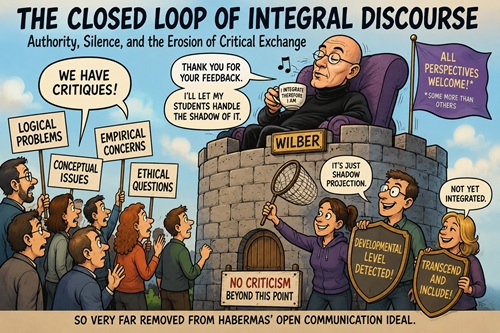 Among the many concepts that Ken Wilber introduced into the integral vocabulary, few have been as influential—or as easily misused—as the idea of the "shadow." Originally intended as a valuable psychological insight, it has often evolved into a rhetorical defense against criticism. Instead of illuminating unconscious motives, it can become a convenient explanation for why critics disagree in the first place. The irony is striking. A concept designed to increase self-awareness can end up reducing intellectual openness. This is not an argument against shadow work itself. It is an argument against extending a psychological concept into an all-purpose epistemological shield. From Jung to IntegralThe notion of the shadow originates in the work of Carl Jung. The shadow refers to those aspects of ourselves that we fail to acknowledge and therefore tend to project onto others. Anger, envy, fear, superiority, and many other traits can be disowned and then perceived as belonging to someone else. As a therapeutic concept, the shadow has considerable value. It encourages self-reflection rather than blame. Integral Theory expanded this insight into a broader developmental framework. Wilber frequently argues that genuine growth requires both "waking up" spiritually and "cleaning up" psychologically. Spiritual realization alone is insufficient if unresolved shadow material continues to distort one's perceptions and relationships. Few would dispute this general principle. The difficulty begins when shadow becomes an explanation not merely for emotional reactions but for intellectual disagreement. The Critic as PatientSuppose someone challenges Integral Theory's interpretation of biological evolution. One response would be to examine the evidence. Another would be to ask whether the critic has accurately represented Wilber's position. A third, however, is subtly different: "Your criticism probably reflects unresolved shadow." Notice what has happened. The discussion has shifted away from the argument and toward the person making it. Perhaps the critic is angry. Perhaps he feels excluded. Perhaps he resents Wilber's success. Perhaps he is unconsciously identified with reductionism. All these possibilities may be psychologically true. They may also be completely irrelevant to whether his criticism is correct. The Genetic Fallacy RepackagedPhilosophy has long recognized the genetic fallacy: dismissing an argument because of its origin rather than evaluating its content. Whether Newton was arrogant tells us nothing about gravity. Whether Darwin disliked religion tells us nothing about natural selection. Likewise, whether a critic has unresolved psychological issues tells us nothing about the validity of his objections. Yet shadow explanations often function precisely in this way. They relocate the discussion from evidence to motivation. Once this move becomes habitual, criticism no longer requires rebuttal. It requires diagnosis. A One-Way MirrorThe problem becomes especially pronounced because the diagnosis is rarely symmetrical. Followers may speculate freely about the shadow motivations of critics. Critics, however, are discouraged from applying the same analysis to Wilber or to the integral community itself. To suggest that Wilber's own spiritual certainty might reflect psychological needs is often regarded as inappropriate, disrespectful, or itself evidence of shadow projection. The result is a one-way mirror. Psychological interpretation flows outward but rarely inward. That asymmetry should itself invite reflection. The Unfalsifiable DefenseEvery intellectual movement develops defense mechanisms. Science has peer review. Religion has orthodoxy. Political ideologies have accusations of bad faith. Integral Theory possesses an unusually sophisticated psychological vocabulary. This is both a strength and a danger. The danger lies in creating explanations that cannot be disproved. If agreement demonstrates openness... and disagreement demonstrates shadow... then every possible outcome confirms the theory. The concept becomes effectively unfalsifiable. Ironically, this mirrors the very dogmatism that Integral Theory often criticizes in religion and ideology. The Attraction of Psychological ExplanationsIt would be unfair to assume that people invoke shadow merely to silence critics. There are understandable reasons why psychological explanations are attractive. They preserve social harmony. They reduce cognitive dissonance. They protect admiration for respected teachers. They maintain coherence within a shared worldview. Most importantly, they allow believers to avoid confronting the unsettling possibility that an intelligent outsider may have identified a genuine weakness. In this respect, the shadow defense is not unique to Integral Theory. Every intellectual movement develops ways of protecting itself. Integral simply happens to possess a particularly elegant vocabulary for doing so. When Shadow Becomes an Escape from Self-CriticismThe deepest irony is that excessive reliance on shadow language can undermine the very practice it is meant to encourage. Authentic shadow work begins with oneself. It asks: "What am I failing to see?" "What assumptions am I protecting?" "What emotional investment do I have in being right?" When these questions are directed primarily toward critics rather than toward one's own community, shadow work becomes inverted. Instead of increasing humility, it reinforces certainty. Instead of encouraging introspection, it discourages dialogue. Instead of exposing blind spots, it creates new ones. Habermas versus HermeneuticsThis is where Jürgen Habermas again provides a useful contrast. Habermas did not deny that people have unconscious motives. He simply insisted that public claims must ultimately stand or fall on publicly accessible reasons. Arguments should be evaluated through dialogue, evidence, and reciprocal criticism—not through speculation about hidden psychological motives. From this perspective, shadow explanations may occasionally be insightful, but they can never substitute for argument. They belong after the debate, not in place of it. Toward Intellectual HumilityShadow work remains a valuable psychological practice. But psychological insight should deepen intellectual humility, not replace intellectual accountability. The healthiest response to criticism is neither immediate agreement nor defensive diagnosis. It is curiosity. Perhaps the critic is projecting. Perhaps the defender is. Perhaps both are. Fortunately, none of these possibilities changes the central question: Is the criticism true? That question cannot be answered by developmental theory, personality analysis, or appeals to spiritual realization. It can only be answered by evidence, logic, and a willingness to discover that even our most cherished ideas may require revision. That, ultimately, is the shadow every intellectual community must confront.
Widget is loading comments...
|