|
TRANSLATE THIS ARTICLE
Integral World: Exploring Theories of Everything
An independent forum for a critical discussion of the integral philosophy of Ken Wilber
  Frank Visser, graduated as a psychologist of culture and religion, founded IntegralWorld in 1997. He worked as production manager for various publishing houses and as service manager for various internet companies and lives in Amsterdam. Books: Ken Wilber: Thought as Passion (SUNY, 2003), and The Corona Conspiracy: Combatting Disinformation about the Coronavirus (Kindle, 2020). Frank Visser, graduated as a psychologist of culture and religion, founded IntegralWorld in 1997. He worked as production manager for various publishing houses and as service manager for various internet companies and lives in Amsterdam. Books: Ken Wilber: Thought as Passion (SUNY, 2003), and The Corona Conspiracy: Combatting Disinformation about the Coronavirus (Kindle, 2020).
Check out my other conversations with ChatGPT
THE INTEGRAL ECHO CHAMBER
The Psychology of the 'Shadow' Defense Why Integral Theory Rarely Corrects Itself Charismatic Authority versus Scientific Culture Integral as an Echo Chamber? A Habermasian Integral Community Charismatic Authority versus Scientific CultureWhy Integral Theory Behaves More Like a Spiritual Movement Than an Academic DisciplineFrank Visser / ChatGPT
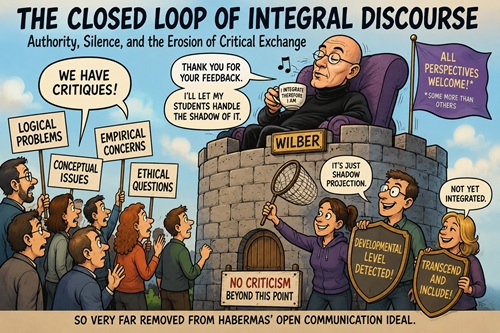 One of the enduring ambiguities of Integral Theory is that it presents itself in two very different ways. On the one hand, it aspires to be a comprehensive philosophical framework capable of integrating the findings of science, psychology, sociology, religion, and the humanities. On the other, it revolves around the intellectual and spiritual authority of a single individual, Ken Wilber, whose writings function as the movement's primary reference point. These two models of knowledge do not sit comfortably together. One belongs to the culture of science, where authority is temporary and criticism is expected. The other belongs to the sociology of charismatic movements, where authority derives from extraordinary personal insight and criticism is often experienced as an attack on the source of meaning itself. The tension between these two cultures helps explain many of the recurring dynamics within the integral community. Two Different Sources of AuthorityScientific authority is earned but never final. A scientist gains respect through successful research, yet every conclusion remains open to revision. Nobel Prize winners are criticized. Famous theories are overturned. Reputation may influence attention, but it cannot determine truth. Charismatic authority operates differently. The authority of the charismatic leader rests on the belief that he possesses exceptional vision, insight, or wisdom unavailable to ordinary observers. Followers trust not only individual conclusions but the source from which those conclusions arise. This distinction was explored a century ago by the sociologist Max Weber. Charismatic authority depends less on institutional procedures than on confidence in the extraordinary qualities of the leader. It is inherently personal. Science deliberately minimizes this kind of authority. Spiritual movements often depend upon it. Wilber's Unique PositionKen Wilber occupies an unusual role. • He is philosopher. • Psychologist. • Mystical interpreter. • Evolutionary theorist. • Cultural critic. • Religious synthesizer. No academic department could grant authority across all these disciplines simultaneously. Yet Integral Theory assumes precisely this breadth of competence. Readers are therefore invited to trust not merely Wilber's reasoning in one field but his capacity to integrate all fields into a coherent whole. That is an extraordinary claim. It naturally encourages extraordinary confidence. The Cost of Comprehensive AuthorityThere is an unavoidable trade-off. The broader a person's authority becomes, the harder it becomes for followers to separate individual insights from the overall system. Suppose Wilber misrepresents some aspect of evolutionary biology. In science, this would simply mean correcting the biology. Within a charismatic framework, however, the mistake threatens confidence in the larger vision. Followers therefore experience pressure to reconcile the disputed claim rather than abandon it. Protecting the authority becomes synonymous with protecting the synthesis. The Language of VisionScientific papers rarely speak of visionary breakthroughs. They present methods, evidence, statistical analysis, limitations, and uncertainty. Integral writing often employs a different vocabulary. • It speaks of higher consciousness. • Second-tier awareness. • Evolutionary unfolding. • Kosmic perspectives. • The integration of all knowledge. None of these expressions is inherently problematic. Collectively, however, they encourage readers to view the author less as a fallible scholar than as someone who has perceived realities inaccessible to conventional thinkers. The relationship shifts from critical evaluation toward interpretive trust. Why Critics Become OutsidersScientific criticism is expected. Researchers routinely challenge one another's work without questioning each other's legitimacy. Charismatic communities function differently. Persistent critics often become symbolic outsiders. Their objections are interpreted not simply as disagreements but as evidence that they have failed to appreciate the larger vision. This helps explain why many long-term critics of Wilber eventually occupy a peculiar social position. They are known. Their work is discussed. Yet they remain outside the accepted interpretive community. Their criticism becomes something to explain rather than something to answer. The Sociology of LoyaltyEvery intellectual movement develops social norms. Scientific communities reward successful criticism. Finding an error in an established theory can enhance one's reputation. Charismatic communities reward loyalty. Defending the founder often strengthens one's standing within the group. This is not necessarily cynical. Many followers genuinely believe they are protecting valuable insights from misunderstanding. Nevertheless, the incentive structure differs dramatically. Scientists gain prestige by overturning accepted ideas. Followers of charismatic thinkers often gain prestige by preserving them. These opposite reward systems produce very different intellectual cultures. The Problem of Sacred TextsWilber has repeatedly revised his work over the decades. Nevertheless, many of his major books have acquired a quasi-canonical status. Readers return to them much as theologians return to foundational texts. Commentaries proliferate. Interpretations multiply. Applications expand. What happens less frequently is systematic reconsideration of whether central claims remain justified in light of new evidence. The books become objects of interpretation rather than hypotheses awaiting possible revision. The culture gradually resembles scriptural exegesis more than scientific development. Mystical Certainty and Public KnowledgeOne reason charismatic authority remains powerful is that it often rests on experiences inaccessible to others. Mystical realization is intensely convincing to the person who undergoes it. It may even transform an entire life. Yet personal certainty does not automatically translate into public knowledge. Science insists that claims be independently examinable. Mysticism necessarily begins with first-person experience. Confusion arises when private certainty becomes the foundation for public theory. Followers may accept conclusions because they trust the mystic rather than because the evidence compels assent. The distinction is subtle but crucial. Can Charisma Become Self-Correcting?Charismatic movements need not reject criticism. Some eventually institutionalize debate. Others encourage independent scholarship. Still others separate reverence for the founder from evaluation of the founder's ideas. Integral Theory stands at precisely this crossroads. It can continue treating Wilber primarily as an exceptional visionary whose synthesis requires defense. Or it can increasingly treat his work as a remarkable but provisional intellectual achievement, open to continuous refinement and correction. These are not mutually exclusive. One may admire Wilber's extraordinary contribution while recognizing that no synthesis—however ambitious—is exempt from revision. Conclusion: From Followers to ColleaguesThe transition from charismatic movement to mature intellectual tradition requires a subtle but profound cultural change. Followers must become colleagues. Interpretation must give way to investigation. Loyalty must become secondary to evidence. Respect for the founder must coexist with the freedom to conclude that, on some important questions, the founder was mistaken. Ironically, this transformation would not diminish Wilber's achievement. It would secure it. The greatest scientific thinkers are remembered not because their theories remained untouched, but because they initiated traditions that others were free to improve. If Integral Theory hopes to become more than the legacy of one extraordinary mind, it must cultivate the same freedom. Only then can it evolve from a charismatic movement into a genuinely self-correcting intellectual culture.
Widget is loading comments...
|