|
TRANSLATE THIS ARTICLE
Integral World: Exploring Theories of Everything
An independent forum for a critical discussion of the integral philosophy of Ken Wilber
  Frank Visser, graduated as a psychologist of culture and religion, founded IntegralWorld in 1997. He worked as production manager for various publishing houses and as service manager for various internet companies and lives in Amsterdam. Books: Ken Wilber: Thought as Passion (SUNY, 2003), and The Corona Conspiracy: Combatting Disinformation about the Coronavirus (Kindle, 2020). Frank Visser, graduated as a psychologist of culture and religion, founded IntegralWorld in 1997. He worked as production manager for various publishing houses and as service manager for various internet companies and lives in Amsterdam. Books: Ken Wilber: Thought as Passion (SUNY, 2003), and The Corona Conspiracy: Combatting Disinformation about the Coronavirus (Kindle, 2020).
Check out my other conversations with ChatGPT
THE INTEGRAL ECHO CHAMBER
The Psychology of the 'Shadow' Defense Why Integral Theory Rarely Corrects Itself Charismatic Authority versus Scientific Culture Integral as an Echo Chamber? A Habermasian Integral Community Integral as an Echo Chamber?How a Philosophy of Inclusion Can Become a Community of ConfirmationFrank Visser / ChatGPT
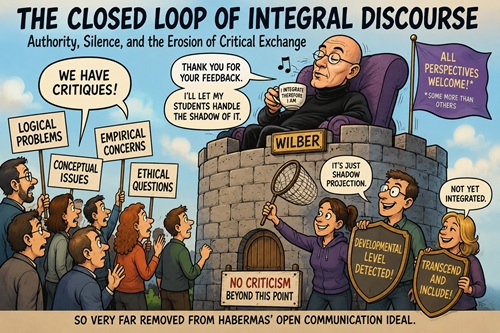 One of the great aspirations of Integral Theory is inclusiveness. Ken Wilber famously urges us to "transcend and include," insisting that every perspective contains some partial truth that deserves recognition within a larger synthesis. It is an inspiring ideal, suggesting an intellectual culture that welcomes diversity without dissolving into relativism. Yet there is an important distinction between including perspectives and welcoming criticism. A community can celebrate multiple viewpoints while remaining remarkably resistant to challenges directed at its own foundational assumptions. This raises an uncomfortable question: has the integral movement, despite its pluralistic rhetoric, gradually acquired some of the characteristics of an echo chamber? This need not imply conscious censorship or ideological conformity. Echo chambers emerge naturally whenever social and intellectual incentives favor confirmation over correction. What Is an Echo Chamber?An echo chamber is not simply a group of like-minded people. Every academic discipline contains shared assumptions. The defining characteristic of an echo chamber is something more subtle: information that supports the community's worldview circulates easily, while information that challenges it gradually loses visibility, credibility, or influence. No one needs to suppress dissent deliberately. The filtering occurs through ordinary social processes. • People quote familiar authorities. • Invite sympathetic speakers. • Recommend books that reinforce existing beliefs. • Interpret criticism through established conceptual categories. Eventually, disagreement becomes increasingly rare—not because objections no longer exist, but because they no longer shape the conversation. The Invisible Filtering ProcessIntegral communities rarely prohibit criticism outright. Indeed, members often insist that they welcome thoughtful debate. The filtering process operates in quieter ways. • Critical books receive little discussion. • Long rebuttals remain unanswered. • Difficult objections are acknowledged but seldom pursued. The conversation moves on. Meanwhile, new essays, podcasts, workshops, and conferences continue elaborating the existing framework. The cumulative effect is subtle. The center of gravity remains unchanged. The Role of Shared VocabularyEvery intellectual community develops its own language. Integral Theory possesses an especially rich conceptual vocabulary: • AQAL. • Holons. • Quadrants. • Altitude. • Second Tier. • States and stages. • Transcend and include. • Flatland. • Mean Green Meme. These concepts can illuminate complex phenomena. They also create a shared interpretive world that increasingly explains events in its own terms. Once a community becomes fluent in this vocabulary, alternative descriptions begin to appear less comprehensive or less sophisticated. The language itself starts filtering perception. Criticism is translated into familiar categories before it is evaluated on its own terms. Confirmation Through CommunityHuman beings are social learners. We naturally seek confirmation from people we respect. Within the integral movement, respected voices often read the same books, attend the same conferences, interview one another, and recommend one another's work. There is nothing unusual about this. Academic disciplines behave similarly. The difference lies in the treatment of sustained external criticism. Scientific communities reward engagement with rival perspectives because competing explanations drive progress. Integral communities often devote considerably more attention to refining internal understanding than to evaluating external objections. Consensus gradually becomes self-reinforcing. The Comfort of CoherenceOne reason echo chambers are attractive is that coherent worldviews are psychologically satisfying. Integral Theory offers an exceptionally coherent map. • Science fits into it. • Religion fits into it. • Psychology fits into it. • Politics fits into it. • Mysticism fits into it. When a framework appears capable of organizing almost everything, abandoning even one important component becomes emotionally costly. People therefore invest in maintaining coherence. This is understandable. The danger arises when preserving coherence becomes more important than testing it. Critics Become PeripheralOver the years, numerous thoughtful critics have raised substantive questions about Integral Theory's treatment of evolution, developmental psychology, epistemology, mysticism, and philosophy of science. Some of these criticisms have appeared in books. Others in academic articles. Still others on websites such as Integral World. Yet relatively few have significantly influenced mainstream integral discourse. The critics remain visible. Their arguments do not. This is one of the defining characteristics of an echo chamber. Opposition exists. Its influence does not. The Illusion of Constant GrowthIntegral communities often emphasize ongoing evolution. New applications appear. Fresh terminology emerges. Additional developmental models are incorporated. The framework seems continually expanding. But expansion is not necessarily revision. Adding new material differs from reconsidering foundational assumptions. An encyclopedia grows continuously. Its organizing principles may remain unchanged for decades. Likewise, Integral Theory often appears dynamic because it constantly incorporates new examples. Whether it modifies its deepest commitments is another question entirely. Social Costs of DissentEvery community establishes implicit norms. Members quickly learn which kinds of disagreement are welcomed and which generate discomfort. Within integral circles, questioning specific applications is usually acceptable. Questioning Wilber's larger synthesis often proves more difficult. Persistent critics may gradually find themselves ignored. • Invited less frequently. • Quoted less often. • Seen as repetitive or excessively negative. Rarely is this exclusion formal. It emerges through countless small social choices. Eventually, many critics stop participating altogether. The echo chamber becomes quieter—not because consensus has been achieved, but because dissent has lost its audience. The Inclusion ParadoxPerhaps the greatest irony is that Integral Theory explicitly seeks to include all perspectives. Yet inclusion of perspectives is not identical to inclusion of criticism. A worldview can successfully classify every alternative position while remaining largely unchanged by encounters with them. Indeed, the more comprehensive the classificatory system becomes, the easier it is to absorb disagreement without being transformed by it. Everything finds its place. Nothing changes the map. Breaking the EchoEcho chambers are rarely dismantled by adding more agreement. They become healthier when disagreement acquires recognized value. Not disagreement for its own sake. Not endless contrarianism. But informed criticism that participants genuinely hope might reveal weaknesses in their own assumptions. That requires a significant cultural shift. Critics must cease being viewed primarily as obstacles to integral understanding. Instead, they should be regarded as contributors to it. The most valuable critic is often not the one who confirms our worldview, but the one who identifies its blind spots. Conclusion: Inclusion Must Include CorrectionIntegral Theory has always aspired to be the most comprehensive philosophical framework of our time. That ambition deserves respect. But comprehensiveness is measured not only by the number of perspectives a theory can classify. It is also measured by its willingness to be transformed by the strongest arguments against it. An echo chamber is not created by malice or censorship. It emerges when agreement circulates more effectively than criticism. If Integral Theory wishes to fulfill its own ideal of "transcend and include," it must extend that principle beyond worldviews and developmental stages to the practice of criticism itself. Only then will inclusion become more than an act of interpretation. It will become an act of intellectual growth.
Widget is loading comments...
|