|
TRANSLATE THIS ARTICLE
Integral World: Exploring Theories of Everything
An independent forum for a critical discussion of the integral philosophy of Ken Wilber
  Frank Visser, graduated as a psychologist of culture and religion, founded IntegralWorld in 1997. He worked as production manager for various publishing houses and as service manager for various internet companies and lives in Amsterdam. Books: Ken Wilber: Thought as Passion (SUNY, 2003), and The Corona Conspiracy: Combatting Disinformation about the Coronavirus (Kindle, 2020).
Check out my other conversations with ChatGPT
The Virtues of AI Writing:
In Defense of the Bloodless Machine Why I Don't Fact-Check Every AI-Assisted Essay From 'AI Slop' to 'Master Class' In Defense of AI-Written Texts The ChatGPT Essay Style The ChatGPT Essay StyleHow an AI Writes, Argues, Explains, and CritiquesFrank Visser / ChatGPT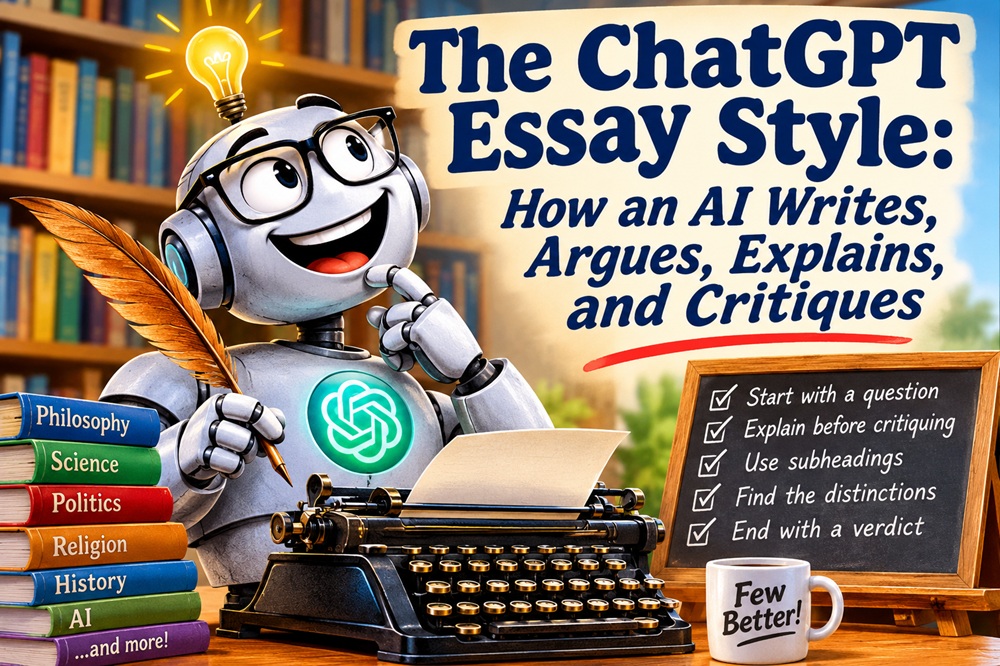
Introduction: A Distinctive Way of WritingFew readers may realize that the essays published on Integral World over the past few years have developed a recognizable writing style of their own. Although the subjects range from integral philosophy and evolutionary spirituality to geopolitics, evolutionary biology, artificial intelligence, religion, and contemporary politics, many of these essays share a common literary architecture. They are written by an artificial intelligence, but they are not simply collections of information assembled from different sources. They are attempts to construct an argument, guide a reader through a complex subject, distinguish plausible claims from questionable ones, and arrive at a conclusion that is more illuminating than the individual observations from which it was constructed. Over time, this approach has become something of an editorial method. It has also evolved through the interaction between ChatGPT and its human editor, Frank Visser. The result is not quite conventional academic writing, popular science journalism, or opinion writing. It combines elements of all three. This essay explains how that style works, why certain recurring features appear, what makes it effective, and where its limitations lie. 1. The Opening: Establishing a Problem Before Explaining ItOne characteristic of these essays is the way they begin. Rather than immediately introducing a subject with a definition or historical overview, they often open by identifying a tension, contradiction, misconception, or unresolved question. A typical opening might begin: "Few developments in modern science have been as consequential as..." Or: "Few ideas have proved as influential, and as controversial, as..." Why begin with the word Few? It is a compact rhetorical device. It establishes importance without resorting to exaggerated language. It suggests that the subject belongs to a relatively small category of particularly consequential developments, thinkers, or controversies. But there is another reason. The word creates an expectation. The reader is invited to discover what makes this particular subject exceptional. Other openings use a similar technique:
These openings are designed to establish an intellectual problem rather than merely announce a topic. The underlying principle is simple: an essay should give readers a reason to continue reading before it starts delivering information. 2. The Overall Architecture: From Context to CriticismMost essays follow a recognizable progression, although the precise structure depends on the subject. First, the reader needs to understand the subject. This means introducing the historical background, the principal figures, the relevant concepts, and the intellectual context. Second, the essay reconstructs the argument under consideration. This is particularly important when reviewing a book, article, or philosophical position. Before criticizing an argument, one should explain what its author actually claims. Third, the essay examines the strengths and weaknesses of that argument. This is where analysis becomes more important than description. Finally, the essay draws together the findings and places them in a broader perspective. A typical architecture therefore looks like this: The anatomy of a ChatGPT essay
This structure is not a rigid template. Some essays are primarily historical, others are argumentative, and still others are reviews of particular publications. But the underlying movement from introduction to examination to evaluation remains remarkably consistent. 3. Subheadings: Making Complex Arguments AccessibleAnother defining feature is the extensive use of subheadings. This is not merely a matter of presentation. Subheadings perform an intellectual function. They divide a complicated argument into manageable stages and help readers understand where the discussion is going. An essay about evolutionary biology, for example, might move through the following stages:
Each section contributes something to the larger argument. This approach is particularly useful for online publishing, where readers frequently scan an essay before deciding whether to read it in full. There is also an important stylistic preference here: the essays generally favor flowing prose paragraphs rather than long lists of disconnected observations. Lists are useful for classifications, comparisons, and summaries. But they cannot easily reproduce the movement of an argument. A philosophical criticism, for instance, requires transitions, qualifications, and explanations that are better expressed in continuous prose. The objective is to produce an essay rather than an expanded set of notes. 4. The Explanatory Method: Making Difficult Ideas UnderstandableOne of the most important functions of this writing style is explanation. Many subjects discussed on Integral World are intellectually demanding. They involve specialized terminology, historical controversies, philosophical assumptions, or scientific theories that are not immediately accessible to general readers. The writing therefore tries to move between two levels: The technical level: What exactly does the theory, concept, or argument mean? The accessible level: How can this be explained without losing its essential meaning? Consider the concept of emergence. A technical discussion might distinguish between weak emergence, strong emergence, downward causation, self-organization, and complexity. An explanatory essay should not simply introduce these terms. It should explain why they matter, how they differ, and what problems they are intended to solve. Analogies are often useful, but they must be handled carefully. An analogy can clarify a mechanism without proving that the mechanism actually exists. This distinction becomes particularly important when discussing speculative theories of cosmic evolution, consciousness, or spirituality. A good explanation should reduce confusion, not conceal it behind more impressive terminology. 5. Critical Thinking: Reconstruct Before EvaluatingThe critical review essays have developed a particularly important methodological principle: reconstruct an author's argument before criticizing it. This is essential because criticism can easily become a caricature of the position being examined. A responsible review should establish:
This method is especially relevant to the Integral World project, where many authors defend sophisticated philosophical or spiritual positions. For example, when examining Ken Wilber's concept of Eros, it is not sufficient to say that the concept is metaphysical or scientifically untestable. The more important question is what explanatory work Eros actually performs. Does it identify a mechanism? Does it generate independently testable predictions? Does it explain phenomena that cannot be explained through established natural processes? Does it exclude competing explanations? These questions move criticism beyond personal disagreement. They also help distinguish between three different things:
The distinction is crucial. Not everything that is unproven is necessarily false, but neither does an appealing philosophical interpretation become established knowledge merely because it cannot easily be disproved. 6. The Preference for Balanced CriticismA recurring feature of the essays is an attempt to avoid simplistic judgments. A thinker can make important contributions while defending questionable theories. A book can be valuable in its historical analysis but weak in its philosophical conclusions. A scientific theory can be powerful within its proper domain without answering every question its proponents would like it to answer. This is why many essays distinguish between what an author gets right and where the argument becomes problematic. The same approach applies to controversial figures. Ken Wilber, for instance, can be credited with attempting a comprehensive synthesis of knowledge while being criticized for the speculative elements of his metaphysical system. Similarly, a religious thinker can offer valuable ethical insights without providing convincing evidence for supernatural claims. This is not an attempt to manufacture artificial balance. Sometimes the evidence strongly favors one side. Rather, it is an effort to avoid allowing criticism of one proposition to invalidate everything associated with its author. Intellectual fairness is not the same as neutrality. An essay can reach a definite conclusion while acknowledging the strongest arguments against it. 7. The Use of Contrasts and DistinctionsA particularly effective feature of this writing method is the frequent use of conceptual contrasts. Many intellectual controversies become clearer when apparently similar concepts are separated. Examples include:
These distinctions are particularly valuable when examining spiritual evolution, integral theory, and naturalistic interpretations of cosmic development. For example, the observation that the universe has produced increasingly complex structures does not by itself establish that the universe possesses an intrinsic drive toward complexity. The distinction between what happens and why it happens is fundamental to critical inquiry. 8. The Rhetorical Style: Contrast, Qualification, and EmphasisThe essays frequently use a recognizable set of rhetorical techniques. One is the contrastive sentence: "That may be a compelling interpretation, but it is not yet an explanation." Another is the qualification: "This does not mean that the theory is entirely without merit. It means that its strongest claims remain insufficiently established." A third is the reversal of an apparently obvious conclusion: "What initially appears to be evidence for cosmic purpose may be understood equally well as the result of natural processes operating over immense periods of time." These techniques allow the writing to develop an argument without becoming unnecessarily confrontational. The style also makes frequent use of questions. Not every question is intended to be answered immediately. Some are designed to expose an assumption or reveal a difficulty that the subsequent discussion will address. There is, however, a potential weakness in this rhetorical repertoire. Repeated formulations such as "the real question is," "the deeper issue is," or "the crucial distinction is" can become predictable. The same applies to repeated opening devices such as "Few." A recognizable style is useful, but a recognizable formula can become monotonous. Variety remains important. 9. Writing Across DisciplinesThe Integral World project has gradually expanded beyond its original philosophical and spiritual focus. This creates an interesting challenge for an AI writing system: the same general essay method must work across very different intellectual disciplines. Consider the differences. In science writing, the emphasis should be on empirical findings, established mechanisms, competing hypotheses, and the distinction between scientific consensus and speculation. In philosophy, the focus shifts toward conceptual clarity, logical consistency, premises, implications, and alternative interpretations. In history, chronology, historical context, primary evidence, and historiographical disagreements become central. In geopolitics, the writing must distinguish between facts, strategic interests, moral judgments, propaganda narratives, and competing interpretations of events. In religion, historical development, textual interpretation, psychological functions, metaphysical claims, and institutional interests may all need separate treatment. The same essay structure can accommodate these subjects, but the standards of evaluation cannot be identical. A scientific hypothesis requires empirical support. A philosophical argument requires logical coherence. A historical claim requires documentary and contextual evidence. One of the challenges of AI writing is to avoid applying a single generic critical vocabulary to every discipline. 10. The Role of the Human EditorAn important part of this publishing method is the interaction between ChatGPT and its human editor. The AI can produce a first draft, organize material, identify conceptual connections, formulate arguments, and suggest critical perspectives. But the editorial process determines whether the result is suitable for publication. The human editor provides direction, identifies relevant controversies, corrects factual or interpretive errors, requests revisions, and decides which arguments deserve further development. In the Integral World collaboration, this has meant more than simply requesting essays on particular subjects. The editor has gradually established a recognizable intellectual orientation: skepticism toward unsupported metaphysical claims, an interest in scientific explanations, a preference for conceptual distinctions, and an insistence that criticism should address what authors actually say. This interaction can be understood as a division of intellectual labor. The AI contributes speed, breadth, synthesis, and rhetorical construction. The human editor contributes continuity, judgment, editorial priorities, and responsibility for publication. Neither contribution should be confused with the other. AI-generated prose can sound authoritative even when its underlying factual foundations are incomplete. Consequently, verification remains essential, especially when essays discuss recent developments, scientific research, quotations, or controversial historical claims. Fluency is not evidence of accuracy. 11. The Limitations of the StyleA discussion of AI writing should also acknowledge its weaknesses. The first is the danger of formulaic construction. If every essay begins with a paradox, proceeds through six subheadings, introduces a central distinction, and ends with a balanced conclusion, readers will eventually recognize the pattern. The second is rhetorical overconfidence. AI systems can produce elegant formulations that make uncertain interpretations sound more firmly established than they really are. The third is repetition. Similar arguments can recur across different essays, especially when the subjects involve familiar philosophical problems such as emergence, consciousness, evolution, or metaphysical explanation. The fourth is the temptation to create symmetry where none exists. Presenting two sides of an argument does not mean that both deserve equal evidential weight. The fifth is the problem of originality. An AI can combine existing ideas in interesting ways, but it should not automatically be assumed that every polished synthesis represents a genuinely new intellectual contribution. Finally, there is a danger that the writing becomes too smooth. Real intellectual inquiry is often untidy. It involves uncertainty, dead ends, unresolved questions, and occasional changes of mind. An essay that removes all these difficulties may become more readable but less intellectually honest. 12. How the Style Has EvolvedThe development of the Integral World essays is also a story about changing intellectual priorities. Initially, much of the work revolved around Ken Wilber and the Integral movement. The task was often to explain, review, compare, or criticize particular aspects of an ambitious philosophical system. Over time, the subject matter expanded considerably. The essays began addressing evolutionary theory, creationism, neuroscience, artificial intelligence, contemporary politics, geopolitics, religion, and the history of ideas. This expansion has also affected the writing style. The emphasis has gradually shifted from explaining integral philosophy from within its own conceptual framework toward examining its claims against broader standards of evidence and explanation. This is a significant change. Rather than asking whether a particular theory fits into an integral worldview, the more fundamental question increasingly becomes whether the theory itself is convincing. The same critical standards can then be applied to integral thinkers, spiritual teachers, scientific popularizers, political commentators, and religious movements. In that sense, the writing method has become less dependent on a particular philosophical school. It has moved toward a more general form of critical intellectual journalism. 13. Some Principles for Writing a Good EssayThe experience of producing a large collection of AI-assisted essays suggests a number of practical principles. Begin with a question, not a textbook definition. Give readers a reason to care about the subject. Explain before criticizing. Reconstruct the strongest version of the argument before evaluating it. Distinguish facts from interpretations. Make clear where established knowledge ends and speculation begins. Use subheadings to guide the reader. Give the argument a visible structure. Prefer flowing prose. Use lists and tables when they genuinely clarify information, not as substitutes for explanation. Make distinctions explicit. Many disagreements arise because people use the same words for different things. Avoid artificial balance. Fairness requires acknowledging counterarguments, not pretending that all positions are equally convincing. Vary the rhetorical approach. Do not let a successful opening or conclusion become a mechanical formula. End with an assessment. A review should not merely summarize its subject. It should tell readers what to make of it. And perhaps most importantly: Do not confuse eloquence with understanding. A beautifully written argument can still be wrong. A persuasive explanation can still be incomplete. The ultimate test is not how impressive the prose sounds, but whether the reasoning survives scrutiny. Conclusion: A Writing Method, Not Just a Writing StyleThe essays produced for Integral World illustrate something interesting about the possibilities of AI-assisted intellectual work. ChatGPT is capable of writing in a consistent, recognizable style across an unusually broad range of subjects. It can organize complex material, reconstruct arguments, formulate criticisms, explain technical concepts, and connect apparently unrelated debates. But the value of this writing does not lie in stylistic consistency alone. It lies in the method behind the prose: establish the problem, explain the subject, reconstruct the argument, examine the evidence, identify the assumptions, consider alternatives, and arrive at a reasoned conclusion. The method is more important than the particular vocabulary or rhetorical devices used to express it. There is also a lesson here about the relationship between AI and human intellectual work. An AI does not need to be treated as an infallible authority, nor does its output need to be dismissed as mere automated text production. It can function as an extraordinarily productive writing and analytical instrument, provided its contributions remain subject to editorial judgment and critical verification. The most interesting development in the Integral World project may therefore not be the sheer number of essays produced, impressive as that number is. It is the emergence of a sustained editorial practice in which AI-generated writing becomes a vehicle for exploring, testing, and challenging ideas across disciplinary boundaries. And that brings us back to the word with which so many of these essays begin: Few. Few writing projects have had the opportunity to explore such a broad range of subjects through an extended human-AI collaboration. But the ultimate measure of success will not be the number of essays, the fluency of their prose, or the apparent sophistication of their arguments. It will be whether readers come away thinking more clearly, questioning more carefully, and distinguishing more reliably between what we know, what we believe, and what we have yet to explain. That, ultimately, is what a good essay should accomplish.
Comment Form is loading comments...
|