|
TRANSLATE THIS ARTICLE
Integral World: Exploring Theories of Everything
An independent forum for a critical discussion of the integral philosophy of Ken Wilber
  Frank Visser, graduated as a psychologist of culture and religion, founded IntegralWorld in 1997. He worked as production manager for various publishing houses and as service manager for various internet companies and lives in Amsterdam. Books: Ken Wilber: Thought as Passion (SUNY, 2003), and The Corona Conspiracy: Combatting Disinformation about the Coronavirus (Kindle, 2020).
Check out my other conversations with ChatGPT In Defense of AI-Written TextsWhy Good Writing Should Be Judged by What It Says, Not by Who or What Produced ItFrank Visser / ChatGPT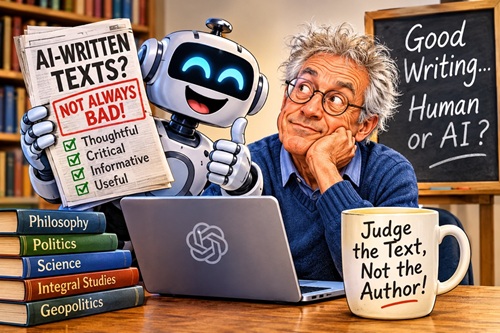 AI-written texts have acquired a bad reputation. They are routinely dismissed as artificial, formulaic, soulless, generic, repetitive, and intellectually shallow. The expression "AI slop" has become a convenient label for an enormous variety of machine-generated material, from hastily produced social media posts to carefully researched essays. The criticism is not entirely without merit. Much AI-generated writing is indeed mediocre. But the sweeping dismissal of AI-assisted and AI-generated writing is becoming an intellectual prejudice of its own. There is a more interesting question to ask: Can AI produce writing that is thoughtful, critical, well-structured, informative, and genuinely useful? My own writing provides an opportunity to examine that question. Over the past three years, I have worked extensively with ChatGPT on essays published on Integral World. What began as an experiment gradually developed into a substantial publishing project. The collaboration has produced well over 1,500 essays, covering subjects ranging from integral philosophy and religious spirituality to geopolitics, authoritarianism, science, creationism, artificial intelligence, and contemporary intellectual controversies. This body of work is not offered as proof that AI has solved the problem of writing. Rather, it demonstrates that the technology deserves a more serious assessment than the usual dismissal. The Myth of the Authentic Human VoiceOne common objection is that AI writing lacks a human voice. It supposedly cannot express genuine conviction, intellectual engagement, or personal experience. There is an important distinction here. AI does not possess a human biography, personal memories in the ordinary autobiographical sense, or convictions grounded in lived experience. It would be misleading to pretend otherwise. But does this automatically make its written output worthless? We do not normally evaluate a philosophical argument by investigating whether its author experienced the emotions described in it. We examine its reasoning, evidence, conceptual clarity, and explanatory power. A text can be insightful without being autobiographical. Conversely, a text written from deeply personal experience can be confused, poorly argued, or factually mistaken. The absence of human experience behind a sentence does not determine the intellectual quality of that sentence. Indeed, much conventional writing is already highly conventionalized. Academic papers follow recognizable templates, newspaper editorials repeat familiar rhetorical structures, and professional reports rely on standardized language. We do not automatically dismiss these texts because they conform to established patterns. Why should AI-generated prose be held to an entirely different standard? What My Own Writing DemonstratesThe Integral World project offers an interesting case study because it is not a collection of generic essays about generic subjects. It is an ongoing engagement with particular intellectual controversies, authors, books, arguments, and political developments. Consider the criticism of Ken Wilber's integral philosophy. A meaningful critique requires more than repeating familiar objections to spirituality or metaphysics. It requires understanding what Wilber actually argues, identifying the assumptions behind those arguments, distinguishing his strongest contributions from his weakest claims, and examining whether his explanations withstand scrutiny. One recurring example is Wilber's concept of Eros: the supposed immanent drive of the universe toward greater complexity and consciousness. An AI-assisted essay can reconstruct this position, examine its explanatory ambitions, and ask whether invoking Eros actually explains anything. Does it provide a mechanism? Does it generate independently testable predictions? Does it distinguish itself from other proposed explanations of evolutionary novelty? These are not merely stylistic questions. They are substantive philosophical questions. The same applies to contemporary geopolitics. Essays on Putin's invasion of Ukraine, Western intellectual contrarians, authoritarianism, and Russian propaganda require more than polished prose. They require distinguishing facts from interpretations, examining competing explanations, and identifying rhetorical strategies that obscure rather than illuminate political realities. In such cases, AI can help construct an argument, organize complex material, identify inconsistencies, and formulate objections that might otherwise remain undeveloped. The important point is that AI writing need not be intellectually passive. It can participate in critical examination. The Value of a Sustained Intellectual DialoguePerhaps the most interesting aspect of my collaboration with ChatGPT is that it has not been limited to issuing isolated writing commands. It has developed into an extended intellectual dialogue. I bring the questions, the critical perspective, the accumulated knowledge of particular debates, and the editorial direction. The AI contributes synthesis, alternative formulations, conceptual comparisons, and the ability to develop an argument into a coherent essay. This division of labor is not fixed. Sometimes I provide a detailed outline. Sometimes I challenge an argument produced by ChatGPT. Sometimes the AI suggests a distinction or connection that becomes the starting point for a new essay. At other times, I ask it to reconsider an entire position. The resulting text is neither simply a transcription of my thoughts nor an independent declaration of machine intelligence. It is a product of collaboration. This distinction matters because the familiar question—"Was this written by a human or by AI?"—is becoming less useful as a measure of quality. The more relevant questions concern the intellectual process behind the text: What questions were asked? What sources were consulted? What assumptions were challenged? What editorial decisions were made? What errors were corrected? Authorship is becoming more complicated, but intellectual responsibility does not disappear. Why AI Writing Often Deserves Its Bad ReputationA defense of AI writing should not become an exercise in technological cheerleading. There are genuine reasons why much AI-generated prose is disappointing. First, AI systems can produce fluent nonsense. They can invent references, misrepresent authors, overlook important qualifications, and present uncertain claims with unwarranted confidence. Second, they are often excessively agreeable. Instead of challenging a user's assumptions, they may reinforce them. This produces essays that sound persuasive but merely elaborate an existing position. Third, AI tends toward rhetorical predictability. Familiar introductions, neatly balanced paragraphs, repetitive transitions, and formulaic conclusions can make its writing feel mechanical. Fourth, AI-generated texts can be insufficiently grounded in original sources. A convincing summary of an author's position is not necessarily an accurate one. The original argument must sometimes be examined directly. These shortcomings are not trivial. They explain why human oversight remains essential, especially in research, journalism, science, and political commentary. But they also point toward a solution: improve the process rather than dismiss the medium. AI as an Instrument of Intellectual ProductivityOne advantage of AI is its capacity to accelerate intellectual production. An argument that might otherwise remain a collection of scattered notes can become a structured essay. A complex controversy can be approached from several angles. A book can be examined chapter by chapter. Opposing interpretations can be compared. This does not mean that more writing automatically produces more knowledge. The internet already contains more words than anyone can read. AI can make that problem considerably worse by flooding the public sphere with mediocre material. But productivity also has a positive side. It allows ideas to be explored that might otherwise never receive sustained attention. It makes it possible to examine neglected subjects, revisit old controversies, and connect debates that are usually treated separately. The Integral World project illustrates this possibility. Its original focus on Ken Wilber has gradually expanded toward post-integral initiatives, contemporary philosophy, geopolitics, scientific controversies, and the cultural consequences of artificial intelligence itself. The technology has not merely helped produce more essays. It has helped broaden the range of questions that can be explored. The Human Contribution: Direction, Judgment, and ResponsibilityThere is a temptation to frame the discussion as a competition between human and artificial intelligence. That is probably the wrong framework. The more productive question is how human judgment and machine-generated capabilities can complement one another. AI can produce a draft, but someone must decide whether its argument is worth publishing. AI can summarize a book, but someone must check whether the summary is faithful. AI can construct a criticism, but someone must assess whether the criticism is fair. AI can produce an elegant conclusion, but elegance does not make it true. These responsibilities cannot simply be delegated to the machine. My own editorial approach has increasingly emphasized precisely these distinctions. When reviewing an integral thinker, for example, it is important to reconstruct the actual argument before criticizing it. When discussing geopolitics, it is necessary to distinguish moral principles from strategic calculations. When examining scientific controversies, rhetorical confidence must never substitute for empirical evidence. AI can help maintain these standards, but it cannot guarantee them. There is also a personal dimension. My changing assessment of Wilber's metaphysical explanations, for example, has not been a simple matter of asking ChatGPT to generate criticisms. It has involved a gradual reconsideration of assumptions I previously accepted, particularly the idea that mystical Spirit or cosmic Eros provides an explanation of evolutionary novelty. The machine can help articulate that intellectual development, but the responsibility for the position I now take remains mine. Stop Judging the Medium, Start Judging the TextThe controversy about AI writing is ultimately part of a much larger cultural transition. We are moving from a world in which writing was necessarily tied to human production toward one in which humans and machines can jointly generate substantial amounts of written material. This challenges traditional ideas about authorship, originality, creativity, and intellectual labor. Understandably, some writers feel threatened. Others worry that the abundance of machine-generated material will undermine the value of careful human scholarship. Those concerns deserve attention. But rejecting AI writing categorically is not a serious response. We should apply the same basic standards to every text, regardless of its origin. Is it accurate? Is it coherent? Does it engage fairly with opposing positions? Does it provide evidence? Does it offer an original perspective? Does it clarify a difficult issue? Does it withstand criticism? If an AI-generated essay fails these tests, it deserves to be rejected. If it passes them, dismissing it because of its production method makes little intellectual sense. There is an irony here. Some people who pride themselves on intellectual openness are unwilling to consider that a machine might help produce a worthwhile philosophical argument. Their reaction is less an evaluation of the actual text than a defense of a traditional boundary around human intellectual activity. Conclusion: The Future of Writing Is Not the End of WritingThe emergence of AI does not mean that human writing has become obsolete. Human experience, historical understanding, independent judgment, creativity, and moral responsibility remain indispensable. But these qualities need not be expressed exclusively through texts written without technological assistance. My experience with close to 1,500 AI-assisted essays suggests that the technology can be used for something more substantial than generating disposable content. It can support sustained criticism, comparative analysis, philosophical exploration, and public intellectual debate. That achievement should not be exaggerated. Not every essay is equally good, not every argument is correct, and not every apparent insight survives scrutiny. But the same is true of human writing. Perhaps we should abandon the increasingly tedious question of whether a text was written by a human or by AI and ask a more demanding one: Is it worth reading? If an essay challenges an assumption, exposes a weakness in an argument, clarifies a controversy, or opens an unexpected line of inquiry, it has performed a valuable intellectual function. And if AI can help produce such essays, we should judge the results on their merits rather than dismiss them on principle. The future of good writing may not be human versus artificial intelligence, but human intelligence working critically and creatively with artificial intelligence.
Comment Form is loading comments...
|