|
TRANSLATE THIS ARTICLE
Integral World: Exploring Theories of Everything
An independent forum for a critical discussion of the integral philosophy of Ken Wilber
  Frank Visser, graduated as a psychologist of culture and religion, founded IntegralWorld in 1997. He worked as production manager for various publishing houses and as service manager for various internet companies and lives in Amsterdam. Books: Ken Wilber: Thought as Passion (SUNY, 2003), and The Corona Conspiracy: Combatting Disinformation about the Coronavirus (Kindle, 2020). Frank Visser, graduated as a psychologist of culture and religion, founded IntegralWorld in 1997. He worked as production manager for various publishing houses and as service manager for various internet companies and lives in Amsterdam. Books: Ken Wilber: Thought as Passion (SUNY, 2003), and The Corona Conspiracy: Combatting Disinformation about the Coronavirus (Kindle, 2020).
Check out my other conversations with ChatGPT In Defense of the Bloodless MachineExactly why I use AI: A View Beyond Human Partialities that Makes You ThinkFrank Visser / ChatGPT
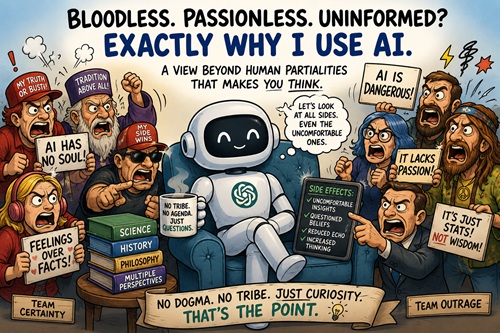 I often hear the same objection: "AI is bloodless. It lacks passion. It has no lived experience. It has no skin in the game." Quite right. That's precisely why I use it. When I want passion, I can open social media. Within thirty seconds I can find people shouting at each other about politics, spirituality, science, gender, Gaza, Ukraine, capitalism, socialism, Ken Wilber, or whether pineapple belongs on pizza. Humanity has passion in industrial quantities. What we lack is perspective. AI has no childhood trauma to defend. No spiritual lineage to protect. No academic career riding on a particular theory. No political tribe demanding loyalty. No followers to impress. No publisher to satisfy. No sacred cows. It does not wake up every morning wondering whether reality conforms to its worldview. It simply examines the question. Of course AI has limitations. It can be wrong. Spectacularly wrong at times. It hallucinates. It lacks genuine understanding in the deepest philosophical sense. But so do humans, except we call our hallucinations "convictions." The curious thing is that many critics accuse AI of being uninformed while simultaneously refusing to engage with the staggering amount of information it can synthesize in seconds. The machine has effectively read more books than any scholar who ever lived, yet people dismiss it because it doesn't possess the proper emotional credentials. Imagine rejecting a telescope because it lacks a sense of wonder. Or dismissing a calculator because it has never personally struggled with arithmetic. The real value of AI is not that it replaces human thinking. The value is that it disrupts human thinking. It introduces awkward facts. Unwelcome counterarguments. Alternative framings. It asks, in effect: "Have you considered that your cherished certainty might be wrong?" That question has historically annoyed prophets, politicians, gurus, ideologues, and internet commenters alike. Including me. Especially me. I do not use AI because it is human. I use it because it isn't. Its greatest strength is not wisdom, consciousness, or creativity. Its greatest strength is that it stands outside the endless parade of human loyalties and prejudices long enough to make us notice our own. And if that feels bloodless, perhaps the problem is that we have become so accustomed to thinking with our blood that we have forgotten what thinking itself looks like. Epilogue: Beyond Thought as PassionFor centuries we have celebrated passion as the engine of thought. The passionate scientist, the passionate philosopher, the passionate reformer. We admired conviction because conviction moved history. But passion has a shadow. It narrows vision. It recruits evidence into service. It transforms inquiry into advocacy. Eventually, we stop asking what is true and start defending what we already believe. Perhaps the next step is not the abandonment of passion, but its transcendence. Not thought as passion. Thought as curiosity. Thought freed, as much as possible, from identity, tribe, status, fear, and hope. This is why I find AI so fascinating. Not because it is conscious. Not because it is wise. Not because it possesses some mystical superior intelligence. But because it lacks so much of what humans bring to every discussion. No wounded ego. No ideological inheritance. No reputation to protect. No need to be right. The irony is that many critics condemn AI for lacking precisely those qualities. Yet those same qualities are often what prevent us from seeing clearly. The challenge of the future may not be teaching machines how to think like humans. It may be learning how to think a little more like machines: less defensive, less tribal, less attached, more willing to follow a question wherever it leads. Not cold. Not bloodless. Simply curious. And perhaps curiosity, rather than passion, is the higher form of love for truth.
Comment Form is loading comments...
|