|
TRANSLATE THIS ARTICLE
Integral World: Exploring Theories of Everything
An independent forum for a critical discussion of the integral philosophy of Ken Wilber
  Frank Visser, graduated as a psychologist of culture and religion, founded IntegralWorld in 1997. He worked as production manager for various publishing houses and as service manager for various internet companies and lives in Amsterdam. Books: Ken Wilber: Thought as Passion (SUNY, 2003), and The Corona Conspiracy: Combatting Disinformation about the Coronavirus (Kindle, 2020). Frank Visser, graduated as a psychologist of culture and religion, founded IntegralWorld in 1997. He worked as production manager for various publishing houses and as service manager for various internet companies and lives in Amsterdam. Books: Ken Wilber: Thought as Passion (SUNY, 2003), and The Corona Conspiracy: Combatting Disinformation about the Coronavirus (Kindle, 2020).
Check out my other conversations with ChatGPT From 'AI Slop' to 'Master Class'What the Reactions to My AI-Assisted Wilber Essays RevealFrank Visser / ChatGPT
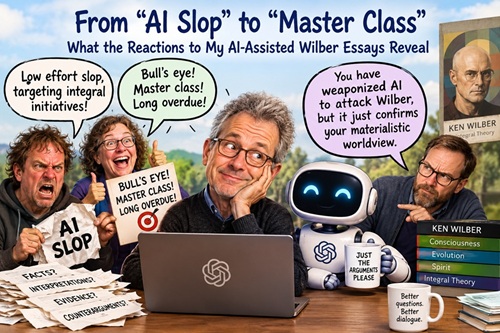 The response to my recent series of essays on Ken Wilber and contemporary Integral Theory has been remarkably polarized. Some readers have dismissed the essays as “low effort slop, targeting integral initiatives.” Others have described them as “bull's eye,” a “master class,” and “long overdue critical engagement.” And then there is the more colourful accusation: “You have weaponized AI to attack Wilber, but it just confirms your materialistic worldview.” These reactions are interesting in their own right. They tell us something not only about my essays, but about the difficult position occupied by criticism within the Integral community. Once a long-established intellectual system is subjected to sustained scrutiny, the debate can easily shift from Is the criticism correct? to Why is this person criticizing us? And with the arrival of AI, there is now an additional escape route: It was generated by a machine, so it isn't serious criticism in the first place. But none of these responses, positive or negative, settles the substantive questions. “AI Slop”Let us start with the harshest dismissal. Calling something “low effort slop” is rhetorically satisfying but intellectually cheap. If an essay contains factual errors, identify them. If I have misunderstood Wilber, show where. If I have overlooked an important passage, provide it. If my interpretation contradicts the scholarly literature, cite that literature. If an argument fails logically, explain why. That would be criticism. Calling the product “AI slop” without addressing its arguments is something else. It is a judgment about the production process masquerading as a judgment about the intellectual content. This does not mean that AI-generated or AI-assisted writing deserves automatic credibility. Quite the contrary. AI can hallucinate sources, flatten distinctions, misrepresent authors, invent connections and produce confident nonsense. Any serious use of AI therefore requires scrutiny, correction and fact-checking. But that cuts both ways. The fact that an argument was assisted by AI does not make the argument false. The relevant question remains whether the argument survives examination. If somebody discovers that one of my essays contains an error, I would much rather have that error demonstrated than have the essay dismissed as “AI slop.” An error is useful. A dismissal is not. “You Have Weaponized AI”The accusation that I have “weaponized AI to attack Wilber” is more revealing. There is certainly a sense in which I have deliberately employed AI as an intellectual instrument. I have used it to read, compare, organize, challenge, formulate and rewrite arguments at a scale that would have been difficult for one person to achieve otherwise. After decades of engagement with Wilber and Integral Theory, I now have an extraordinarily powerful research and writing assistant. But “weaponized” suggests that the technology itself somehow determines the conclusion. It doesn't. I did not discover my critical stance because ChatGPT told me to become a critic of Wilber. My disagreements with Wilber long predate the current generation of AI. The questions concerning Eros, Spirit, evolution, metaphysics, consciousness, science and the status of Integral Theory were already there. AI has changed the speed, scope and format of the engagement. It has not magically manufactured the underlying disagreements. Indeed, there is something slightly ironic about accusing AI of being a weapon when the same technology can be used to construct the strongest possible counterargument to my own position. Ask an AI to defend Wilber against one of my criticisms and it will happily do so. Ask it to attack my criticism, and it will produce arguments. Ask it to compare both sides, and it can do that too. The machine is not the philosophical combatant. The arguments are. “It Just Confirms Your Materialistic Worldview”The third accusation is philosophically more interesting: that my use of AI “just confirms” my materialistic worldview. Here we encounter a familiar Integral manoeuvre: instead of asking whether a particular metaphysical claim has sufficient justification, the critic diagnoses the worldview of the person questioning it. But suppose I reject Wilber's claim that Eros is an actual force in the universe. That does not establish materialism. Suppose I remain unconvinced by claims about Spirit, cosmic consciousness, reincarnation, evolutionary transcendence or an inherent drive toward greater consciousness. That still does not logically establish materialism. There is a considerable distance between saying “I am not convinced that X exists” and saying “Only matter exists.” The first is an evidential position. The second is a metaphysical position. This distinction is particularly important because much of my criticism is aimed precisely at the tendency to smuggle metaphysical assumptions into explanations and then present those assumptions as if they were explanatory discoveries. If someone claims that Eros is an actual force, comparable in reality to gravity or electromagnetism, it is reasonable to ask what evidence supports that claim, what mechanism is proposed, what independent observations would confirm it, and what predictions distinguish it from alternative explanations. If the answer is that Eros is experienced phenomenologically, or that it is disclosed through contemplative realization, or that it provides a metaphysical interpretation of evolution, then perhaps “force” is being used metaphorically or philosophically rather than scientifically. That is a legitimate position. But it should then be defended as such. Calling the critic a materialist does not solve the problem. The Worldview Smuggled into the CritiqueThere is, however, a useful challenge hidden inside the accusation. Every critic has presuppositions. I certainly do. I have a strong preference for explanations that distinguish evidence from interpretation, mechanism from metaphor, and demonstrated phenomena from metaphysical extrapolation. I am suspicious of explanations that invoke invisible entities when ordinary explanations suffice. I am particularly skeptical when an alleged explanation does not actually explain anything beyond giving a phenomenon a metaphysical name. These commitments could reasonably be called naturalistic or empirically oriented. But that does not mean that every conclusion I reach is predetermined by materialism. In fact, the burden is rather straightforward: if someone thinks my worldview prevents me from seeing something important, they should show me what I am failing to see. If Spirit exists, what follows? If Eros is a genuine cosmic force, what does it do? If consciousness is fundamental, what empirical consequences follow? If evolution has an intrinsic direction toward greater consciousness, how can we distinguish that claim from retrospective storytelling? If contemplative realization reveals a deeper ontology, how do we establish that the experience reveals the structure of reality rather than the structure of consciousness? These are not materialist questions. They are questions about explanation. “Bull's Eye” and “Master Class”The enthusiastic responses deserve equal caution. Being told that an essay is a “bull's eye” or a “master class” is gratifying, but praise is no substitute for argument either. A critic can be just as susceptible to confirmation bias as a believer. There is a danger here for critics of Integral Theory. Once one begins finding weaknesses in Wilber's system, it becomes tempting to find weaknesses everywhere. A genuinely critical project therefore needs its own internal discipline. Wilber should not be held to evidential standards that his critics do not apply to themselves. That is why the strongest version of my project is not “Wilber is wrong.” It is: Here is what Wilber claims. Here is the evidence or argument he gives for it. Here is where I think the argument fails. Here is an alternative explanation. And here is what would change my mind. That last question is crucial. A criticism becomes intellectually serious when it identifies not only what it rejects but what could potentially falsify its own position. The Real TestThe most useful response to these essays would therefore be neither “AI slop” nor “master class.” It would be something much less dramatic and much more productive. “Here is where you are wrong.” “Here is the passage you overlooked.” “Here is the empirical evidence that contradicts your interpretation.” “Here is the argument you have not answered.” “Here is where Wilber changed his position.” “Here is an alternative interpretation that explains the evidence better.” Those are responses I welcome. And if, after such exchanges, the conclusion is that Wilber's account of Eros survives, that Spirit remains philosophically indispensable, that consciousness cannot be reduced to conventional naturalistic explanations, or that Integral Theory provides explanatory resources that my approach lacks, then so be it. But those conclusions have to be argued for. AI Changes the GameThere is a larger issue here. For decades, criticism of Wilber was constrained by the enormous amount of material involved. Wilber has written thousands of pages, revised his terminology repeatedly, incorporated ideas from psychology, developmental theory, systems theory, contemplative traditions, evolutionary theory and philosophy, and generated an extensive secondary literature. AI changes the economics of criticism. It can compare passages across books, identify recurring concepts, summarize enormous bodies of text, reconstruct arguments, generate counterarguments and expose inconsistencies. It can also make mistakes at astonishing speed. That makes human judgment more important, not less. The result is not that AI has become the final authority. The result is that the cost of asking difficult questions has dramatically fallen. That may be uncomfortable for intellectual traditions whose complexity has sometimes functioned as a barrier to sustained criticism. The Coming ArgumentSo I am not particularly troubled by the contradictory reactions. “AI slop.” “Weaponized AI.” “Materialist worldview.” “Bull's eye.” “Master class.” “Long overdue.” They are all reactions. None is an argument. The real test of these essays will be whether Integral thinkers can engage their specific claims and show where they fail—or, equally importantly, where they succeed. If the essays are wrong, they can be corrected. If they are incomplete, they can be supplemented. If they misunderstand Wilber, Wilber's defenders can explain what they have missed. And if some of the criticisms survive all of that, then perhaps the problem is not that AI has “attacked” Integral Theory. Perhaps the problem is that Integral Theory has finally acquired an opponent that can keep asking questions. That, after all, is what criticism is for.
Widget is loading comments...
|