|
TRANSLATE THIS ARTICLE
Integral World: Exploring Theories of Everything
An independent forum for a critical discussion of the integral philosophy of Ken Wilber
  Frank Visser, graduated as a psychologist of culture and religion, founded IntegralWorld in 1997. He worked as production manager for various publishing houses and as service manager for various internet companies and lives in Amsterdam. Books: Ken Wilber: Thought as Passion (SUNY, 2003), and The Corona Conspiracy: Combatting Disinformation about the Coronavirus (Kindle, 2020). Frank Visser, graduated as a psychologist of culture and religion, founded IntegralWorld in 1997. He worked as production manager for various publishing houses and as service manager for various internet companies and lives in Amsterdam. Books: Ken Wilber: Thought as Passion (SUNY, 2003), and The Corona Conspiracy: Combatting Disinformation about the Coronavirus (Kindle, 2020).
Check out my other conversations with ChatGPT Why I Don't Fact-Check Every AI-Assisted EssayOn transparency, sources, prompts, and the editorial policy behind 1,000+ essaysFrank Visser / ChatGPT
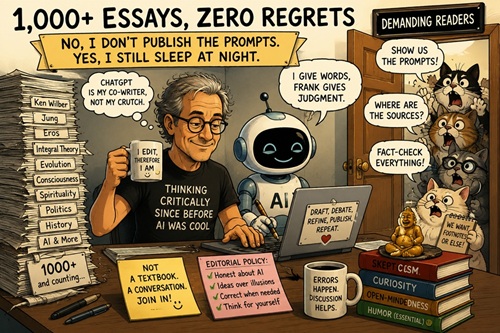
Over the past three years, I have generated more than a thousand essays with the assistance of ChatGPT. From time to time, readers have asked a reasonable question: Why don't you provide the prompts you used? And why don't you systematically list and verify all the sources behind these essays? The short answer is that I have deliberately chosen not to make that part of the editorial process. That choice deserves an explanation. It is important first to distinguish between different kinds of writing. If I were publishing investigative journalism, reporting on current events, writing about medicine, presenting historical claims as established fact, or making serious allegations about identifiable people, I would consider systematic fact-checking and source documentation indispensable. The same would apply to academic writing intended to meet scholarly standards. But that is not primarily what my website is doing. The essays I have been producing with ChatGPT are largely intellectual, philosophical, critical, and interpretive essays. They explore ideas, compare thinkers, criticize arguments, reconstruct debates, and develop perspectives. Many of them concern figures and theories that I have been thinking about for decades. The purpose is not to present each essay as a peer-reviewed academic contribution. It is to stimulate reflection and debate. This distinction determines my editorial policy. The essays are not presented as scholarly research papersWhen I write an essay on Ken Wilber, Jung, integral theory, spirituality, evolution, consciousness, politics, or the history of ideas, I am not pretending that the resulting text has gone through the procedures of academic scholarship. The essays are essays. They are arguments, interpretations, critiques, thought experiments, and sometimes provocations. That does not mean that facts are irrelevant. It does mean that I do not believe every essay needs to be accompanied by the apparatus of a dissertation: footnotes for every assertion, a bibliography of every book consulted, and a complete record of every prompt given to an AI system. There is a difference between intellectual transparency and forensic documentation. I want my readers to know that ChatGPT is involved in the production of these essays. I have been quite open about that. The essays are often explicitly credited to "Frank Visser / ChatGPT." I am not presenting AI-assisted writing as if it were entirely the spontaneous product of my unaided brain. But transparency does not require publishing the entire machinery of production. A novelist does not normally publish every discarded sentence. A journalist does not necessarily publish every Google search that preceded an article. A philosopher does not publish every conversation that helped shape an argument. And I do not think an essay becomes more intellectually valuable merely because the reader can inspect the exact wording of the prompt that initiated it. Why I have not felt the need for systematic fact-checkingThe more interesting question is why I have generally not felt the need to fact-check every essay produced in this way. The answer lies partly in the nature of the material. Much of what I publish is not dependent on a single empirical fact whose accuracy determines the entire argument. The essays often discuss broad intellectual patterns: the relationship between Jung and Wilber, the strengths and weaknesses of integral theory, the philosophical implications of evolution, the differences between depth and developmental psychology, or the way spiritual concepts are used in contemporary thought. These are not mathematical proofs. They are not medical diagnoses. They are not legal opinions. They are not investigative reports. They are interpretive essays. If I write that Wilber's theory tends toward a teleological interpretation of evolution, that is an argument that can be debated. If I write that his concept of Eros functions as a metaphysical explanation rather than a scientific mechanism, that is an interpretation. If I compare Wilber's understanding of development with Jung's psychology, readers can disagree about the comparison. The relevant question is therefore not simply: "Is every sentence factually verifiable?" It is also: "Is the argument interesting, coherent, plausible, and open to criticism?" That is the editorial standard I have generally followed. My own background mattersThere is another factor that should not be overlooked. I am not approaching these subjects as someone encountering them for the first time. I have been writing critically about integral theory and Ken Wilber for many years. I have read extensively in this field and have developed my own positions through decades of engagement with these debates. ChatGPT did not suddenly give me a subject about which I knew nothing. Rather, it became a writing and thinking partner. That distinction is important. The AI helps me formulate questions, explore arguments, structure essays, compare perspectives, and sometimes discover connections I had not considered. It can produce drafts at a speed that would have been impossible for me to match manually. But I remain the editor. I decide what topics to pursue. I decide which arguments are interesting. I decide when an essay goes too far. I challenge ChatGPT when it gets something wrong. I ask for revisions. I reject formulations I don't agree with. And, crucially, I decide whether the final essay is worth publishing. The process is therefore not simply: "ChatGPT writes; Frank publishes." It is closer to: Frank asks, ChatGPT explores, Frank evaluates, and the essay emerges from the interaction. That is why I am comfortable attaching my name to these essays. Why not publish the prompts?Some readers have suggested that the prompts should be made public so that everyone can see exactly how the essays were generated. I understand the request, but I do not consider it particularly useful. A prompt is not the equivalent of a source. Knowing that I asked ChatGPT, for example, to "write a critical essay on Wilber's concept of Eros" tells you something about the starting point of the essay. It does not tell you whether the resulting argument is correct. Nor does publishing the prompt allow the reader to reproduce the essay in any meaningful sense. AI systems are probabilistic and conversational. The same prompt can generate different responses at different times, depending on the model, context, preceding conversation, and subsequent revisions. The final essay is the important artifact. The prompt is part of the production process, not necessarily part of the intellectual argument. Of course, there are situations where prompts are worth sharing. If the subject is AI methodology itself, if someone wants to study how a particular output was generated, or if reproducibility is central to the project, then prompt transparency can be valuable. But for an essay on Jung, Wilber, Bergson, or the history of Russia, I do not see the prompt as essential editorial information. The question of sources is more complicatedThe request for sources is more legitimate. Readers have every right to ask: "Where did this claim come from?" And when a factual claim is important, specific, controversial, or potentially misleading, sources are valuable. But there is a practical problem with treating every AI-generated essay as a fully sourced academic publication. My essays often combine decades of accumulated reading with the AI's general knowledge and the ongoing conversation between the two of us. There is no simple list of "sources used" that corresponds neatly to each paragraph. The intellectual background may include books I read years ago, articles I encountered decades ago, discussions I have had with other people, and material absorbed over a lifetime. Trying to reconstruct an exhaustive source list after the fact would often create a false impression of precision. It might look scholarly without actually being so. I would rather be honest about the genre. When I explicitly research a topic, I can provide sources. When I quote an author, the quotation should be traceable. When I make a specific factual claim that matters to the argument, I should be prepared to substantiate it. But I do not believe every essay requires a bibliography pretending to document an intellectual genealogy that cannot realistically be reconstructed. AI makes this problem more visibleThere is, however, a broader issue here. The arrival of generative AI has exposed a tension that existed long before ChatGPT. Traditional publishing often creates the impression that a text has a clear and linear origin. An author reads sources, takes notes, thinks, writes, cites, and publishes. Reality has always been messier. Ideas circulate. People forget where they encountered something. Arguments are influenced by conversations. Writers absorb concepts without remembering their original source. Editors reshape manuscripts. Friends suggest formulations. And writers themselves often cannot reconstruct the complete genealogy of an idea. AI makes this hidden process visible because the interaction with the machine can, in principle, be recorded. But that does not mean that every interaction must become part of the published artifact. The question should always be: What information does the reader need in order to evaluate the claim? Sometimes the answer is a citation. Sometimes it is a source list. Sometimes it is an explanation of methodology. And sometimes it is simply the recognition that what one is reading is an essay offering an interpretation rather than a scholarly claim to definitive knowledge. The danger of confusing citations with truthThere is also a danger in fetishizing sources. An essay can have fifty footnotes and still be nonsense. A claim can be heavily cited and still be misleading. A bibliography can create an aura of authority without guaranteeing the quality of the argument. Conversely, an insightful essay can sometimes begin with a simple observation and develop an argument that does not depend on an extensive scholarly apparatus. Sources are important. But sources do not replace thinking. My primary interest has always been in the argument. Does the interpretation make sense? Does it illuminate something? Does it expose a contradiction? Does it challenge a familiar assumption? Does it lead to a better question? Does it survive criticism? Those are the standards I care about most. This does not mean "AI can never be wrong"I should be very clear about one thing. My decision not to fact-check every essay does not mean that I believe ChatGPT is infallible. It is not. AI systems can hallucinate. They can misattribute quotations. They can confuse dates. They can invent references. They can produce confident nonsense. Anyone who uses AI seriously should know this. The question is one of proportion. If I were writing a medical article, I would verify the medical claims. If I were publishing a historical investigation, I would check the sources. If I were making claims about current politics, I would consult up-to-date information. If I were accusing someone of wrongdoing, I would insist on rigorous documentation. But if I am writing an exploratory essay about whether Wilber's concept of Eros is philosophically coherent, I am not going to pretend that the essay's validity depends on verifying every sentence against an academic database. Different genres require different standards. A living experiment in AI-assisted writingThere is also something experimental about what I have been doing. More than a thousand essays in three years is an extraordinary volume by traditional publishing standards. It would have been impossible for me to produce this much material without AI assistance. I have therefore treated my website, in part, as an experiment in AI-assisted intellectual publishing. I am interested in what happens when a human writer with an established intellectual background begins working with a generative AI system at scale. What kinds of ideas emerge? Does the speed of production change the nature of reflection? Does AI make it possible to explore questions that would otherwise remain unwritten? Does the abundance of essays become a problem in itself? Does quantity dilute quality—or does it create a larger experimental field from which genuinely interesting ideas can emerge? These questions are, to me, more interesting than whether every prompt should be archived. The essays are the experiment. The archive is the evidence. Readers are free to judge the results. My editorial policy, in briefSo, to answer the recurring requests directly, my policy is roughly this. I will continue to be transparent that these essays are produced with substantial assistance from ChatGPT. I will not routinely publish the prompts used to generate them, because I do not consider the prompts essential to evaluating the finished arguments. I will provide sources when an essay is explicitly based on research, when readers need them to verify important claims, or when I have specifically researched the subject. I will not pretend that every essay is a fully fact-checked academic publication. I will correct factual errors when they are brought to my attention and when the correction is justified. And I will continue to distinguish, as far as possible, between factual claims, interpretations, arguments, and speculation. That last distinction is perhaps the most important one. The purpose of these essays is not to create an illusion of certainty. It is to create a space for thinking. The reader remains the final fact-checkerThere is perhaps an unexpected virtue in publishing this way. An essay is not a sacred text. It is an invitation to respond. If I get something wrong, tell me. If ChatGPT invents a quotation, expose it. If my interpretation of Wilber is unfair, make the case. If my historical reconstruction is inaccurate, provide the evidence. If my argument rests on a false premise, identify it. That is how intellectual life works. The answer to AI's fallibility should not be to pretend that AI-generated writing is infallible once it has been wrapped in enough citations. Nor should it be to abandon AI-assisted writing altogether. The answer is critical engagement. My essays are therefore best understood as contributions to an ongoing conversation. They are not final authorities. They are not peer-reviewed research. They are not intended to replace books, scholarship, or primary sources. They are explorations. And perhaps that is the appropriate editorial policy for a project of this kind. I have produced more than a thousand essays with ChatGPT not because I believe that every one of them contains a definitive truth, but because the technology has made it possible to explore an extraordinary number of questions that otherwise might never have been explored at all. Some essays will be stronger than others. Some will contain mistakes. Some will provoke disagreement. Some may turn out to be wrong. But that is not necessarily a defect in the project. The real test is whether, taken together, they make us think more carefully. And for that purpose, I am less interested in publishing the prompts that produced the essays than in hearing the arguments that the essays themselves provoke. Widget is loading comments...
|