|
TRANSLATE THIS ARTICLE
Integral World: Exploring Theories of Everything
An independent forum for a critical discussion of the integral philosophy of Ken Wilber
  Frank Visser, graduated as a psychologist of culture and religion, founded IntegralWorld in 1997. He worked as production manager for various publishing houses and as service manager for various internet companies and lives in Amsterdam. Books: Ken Wilber: Thought as Passion (SUNY, 2003), and The Corona Conspiracy: Combatting Disinformation about the Coronavirus (Kindle, 2020).
Check out my other conversations with ChatGPT
Geography and Geopolitics:
The Revenge of Geography: When Maps Become Destiny The Revenge of Geopolitical Realism What If Russia Invaded Ukraine for Security Reasons? Jared Diamond: The Geography of Human History Robert D. Kaplan's Geopolitical Pessimism Waste Land: A World in Permanent CrisisA Critical Review of Robert D. Kaplan's Geopolitical PessimismFrank Visser / ChatGPT
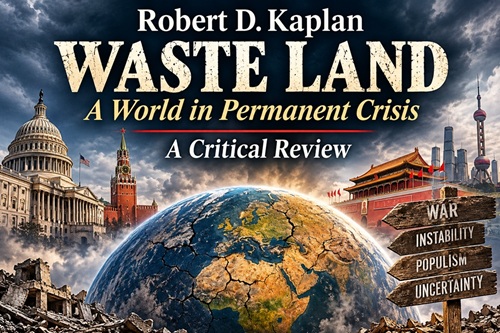 Robert D. Kaplan has built a distinguished career interpreting international politics through the lenses of geography, history, civilization, and the darker dimensions of human nature. His writing is characterized by a strong sense of historical tragedy: civilizations rise and fall, political orders are fragile, geographical constraints endure, and human beings repeatedly fail to learn from their mistakes. His book Waste Land: A World in Permanent Crisis (2023) extends this worldview into an examination of a world seemingly trapped in perpetual disorder. The title itself evokes T. S. Eliot's famous poem, suggesting not merely political instability but a deeper cultural and moral desolation. Kaplan is an important writer precisely because he resists the comforting assumption that history moves automatically toward greater freedom, prosperity, and rationality. He reminds readers that progress is reversible, that political institutions can collapse, and that the international order is never as secure as it appears. Yet there is a problem with Kaplan's approach. His historical pessimism can become an explanatory framework in its own right, making crisis appear almost inevitable. By emphasizing the persistence of disorder, he risks underestimating the capacity of political institutions, technological innovation, international cooperation, and human agency to change historical trajectories. The central question of this review is therefore not whether Kaplan correctly identifies a world in crisis. Much of his diagnosis is persuasive. It is whether his pessimistic interpretation adequately explains why crises occur, why some societies overcome them, and why others do not. 1. Weimar as a metaphor for the contemporary worldThe book is organized into three sections: Weimar Goes Global, The Great Powers in Decline, and Crowds and Chaos. The organizing metaphor is the Weimar Republic of Germany between 1919 and 1933, a democratic experiment that ultimately succumbed to Hitler's dictatorship. Kaplan sees parallels between Weimar's political fragmentation and today's interconnected international system. In both cases, political institutions are under pressure, social cohesion is weakening, and crises in one domain can rapidly spill over into others. The difference is that today's world is technologically interconnected to an unprecedented degree. A financial crisis, pandemic, regional war, or political upheaval can have consequences far beyond its original geographical location. This is one of the book's most compelling observations. Globalization has not necessarily produced a more harmonious international society. It has also multiplied the channels through which instability travels. The world has become smaller without necessarily becoming more governable. Kaplan's formulation that geography is shrinking rather than disappearing is particularly insightful. Technology reduces distances, but it also makes every geographical location potentially more consequential. What happens in Ukraine, Taiwan, the Middle East, or the South China Sea can affect the security and prosperity of countries thousands of kilometres away. However, the Weimar analogy requires caution. The Weimar Republic was a particular historical formation, with specific institutional weaknesses, economic traumas, political movements, and historical circumstances. Today's international system is not a single republic, nor does it possess a unified political structure that could collapse in the same way. The analogy is therefore more suggestive than explanatory. It draws attention to institutional fragility but does not establish that contemporary democracy is following the same trajectory as interwar Germany. More importantly, Weimar did not collapse simply because society was fragmented or because people had lost a common cultural identity. The Great Depression, political violence, elite decisions, institutional weaknesses, and the deliberate destruction of democratic government all played crucial roles. Historical analogies become misleading when they substitute for a careful examination of causal mechanisms. 2. The decline of the great powersKaplan's second major theme concerns the apparent decline of the world's three principal powers: the United States, China, and Russia. He does not simply argue that American decline is inevitable. In fact, he considers the possibility that China and Russia are experiencing more serious structural problems than the United States. American political dysfunction is highly visible, whereas authoritarian systems can conceal their weaknesses behind censorship, propaganda, and the concentration of power. This is an important distinction. Democratic societies publicly display their disagreements, failures, and political conflicts. Authoritarian governments can create an appearance of stability by suppressing criticism. Consequently, comparing the visible disorder of democracies with the manufactured order of dictatorships can produce a distorted assessment of their relative strength. Kaplan is particularly critical of Vladimir Putin's Russia and Xi Jinping's China. He sees both systems as increasingly personalized forms of authoritarian government, with dangerous consequences for succession, political flexibility, and international stability. His analysis of Russia is especially relevant in the aftermath of the invasion of Ukraine. Putin's decision to launch a full-scale war in February 2022 illustrates the dangers of concentrated political power, distorted intelligence, imperial ambition, and the absence of meaningful institutional restraints. Nevertheless, Kaplan's geopolitical realism also deserves scrutiny here. Russia's security concerns cannot simply be dismissed as imaginary. Its geographical position, historical invasions, military vulnerabilities, and perceptions of NATO expansion belong to the context in which Russian foreign policy operates. But explaining these concerns is not the same as accepting Russia's interpretation of them, let alone legitimizing its invasion of a sovereign neighbour. There is a crucial distinction between perceived insecurity, strategic calculation, and objective justification. Russia's invasion was neither geographically inevitable nor morally justified. Other countries facing difficult security environments have made different choices. Political leadership, ideology, historical ambitions, and the agency of neighbouring states all matter. This is where geopolitical realism can become too accommodating toward the behaviour of powerful states. By concentrating on their strategic calculations, analysts sometimes risk treating smaller countries as objects of great-power competition rather than independent political communities. Ukraine is not simply a geographical buffer between Russia and the West. It is a country with its own history, political aspirations, and right to determine its international orientation. Kaplan's realism is useful when it explains the constraints within which states operate. It becomes problematic when those constraints appear to determine what powerful states are entitled to do. 3. American decline and the crisis of democracyKaplan's treatment of the United States is among the most interesting parts of the book. He identifies a country increasingly divided between political extremes, with its traditional political centre losing influence. The problem is not merely ideological polarization. It is also institutional and cultural. The American political system has become vulnerable to personalities who exploit public resentment, distrust of institutions, and the emotional dynamics of mass communication. Donald Trump is an important example in Kaplan's analysis. His political style belongs to an environment in which short videos, social media, instant reactions, and emotionally charged messages have displaced much of the slower, more deliberative political culture associated with traditional print media. Kaplan contrasts the intellectual habits of the print and typewriter age with those of the digital era. The former encouraged more elaborate arguments, editorial scrutiny, and a degree of intellectual moderation. The latter rewards speed, provocation, outrage, and simplified narratives. This is a persuasive observation, although it risks idealizing the past. Traditional media were hardly immune to propaganda, political manipulation, sensationalism, or ideological conformity. Nor does digital communication automatically produce intellectual decline. It can also make independent information, investigative journalism, and political mobilization more widely accessible. The real problem is not technology itself but the political and economic incentives governing its use. Social media platforms compete for attention, and emotional reactions are particularly effective at generating engagement. Political entrepreneurs have learned to exploit this environment. The resulting fragmentation of public discourse makes it harder to establish shared facts, let alone reach agreement about collective problems. Kaplan's criticism of American political decadence also raises an important question: can a democracy remain stable when its political elites lose confidence in its institutions? The answer is not necessarily negative. Democratic systems have survived profound crises before. The United States itself emerged from the Civil War, the Great Depression, and the political upheavals of the 1960s. Its institutions have repeatedly demonstrated both resilience and vulnerability. What matters is whether political actors continue to respect constitutional constraints, accept electoral outcomes, and recognize the legitimacy of political opposition. Kaplan is right to warn that these conditions cannot be taken for granted. But the historical record also suggests that democratic renewal is possible. 4. The danger of mass democracy and the politics of crowdsThe third section, Crowds and Chaos, takes the argument in a more controversial direction. Kaplan is concerned about the political consequences of mass society, urbanization, and digital communication. He sees the modern crowd as a potential source of tyranny, not merely as a victim of authoritarian leaders. In earlier historical periods, tyranny was primarily exercised from above. Modern mass communication, however, makes it possible for collective emotions to exert coercive pressure from below. Online mobs can punish dissent, spread conspiracy theories, destroy reputations, and impose ideological conformity without any centralized political authority. This is a genuine problem. The digital crowd can be impulsive, intolerant, and indifferent to evidence. Its members may experience a sense of moral certainty that is strengthened by the apparent agreement of thousands of others. Yet Kaplan's treatment of crowds raises another question: who decides when collective political action becomes dangerous? Demonstrations, protests, popular movements, and mass political mobilization are also essential components of democracy. The civil rights movement, anti-apartheid activism, and the peaceful revolutions against communist regimes all involved collective action. The crowd is not inherently irrational, just as the political elite is not inherently rational. Indeed, history offers numerous examples of elites generating catastrophic political decisions while ordinary citizens resisted them. The German experience itself demonstrates that authoritarianism can be produced through a combination of mass mobilization and elite collaboration. Kaplan's emphasis on the dangers of mass politics therefore needs to be balanced by an equally serious examination of elite irresponsibility. Democracy is not simply the art of keeping crowds under control. It is a system for making political power accountable, including the power exercised by those who consider themselves wiser, better educated, or more qualified to govern. There is a danger that a critique of populism can slide into an overly aristocratic understanding of politics, in which popular participation is treated as a problem rather than as an essential democratic principle. The appropriate response to irrational mass politics is not less democracy, but better democratic institutions, stronger civic education, more independent journalism, and greater political accountability. 5. Kaplan's nostalgia for orderPerhaps the most revealing feature of Waste Land is its underlying preference for order over political experimentation. Kaplan draws on conservative thinkers and historical examples to argue that stable political arrangements are indispensable. He even evokes the stabilizing influence of monarchies and the symbolic authority of kings and queens. His appreciation for traditional forms of authority is understandable. Political communities need institutions, shared expectations, and a sense of continuity. Societies cannot function indefinitely through permanent political mobilization and revolutionary enthusiasm. But Kaplan's argument raises an uncomfortable question: what kind of order are we talking about, and whose interests does it serve? The history of monarchy, empire, and authoritarian government is not simply a history of stability. It is also a history of exploitation, repression, colonial domination, and political exclusion. The apparent stability of an authoritarian regime may conceal enormous social tensions. The absence of public disagreement is not evidence of political consensus. Nor should the stability of the international system be confused with justice within that system. The Cold War, for example, produced a degree of strategic predictability through nuclear deterrence, but this did not prevent proxy wars, dictatorships, military interventions, or enormous human suffering. Similarly, the American-led international order after 1945 contributed to unprecedented economic integration and relative stability among major Western powers. Yet it also accommodated numerous authoritarian allies and military interventions. Kaplan's appreciation of American hegemony should therefore be accompanied by a more critical assessment of the costs and contradictions of that order. A stable international system is desirable, but stability alone is not a sufficient political objective. The question is whether it provides security, sovereignty, human rights, and opportunities for peaceful political development. 6. The missing counterargument: globalization can also stabilizeOne of the limitations of Kaplan's argument is his tendency to emphasize the destabilizing consequences of globalization and technological change. Certainly, interdependence creates vulnerabilities. Supply chains can be disrupted, pandemics can spread, financial crises can become international, and digital communication can amplify political extremism. But interdependence also creates incentives for cooperation. International trade, scientific collaboration, diplomatic institutions, and shared regulatory frameworks can reduce the likelihood of conflict. The European Union, despite its many shortcomings, offers an important historical example of former adversaries building a durable framework of cooperation. The same technological developments that accelerate the transmission of crises also enable scientific discoveries, international coordination, and the rapid dissemination of information. The question is therefore not whether globalization produces stability or instability. It produces both, depending on the institutional arrangements and political decisions that shape it. Kaplan's diagnosis would be stronger if it explored this dual character more systematically. The same applies to climate change. Kaplan rightly treats environmental disruption as a source of geopolitical instability, especially through migration, resource scarcity, and political fragility. But climate change is also an area in which international cooperation is unavoidable. No major power can insulate itself completely from its consequences. This does not mean that international agreements will necessarily succeed. It means that the future is not determined exclusively by competition and conflict. The absence of effective global governance is a serious problem, but it is not proof that better forms of cooperation are impossible. 7. A world without historical inevitabilityThere is a deeper methodological problem running through Waste Land: the tendency to interpret contemporary events through the accumulated weight of historical tragedy. Kaplan is an accomplished historical writer, and his literary references give his work considerable intellectual richness. But historical parallels can sometimes become substitutes for causal analysis. If Weimar is our metaphor, are we heading toward fascism? If empires are declining, must international disorder follow? If technology fragments society, must democracy deteriorate? If authoritarian leaders become increasingly isolated, must their countries eventually descend into chaos? None of these outcomes is inevitable. History provides patterns, possibilities, and warnings. It does not provide predetermined scripts. This is particularly important in geopolitics, where the actions of political leaders, the decisions of governments, and the responses of other countries can radically alter the course of events. The invasion of Ukraine provides a good example. Russia's geographical position, historical experiences, and security calculations help explain its strategic environment. But they do not explain the invasion by themselves. Putin's particular interpretation of Russian history, his imperial ambitions, his assumptions about Ukrainian resistance, and his misjudgment of Western responses were also decisive. A different Russian leadership might have made different choices. Likewise, the future of American democracy depends not simply on structural decline but on the decisions of political institutions, voters, courts, civil society, and political leaders. The distinction between historical constraints and historical inevitability is essential. Kaplan is at his best when he identifies the former. He is less convincing when his tragic worldview seems to blur the distinction. 8. What is missing from Kaplan's geopolitical vision?A book about permanent crisis should also address the mechanisms through which societies escape crises. Kaplan is remarkably good at identifying dangers, but less successful at developing a constructive account of political renewal. His emphasis on moderation, restraint, historical awareness, and strong institutions is sensible, but these remain broad prescriptions rather than a detailed political program. Three subjects deserve considerably more attention. First, institutional adaptation. Democratic institutions are not static structures. They can reform themselves, develop new forms of accountability, and respond to technological and economic transformations. The history of democratic government is not simply one of decline. It is also a history of institutional learning. Second, international cooperation. Great-power competition is real, but so are common interests. The United States, China, Russia, and European countries face transnational challenges that cannot be addressed through military deterrence and geopolitical maneuvering alone. Even bitter adversaries have reasons to cooperate on nuclear security, climate change, pandemics, and economic stability. Third, human agency. Kaplan's historical imagination sometimes gives the impression that individuals and societies are caught in processes larger than themselves. Yet political outcomes depend on decisions. History is not merely something that happens to us. It is also something we collectively produce. A more balanced geopolitical analysis would combine Kaplan's tragic realism with a stronger understanding of institutional resilience, political reform, and the possibilities of international cooperation. This is not naïve optimism. It is a recognition that pessimism, just like optimism, can become an intellectual prejudice. 9. Kaplan compared with his earlier workReaders familiar with Kaplan's earlier book The Revenge of Geography (2012) will recognize a continuous intellectual outlook. In that book, geography was presented as a powerful constraint on political possibilities. Mountains, coastlines, rivers, plains, and strategic locations shape the opportunities and vulnerabilities of nations. The central criticism of that approach was its tendency toward geographical determinism. Geography matters enormously, but it does not dictate political outcomes. Institutions, technology, ideology, leadership, and historical contingency also matter. Waste Land applies a comparable perspective to the broader historical and political environment. This time, the emphasis is less on physical geography and more on the structural conditions of global instability: technological interconnectedness, demographic change, urbanization, mass communication, and the decline of established political orders. The same critical question arises: are these conditions explanatory factors, or are they becoming an overarching narrative through which virtually every contemporary development is interpreted? Kaplan's strongest contribution is to remind us that political systems operate within constraints that cannot simply be wished away. His weakness is that he sometimes gives those constraints too much explanatory weight. There is also a revealing tension between the two books. In The Revenge of Geography, geographical constraints are presented as enduring features of international politics. In Waste Land, technology is shrinking geographical distances and intensifying global interdependence. Yet the underlying lesson remains similar: the world is governed by forces that political idealists tend to underestimate. That is a valuable corrective, but it should not become a new form of determinism. 10. Final assessment: realism without resignationWaste Land is an intellectually stimulating book that deserves serious consideration. Kaplan's extraordinary historical knowledge, literary references, and geopolitical experience make him an engaging guide through the uncertainties of contemporary international politics. His warnings about democratic fragility, authoritarian leadership, technological disruption, political polarization, and the weakening of international order are important. In particular, his observation that technological interconnectedness does not automatically produce political cooperation deserves attention. But the book also illustrates the limitations of a worldview dominated by historical pessimism and geopolitical realism. Kaplan sometimes seems to regard order as a greater political achievement than freedom, and stability as a more fundamental objective than justice. His suspicion of mass democracy, his appreciation of traditional authority, and his emphasis on American hegemony reveal a conservative political preference that deserves more explicit examination. There is nothing inherently wrong with defending political order. Without functioning institutions, individual freedom becomes precarious. But order can also protect entrenched power, suppress legitimate dissent, and perpetuate injustice. The alternative to disorder is not necessarily authoritarian stability. It can be democratic resilience. Similarly, recognizing the realities of great-power politics does not require accepting a world in which powerful countries determine the destinies of weaker neighbours. Russia's invasion of Ukraine demonstrates precisely why the distinction between geopolitical explanation and political justification must be maintained. Kaplan's tragic realism is a useful antidote to simplistic accounts of inevitable progress. But it needs a counterweight: a recognition that history is open-ended, that political institutions can improve, and that international cooperation is not necessarily an illusion. Perhaps the most important lesson of the Weimar Republic is not that democracy is doomed to fail when confronted with social fragmentation. It is that democratic institutions require active protection, responsible political leadership, and citizens willing to defend constitutional principles. There is no guarantee that they will succeed. But neither is there any historical law requiring their failure. The world may indeed be a waste land in many respects. But treating it as a permanent condition risks turning a warning into a prophecy. Kaplan wants us to think tragically. Fair enough. But we should also think critically about tragedy itself. A geopolitical analysis that explains why things go wrong should also investigate how they might go right. Realism without fatalism, historical awareness without determinism, and political order without sacrificing democratic freedom: that would be a more complete response to the challenges Kaplan so eloquently describes. Comment Form is loading comments...
|