|
TRANSLATE THIS ARTICLE
Integral World: Exploring Theories of Everything
An independent forum for a critical discussion of the integral philosophy of Ken Wilber
  Frank Visser, graduated as a psychologist of culture and religion, founded IntegralWorld in 1997. He worked as production manager for various publishing houses and as service manager for various internet companies and lives in Amsterdam. Books: Ken Wilber: Thought as Passion (SUNY, 2003), and The Corona Conspiracy: Combatting Disinformation about the Coronavirus (Kindle, 2020).
Check out my other conversations with ChatGPT
Geography and Geopolitics:
The Revenge of Geography: When Maps Become Destiny The Revenge of Geopolitical Realism What If Russia Invaded Ukraine for Security Reasons? Jared Diamond: The Geography of Human History Jared Diamond: The Geography of Human HistoryA Critical Examination of Environmental Determinism, Historical Generalization, and the Limits of Grand TheoryFrank Visser / ChatGPT
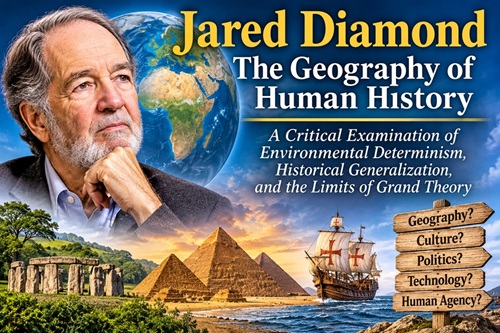 Introduction: The Man Who Wanted to Explain EverythingFew contemporary popular intellectuals have attempted something as ambitious as Jared Diamond. In books such as Guns, Germs, and Steel (1997), Collapse: How Societies Choose to Fail or Succeed (2005), and The World Until Yesterday (2012), Diamond has sought to explain the enormous differences between human societies, the rise and fall of civilizations, and the long-term trajectories of human development. His central ambition is admirable: to replace explanations based on racial superiority, cultural exceptionalism, or the supposed inherent qualities of particular peoples with explanations grounded in geography, ecology, biology, and environmental history. Why did European societies eventually acquire the technological and military advantages that enabled them to conquer much of the world? Why did some civilizations flourish while others collapsed? Why did agriculture develop in certain regions before others? Diamond offers a sweeping answer: geographical and environmental circumstances have profoundly shaped the possibilities available to human societies. This is an important corrective to simplistic historical explanations. But Diamond's work also illustrates the dangers of grand historical theories. In trying to explain enormous stretches of human history through a relatively compact set of environmental variables, he sometimes simplifies precisely those historical processes that require the greatest explanatory attention. The problem is not that geography is irrelevant. It is that geography can become an overly convenient explanation, replacing one form of historical determinism with another. 1. Guns, Germs, and Steel: A Powerful Question, an Incomplete AnswerDiamond's most influential book begins with a question posed to him by a New Guinean acquaintance, Yali: Why did Europeans develop so much material power and bring it to New Guinea, rather than New Guineans developing comparable power and bringing it to Europe? It is a deceptively simple question with enormous historical implications. Diamond rejects racial explanations. There is no convincing evidence that Europeans are inherently more intelligent or capable than other peoples. Instead, he traces the origins of global inequalities to geographical differences that emerged thousands of years before European colonial expansion. The Eurasian continent, he argues, possessed several decisive advantages. It contained a relatively large number of domesticable plants and animals, including wheat, barley, cattle, sheep, and horses. Its predominantly east-west orientation facilitated the diffusion of crops, livestock, technologies, and ideas across similar climatic zones. Agriculture generated food surpluses, which supported larger populations, specialized occupations, political institutions, and eventually military technologies. Other regions faced different constraints. Africa's north-south orientation complicated the spread of agricultural innovations across climatic and ecological boundaries. The Americas contained fewer domesticable large mammals, while geographical barriers restricted the diffusion of crops and technologies. The resulting explanation is elegant and compelling. But elegance is not the same as completeness. Diamond's account risks making the transition from environmental opportunity to historical outcome appear much more automatic than it actually was. The presence of domesticable species does not explain by itself why particular societies adopted agriculture, how they organized agricultural production, or why certain political institutions emerged. Nor does the existence of a technological advantage explain how it was translated into military and imperial power. Geography creates possibilities and constraints. It does not independently determine what societies do with them. 2. The Problem of Environmental DeterminismDiamond is often described as an environmental determinist, although he would undoubtedly reject the strongest interpretation of that label. His position is more sophisticated than the crude proposition that geography determines everything. He recognizes the importance of historical contingencies, cultural differences, and political decisions. Nevertheless, his explanatory framework gives environmental conditions an exceptionally prominent role. The danger is that geographical explanations can become substitutes for explanations of human agency. Once the relevant environmental conditions have been identified, subsequent developments may appear to follow almost inevitably. But consider the enormous differences between societies occupying broadly comparable geographical environments. Why did some develop centralized states while others maintained decentralized political arrangements? Why did some adopt particular technologies while others did not? Why did similar ecological pressures produce different institutional responses? These questions require an analysis of political organization, social conflict, property relations, religion, cultural transmission, and historical contingency. Geography alone cannot provide that analysis. Indeed, environmental determinism can become difficult to distinguish from historical hindsight: once a society has succeeded, its geographical advantages are identified; once it has failed, its environmental disadvantages are emphasized. A satisfactory theory must do more than explain outcomes retrospectively. It must identify mechanisms and generate expectations that could potentially prove it wrong. 3. The Missing Politics of Historical DevelopmentOne of the most significant weaknesses of Diamond's grand narrative is its treatment of political and economic power. The emergence of agricultural surpluses, for example, does not automatically produce the same social arrangements everywhere. Surpluses can be distributed relatively widely, appropriated by elites, controlled by religious authorities, or used to sustain military institutions. The question is not simply whether a society can produce surplus food, but who controls it and what political structures develop around that control. Similarly, the development of technology is not merely a geographical phenomenon. Technologies are adopted, modified, suppressed, and selectively distributed through institutions and power relationships. European expansion cannot be understood simply by referring to Eurasian geography, domesticable animals, and the diffusion of technologies. It also requires attention to the development of European states, commercial competition, financial institutions, military organization, maritime expansion, and the particular historical circumstances of colonial conquest. The same applies to capitalism. Environmental conditions may help explain the availability of resources and the possibilities of economic development, but they do not adequately explain the institutional and political arrangements through which wealth is accumulated and distributed. Diamond's approach is therefore strongest when explaining broad background conditions and weakest when it attempts to account for the actual historical processes connecting those conditions to particular outcomes. 4. Germs, Conquest, and the Limits of Biological ExplanationOne of Diamond's most important arguments concerns the role of infectious diseases in European conquest. Populations in Eurasia had experienced prolonged exposure to diseases associated with domesticated animals and dense settlements. Over generations, some acquired partial immunity to pathogens that devastated populations elsewhere. When Europeans arrived in the Americas, diseases such as smallpox spread with catastrophic consequences. Indigenous populations, lacking comparable prior exposure, suffered enormous mortality. This argument is historically important. Disease was not an incidental factor in European conquest; it was one of its principal enabling conditions. But there is a danger in allowing this biological explanation to overshadow the political and military processes of conquest. European victories were not simply the consequence of germs. They also involved alliances with Indigenous groups, internal conflicts among Indigenous polities, military tactics, firearms, horses, logistical arrangements, and the strategic decisions of particular actors. The Spanish conquest of the Aztec and Inca empires, for example, cannot be reduced to the introduction of European diseases. The political circumstances of those empires and the alliances formed by the Spanish were crucial. Moreover, disease did not make colonial domination inevitable. Conquest, settlement, exploitation, resistance, and the creation of colonial institutions were historical processes involving human decisions. Biology helps explain the extraordinary vulnerability of Indigenous populations. It does not explain the entirety of colonial history. 5. Collapse: Environmental Crisis and Civilizational FailureIn Collapse, Diamond shifts from explaining the origins of global inequality to examining why societies sometimes destroy the ecological foundations of their own existence. He discusses the disappearance or transformation of societies such as the Norse Greenland settlements, the inhabitants of Easter Island, and the Classic Maya, alongside examples of environmental adaptation and successful resource management. His general framework identifies five factors: • Environmental damage. • Climate change. • Hostile neighbours. • Loss of support from friendly neighbours. • A society's response to environmental problems. This is a useful framework because it refuses to treat environmental disasters as isolated natural events. Societies encounter environmental pressures, but their political and cultural responses influence the consequences. Yet Diamond's case studies have attracted substantial criticism from archaeologists and historians. Easter Island, in particular, has become a controversial example. Diamond presents deforestation and ecological degradation as central to the island's demographic and social collapse. More recent research has challenged the traditional image of a population that destroyed its own environment and subsequently experienced catastrophic collapse before European arrival. The role of Polynesian rats in forest regeneration, the resilience of Indigenous agricultural practices, and the devastating consequences of European contact all complicate the familiar narrative of ecological self-destruction. Likewise, explanations of Maya political disintegration must account for considerable regional variation, warfare, political competition, agricultural practices, and adaptation. There was no single Maya collapse occurring uniformly across the entire civilization. The broader lesson is important: environmental stress does not produce identical outcomes in every society. Political organization, social inequality, institutional flexibility, and historical circumstances matter enormously. Diamond is right to emphasize ecological constraints. He is less convincing when individual case studies are made to fit a general model of civilizational collapse. 6. The Problem of Selecting Historical ExamplesGrand historical theories face a methodological problem: the selection of examples. Diamond examines societies that illustrate his arguments, but historical evidence is often incomplete, disputed, or open to competing interpretations. The danger is that examples become illustrations of an explanatory framework rather than independent tests of it. If a society collapses, environmental degradation may be identified as the principal cause. If it survives, its adaptation is emphasized. If its development differs from expectations, additional historical circumstances are introduced. This flexibility can make a theory appear more comprehensive than it actually is. A stronger methodology would compare societies facing similar environmental pressures but producing different outcomes, as well as societies facing different pressures but developing similar institutions. Such comparisons would help establish which variables are genuinely explanatory and which merely correlate with historical outcomes. It would also require greater attention to counterexamples: societies that flourished in apparently unfavourable environments, and societies that failed despite considerable geographical advantages. The important question is not whether Diamond can find geographical explanations for historical events. He frequently can. It is whether those explanations outperform competing accounts. 7. The World Until Yesterday: Romanticizing Traditional Societies?In The World Until Yesterday, Diamond examines what contemporary societies might learn from traditional societies. He discusses child-rearing, conflict resolution, risk management, attitudes toward the elderly, religion, and social organization. There is considerable value in his willingness to challenge the assumption that modern Western institutions represent the inevitable culmination of human social development. Traditional societies have developed sophisticated ways of managing particular environmental and social problems. Their knowledge deserves serious attention. However, Diamond sometimes risks presenting traditional societies through a somewhat romantic lens. Small-scale societies are not necessarily peaceful, egalitarian, psychologically healthier, or environmentally sustainable. They can exhibit violence, coercion, rigid hierarchies, exclusion, and severe forms of social control. Nor can practices developed in small, relatively isolated communities necessarily be transferred to complex industrial societies. The comparison requires more care than a simple contrast between the advantages of traditional life and the disadvantages of modernity. Traditional societies are not repositories of lost wisdom waiting to be rediscovered. They are diverse historical formations, each with its own achievements, limitations, and problems. 8. A More Complete Theory of Human HistoryWhat would a more satisfactory approach look like? It would retain Diamond's emphasis on geography, ecology, climate, domestication, and disease, but integrate these factors into a broader historical framework. At least five dimensions deserve equal attention. First, environmental conditions. Climate, geography, natural resources, biodiversity, and ecological constraints establish the material conditions within which societies develop. Second, technological innovation. Human societies invent, borrow, adapt, and sometimes abandon technologies. Their trajectories depend not only on available resources but also on the transmission and organization of knowledge. Third, political institutions. States, empires, legal systems, property arrangements, and administrative structures shape how societies mobilize resources and respond to challenges. Fourth, economic power and social inequality. The distribution of wealth, access to land, control of labour, and competition between social groups influence historical development in ways that cannot be reduced to ecological variables. Fifth, historical contingency and human agency. Wars, political decisions, individual leadership, social movements, cultural exchanges, and unexpected events can redirect historical trajectories. These dimensions interact. None can be understood entirely in isolation. This is not an argument for replacing geographical determinism with political or economic determinism. It is an argument for a genuinely multicausal understanding of history. 9. The Paradox of Grand NarrativesThere is an interesting paradox in Diamond's intellectual project. He wants to escape the prejudices of conventional historical narratives, particularly those that attribute Western dominance to European superiority. His explanation is intended to be more scientific, comparative, and universal. Yet the ambition to explain the entire history of human civilization through a limited number of general principles creates its own form of reductionism. The problem is familiar from other grand theories. Marxism can overemphasize economic relations; biological reductionism can overemphasize genetic explanations; cultural theories can overemphasize values and beliefs; technological determinism can overemphasize inventions. Diamond's version tends toward geographical and ecological explanation. Each approach identifies something important. None should be mistaken for a complete theory of history. Human history is not a simple unfolding of environmental possibilities. It is a complex interaction between material conditions, institutional arrangements, cultural interpretations, power struggles, and unpredictable events. A good historical theory should help us understand this complexity, not conceal it beneath an elegant explanatory formula. Conclusion: Geography Matters, but It Does Not Explain EverythingJared Diamond deserves considerable credit for asking large questions and making historical and scientific knowledge accessible to a broad readership. Guns, Germs, and Steel challenged racial explanations of global inequality, while Collapse brought environmental sustainability into discussions of historical development. These are substantial intellectual contributions. Nevertheless, Diamond's work is less successful when its environmental explanations become comprehensive accounts of historical change. Geography influences what societies can do, but it does not determine what they will do. Ecological constraints matter, but political institutions, social inequalities, cultural practices, and human decisions mediate their effects. The central weakness of Diamond's approach is not that it takes geography seriously. It is that it sometimes gives geography too much explanatory responsibility. There is also a larger methodological lesson. The ability to construct a persuasive narrative connecting thousands of years of human history should not be confused with the ability to demonstrate a comprehensive causal theory. Diamond's books are valuable introductions to the environmental dimensions of history. They should not be treated as definitive explanations of the rise, development, and collapse of civilizations. The most productive way forward is neither to reject Diamond nor to accept his grand narrative wholesale. It is to retain his geographical insights while placing them within a richer account of historical causation. Geography sets the stage. It does not write the script. Comment Form is loading comments...
|