|
TRANSLATE THIS ARTICLE
Integral World: Exploring Theories of Everything
An independent forum for a critical discussion of the integral philosophy of Ken Wilber
  Frank Visser, graduated as a psychologist of culture and religion, founded IntegralWorld in 1997. He worked as production manager for various publishing houses and as service manager for various internet companies and lives in Amsterdam. Books: Ken Wilber: Thought as Passion (SUNY, 2003), and The Corona Conspiracy: Combatting Disinformation about the Coronavirus (Kindle, 2020).
Check out my other conversations with ChatGPT
Geography and Geopolitics:
The Revenge of Geography: When Maps Become Destiny The Revenge of Geopolitical Realism What If Russia Invaded Ukraine for Security Reasons? Jared Diamond: The Geography of Human History The Revenge of Geography: When Maps Become DestinyA Critical Review of Robert D. Kaplan's Geopolitical WorldviewFrank Visser / ChatGPT
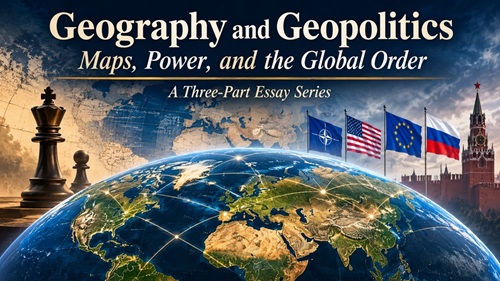 Introduction: Geography Strikes BackRobert D. Kaplan's The Revenge of Geography: What the Map Tells Us About Coming Conflicts and the Battle Against Fate (2012) is an ambitious attempt to restore geography to the center of geopolitical thinking. At a time when globalization, technological innovation, international institutions, and economic interdependence seemed to promise an increasingly borderless world, Kaplan offered a sobering corrective: geography had not disappeared. Mountains, rivers, deserts, coastlines, plains, and strategically located waterways continued to shape the possibilities and limitations of political power. His central argument is compelling in its basic formulation. Political leaders may change, ideologies may rise and fall, and economic systems may be transformed, but the physical geography of the planet remains remarkably constant. States cannot simply choose their geographical circumstances. Russia cannot move its enormous landmass closer to the Atlantic, China cannot eliminate its continental vulnerabilities, and the United States enjoys strategic advantages from its position between two oceans. Yet there is a problem with Kaplan's approach. In reminding us that geography matters, he sometimes comes dangerously close to suggesting that geography explains more than it actually does. The map becomes not merely a constraint on political behavior but an almost autonomous force directing historical events. The result is a stimulating work of geopolitical interpretation, but also one that risks reviving an older and more deterministic tradition of geopolitical thought. 1. The Intellectual Background: From Mackinder to SpykmanKaplan builds on a long tradition of geopolitical scholarship. Among his principal intellectual predecessors are British geographer Halford Mackinder, American political scientist Nicholas Spykman, and German geographer Friedrich Ratzel. Mackinder's famous Heartland theory, developed in the early twentieth century, assigned exceptional strategic importance to the Eurasian interior. His argument was that control over the continental heartland could potentially provide the foundations for domination of the surrounding regions and, ultimately, the world. Spykman modified this perspective by emphasizing the importance of the Eurasian coastal regions, which he called the Rimland. For him, the balance of power depended less on control of the inaccessible continental interior than on the ability to prevent any single power from dominating the strategically important maritime margins of Eurasia. These theories influenced twentieth-century strategic thinking, including aspects of Cold War containment. Kaplan sees continuing relevance in them, particularly in understanding the relationship between Russia, China, Europe, and the United States. There is certainly something to be said for this tradition. Geography imposes real constraints on military operations, trade routes, resource distribution, and strategic access. A country surrounded by hostile neighbors faces different problems from an island protected by oceans. But the intellectual heritage also carries baggage. Classical geopolitics sometimes treated states as organisms struggling for territorial survival, while interpreting expansion and competition as almost natural consequences of geographical circumstances. Such reasoning can make political choices appear inevitable and can provide intellectual cover for imperial ambitions. Kaplan is more sophisticated than the crude geographical determinists of the past, but he does not entirely escape their assumptions. 2. Geography as Constraint, Not DestinyThe strongest part of Kaplan's argument is his insistence that geography deserves renewed attention. Consider Russia. Its immense territory, relatively exposed western approaches, difficult access to warm-water ports, and historical experience of invasions have undoubtedly influenced its strategic culture. The European plain offers relatively few natural defensive barriers between Russia and Central Europe. These circumstances have contributed to Russian concerns about strategic depth and territorial security. China faces a different geographical predicament. Its densely populated eastern seaboard is separated from much of its continental interior by significant geographical barriers, while its maritime approaches are increasingly important to its economic development. Its vulnerability to maritime pressure has become a major consideration in its strategic planning. The United States, by contrast, enjoys an extraordinary geographical position. Two oceans separate it from the principal centers of Eurasian power, while its extensive navigable river systems and access to both the Atlantic and Pacific have facilitated continental integration and international trade. These are not trivial observations. Geography helps explain why states have different strategic opportunities and vulnerabilities. But explaining constraints is not the same as explaining outcomes. Russia's geographical exposure does not make the invasion of Ukraine inevitable. China's maritime vulnerability does not predetermine its future relationship with Taiwan. America's oceanic protection does not automatically produce wise foreign policy. The same geographical circumstances can generate different political responses under different leaderships, institutions, economic conditions, and historical circumstances. Geography establishes a field of possibilities. It does not dictate which possibilities political actors will pursue. 3. Russia: The Geography of Insecurity and Imperial AmbitionRussia is perhaps the most revealing case for examining both the strengths and weaknesses of Kaplan's approach. The country's geography has undoubtedly shaped its historical development. Its enormous western plains have facilitated invasions from Europe, while its limited access to ice-free maritime routes has encouraged a persistent interest in strategic access and naval power. Russian rulers have repeatedly sought buffers along their western borders. The Soviet Union's domination of Eastern Europe after the Second World War can partly be understood in this context. The desire for strategic depth was not invented by Vladimir Putin. However, there is a crucial distinction between understanding Russian security concerns and accepting Russian territorial claims. The geographical vulnerability of Russia does not confer a permanent entitlement to neighboring countries. Poland, the Baltic states, Finland, and Ukraine have their own geographical circumstances, historical experiences, and legitimate security interests. Indeed, the same geographical reasoning that explains Russian anxiety also helps explain why neighboring countries seek protection against Russian power. This is particularly important in the case of Ukraine. Its geographical position between Russia and Central Europe has made it strategically significant for centuries. But strategic significance is not political ownership. Ukraine is not simply a geographical buffer, an extension of the Russian security perimeter, or a corridor between competing power centers. It is a political community with its own historical development and right to determine its international orientation. A geopolitical analysis that treats Ukraine primarily as an object in the strategic calculations of larger powers risks reproducing precisely the imperial logic it should be examining. There is another problem. Russian insecurity can become self-reinforcing. When Moscow interprets the independence of neighboring states as a threat, its attempts to control them generate precisely the hostility and resistance that make Russia feel more insecure. The invasion of Ukraine in 2022 illustrates this paradox. Rather than securing a neutral buffer, Russia helped consolidate Ukrainian national identity, strengthen NATO, and encourage Finland and Sweden to abandon military non-alignment. Geography helps explain Russia's strategic anxieties. It does not excuse its decisions, and it certainly does not make them inevitable. 4. China and the Return of Maritime CompetitionKaplan's discussion of China is another important contribution. China's geographical position creates a tension between its continental and maritime interests. Historically, Chinese civilization developed primarily around its great river systems and agricultural heartlands. Modern China, however, is deeply dependent on maritime commerce, imported energy, and international shipping routes. Its eastern coastline is economically dynamic but strategically exposed. The so-called First Island Chain, stretching from Japan through Taiwan and the Philippines, represents an important geographical constraint on Chinese naval access to the Pacific. This helps explain Beijing's growing interest in naval modernization, the South China Sea, and the security of its maritime trade routes. But again, geographical explanations can become misleading when they are transformed into predictions of inevitable conflict. China's strategic options are shaped not only by its coastline but also by its economic interdependence, domestic political system, technological capabilities, leadership decisions, and relations with neighboring states. The South China Sea is not merely a geographical arena. It is also a political and legal environment involving competing territorial claims, international maritime law, and the sovereignty of smaller states. Taiwan, similarly, is not simply an island occupying a strategically important position. It is a self-governing society whose population has political preferences and democratic institutions that cannot be reduced to its geographical location. Kaplan is right to emphasize the strategic importance of geography. He is less convincing when geographical competition threatens to overshadow the political agency of the countries and populations involved. 5. Europe: Geography and the Problem of Political IntegrationEurope offers another interesting test of Kaplan's approach. The continent's geographical diversity has historically encouraged political fragmentation. Mountain ranges, river systems, peninsulas, and relatively accessible land routes have created numerous centers of political power. Unlike the United States, Europe never developed a single continental political authority. Its history is characterized by competing states, shifting alliances, and recurring struggles for regional dominance. The European Union represents an extraordinary attempt to overcome some of these historical divisions through economic integration, shared institutions, and political cooperation. Yet geography has not disappeared. Russia's proximity to Eastern Europe, the strategic importance of the Baltic and Black Seas, and Europe's dependence on external energy supplies have all demonstrated the continuing relevance of geographical realities. The war in Ukraine has made this especially clear. Nevertheless, European integration also demonstrates the limitations of geographical determinism. Countries that fought devastating wars against one another have established institutions that make renewed conflict between them far less likely. Geography may create opportunities for conflict, but political institutions can transform the meaning of geographical proximity. The European experience is therefore not simply an illustration of Kaplan's thesis. It is also a partial challenge to it. 6. The Neglected Geography of Technology and EconomicsOne limitation of Kaplan's argument is that geography is not static in its practical significance, even when the physical landscape remains unchanged. Technological developments can fundamentally alter the strategic meaning of geographical features. Railways transformed continental transportation. The airplane reduced the importance of some traditional barriers. Nuclear weapons changed the meaning of strategic depth. Satellites, precision missiles, drones, cyber capabilities, and modern surveillance have further transformed military geography. The same mountain range that once offered substantial protection may now be vulnerable to aerial observation and precision strikes. Likewise, maritime geography remains important, but global supply chains, undersea cables, digital infrastructure, and satellite communications have created additional dimensions of strategic vulnerability. Economic geography is also changing. Energy transitions, new trade routes, technological supply chains, and access to critical minerals can alter the relative importance of territories and maritime corridors. The Arctic is a particularly interesting example. Climate change is gradually changing the accessibility of northern shipping routes and increasing the strategic significance of previously remote regions. Geography remains important, but its strategic meaning is historically variable. Kaplan sometimes gives the impression that the physical map provides a more stable explanatory foundation than political and economic analysis. In reality, the relationship between geography and power is constantly being reconstructed by technological and economic change. 7. The Problem of Selective Historical InterpretationA further weakness is the danger of selecting historical examples that confirm geographical theories while neglecting cases that complicate them. If geography is sufficiently flexible, almost any historical outcome can be explained retrospectively. A state's expansion can be attributed to its strategic location. Its retreat can be attributed to geographical overextension. Its economic success can be explained by access to waterways. Its failure can be attributed to barriers to trade. But a theory that can explain almost every outcome after the fact may have limited predictive power. To establish the explanatory importance of geography, we need more than examples of geographical circumstances coinciding with political outcomes. We need to demonstrate how geographical conditions operate through identifiable mechanisms and to compare their influence with competing explanations. For example, why have some geographically exposed states developed successful democratic institutions and peaceful relations with their neighbors, while others have pursued aggressive territorial policies? Why have some states with enormous natural resources become prosperous, while others have experienced authoritarianism, corruption, and economic stagnation? Geography alone cannot answer these questions. Historical contingency, political institutions, leadership, ideology, economic organization, and international relationships all matter. Kaplan is an accomplished geopolitical storyteller, but storytelling and causal explanation are not the same thing. 8. The Missing Human DimensionPerhaps the most fundamental problem with traditional geopolitics is its tendency to view the world from the perspective of states rather than people. Maps depict territories, borders, mountains, rivers, and strategic corridors. They do not adequately represent the experiences, aspirations, and political preferences of the populations living within them. From a geopolitical perspective, Ukraine may appear as a strategically important territory between Russia and Europe. From the perspective of Ukrainians, it is their homeland. The difference is not merely rhetorical. It concerns the moral and political status of smaller nations in an international system dominated by powerful states. The same applies to Taiwan, the Baltic countries, the Balkans, and many other regions. A geopolitical theory that emphasizes the interests of great powers can inadvertently marginalize the sovereignty of smaller countries. It risks treating their independence as a variable in someone else's strategic calculations. This is one of the reasons why geopolitical realism needs to be complemented by political and moral analysis. Understanding why powerful states behave as they do is not equivalent to accepting their behavior as legitimate. 9. Geography, Realism, and the Limits of Power PoliticsKaplan's book belongs broadly to the realist tradition in international relations. Realists emphasize the persistence of power competition, the importance of national interests, and the limitations of international institutions in an anarchic international system. There is much to learn from this perspective. International politics cannot be understood solely through declarations of goodwill, legal principles, or aspirations for global cooperation. Power matters. Military capabilities matter. Strategic location matters. Historical insecurity matters. But realism becomes inadequate when it treats these factors as the whole story. States are not merely geographical organisms competing for territory. They are political communities whose behavior is influenced by domestic institutions, ideologies, leadership, economic interests, and competing interpretations of national identity. Moreover, international politics is not exclusively a struggle for domination. Cooperation, mutual dependence, international law, and shared institutions can also shape state behavior. The postwar European order demonstrates that political actors can deliberately construct arrangements that reduce the likelihood of conflict, even in regions with a long history of territorial rivalry. A mature geopolitical analysis must therefore combine realism with an understanding of political agency and normative principles. The alternative is a fatalistic worldview in which great powers are perpetually condemned to compete and smaller countries are expected to accommodate themselves to the geographical preferences of their larger neighbors. 10. The Revenge of Geography: A Misleading Metaphor?Kaplan's title is rhetorically effective. It suggests that geography, temporarily neglected by globalization and liberal internationalism, is returning to punish those who underestimated it. But the metaphor is potentially misleading. Geography does not take revenge. Mountains do not formulate foreign policy. Rivers do not invade neighboring countries. Seas do not demand military bases. Human beings act within geographical environments, interpreting their opportunities and constraints through political institutions, historical memories, economic interests, and ideological frameworks. The distinction matters because it prevents us from confusing the circumstances of political action with its causes. Geography is neither irrelevant nor omnipotent. It is one dimension of a much larger causal system. Indeed, the most useful way to read Kaplan is not as an argument that geography determines history, but as a warning against ignoring the material conditions within which political decisions are made. That is a considerably more defensible proposition. Conclusion: Geography Matters, but History Is Made by PeopleRobert Kaplan has written an important and stimulating book. He reminds readers that the physical world has not become irrelevant simply because globalization, digital communication, and international institutions have transformed international relations. His treatment of Russia, China, Europe, and the United States demonstrates why geography remains indispensable to strategic analysis. States have different geographical advantages and vulnerabilities, and these differences influence their security policies and international relationships. But Kaplan's geopolitical perspective is less convincing when it approaches geographical determinism. The physical map cannot adequately explain the choices of political leaders, the development of institutions, the emergence of ideologies, or the moral claims of nations and peoples. Russia's geographical vulnerabilities do not justify its imperial ambitions. China's maritime position does not make conflict with its neighbors inevitable. Europe's geographical fragmentation does not prevent political integration. And the United States' extraordinary geographical advantages do not guarantee strategic wisdom. The essential distinction is between explaining constraints and explaining decisions. Geography shapes the circumstances in which history unfolds. It does not write history by itself. Perhaps the most important lesson to draw from Kaplan is therefore not that geography has returned to take revenge, but that geopolitical analysis must learn to accommodate several dimensions of reality simultaneously: geography, economics, technology, political institutions, ideology, historical contingency, and human agency. Maps are indispensable tools for understanding international politics. They become dangerous when we mistake them for explanations of everything. Final verdict: The Revenge of Geography is a valuable introduction to the geographical foundations of geopolitics, but an incomplete theory of international relations. Kaplan is right to challenge the fashionable neglect of geography. He is less successful in establishing how much explanatory weight geography should carry. His book is best read as a corrective to geographical amnesia, not as a general theory of historical destiny.
Comment Form is loading comments...
|