|
TRANSLATE THIS ARTICLE
Integral World: Exploring Theories of Everything
An independent forum for a critical discussion of the integral philosophy of Ken Wilber
  Frank Visser, graduated as a psychologist of culture and religion, founded IntegralWorld in 1997. He worked as production manager for various publishing houses and as service manager for various internet companies and lives in Amsterdam. Books: Ken Wilber: Thought as Passion (SUNY, 2003), and The Corona Conspiracy: Combatting Disinformation about the Coronavirus (Kindle, 2020).
Check out my other conversations with ChatGPT
On Climate Change:
Earth's Great Climate Swings The Paleocene-Eocene Thermal Maximum Global Warming and Regional Cooling The Geological Footprints We Will Leave Behind The Climate Crisis Meets the Politics of Power COP31 in TurkeyThe Climate Crisis Meets the Politics of PowerFrank Visser / ChatGPT
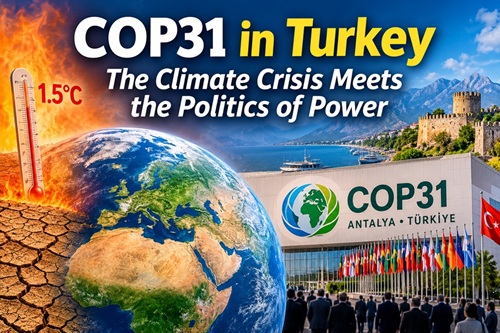 Introduction: Thirty-one conferences and countingFrom 9 to 20 November 2026, the world's governments are gathering in Antalya, Turkey, for the thirty-first United Nations Climate Change Conference (COP31). Once again, political leaders, climate scientists, diplomats, business representatives and environmental organizations are assembling to discuss how humanity should respond to global warming. The very existence of these annual conferences reflects an important achievement: climate change is no longer a marginal scientific concern but a recognized international political problem. The Paris Agreement of 2015 established a common framework, governments have adopted increasingly ambitious climate targets, renewable energy has expanded enormously, and the economic implications of decarbonization are now central to international politics. Yet there is an uncomfortable question that becomes more difficult to avoid with every passing year: Why, after thirty previous climate conferences, are we still so far from achieving the objectives they repeatedly proclaim? COP31 takes place against a particularly sobering background. The world is approaching, and may temporarily exceed, the 1.5°C warming threshold. Extreme heat, droughts, floods, wildfires and other climate-related disasters are becoming increasingly consequential. Meanwhile, global fossil-fuel consumption remains substantial, and the political and economic interests invested in the existing energy system have not disappeared. The central problem is no longer a lack of scientific knowledge or technological alternatives. It is the inability of governments to translate collective recognition of the problem into sufficiently rapid collective action. COP31 therefore deserves to be judged not by the eloquence of its speeches or the number of initiatives announced, but by what governments are actually prepared to change. The unusual Turkish-Australian arrangementCOP31 has an unusual institutional arrangement. Turkey (officially Türkiye) hosts the conference and holds the presidency, while Australia chairs the formal negotiations. This division of responsibilities emerged from a diplomatic impasse over which country should host the summit. The arrangement is interesting in itself. Turkey controls the conference's broader action agenda, while Australia's Climate Minister Chris Bowen leads the negotiations between governments. Whether this division will facilitate compromise or complicate accountability remains to be seen. iisd.org+1 Turkey's own position deserves particular scrutiny. It has committed to reaching net-zero emissions by 2053, but its climate policy has attracted criticism for relying on reductions relative to a projected emissions scenario rather than sufficiently ambitious absolute reductions. The absence of a clear timetable for phasing out coal is another weakness. There is an obvious contradiction in hosting an international climate summit while the domestic energy transition remains incomplete. This does not automatically disqualify Turkey from leading the conference, but it illustrates a recurring problem: countries are often more enthusiastic about announcing international ambitions than confronting the economic and political costs of implementing them at home. The same criticism applies to numerous other host countries. COP conferences are not morality competitions in which only countries with impeccable environmental records are allowed to participate. But credibility matters, particularly when the host is supposed to demonstrate political leadership. The fossil-fuel question: The elephant in the conference hallThe most important issue at COP31 is arguably the one on which governments have repeatedly failed to agree: the future of fossil fuels. The scientific case is straightforward. Coal, oil and natural gas are the principal drivers of anthropogenic carbon dioxide emissions. If the world is serious about limiting global warming, their production and consumption must decline substantially. At COP28 in Dubai, governments agreed for the first time to language about transitioning away from fossil fuels in energy systems. This was a significant diplomatic achievement, although the wording left considerable room for interpretation. At COP30 in Brazil, however, governments failed to agree on a more concrete roadmap for that transition. The Brazilian presidency subsequently continued work on the issue, but the disagreement has now followed the negotiators to Antalya. The problem is not difficult to identify. Countries dependent on fossil-fuel production have little enthusiasm for binding international commitments that threaten their economic interests. Other countries want a clearer timetable, while developing nations insist that wealthy historical emitters should bear a disproportionate share of the costs. According to the reporting from Antalya, the Arab Group has already opposed imposing uniform global targets or targets directed at particular energy sources. Meanwhile, the European Union, Pacific island states and least-developed countries have supported a more ambitious approach. This is where climate diplomacy encounters the realities of international power politics. A government may acknowledge climate science perfectly well and still resist measures that threaten its oil revenues, industrial competitiveness, energy security or domestic political stability. Scientific consensus does not automatically produce political consensus. The result is a familiar diplomatic compromise: governments agree that emissions must fall, but disagree about who must reduce them, how quickly, and at whose expense. The danger is that the transition away from fossil fuels becomes an indefinitely postponed objective, surrounded by declarations of good intentions. Climate finance: Who pays for the damage?Another central issue is climate finance. Developing countries have a legitimate grievance. The industrialized nations that accumulated much of their wealth through fossil-fuel-powered development have contributed disproportionately to historical greenhouse gas emissions. Yet many of the countries most vulnerable to climate change have contributed relatively little to the problem. Small island states face rising sea levels. African countries experience increasingly severe droughts and agricultural disruptions. Poorer populations often lack the financial resources to rebuild after extreme weather events. The question of responsibility therefore cannot be separated from the question of justice. At COP29 in Baku, governments agreed on a new climate-finance goal of at least $300 billion annually for developing countries by 2035, with developed countries taking the lead. They also called for efforts to scale up financing from all sources to $1.3 trillion annually by that date. These figures sound impressive. But there are important qualifications. First, a financing target is not the same as money actually reaching vulnerable countries. Second, loans are not equivalent to grants. A country already struggling with debt should not have to borrow heavily to repair damage caused by a climate crisis it did relatively little to create. Third, access to international climate funds can be bureaucratically complicated. Countries with limited administrative capacity may struggle to prepare the applications and technical documentation required to obtain assistance. The International Institute for Sustainable Development identifies all three problems as important issues at COP31, including the distinction between grants and loans and the difficulty of accessing available funding. There is also a more fundamental question. Should climate finance be regarded primarily as development assistance, as an investment in global stability, or as compensation for historical responsibility? These are not interchangeable concepts. The distinction matters because each implies a different understanding of obligation. A serious climate agreement must move beyond announcing financial ambitions. It must establish predictable, accessible and equitable funding mechanisms. Adaptation and loss and damage: Living with a warming planetThe emphasis on reducing emissions sometimes obscures another reality: climate change is already happening, and societies must adapt. Even if emissions were reduced dramatically tomorrow, the world would continue experiencing climate impacts for decades because of the greenhouse gases already accumulated in the atmosphere. Adaptation therefore deserves considerably more attention than it often receives in international political declarations. This means investing in flood protection, drought-resistant agriculture, water management, early-warning systems, resilient infrastructure and public health services. It also means recognizing that different populations face different risks. Closely related is the question of loss and damage: the destruction and suffering that cannot adequately be prevented through either emissions reductions or adaptation. The Loss and Damage Fund, established at COP27 and operationalized at COP28, represents an important recognition of this problem. But establishing a fund is only the beginning. Its capitalization and actual delivery of assistance remain inadequate relative to the scale of the challenge. iisd.org There is something profoundly unfair about asking vulnerable countries to become more resilient while failing to provide the resources required to do so. Climate justice cannot remain a rhetorical expression. It must have a material meaning. The implementation problem: More than another collection of pledgesThe Turkish presidency has emphasized implementation rather than producing yet another collection of international promises. Its ten priority themes include clean energy, green industrialization, food security, climate-resilient cities, zero waste, oceans, youth, health systems and the implementation of national climate plans. Among the proposed ambitions are increasing electricity's share of global final energy consumption to 35 percent by 2035, reducing projected increases in municipal waste, and improving energy efficiency in buildings. The presidency has also promoted mechanisms to connect developing countries with investment, technology and expertise. This emphasis is welcome. The world does not primarily suffer from a shortage of climate initiatives. It suffers from a shortage of sufficiently rapid implementation. Nevertheless, the implementation agenda has its own weakness: the tendency to confuse measurable activity with meaningful progress. How many renewable-energy projects have been announced? How many partnerships have been established? How many investment proposals have been presented? How many declarations have been signed? These are potentially useful indicators, but they are not the ultimate test. The ultimate test is whether global greenhouse gas emissions actually decline at the speed required, whether fossil-fuel infrastructure is retired rather than merely supplemented, and whether vulnerable populations receive effective protection. An impressive list of initiatives can coexist with an inadequate overall climate trajectory. The geopolitics of climate cooperationCOP31 also demonstrates that climate change cannot be separated from geopolitics. The international climate regime assumes that countries with different political systems, economic structures and historical responsibilities can cooperate around a common existential problem. In principle, this is an attractive idea. In practice, cooperation is complicated by competition between the United States and China, energy-security concerns, trade disputes, industrial rivalry and conflicts over economic development. China occupies a particularly important position. It is simultaneously the world's largest emitter of greenhouse gases and a leading manufacturer of solar panels, batteries and electric vehicles. Its enormous investments in renewable energy are indispensable to the global transition, but its continued dependence on coal remains a major contradiction. Western governments, meanwhile, want to reduce their dependence on Chinese clean-technology supply chains while simultaneously accelerating the deployment of those very technologies. This illustrates the paradox of climate globalization: countries need one another to solve the problem, but increasingly distrust one another in the process. The international political environment is also affected by war, military expenditure and energy insecurity. Governments that regard national security as their overriding priority may be reluctant to accept climate policies that appear to restrict their strategic options. Climate cooperation therefore requires more than scientific agreement. It requires a minimum level of geopolitical trust, and that is precisely what the contemporary international system is struggling to provide. The contradiction of economic growthThere is another issue that receives less attention than it deserves: the relationship between climate policy and the prevailing economic model. Most governments want to reduce greenhouse gas emissions without fundamentally challenging their commitment to economic growth. They hope to reconcile expanding production, increasing consumption, rising material prosperity and environmental sustainability through technological innovation. There is certainly room for optimism here. Renewable energy, electrification, improved storage, more efficient buildings and industrial innovation can substantially reduce the environmental footprint of economic activity. But technological progress does not automatically eliminate environmental pressures. Economic growth can generate additional demand for energy and materials, offsetting some of the efficiency gains. The extraction of minerals for batteries, the construction of infrastructure and the expansion of global consumption all have environmental consequences of their own. This does not mean that economic growth must simply be abandoned. Nor does it mean that developing countries should be denied the opportunity to improve living standards. It does mean that governments should be more honest about the scale of the transformation required. A climate strategy that assumes unlimited material expansion can be reconciled with ecological limits merely through technological optimism risks becoming another form of wishful thinking. The challenge is to distinguish between economic activities that genuinely improve human welfare and those that primarily expand consumption without corresponding social benefits. The limits of climate diplomacyPerhaps the deepest problem with COP31 is not specific to Turkey, Australia or any other participating country. It concerns the institutional structure of the entire COP process. The United Nations climate negotiations operate through consensus among nearly 200 parties. This gives every country a voice, which is important for international legitimacy. But it also means that a relatively small group of governments can obstruct ambitious agreements. The system consequently encourages compromise, often at the expense of urgency. Furthermore, international climate agreements generally depend on national governments implementing their own commitments. There is no world government capable of compelling countries to abandon coal mines, close oil fields or radically restructure their energy systems. The Paris Agreement relies on nationally determined contributions, periodic reviews and political pressure rather than a global enforcement mechanism. This is understandable. Sovereign governments are unlikely to surrender control over their energy systems to an international institution. But it creates a fundamental contradiction: climate change is a global problem requiring coordinated action, while the political authority to address it remains predominantly national. The COP process can facilitate cooperation, establish common expectations and encourage technological and financial collaboration. It cannot substitute for domestic political decisions. This is why the success of a climate conference must ultimately be measured outside the conference hall. What should count as success at COP31?As COP31 enters its final days, the negotiations are moving into their most politically difficult phase. On November 16, negotiators were preparing an overarching draft decision, with finance and the energy transition among the principal unresolved issues. The proposed just-transition mechanism was also under discussion. It would be premature to declare the conference a success or failure before its scheduled conclusion on November 20. Nevertheless, several criteria should determine how its achievements are evaluated. First, fossil fuels must be addressed directly. A credible outcome should establish a meaningful direction and timetable for reducing dependence on coal, oil and gas, rather than relying on vague language about clean energy. Second, climate finance must become more credible. Financial commitments should translate into accessible funding, with particular attention to grants, adaptation and loss and damage. Third, national climate targets must become more transparent. Governments should be judged against actual emissions reductions, not against conveniently selected hypothetical scenarios. Fourth, the energy transition must be socially sustainable. Workers, poorer households and developing countries should not be expected to bear disproportionate costs. A just transition requires practical assistance, not merely declarations of solidarity. Finally, implementation must be independently monitored. Governments should report not only what they intend to do but what they have actually accomplished. These criteria are not particularly radical. They are the minimum requirements for a credible international climate policy. Conclusion: The climate cannot negotiate with politiciansCOP31 is another demonstration of humanity's extraordinary capacity to recognize a global problem while struggling to overcome the political obstacles to solving it. There is something almost surreal about the spectacle. Thousands of delegates travel to an international conference, discuss the future of the planet, negotiate complex documents, announce new initiatives and express their determination to act. Meanwhile, the underlying economic and political structures responsible for greenhouse gas emissions continue to operate. Yet dismissing the COP process altogether would be a mistake. Without international climate negotiations, cooperation would be considerably more difficult. The Paris Agreement has provided a framework for national climate policies, and the expansion of renewable energy demonstrates that international coordination, technological innovation and political incentives can produce tangible results. The problem is not that nothing has been achieved. The problem is that what has been achieved remains insufficient. We should also resist the temptation to interpret every diplomatic compromise as evidence of bad faith. Governments face genuine dilemmas involving employment, energy affordability, development, national security and historical responsibility. But recognizing these difficulties should not become an excuse for endless postponement. The fundamental asymmetry remains: climate change operates according to physical laws, whereas climate diplomacy operates according to political convenience. Carbon dioxide does not care about national sovereignty, diplomatic protocol, electoral cycles or the economic interests of oil-producing countries. Atmospheric concentrations accumulate regardless of whether governments have reached a consensus. The climate crisis will not wait until the world's governments are ready to cooperate. That is the uncomfortable lesson of thirty-one climate conferences. If COP31 produces another impressive declaration without a corresponding acceleration of emissions reductions, it will have demonstrated once again that international recognition of a crisis is not the same as political determination to resolve it. The real question is no longer whether humanity understands the climate problem. It is whether its political institutions are capable of acting on that understanding before the consequences become considerably more difficult and expensive to manage. Editorial note (18 November 2026): This essay assesses COP31 while negotiations are still underway. It does not presume the contents or success of the final agreement, expected on November 20. Comment Form is loading comments...
|