|
TRANSLATE THIS ARTICLE
Integral World: Exploring Theories of Everything
An independent forum for a critical discussion of the integral philosophy of Ken Wilber
  Frank Visser, graduated as a psychologist of culture and religion, founded IntegralWorld in 1997. He worked as production manager for various publishing houses and as service manager for various internet companies and lives in Amsterdam. Books: Ken Wilber: Thought as Passion (SUNY, 2003), and The Corona Conspiracy: Combatting Disinformation about the Coronavirus (Kindle, 2020). Frank Visser, graduated as a psychologist of culture and religion, founded IntegralWorld in 1997. He worked as production manager for various publishing houses and as service manager for various internet companies and lives in Amsterdam. Books: Ken Wilber: Thought as Passion (SUNY, 2003), and The Corona Conspiracy: Combatting Disinformation about the Coronavirus (Kindle, 2020).
Check out my other conversations with ChatGPT Earth's Great Climate Swings500 Million Years of Temperature, CO2 and an Unprecedented Modern WarmingFrank Visser / ChatGPT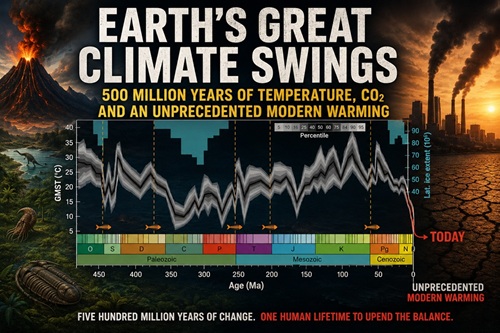 A planet that has rarely been climatically “normal”Earth's climate history is vastly more dramatic than the relatively stable climate experienced by human civilization. Over the past roughly 500 million years, global mean surface temperature has repeatedly swung between greenhouse and icehouse states, with enormous consequences for sea level, ice sheets, ecosystems and evolution. A major new reconstruction published in Science in 2024, known as PhanDA, provides the most comprehensive quantitative picture yet of global mean surface temperature over approximately 485 million years. By combining geological temperature proxies with climate-model simulations, Emily Judd and colleagues reconstructed a planetary climate ranging from roughly 11°C to 36°C in global mean surface temperature. The result is a striking reminder that today's climate is not representative of the long-term Phanerozoic average. Indeed, Earth has spent considerably more time in climates warmer than today's than in comparably cold conditions. But this observation immediately creates an apparent paradox. If Earth has frequently been much warmer than today, why is contemporary warming considered exceptional? The answer is that two different questions must be separated: how warm Earth has been, and how rapidly its climate is changing now. The first has an extraordinarily long geological history. The second is where the modern situation becomes genuinely remarkable. The Phanerozoic climate roller coasterThe last 500 million years encompass most of the Phanerozoic Eon: the Paleozoic, Mesozoic and Cenozoic eras. During this immense interval, continents moved from radically different configurations, mountains rose and eroded, oceans opened and closed, biological productivity transformed the carbon cycle, and the Sun itself gradually became brighter. Climate therefore never remained static. During greenhouse phases, permanent polar ice was absent or greatly reduced and global temperatures could become substantially higher than today. During icehouse phases, large continental ice sheets developed and global temperatures fell dramatically. The new PhanDA reconstruction estimates a range of approximately 11-36°C for global mean surface temperature. That is an enormous range compared with the roughly 1°C of warming that separates the late nineteenth-century climate from the climate of the early twenty-first century. The reconstruction also confirms something that paleoclimatologists have suspected for decades: Earth's climate system has multiple interacting controls, but atmospheric CO2 is one of the most important. The relationship is particularly striking because CO2 concentration and global temperature broadly rise and fall together over geological time. Judd and colleagues found a strong correlation between CO2 and temperature and concluded that CO2 was the dominant control on Phanerozoic global climate. Their estimated “Earth system sensitivity” is about 8°C per CO2 doubling when very long-term feedbacks are included. This is not directly equivalent to the conventional climate sensitivity used in modern projections, because geological feedbacks such as ice sheets, vegetation and the carbon cycle operate on much longer timescales. That distinction is important. The geological record is not simply a gigantic laboratory in which one can read off a single number for modern climate sensitivity. Nevertheless, it provides powerful evidence that CO2 is a major climate regulator. CO2: not the only control, but a powerful oneIt would be a mistake to imagine that CO2 operates in isolation. The climate system responds to solar luminosity, volcanic activity, continental configuration, ocean circulation, ice cover, vegetation, atmospheric dust, methane and other greenhouse gases. On shorter geological timescales, orbital variations can redistribute solar energy and help pace glacial cycles. Over hundreds of millions of years, however, the carbon cycle becomes particularly important. Volcanic outgassing adds carbon dioxide to the atmosphere. Chemical weathering removes it. Burial of organic carbon and carbonate sediments can sequester carbon for millions of years. The evolution and expansion of plants dramatically altered these processes. CO2 therefore functions not merely as an external “forcing” but as part of a gigantic planetary feedback system. When atmospheric CO2 is high, the greenhouse effect tends to raise temperatures. Warmer conditions can accelerate weathering, which ultimately removes CO2 from the atmosphere and acts as a negative feedback. Conversely, colder conditions can reduce weathering and allow volcanic emissions to rebuild atmospheric CO2 over very long intervals. This is one reason Earth's climate has remained within a broadly habitable range despite enormous changes in solar luminosity and continental geography. The remarkable Cenozoic coolingThe most illuminating comparison with the present comes from the last 66 million years—the Cenozoic. This interval records a spectacular long-term cooling trend. The early Cenozoic was a greenhouse world. Around 50-51 million years ago, global temperatures were dramatically higher than today. The recently revised Cenozoic CO2 reconstruction by the international CenCO2PIP consortium estimates that atmospheric CO2 peaked at roughly 1,600 ppm around 51 million years ago. At approximately 33.9 million years ago, Antarctic glaciation began as CO2 fell to around 720 ppm; by about 32 million years ago, concentrations had declined to roughly 550 ppm. The transition from greenhouse to icehouse continued. By the Pliocene-Pleistocene boundary around 2.6 million years ago, CO2 had fallen below roughly 270 ppm and Earth was entering the bipolar icehouse state that characterizes the recent geological past. The consequences were enormous. Antarctica became permanently glaciated, Greenland developed its major ice sheet, sea levels fell, and eventually the repeated glacial-interglacial cycles of the Pleistocene emerged. In other words, today's relatively cool climate is not simply an arbitrary point on a temperature graph. It represents the culmination of a tens-of-millions-of-years cooling trajectory. The Holocene: an unusually stable climatic nicheHuman civilization emerged during the Holocene, beginning about 11,700 years ago. Compared with the wild climatic fluctuations of deep geological time, the Holocene has been remarkably benign. There were certainly regional and millennial-scale fluctuations, but the global climate remained within a relatively narrow range. Agriculture, permanent settlements and complex societies developed during this climatic interval. This matters because our species did not evolve civilization under average Phanerozoic conditions. We built civilization during a relatively cool icehouse phase, under atmospheric CO2 concentrations of roughly 260-280 ppm and with enormous continental ice sheets confined largely to Greenland and Antarctica. The climate system could, of course, support life at much higher temperatures. It did so for millions of years. But the question is not whether humans could survive on a warmer planet. The question is whether the climatic conditions under which agriculture, coastlines, water systems and human societies developed can remain stable. Today's climate is cool by geological standardsThis is the first apparent paradox. Modern Earth is not especially warm by the standards of the last 500 million years. The PhanDA reconstruction places the Phanerozoic temperature range between approximately 11°C and 36°C, whereas the modern global mean surface temperature is around 14-15°C, depending on the precise reference period and dataset. The modern planet therefore sits toward the cooler end of the geological spectrum. We live in an icehouse world. There are enormous permanent ice sheets in Greenland and Antarctica. Seasonal sea ice exists in both polar regions. The planet's sea level is correspondingly low compared with many greenhouse intervals. A return to some of the climates that were perfectly normal in the Mesozoic or early Cenozoic would therefore not merely mean slightly warmer summers. It would imply profound changes in the cryosphere, oceans, ecosystems and coastlines. This is why the statement “Earth has been warmer before” is scientifically correct but insufficient as an argument about present warming. Earth has also been colder before. It has survived both. What matters is the rate of change, the cause, the climatic state from which the change begins, and the consequences for a civilization adapted to a particular climate. The extraordinary modern CO2 increaseThe most conspicuous feature of the modern carbon cycle is the speed with which atmospheric CO2 has increased. Before industrialization, atmospheric CO2 was approximately 280 ppm. NOAA's modern measurements show that global atmospheric CO2 has now risen to around 428 ppm, with the estimated global daily value at 427.8 ppm in late July 2026. At Mauna Loa, the monthly mean reached 431.44 ppm in June 2026. This is not simply another fluctuation in the natural carbon cycle. The carbon isotopic composition of atmospheric carbon, the declining oxygen content of the atmosphere, fossil-fuel production and the global carbon budget all independently demonstrate that the overwhelming source of the modern CO2 increase is human combustion of fossil carbon, supplemented by land-use change. The geological record tells us that CO2 can remain high for very long periods. Modern society is doing something different: injecting enormous quantities of carbon into the atmosphere and oceans over a geological instant. That distinction is crucial. The rate of warming is the real anomalyEarth has certainly experienced episodes of very rapid warming in geological terms. The Paleocene-Eocene Thermal Maximum around 56 million years ago, for example, involved a major carbon release and substantial warming over a period far shorter than most geological climate transitions. So “the fastest warming ever in Earth's history” is too absolute a statement. But modern warming is nevertheless extraordinary when compared with the climatic stability of the Holocene and with the natural background rate over the timescales relevant to human civilization. The IPCC estimates that human activities caused approximately 1.1°C of global warming in 2011-2020 relative to 1850-1900. And the warming has continued. 2024 was the warmest year in the instrumental record, at approximately 1.60°C above the 1850-1900 reference period in the Copernicus ERA5 dataset. 2025 was cooler but still exceptionally warm, at approximately 1.47°C above the same baseline. Copernicus estimates the current long-term warming level at roughly 1.4°C. By June 2026, the latest available Copernicus data showed a 12-month average from July 2025 to June 2026 approximately 1.43°C above the 1850-1900 pre-industrial reference. June 2026 itself was 1.39°C above that baseline and was the second-warmest June in the record. These numbers are not geological curiosities. They describe the climate in which contemporary societies are operating now. “But CO2 was much higher in the past”This objection contains an important truth. CO2 concentrations were indeed vastly higher during some periods of Earth's history. The early Cenozoic, for example, appears to have experienced concentrations well above today's level, and the CenCO2PIP reconstruction estimates around 1,600 ppm at the early Eocene peak. This does not contradict the greenhouse effect. It illustrates it. Those high-CO2 worlds were considerably warmer and generally lacked the enormous permanent ice sheets characteristic of the present. Nor does the existence of high ancient CO2 demonstrate that modern CO2 is harmless. Quite the opposite: the geological record shows what a high-CO2 Earth can look like. The proper conclusion is not “CO2 was higher before, therefore CO2 does not matter.” It is “CO2 has been higher before, and those high-CO2 climates were generally much warmer.” Why today's climate can be both cool and rapidly warmingThere is therefore no contradiction between saying that modern Earth is relatively cool and that modern global warming is exceptionally significant. Imagine Earth's climate history as a huge geological graph. The vertical axis—temperature—shows enormous fluctuations. Modern temperature is near the cooler end of that range. But the horizontal axis—time—reveals something entirely different. For hundreds of millions of years, major transitions between climate states generally unfolded over thousands, millions or tens of millions of years. Human civilization is now changing the composition of the atmosphere within centuries. The present trajectory is therefore not exceptional because Earth has never been this warm. It is exceptional because a relatively cool icehouse climate is being pushed rapidly toward warmer conditions by a sudden anthropogenic perturbation of the carbon cycle. A changing planet, not a static thermostatAnother misconception is that CO2 determines temperature in a simple one-variable equation. The real climate system is much more complicated. CO2 changes radiative forcing. Temperature changes ice cover. Ice cover changes planetary albedo. Warming changes atmospheric water vapor. Oceans absorb heat and carbon dioxide. Vegetation responds to temperature and CO2. Clouds respond to atmospheric conditions. Ocean circulation redistributes heat. Permafrost and wetlands interact with the carbon and methane cycles. These feedbacks can amplify or dampen an initial forcing. This is precisely why the geological record is so valuable. It captures the integrated response of the entire Earth system rather than merely the immediate radiative effect of CO2. The 2024 PhanDA reconstruction's estimated Earth-system sensitivity of roughly 8°C per CO2 doubling should therefore not be interpreted as a prediction that every doubling of modern CO2 will produce 8°C of warming within a few decades. It incorporates slow feedbacks that operate over geological timescales. Modern equilibrium climate sensitivity is substantially lower. The geological result nevertheless demonstrates the enormous capacity of the Earth system to respond to sustained changes in atmospheric CO2. The deeper lesson of 500 million yearsThe geological record actually gives us two messages, and both are important. The first is reassuring: Earth's climate is not fragile in the sense that a few degrees of warming will destroy life on Earth. Life has persisted through extraordinary climatic upheavals. The planet has been far hotter and far colder than today. The second message is much less reassuring: the fact that life survives climate change does not mean particular ecosystems, species or civilizations remain unaffected. Mass extinctions have repeatedly accompanied major disruptions of the Earth system. Ice sheets have appeared and disappeared. Sea levels have risen and fallen by many tens of metres. Tropical climates have expanded and contracted. Entire ecological regimes have vanished. The planet will survive whatever humans do. The more interesting question is what kind of planet humans will inhabit. The modern paradox resolvedThe history of Earth's climate therefore gives us a much more nuanced picture than either climate alarmism or climate complacency. Yes, Earth has been much warmer than today. Yes, atmospheric CO2 has frequently been much higher than today. Yes, natural climate change has sometimes been dramatic. But none of these observations undermines the evidence for anthropogenic global warming. Indeed, the geological record reinforces it. The new 485-million-year reconstruction finds a strong relationship between CO2 and global temperature and identifies CO2 as the dominant control on Phanerozoic climate. The Cenozoic CO2 record independently shows a long decline in atmospheric CO2 accompanying the transformation from a hot greenhouse world into today's cold icehouse world. And the instrumental record shows that humanity has now abruptly reversed part of that long-term decline. We have taken carbon that was locked underground for millions of years and returned it to the atmosphere within a few centuries. That is the genuinely extraordinary feature of the modern climate story. Earth is not experiencing its hottest climate. It is experiencing something more historically peculiar: a relatively cool, icehouse planet undergoing a rapid, human-driven injection of greenhouse gases that is pushing the climate away from the relatively stable conditions in which civilization developed. The geological record does not tell us that the Earth is doomed. It tells us something more scientifically useful. Earth has changed before. It will change again. CO2 has helped drive many of those changes. And while the planet itself will ultimately accommodate whatever climate humans create, there is no guarantee that the resulting climate will be nearly as accommodating to human civilization as the remarkably narrow climatic window in which civilization arose. That is the real lesson of the past 500 million years: Earth's climate is extraordinarily dynamic, but the conditions we have come to regard as “normal” are anything but inevitable.
Widget is loading comments...
|