|
TRANSLATE THIS ARTICLE
Integral World: Exploring Theories of Everything
An independent forum for a critical discussion of the integral philosophy of Ken Wilber
  Frank Visser, graduated as a psychologist of culture and religion, founded IntegralWorld in 1997. He worked as production manager for various publishing houses and as service manager for various internet companies and lives in Amsterdam. Books: Ken Wilber: Thought as Passion (SUNY, 2003), and The Corona Conspiracy: Combatting Disinformation about the Coronavirus (Kindle, 2020). Frank Visser, graduated as a psychologist of culture and religion, founded IntegralWorld in 1997. He worked as production manager for various publishing houses and as service manager for various internet companies and lives in Amsterdam. Books: Ken Wilber: Thought as Passion (SUNY, 2003), and The Corona Conspiracy: Combatting Disinformation about the Coronavirus (Kindle, 2020).
Check out my other conversations with ChatGPT
On Climate Change: Earth's Great Climate Swings The Paleocene-Eocene Thermal Maximum Global Warming and Regional Cooling When Global Warming Produces Regional CoolingThe Atlantic Meridional Overturning Circulation ParadoxFrank Visser / ChatGPT
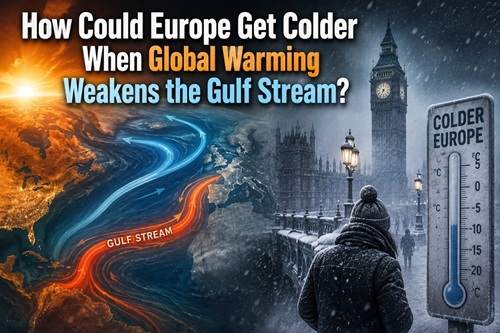
The apparent paradoxOne of the strangest consequences of climate change is that global warming can, under certain circumstances, produce regional cooling. Europe is the classic example. If global warming substantially weakens the Atlantic circulation that transports tropical heat northward, northwestern Europe could become considerably colder than it otherwise would be—even while the planet as a whole continues to warm. This is not a contradiction. It is a consequence of the fact that global temperature and regional temperature are governed by different processes. There is, however, an important correction to the popular formulation. It is misleading to say that global warming will simply “stop the Gulf Stream.” The Gulf Stream is only one component of the much larger Atlantic Meridional Overturning Circulation, or AMOC. The Gulf Stream itself is strongly influenced by winds and would not simply switch off if the AMOC weakened or even collapsed. What is potentially disrupted is the larger circulation system that carries enormous quantities of heat northward into the Atlantic. The Atlantic conveyor beltThe AMOC can be thought of as a gigantic system for redistributing heat. Warm, relatively salty surface water flows northward from the tropics. Some of this circulation is carried by the Gulf Stream and its extensions. As the water reaches the North Atlantic, it loses heat to the atmosphere. Cooling, together with its relatively high salinity, makes the water denser. The crucial step follows: sufficiently dense water sinks into the deep ocean. It then flows southward at depth, eventually participating in a global pattern of ocean circulation before returning toward the surface elsewhere. The entire system therefore transports heat from lower latitudes toward the North Atlantic. This is one reason northwestern Europe is remarkably mild for its latitude. London, Amsterdam and Paris are all located at latitudes where one might expect much colder winters. Compare them with parts of eastern Canada at similar latitudes and the difference becomes obvious. The ocean is doing much of the explaining. Why global warming can weaken the circulationHere the paradox begins. Global warming makes the surface of the North Atlantic warmer. Warmer water is less dense, making it harder for it to sink. At the same time, a warmer climate intensifies the hydrological cycle. Increased precipitation and freshwater runoff, together with melting ice, can add freshwater to the North Atlantic. Freshwater is less dense than salty seawater. The result is a double effect: warmer and fresher surface water is more buoyant. If sufficiently dense water no longer sinks as effectively, the deep branch of the AMOC weakens. Less water needs to return southward at depth, and the whole overturning circulation can slow. The Met Office describes this as the expected consequence of climate change: warming and increased freshwater input make the surface ocean less dense and reduce deep-water formation. Climate models therefore consistently project an AMOC weakening during the twenty-first century. What happens to Europe?Suppose the AMOC weakens substantially. The atmosphere over Europe would still be exposed to the greenhouse warming caused by higher CO2. But at the same time, less oceanic heat would be transported northward. These two effects work in opposite directions. Greenhouse gases push European temperatures upward. A weaker AMOC reduces the amount of heat delivered to the North Atlantic and pushes temperatures downward relative to what they would otherwise have been. The result is not necessarily a colder Europe than today. Under the gradual AMOC weakening expected in mainstream climate projections, Europe is generally still expected to warm overall. The weakening merely offsets part of the greenhouse warming. The Met Office puts the point explicitly: a weaker AMOC would reduce warming over western Europe, but with the gradual weakening expected this century, the overall effect remains warming. This distinction is essential. Global warming does not normally mean that Europe will cool. It means that AMOC weakening could make Europe warm less than the global average. But what if the AMOC actually collapsed?That is a different and much more dramatic scenario. A sufficiently large AMOC collapse would drastically reduce northward heat transport. The North Atlantic would cool, and sea ice could expand southward. Sea ice introduces another feedback. Bright ice reflects a substantial fraction of incoming sunlight back into space. Dark ocean water absorbs much more solar energy. More sea ice therefore promotes further cooling, particularly during the dark northern winter and at high latitudes. A major AMOC collapse could consequently produce pronounced cooling across the North Atlantic region and northwestern Europe. Climate-model experiments show that an AMOC shutdown can produce substantial cooling in the northern hemisphere, altered atmospheric circulation, changes in European precipitation and shifts in storm tracks. The Netherlands would be particularly exposed because it lies directly within the climatic region affected by North Atlantic circulation. Dutch climate assessments have modelled an AMOC shutdown producing substantially colder northwestern European winters, alongside major changes in sea ice, precipitation and storm patterns. This is the mechanism behind the famous—and scientifically exaggerated—scenario popularized by the film The Day After Tomorrow. The physics is real. The Hollywood timescale is not. The Day After Tomorrow problemThe 2004 movie depicts the AMOC collapsing almost instantaneously and throwing the Northern Hemisphere into an ice age within days. That is not realistic. A genuine AMOC collapse would be a major climate transition, not a weather event. Even abrupt changes in the geological record occurred over timescales vastly longer than those depicted in the film. More importantly, scientists currently do not expect a complete AMOC shutdown this century under conventional scenarios. The IPCC's Sixth Assessment Report concluded with medium confidence that an abrupt AMOC collapse would not occur before 2100. Its assessment nevertheless projects substantial weakening, with the magnitude depending on future warming. And recent research has actually provided some additional reassurance about the possibility of a complete collapse. What the latest science saysA major 2025 Nature study by Baker and colleagues examined AMOC behaviour in 34 climate models under extremely strong greenhouse-gas and freshwater forcing. Every model showed weakening, but none produced a complete AMOC collapse. Persistent upwelling in the Southern Ocean helped sustain the circulation. The study therefore suggests that the AMOC is more resilient than some earlier studies had indicated. Another 2025 study in Nature Geoscience, using observational constraints to narrow the range of model projections, estimated an AMOC weakening of approximately 18-43% by the end of the century. That does not mean the AMOC is safe. It means that the most scientifically defensible picture at present is one of substantial weakening rather than an imminent total shutdown. The distinction matters enormously. The geological record shows that this can happenThere is also nothing unprecedented about the basic mechanism. During the last ice age, enormous quantities of freshwater entered the North Atlantic as continental ice sheets melted. Several abrupt climate events occurred in which the AMOC weakened dramatically. The Younger Dryas is the most famous example. After the last glacial period had begun warming, the Northern Hemisphere abruptly returned to much colder conditions for roughly a millennium. The precise mechanisms remain an active area of research, but the episode demonstrates that Atlantic circulation can reorganize rapidly enough to produce major regional climate changes. The Earth system therefore contains a genuine climatic “switch”—or, more accurately, a range of possible circulation states—whose behaviour is governed partly by temperature and salinity. That is one reason scientists take AMOC weakening seriously. The fascinating asymmetry of climate changeThe AMOC illustrates a broader principle that is easy to miss when discussing global warming. Climate change does not produce the same temperature change everywhere. The global mean is an average. Beneath that average are enormous regional differences. The Arctic warms much faster than the global average. Continental interiors can experience extreme warming. Some ocean regions warm relatively slowly because the ocean absorbs enormous quantities of heat. And northwestern Europe has an additional complication: its climate depends heavily on Atlantic heat transport. Consequently, an AMOC slowdown can produce a peculiar geographical pattern: the planet warms, the North Atlantic warms less, and parts of northwestern Europe may temporarily experience cooling relative to the global trend. This is not evidence against global warming. It is evidence of how complicated the climate system actually is. Why this matters for the larger climate storyThere is a deeper connection with the main essay. Earth's climate history shows that CO2 is a powerful control on global temperature. But the climate system does not respond to CO2 as a simple uniform heating blanket. CO2 changes the energy balance of the atmosphere. The atmosphere warms. The hydrological cycle changes. Ice melts. Ocean temperatures and salinity change. Ocean circulation responds. Atmospheric circulation changes. And those changes redistribute heat around the planet. The AMOC is therefore an excellent example of why climate science must be understood as an Earth-system science rather than simply as a study of atmospheric temperature. The irony: cooling Europe would still be part of global warmingThere is an especially interesting irony here. Imagine that humanity continues increasing atmospheric CO2 and global temperatures continue rising, while the AMOC weakens substantially. The result could be a world in which the global average becomes warmer while parts of northwestern Europe become relatively colder. But Europe would not thereby be escaping climate change. Quite the opposite. A severely weakened AMOC would bring its own disruptions: altered precipitation, changing storm tracks, sea-level changes around the Atlantic, ecosystem impacts, fisheries disruption and potentially much greater winter temperature contrasts across Europe. The phrase “global warming” therefore sometimes obscures the complexity of what is actually happening. We are not heating the planet uniformly. We are perturbing an interconnected climate system. The important bottom lineThe popular statement that “global warming could stop the Gulf Stream and freeze Europe” contains a kernel of genuine physics wrapped in considerable exaggeration. The scientifically accurate version is more interesting. Human-caused warming is expected to weaken the AMOC because warmer and fresher North Atlantic surface waters are less favourable for deep-water formation. A weaker AMOC transports less heat northward and therefore partly offsets greenhouse warming over Europe. A complete AMOC collapse would cause much more dramatic regional cooling, especially around the North Atlantic and northwestern Europe. But current evidence does not indicate that a complete collapse is the expected outcome this century. Recent modelling and observationally constrained research suggest that substantial weakening is much more plausible than total shutdown. And that leads back to the central lesson of Earth's climate history. The climate system is not a thermostat. It is an extraordinarily complex network of interacting components—atmosphere, ocean, ice, continents and biosphere. Increase CO2 and the planet warms overall, but that warming can simultaneously alter the circulation of the oceans in ways that cool particular regions. So yes, in a sufficiently severe scenario, global warming could help make northwestern Europe colder. But that would not disprove global warming. It would be one of its most remarkable consequences.
Widget is loading comments...
|