|
TRANSLATE THIS ARTICLE
Integral World: Exploring Theories of Everything
An independent forum for a critical discussion of the integral philosophy of Ken Wilber
  Frank Visser, graduated as a psychologist of culture and religion, founded IntegralWorld in 1997. He worked as production manager for various publishing houses and as service manager for various internet companies and lives in Amsterdam. Books: Ken Wilber: Thought as Passion (SUNY, 2003), and The Corona Conspiracy: Combatting Disinformation about the Coronavirus (Kindle, 2020). Frank Visser, graduated as a psychologist of culture and religion, founded IntegralWorld in 1997. He worked as production manager for various publishing houses and as service manager for various internet companies and lives in Amsterdam. Books: Ken Wilber: Thought as Passion (SUNY, 2003), and The Corona Conspiracy: Combatting Disinformation about the Coronavirus (Kindle, 2020).
Check out my other conversations with ChatGPT
On Climate Change: Earth's Great Climate Swings The Paleocene-Eocene Thermal Maximum Global Warming and Regional Cooling The Paleocene-Eocene Thermal MaximumAnd What It Tells Us About Our Climate FutureFrank Visser / ChatGPT
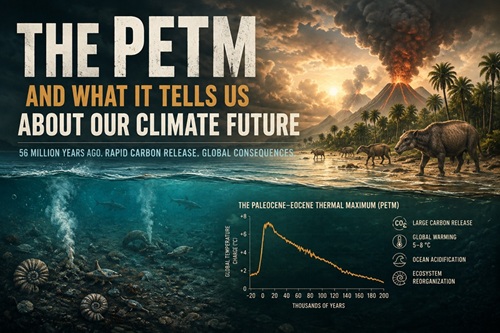
The Paleocene-Eocene Thermal Maximum, or PETM, is one of the most revealing episodes in Earth's climate history. Around 56 million years ago, the planet experienced a relatively sudden injection of carbon into the atmosphere and oceans, followed by substantial global warming, ocean acidification and major ecological changes. The PETM is not a perfect analogue for today's climate crisis. Earth was a very different planet at the time, with different continents, ecosystems and ice conditions. Nevertheless, it provides something that climate science badly needs: a natural experiment showing what happens when the carbon cycle is subjected to a large perturbation. That makes the PETM highly relevant to the present. A Greenhouse WorldThe PETM occurred at the transition between the Paleocene and Eocene epochs. The Earth was already considerably warmer than today. There were no large permanent ice sheets covering Antarctica or Greenland, and warm conditions extended far into the polar regions. Yet the planet underwent an additional episode of rapid warming. The geological record indicates a substantial negative carbon-isotope excursion: large quantities of carbon enriched in the lighter isotope carbon-12 entered the atmosphere-ocean system. The precise source remains debated. Possibilities include volcanic activity, the oxidation or destabilization of carbon-rich sediments, methane-related processes and other geological sources. What matters for the climate comparison is that the carbon cycle was dramatically disturbed. Global temperatures subsequently increased by several degrees Celsius. Estimates vary depending on the reconstruction and the period being considered, but the PETM represents one of the clearest examples in the geological record of major warming associated with a rapid carbon-cycle perturbation. The event also produced ocean acidification. When atmospheric CO2 dissolves into seawater, it forms carbonic acid and reduces ocean pH. The PETM therefore provides evidence that adding large amounts of carbon to the atmosphere does not merely raise temperature. It changes ocean chemistry as well. The Rate MattersThe most important comparison with our own time concerns not simply how much carbon was released, but how quickly. The PETM carbon release probably occurred over thousands of years, although estimates of its precise duration remain uncertain. Human civilization, by contrast, is transferring enormous quantities of carbon from geological reservoirs into the atmosphere within decades and centuries. This is an extraordinary feature of the present climate perturbation. Geological history contains many episodes of climate change, but the industrial era is characterized by an exceptionally rapid alteration of the carbon cycle. This distinction is sometimes lost in arguments about paleoclimate. Someone may point out that Earth's climate has been much warmer in the past and conclude that current warming is therefore nothing unusual. But the relevant question is not whether the planet has ever been warmer. Of course it has. The question is: what is causing the present perturbation, how rapidly is it occurring, and how does the Earth system respond to such a perturbation? The PETM gives us an important part of that answer. A Natural ExperimentThe great scientific value of the PETM is that it functions as a kind of natural experiment. Scientists cannot deliberately inject billions of tonnes of carbon into the atmosphere and observe the consequences over thousands of years. The geological record, however, contains several occasions when nature effectively performed versions of such an experiment for us. The PETM shows that a substantial carbon injection was associated with rapid warming and major changes in the ocean and biosphere. It also demonstrates that the climate system does not simply absorb additional carbon without consequences. There is an important qualification. The PETM does not prove that today's climate will follow exactly the same trajectory. The background climate was different, the continents were arranged differently, the oceans were different, and there were no modern continental ice sheets. The sensitivity and feedbacks of the Earth system consequently cannot simply be copied from the PETM and applied to the twenty-first century. But that limitation does not make the PETM irrelevant. It makes the comparison more scientifically interesting. The PETM tells us about the response of the Earth system to carbon-cycle disruption, rather than providing a simple forecast of future temperature. The Biological ResponseThe PETM was also a biological event. Many organisms shifted their geographical ranges as temperatures changed. Terrestrial ecosystems underwent substantial reorganization, while marine ecosystems experienced changes associated with warming and ocean acidification. Some deep-sea organisms suffered severe losses, and mammals expanded into regions that had previously been unsuitable for them. Evolutionary adaptation did occur. But this is another point where the comparison with today requires care. Species can adapt to environmental change, but adaptation has limits, and the rate at which the environment changes matters. Modern species are not confronted merely with a warmer planet. They are confronted with rapidly changing temperatures, altered precipitation patterns, changing seasons, habitat fragmentation, ocean acidification and other anthropogenic pressures simultaneously. The PETM therefore illustrates an important principle: climate change is not simply a matter of moving the thermometer upward. It reorganizes ecological systems. The Ice-Sheet DifferenceOne of the biggest differences between the PETM and today concerns ice. The PETM occurred during an exceptionally warm greenhouse climate. Large permanent ice sheets were absent, or at least dramatically different from those of the modern world. Consequently, one cannot simply take PETM temperatures and use them as a direct forecast for twenty-first-century sea-level rise. Today's world contains enormous quantities of water locked in the Greenland and Antarctic ice sheets. Warming the planet therefore creates the possibility of long-term ice-sheet loss and substantial sea-level rise. This is one reason paleoclimate records extending beyond the PETM are so valuable. They show repeatedly that sea level, ice volume, atmospheric CO2 and global temperature are tightly connected over geological timescales. The lesson is not that sea level will suddenly jump to a particular PETM value. Rather, it is that the apparently stable modern configuration of ice sheets is not a permanent feature of the Earth system. The Recovery Is Also ImportantAnother fascinating feature of the PETM is its recovery. The climate eventually returned toward its previous state, but this did not happen because the carbon simply disappeared. Carbon was gradually removed through processes including weathering, oceanic uptake and sedimentation. These processes operate on very different timescales from human political and economic systems. This is crucial for understanding the phrase "climate change." If humans stopped adding CO2 tomorrow, the climate would not instantly return to its preindustrial condition. Some of the excess carbon would remain in the atmosphere-ocean system for a very long time. Temperatures would respond over different timescales, while ice sheets, ecosystems and sea level would continue adjusting. The Earth eventually has powerful mechanisms for regulating atmospheric carbon. But "eventually" in geological terms can mean thousands or hundreds of thousands of years. That is of little comfort to a civilization concerned with the next few generations. What the PETM Does Not ProveThe PETM should therefore not be turned into a climate scare story. It does not establish that humanity is heading inevitably toward PETM-like warming. Nor does it provide a precise estimate of equilibrium climate sensitivity. It cannot tell us exactly what temperature the Earth will reach in 2100 under a particular emissions scenario. Nor does it justify the claim that every geological warming event was caused by exactly the same mechanism as modern warming. Paleoclimate is more complicated than that. What the PETM does provide is something more fundamental: evidence that the climate system is capable of responding strongly to substantial changes in the carbon cycle, and that those changes can have consequences extending far beyond temperature alone. A Warning From Deep TimePerhaps the most important lesson of the PETM is therefore a conceptual one. Climate change is often discussed as though today's atmospheric composition were the normal state of nature and any departure from it were somehow artificial. Geological history tells us the opposite. The Earth has experienced enormous climatic variations, and atmospheric CO2 has changed dramatically throughout its history. But this does not make human-induced climate change insignificant. It makes the geological comparison more revealing. The modern world is conducting a remarkably rapid experiment in carbon-cycle modification. We are taking carbon that was deposited over geological timescales and returning a significant fraction of it to the atmosphere within a few centuries. The PETM shows what can happen when the Earth system receives a large carbon shock. Our experiment differs in many details, but the underlying physics and chemistry are the same: more atmospheric CO2 increases radiative forcing; the oceans absorb much of the additional carbon and become more acidic; warming triggers feedbacks; and ecosystems respond to the resulting environmental changes. The PETM therefore should neither be ignored nor exaggerated. It is not a crystal ball. It is a geological case study. And perhaps that is precisely why it matters. The planet has already experienced a world in which a major carbon-cycle disruption produced rapid warming and profound ecological consequences. The remarkable fact about our own period is that, for the first time in Earth's history, one species is deliberately initiating such a perturbation on a global scale—and doing so at a rate that is exceptionally rapid by geological standards. Deep time does not tell us exactly what will happen next. But it tells us that the climate system remembers carbon.
Widget is loading comments...
|