|
TRANSLATE THIS ARTICLE
Integral World: Exploring Theories of Everything
An independent forum for a critical discussion of the integral philosophy of Ken Wilber
  Frank Visser, graduated as a psychologist of culture and religion, founded IntegralWorld in 1997. He worked as production manager for various publishing houses and as service manager for various internet companies and lives in Amsterdam. Books: Ken Wilber: Thought as Passion (SUNY, 2003), and The Corona Conspiracy: Combatting Disinformation about the Coronavirus (Kindle, 2020).
Check out my other conversations with ChatGPT
On Climate Change: Earth's Great Climate Swings The Paleocene-Eocene Thermal Maximum Global Warming and Regional Cooling The Geological Footprints We Will Leave Behind The PlasticoceneThe Geological Footprints We Will Leave BehindFrank Visser / ChatGPT
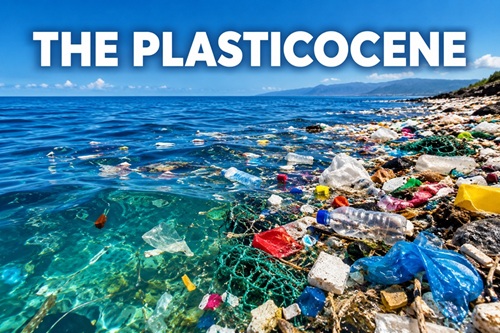 What will future geologists find when humanity is gone? A layer of plastic, concrete, radioactive isotopes, altered fossils, and the chemical signatures of a civilization that briefly transformed an entire planet. Imagine a geologist living ten million years from now, examining a cliff exposed by erosion. The rock layers tell a story of ancient seas, volcanic eruptions, vanished forests, and mass extinctions. Then, somewhere near the top of the formation, the familiar geological narrative changes abruptly. A thin but peculiar layer contains unusual concentrations of metals, synthetic chemicals, carbon residues, microscopic plastic fragments, and radioactive isotopes. Fossils become scarce or change character. The chemical composition of the sediment records a disturbance that cannot be explained by an ordinary geological process. The geologist has discovered the remains of humanity. Perhaps the most remarkable thing about our civilization is that we are leaving behind a record of our existence without intending to do so. We build monuments to preserve our names, erect statues to commemorate our rulers, and write books in the hope that someone will read them centuries later. Yet the most durable testimony to our presence may not be anything we deliberately created. It may be the unintended residue of our daily activities: the plastics we discarded, the carbon we released, the minerals we extracted, the landscapes we reshaped, and the radioactive materials we scattered across the Earth. What will survive of us is unlikely to resemble a museum of human achievement. It will be a geological archive of our metabolism as a species. Should we call this interval the Anthropocene, emphasizing humanity's planetary influence, or the Plasticocene, highlighting one of its most distinctive material legacies? The first name captures the scale of the transformation; the second draws attention to a particularly revealing symbol of our technological age. Either way, the central question remains: what physical evidence will our civilization leave in the rocks of the future? 1. The nuclear fingerprint: a planet-wide timestampIf future geologists needed to identify a particularly precise starting point for the industrial transformation of the planet, they could look for the radioactive traces left by nuclear weapons testing. Beginning in the mid-twentieth century, atmospheric nuclear detonations dispersed artificial radionuclides across the globe. Some entered the atmosphere, travelled vast distances, and settled into lakes, oceans, soils, glaciers, and other environments. Among them are plutonium isotopes that do not occur in comparable natural abundance. Their appearance provides a remarkably distinctive marker of the nuclear age. The proposed geological boundary for the Anthropocene was associated with this mid-century signal, particularly the sharp increase in plutonium around 1952. Sediments from Crawford Lake in Ontario, Canada, became the preferred reference site for the proposal because its annually layered deposits preserve a detailed environmental history. There is something extraordinary about this. Humanity's attempt to demonstrate its capacity for self-annihilation has also created a timestamp that may outlast the civilization responsible for it. Radioactive elements have different half-lives. Some will become undetectable relatively quickly on geological timescales; others will persist for thousands of years or considerably longer. The exact record will depend on the isotope, its environment, and the preservation of the sediment. Nevertheless, nuclear fallout offers future investigators something unusual: a global signature associated with a historically documented human activity. The geological record may thus preserve evidence not merely that an intelligent species existed, but that it acquired the power to destroy itself on an industrial scale. There is a bitter irony here. We may leave behind a more precise record of our nuclear anxieties than of our hopes for peace. 2. Plastic: the fossil that never evolvedIf radioactivity supplies a timestamp, plastic may supply the characteristic material of our age. For most of Earth's history, the remains of living things have entered the geological record through familiar processes. Shells accumulate on the seabed, plants become buried in sediment, and organic matter is gradually transformed. Human beings have introduced something different: synthetic polymers manufactured in enormous quantities from industrial feedstocks, many derived from fossil fuels. Plastic is not a single substance. It is a family of materials with different chemical structures, additives, and rates of degradation. Some plastics fragment under sunlight and mechanical stress; others can persist much longer. Their eventual fate depends on their composition and the conditions in which they are buried. Yet their widespread dispersal has already made them recognizable components of modern soils and sediments. Future geologists may find plastic fragments embedded in sedimentary layers, mixed with sand and organic matter, or incorporated into rocks formed under unusual local conditions. Some plastic waste melts together with mineral particles and other debris, producing hybrid materials known as plastiglomerates. Plastic residues can also accumulate on rocky shorelines as plasticrusts, while melted and reshaped waste may form unusual objects sometimes called pyroplastics. These are not necessarily destined to survive unchanged for millions of years. Burial, heating, chemical alteration, and erosion can transform or destroy them. But even where the original polymers disappear, their residues or associated chemical signatures may remain detectable. The more important point is that plastic has entered the geological cycle. It is transported by rivers, deposited on coastlines, buried in sediments, and redistributed by erosion. Its movement increasingly resembles that of other sedimentary materials, even though its origin is industrial rather than biological. Imagine a future rock formation in which mineral grains are mixed with the remains of packaging, synthetic fibres, fragments of fishing equipment, and other manufactured objects. The original labels will be gone. The brand names will be unreadable. But the chemical and structural evidence may reveal that these materials were produced by a species that manufactured objects on a scale never previously seen in Earth's history. A plastic bottle might not survive intact for ten million years. The Plasticocene does not require it to. A geological signature can outlast the original object through fragmentation, chemical transformation, burial, and incorporation into sediment. And what an extraordinary signature it is: a material invented to be useful for a few minutes, or perhaps a few years, that may leave traces long after the society that found it indispensable has disappeared. 3. Concrete, steel, and the fossilization of citiesPlastic may be the emblematic substance of our age, but concrete may be its most massive artificial deposit. Humanity has transformed the Earth's surface through mining, excavation, road building, dam construction, tunnelling, and urbanization. Cities are not merely collections of buildings. They are enormous accumulations of processed geological material: sand, gravel, limestone, clay, iron ore, copper, and countless other resources extracted, transported, and rearranged. Concrete combines natural aggregates with cement, while steel incorporates iron refined through energy-intensive industrial processes. Glass, brick, asphalt, aluminium, and synthetic insulation add further layers of manufactured matter. Together, these materials create a new kind of geological environment. Some of our structures will be destroyed by earthquakes, floods, fires, and erosion. Others will be buried beneath later sediments. Underground transport systems and foundations may survive as irregular cavities, mineralized structures, or remnants of artificial strata. Rubble from collapsed buildings may eventually become incorporated into deposits that no longer resemble an urban landscape. In some places, future geologists may encounter something analogous to a fossilized city: not intact streets and recognizable skyscrapers, but a thick, heterogeneous accumulation of concrete fragments, bricks, metal oxides, glass, plastics, and altered soil. Our cities may become technofossil assemblages—collections of manufactured objects and their remains that can be recognized in the geological record. Yet this fossilization will be uneven. Most buildings will not become neatly preserved monuments. Steel corrodes, concrete cracks, glass breaks, and many materials are recycled or dispersed. Geological preservation depends on local conditions, and the record will be patchy. Nevertheless, the sheer scale of construction makes it likely that human-made deposits will remain important features of the planet's surface and subsurface for a very long time. There is also a revealing distinction between the geological materials we extract and the materials we create. Limestone, sand, and iron ore belong to Earth's long history. Cement, reinforced concrete, and industrial alloys represent new arrangements of those materials, produced through human knowledge, energy use, and engineering. We did not create the elements of our civilization. We reorganized them. That may ultimately be one of the most distinctive signatures of humanity: a species that became a geological force by learning to dig up the planet, process its contents, and put them back in places where natural processes would rarely have assembled them in quite the same way. 4. The carbon anomaly: the atmosphere written into stonePerhaps our most consequential geological legacy will not be a manufactured object at all. It will be a chemical imbalance. For millions of years, the carbon cycle has involved exchanges among the atmosphere, oceans, living organisms, soils, and geological reservoirs. The burning of coal, oil, and natural gas has rapidly transferred carbon from long-buried deposits into the atmosphere. Deforestation and other land-use changes have added to the disturbance. The resulting increase in atmospheric carbon dioxide has altered the climate system. Some of the excess carbon enters the oceans, changing seawater chemistry and contributing to ocean acidification. Other carbon remains in the atmosphere, trapping additional heat and shifting temperatures, precipitation patterns, ice cover, and sea levels. Future geologists will not need to find a fossilized smokestack to detect this transformation. They may identify it through carbon-isotope ratios, chemical changes in marine sediments, altered patterns of fossil preservation, and evidence of rapid environmental change. The distinction between carbon isotopes is particularly useful. Carbon released by burning ancient organic matter has a different isotopic signature from carbon in many other sources. Fossil-fuel combustion has also reduced atmospheric radiocarbon relative to what it would otherwise have been, while nuclear weapons testing produced a separate radiocarbon signal. Together with other measurements, these patterns help researchers reconstruct the history of industrial emissions. The record will not be as simple as a single black line. Carbon moves through different reservoirs, and geological processes can blur or redistribute signals. The climate response will also vary from one region to another. Yet the broad chemical disturbance is unmistakable. Our civilization may therefore leave behind a geological record of a paradox: we dug into the distant past to obtain energy, and in doing so we changed the conditions under which the planet's future will unfold. Coal formed from ancient vegetation. Oil and gas accumulated through complex geological processes over immense spans of time. These deposits represented stored chemical energy from earlier chapters of Earth history. Industrial civilization released part of that energy within a few centuries, returning carbon to the active Earth system far faster than many natural geological processes ordinarily would. The atmosphere is not rock, but its changes are written into rocks, ice, sediments, and biological remains. If future investigators reconstruct our era, they may find that the most consequential artifact of industrial civilization was not the steam engine, the automobile, or the power station. It was the alteration of the planetary system that made those inventions possible. 5. Fly ash, heavy metals, and the industrial dust of civilizationEvery industrial civilization produces waste, but ours has distributed certain kinds of waste on a planetary scale. Coal combustion releases fine particles of fly ash that can travel through the atmosphere before settling on land and water. These particles can become incorporated into lake sediments, peat deposits, soils, and other geological archives. Their abundance and composition can help identify periods of industrial activity. Mining and metallurgy leave other distinctive traces. Lead, mercury, cadmium, copper, and other elements can become concentrated in sediments and soils as a result of extraction, smelting, manufacturing, and waste disposal. Their isotopic compositions can sometimes help distinguish industrial sources from natural background levels. Persistent organic pollutants, including certain industrial chemicals and pesticides, may also survive long enough to provide evidence of specific phases of technological history. Their distribution is variable, and many will eventually degrade, but some can be traced in sediments long after their use has ceased. Then there are the enormous deposits of mine tailings, industrial slag, ash, and discarded construction materials. These are not merely contaminants scattered across a natural landscape. They are artificial geological formations in their own right. A future geologist studying an industrial region may find that its sediments contain an unusual concentration of metals, spherical ash particles, altered minerals, and chemical compounds absent or rare in older deposits. The evidence may reveal not only that industry existed, but something about the kinds of energy and technologies that powered it. The layers may distinguish the coal-burning industrial age from later technological phases, although such distinctions will rarely be perfect or globally uniform. Our waste is, in effect, a material history of our ingenuity. The same processes that produced steel, electricity, fertilizers, and modern infrastructure also generated residues that have entered soils, rivers, oceans, and sediments. A civilization's geological signature is not simply what it makes. It is also what it cannot use, what it discards, and what it leaves for other processes to redistribute. 6. The great rearrangement of lifeGeology is not merely the study of rocks. It is also the study of life as preserved in the rocks. And here, too, humanity is leaving a remarkable signature. The fossil record contains the remains of successive biological communities. Trilobites, ammonites, dinosaurs, and countless other organisms appeared, flourished, and disappeared. Their distributions and extinctions help geologists reconstruct ancient environments and recognize major transitions in Earth's history. Humanity is now rearranging the distribution of life on a global scale. Species are transported across oceans and continents, intentionally or accidentally, through shipping, agriculture, trade, and travel. Some become established in new environments; others displace native species. Habitat destruction, overexploitation, pollution, and climate change place additional pressures on ecosystems. Future sediments may contain the remains of organisms that spread globally through human activity, alongside evidence of species that became rare or disappeared. Fossils may reveal changes in the composition of plankton, molluscs, corals, and other organisms sensitive to environmental conditions. In some locations, the disappearance of formerly abundant species may be more conspicuous than the appearance of new ones. Not every extinction will leave a clear geological boundary, and the present biodiversity crisis should not be confused with a completed mass extinction. Whether it eventually produces a biological disruption comparable to the great mass extinctions of the past remains uncertain. But human-driven changes in the biosphere are already detectable. The record may tell a complicated story. Some species will flourish in human-altered environments. Others will retreat or vanish. Domestic animals and cultivated plants may leave recognizable remains, while invasive organisms may become abundant in sediments far from their original habitats. Our geological footprint will therefore include a biological redistribution: a reshuffling of Earth's living inhabitants. In this sense, the Anthropocene is not merely an episode in which one species became unusually abundant. It is an interval in which one species began altering the evolutionary circumstances of many others. Future geologists may find our influence written not only in what survives, but in what is conspicuously missing. 7. Fertilizers, nitrogen, and the invisible chemistry of foodOne of the least visually spectacular transformations may turn out to be among the most consequential. Modern agriculture has changed the global nitrogen cycle. Industrial fertilizer production converts atmospheric nitrogen into biologically available forms, enabling crop yields that would otherwise be difficult to sustain. Fertilizers, together with intensive livestock farming and the cultivation of nitrogen-fixing crops, have substantially increased the amount of reactive nitrogen circulating through ecosystems. Much of this nitrogen eventually moves beyond agricultural fields. It enters rivers, lakes, estuaries, and coastal waters, where it can stimulate excessive algal growth. When this organic matter decomposes, oxygen depletion can create dead zones in which many organisms struggle to survive. The geological evidence may include altered nitrogen-isotope ratios, increased nutrient concentrations, changes in microscopic aquatic organisms, and sediments deposited under oxygen-poor conditions. Phosphorus, too, has been redistributed through mining, fertilizer production, sewage, and agriculture. Both elements are essential to life, but their industrial redistribution can alter ecosystems over large areas. This is an important reminder that the human geological footprint is not confined to spectacular structures or visible pollution. It also consists of changes to the chemical flows that sustain life. Our food system has become a planetary force. Fields that look green and natural may depend on industrial processes that draw resources from mines, consume energy, and produce chemical residues that travel far beyond the farm. A future sediment core may reveal the consequences of those processes even where no trace of the original machinery remains. The layer will not necessarily tell its discoverers how many people lived in a particular city, what they ate for dinner, or which political system governed them. But it may show that, for a period in Earth's history, one species substantially reorganized the chemistry of the biosphere to feed itself. 8. Landfills: the archaeological record of a disposable civilizationImagine excavating a landfill millions of years from now. The original landscape may have disappeared beneath erosion or later sedimentation. The waste itself may have been compressed, chemically altered, and partially decomposed. Yet the deposit could remain a strange assemblage of manufactured materials, preserved in an artificial stratigraphic layer. Landfills are unusual geological environments because they concentrate objects that would otherwise be dispersed across the planet. Plastics, metals, ceramics, glass, electronic components, synthetic textiles, and organic waste accumulate together. Some objects are relatively durable; others degrade or react chemically. Conditions vary dramatically with moisture, oxygen, temperature, and burial depth. Electronic waste presents a particularly revealing case. Circuit boards, cables, batteries, and other devices combine materials that rarely occur together in nature. Copper, gold, tin, aluminium, rare-earth elements, polymers, and engineered ceramics may be found in a single discarded object. To a future geologist, such combinations could be as distinctive as an unusual mineral assemblage. But the deeper irony concerns the life expectancy of the things we discard. Many consumer objects are designed, marketed, and purchased within a culture of rapid replacement. Their useful lives may be short compared with the period during which their material remains circulate through the environment. A smartphone may become obsolete in a few years. Its components may be recycled, dispersed, or buried. The precise object might never survive in recognizable form, but its materials could persist in altered deposits. The same is true of clothing, packaging, vehicles, household appliances, and construction waste. Some materials will be recovered and reused; others will be lost to the sedimentary cycle. Future investigators might reconstruct our economy from these deposits without knowing anything about money, advertising, or consumer psychology. They would see a civilization that repeatedly extracted materials, assembled them into complex objects, used them, and discarded them. Perhaps they would call us the species of planned obsolescence. Perhaps they would simply conclude that we were extraordinarily productive—and extraordinarily wasteful. 9. What will survive for a million years?Not all traces of humanity have the same geological durability. It is useful to distinguish between materials that are readily destroyed, materials that persist but are transformed, and signals that can be detected long after their original sources have disappeared.
The table describes potential evidence, not a guarantee that every signal will survive for millions of years. Geological preservation is selective. Erosion can destroy deposits; tectonic activity can bury, deform, or recycle them; chemical reactions can transform materials beyond recognition. Nor will future geologists necessarily encounter one clean, continuous layer spanning the entire planet. Some environments preserve annual sediments; others accumulate material irregularly or lose it through erosion. A robust reconstruction will require several independent indicators. The strongest evidence will come from the convergence of different records. Radioactive fallout can establish a chronology. Plastics and industrial particles can identify manufactured materials. Isotope ratios can reveal changes in carbon and nitrogen cycles. Fossils can document biological turnover. Artificial deposits can expose the physical scale of construction and extraction. Together, these signals may allow future scientists to reconstruct our transformation of the planet even if they never discover a human bone, a readable inscription, or a single recognizable machine. And what about our most celebrated achievements? Our literature, music, mathematics, political revolutions, philosophical arguments, and religious traditions might survive in archives or through the descendants of human culture. But none of them is guaranteed to leave a recognizable geological signature. Geology preserves material traces, not the full meaning of the lives that produced them. A layer of plastic cannot tell a future scientist what Shakespeare meant to us. A spike in atmospheric carbon cannot reveal the debates that accompanied industrialization. A concrete foundation cannot explain the aspirations of the people who built a city. The geological record will be powerful, but radically incomplete. 10. The Anthropocene controversy: a name is not the evidenceThere is a scientific distinction worth preserving. The Anthropocene is widely used to describe the period of profound human influence on Earth, but it was not formally accepted as a new geological epoch in the international Geological Time Scale. In March 2024, the relevant geological bodies rejected the proposal to formalize it, while explicitly recognizing that the term would continue to be useful in scientific and public discussion. That decision concerned the formal classification of geological time, not whether human activity has produced a distinctive geological record. The proposed boundary around the mid-twentieth century was attractive because multiple signals intensified around that time. Nuclear fallout offered a particularly precise marker, while the expansion of industrial production, fossil-fuel consumption, chemical pollution, and global trade supplied complementary evidence. However, the history of human influence on Earth extends much further back. Agriculture, deforestation, irrigation, mining, and urbanization have altered landscapes for millennia. The timing of these changes varies geographically, making it difficult to identify a single global beginning that satisfies the technical requirements for a formal geological epoch. The choice between the Anthropocene and the Plasticocene raises a related question. Are we trying to name a geological interval, or to identify its most distinctive material symbol? The Anthropocene emphasizes the cause: human activity. The Plasticocene emphasizes a particularly revealing consequence: the widespread introduction of synthetic materials into Earth's surface systems. Neither term captures everything. Plastic is not responsible for the entire planetary transformation. A world without plastic could still experience climate change from fossil-fuel combustion, nuclear fallout, industrial metal pollution, habitat destruction, and mass redistribution of sediments. Conversely, plastic pollution is significant even if the Anthropocene never becomes a formal geological epoch. The terminology matters less than the evidence. Whatever future scientists call our time, the physical record will not depend on a successful vote by a geological committee. 11. The geological afterlife of humanityThere is something humbling about considering civilization from the perspective of deep time. Human history is usually narrated through events that matter to us: the rise and fall of empires, the invention of writing, the scientific revolution, the industrial revolution, and the emergence of digital technology. Geological history operates on a different scale. It asks which changes become embedded in the physical structure of the planet and remain recognizable after the events themselves have vanished. From that perspective, the distinction between triumph and catastrophe becomes less straightforward. A technological achievement may produce a durable geological signal without being an unqualified benefit. A disaster may leave a clear marker without determining the ultimate fate of a civilization. What survives is not necessarily what mattered most to the people who lived through it. Consider the digital revolution. Billions of people now communicate, work, trade, and entertain themselves through electronic devices. Yet the information stored on those devices may be lost within decades if the infrastructure supporting it disappears. The geological record, by contrast, may preserve traces of the copper, silicon, gold, polymers, and other materials from which the devices were made. The physical ingredients may outlast the information. Perhaps a future intelligence will discover fragments of silicon-rich material, metal-rich residues, and unusual deposits associated with the industrial age. It might infer that a technologically sophisticated species existed, but find no evidence of the literature, science, or philosophical reflection that made that technology possible. Our knowledge could disappear while the consequences of applying it remain. The same applies to our cities. Their original purposes may be forgotten. Their political symbols may be destroyed. Their monuments may collapse. But their material remains may continue to influence erosion, drainage, sedimentation, and the chemistry of the surrounding environment. Humanity's geological afterlife will not be a faithful autobiography. It will be an edited account written by physical processes. 12. Will the Earth remember us?The Earth does not remember in the human sense. It has no intention of preserving our achievements, and no concern for the fate of our species. Geological processes retain some traces and erase others. The record is a consequence of physical conditions, not a memorial deliberately constructed for future generations. Yet the metaphor of planetary memory is compelling because it captures something real. The Earth can preserve evidence of events long after the participants have disappeared. Ancient volcanic eruptions, asteroid impacts, climatic transitions, and mass extinctions are known through the traces they left in rocks and sediments. Humanity has joined that history, whether or not we choose to recognize the fact. Our species is not the first to change its environment. Life itself transformed the planet, most famously through the evolution of photosynthesis and the resulting rise of atmospheric oxygen. Organisms have altered soils, oceans, and the composition of the atmosphere for billions of years. What distinguishes modern humanity is the extraordinary speed, geographic reach, and technological character of its influence. We have developed the capacity to move enormous quantities of matter, mobilize geological carbon, distribute synthetic substances, rearrange ecosystems, and introduce artificial radionuclides into the environment. We are not outside nature, manipulating it from some separate realm. Our mines, factories, farms, and cities are products of natural materials and biological energy flows. But the scale and organization of these activities have created a new kind of planetary disturbance. The Plasticocene is therefore more than a story about litter. It is a story about a species that learned to transform matter on an industrial scale, without always understanding the long-term consequences of that transformation. And the Anthropocene is more than a story about human dominance. It is also a story about the limits of control. We can manufacture materials that resist degradation, release carbon that changes the climate, and engineer landscapes that reshape rivers. Yet we cannot simply dictate how these materials will circulate, where they will accumulate, or what consequences will emerge from their interactions. Our geological footprint is a record of both power and unintended consequence. Conclusion: the footprints we leave behindSuppose that, ten million years from now, an intelligent species examines a sedimentary formation containing microscopic plastic fragments, unusual concentrations of industrial metals, the altered chemical signatures of ancient fossil fuels, and biological remains from a period of rapid ecological disruption. Would it recognize humanity? It might not know our name. It might never discover our cities, our books, or our electronic archives. It might not even establish that the materials were produced by a single species rather than by several related forms of life. Those conclusions would depend on the evidence available and the sophistication of the investigators. But it could reasonably infer that something extraordinary happened. A relatively short interval in the geological record would contain a convergence of unusual materials, chemical anomalies, radioactive traces, and biological changes. The combination would point toward a period when Earth's surface processes were profoundly altered by an agent capable of large-scale extraction, manufacture, energy use, and environmental transformation. That would be our geological signature. Perhaps the name Plasticocene will endure as a cultural metaphor, even if the Anthropocene remains informal in geological classification. It captures the peculiar contradiction of our age: a civilization that produces objects for temporary convenience but introduces materials into the environment that may persist far beyond their intended usefulness. Yet plastic is only one chapter. Our deeper legacy lies in the combined traces of nuclear technology, industrial chemistry, fossil-fuel combustion, construction, mining, agriculture, and biological redistribution. We will leave behind a planet whose geological record contains evidence of what we extracted, what we manufactured, what we burned, what we discarded, and what we changed. That record will not tell the whole story. It may say little about our kindness, our creativity, our moral struggles, or our attempts to understand ourselves. It will not distinguish automatically between our noblest intentions and our worst mistakes. But it will preserve something important: the physical consequences of a species that became powerful enough to alter the conditions of its own existence. We often ask what kind of world we will leave to future generations. The geological perspective extends that question far beyond our descendants. It asks what evidence of us might remain after human civilization, human memory, and perhaps humanity itself have disappeared. The answer is likely to be neither a magnificent monument nor a single indestructible artifact. It will be a scattered, uneven, chemically altered archive distributed through sediments, rocks, soils, and the remains of living things. A little plutonium here. A fragment of plastic there. A layer of industrial ash. A shift in carbon isotopes. A fossil assemblage that no longer resembles the one beneath it. Together, these traces may tell the story of a civilization that occupied the planet for a geological instant and left a disproportionately large mark. We may disappear from the face of the Earth. But the Earth will not necessarily return to the condition in which we found it. And that may be the most enduring footprint of all.
Widget is loading comments...
|