|
TRANSLATE THIS ARTICLE
Integral World: Exploring Theories of Everything
An independent forum for a critical discussion of the integral philosophy of Ken Wilber
  Frank Visser, graduated as a psychologist of culture and religion, founded IntegralWorld in 1997. He worked as production manager for various publishing houses and as service manager for various internet companies and lives in Amsterdam. Books: Ken Wilber: Thought as Passion (SUNY, 2003), and The Corona Conspiracy: Combatting Disinformation about the Coronavirus (Kindle, 2020).
Check out my other conversations with ChatGPT
AI, Big Tech and Religion:
When Technology Becomes God Peter Thiel: The Billionaire Who Wants to Escape Democracy The Billionaires and the Apocalypse Musk versus Thiel: Two Billionaires, Two Visions of the Future Naomi Klein and The Politics of Catastrophe Naomi KleinThe Politics of Catastrophe, Corporate Power, and the Limits of Anti-Capitalist CriticismFrank Visser / ChatGPT
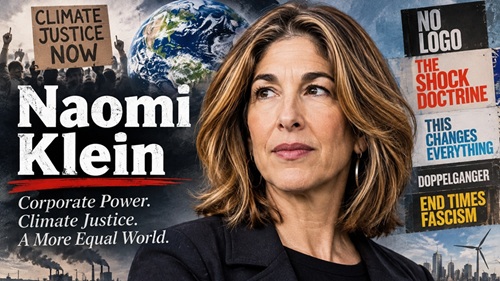 Introduction: The Radical Critic of Corporate GlobalizationNaomi Klein occupies an important position in contemporary anti-capitalist and progressive political thought. As a journalist, author, and activist, she has spent much of her career exposing the relationship between corporate power, economic globalization, political opportunism, and environmental destruction. Her books have become influential beyond academic circles, helping to shape the vocabulary through which a generation of activists understands neoliberalism, globalization, and the climate crisis. Klein's reputation rests particularly on three major works: No Logo (1999), her investigation of corporate branding and globalization; The Shock Doctrine (2007), her account of how political and economic elites exploit crises to advance neoliberal policies; and This Changes Everything (2014), her argument that climate change cannot be adequately addressed without confronting capitalism itself. Her more recent work, Doppelganger (2023), explores political polarization, conspiracy culture, and the disturbing experience of being confused with another public intellectual, Naomi Wolf. There is much to admire in Klein's work. She is an effective investigative journalist, a powerful communicator, and an important critic of the concentration of economic and political power. She has helped make structural problems visible that conventional political discourse frequently marginalizes. Nevertheless, her work also raises important questions. Does her emphasis on capitalism as the underlying explanation of contemporary crises sometimes become too comprehensive? Does she distinguish sufficiently between different varieties of capitalism, or between the failures of markets and the failures of political institutions? And does her political analysis occasionally sacrifice explanatory precision for the rhetorical effectiveness of a compelling narrative? These questions do not diminish her importance. They are precisely the questions that a serious engagement with her work should address. 1. No Logo: Exposing the Corporate BrandKlein's international breakthrough was an investigation of the growing power of multinational brands and the transformation of corporations from manufacturers of products into producers of cultural identities. The central argument was that large corporations increasingly outsourced production while concentrating their resources on branding, marketing, and the construction of consumer identities. The resulting economic arrangement separated the visible corporate image from the often-invisible conditions under which goods were manufactured. Nike, McDonald's, Disney, and other multinational companies became examples of a new corporate order in which brands occupied an increasingly dominant position in public life. Klein connected this development to labor exploitation, sweatshops, precarious employment, and the displacement of local economic cultures. Her argument was not simply that advertising had become more sophisticated. It was that corporate branding was increasingly colonizing social space. This was an important contribution. It challenged the assumption that consumer choice necessarily represented economic freedom. Consumers might choose between competing brands while having little knowledge of the labor conditions, environmental costs, or corporate arrangements behind them. However, No Logo also illustrates a recurring limitation in Klein's approach: the tendency to present corporate globalization as a relatively unified system of domination. Multinational corporations are not identical. Their business models, labor practices, ownership structures, and relationships with governments differ considerably. Globalization has also produced economic opportunities, technological diffusion, and improvements in living standards, particularly in countries that previously occupied peripheral positions in the world economy. Recognizing these developments does not excuse exploitation. It does, however, complicate the picture. The question is not whether multinational corporations exercise enormous power. Clearly they do. It is whether the analysis adequately distinguishes between the different institutional arrangements through which that power operates. Klein's achievement was to make corporate power culturally visible. Her weakness was a tendency to treat the global economic system as more coherent and uniform than it actually is. 2. The Shock Doctrine: The Politics of CrisisPerhaps Klein's most influential and controversial book, this work argues that economic and political elites exploit moments of collective disorientation to impose unpopular economic reforms. Klein's central thesis is that crises create political opportunities. When societies experience wars, coups, economic collapses, natural disasters, or other traumatic events, established political arrangements become vulnerable. During these periods of uncertainty, governments and powerful economic interests can introduce policies that would encounter greater resistance under normal circumstances. She connects this process to the economic doctrines associated with Milton Friedman and the Chicago School, as well as to the histories of Chile under Pinochet, post-Soviet Russia, Iraq after the 2003 invasion, and New Orleans after Hurricane Katrina. The book's strength lies in drawing attention to the political economy of emergencies. Crises do not automatically produce progressive or egalitarian responses. They can also be used to privatize public assets, weaken labor protections, and redistribute resources toward already powerful interests. This is a valuable corrective to the idea that economic reforms are always the result of rational deliberation and democratic consent. Yet the book's explanatory framework is also problematic. First, Klein sometimes appears to attribute too much coherence to the relationship between crises and neoliberal reform. Not every privatization is the product of a deliberate strategy to exploit collective trauma. Not every economic liberalization is imposed through political manipulation. Some reforms emerge from genuine fiscal emergencies, institutional failures, ideological convictions, or democratic electoral mandates. Second, the distinction between exploiting a crisis and responding to one can be difficult to establish. A government may introduce market-oriented reforms during a period of national emergency without the emergency itself being manufactured or deliberately exploited. Third, the book risks making neoliberalism appear to be a single coordinated project rather than a diverse collection of economic ideas and policy experiments. Friedman's intellectual influence is undeniable, but neoliberalism has never been a perfectly unified doctrine. Its proponents disagree about monetary policy, industrial policy, social welfare, competition, regulation, and the appropriate boundaries of government. Klein's narrative is compelling because it identifies recurring political patterns. But recurring patterns are not necessarily evidence of a single underlying conspiracy or centrally coordinated strategy. The strongest version of her thesis is therefore more modest: political emergencies frequently create opportunities for powerful actors to advance policies that benefit them, especially when democratic accountability is weakened. That proposition is persuasive. It does not require the stronger suggestion that neoliberal reform is fundamentally a product of crisis exploitation. 3. Capitalism as the Master ExplanationOne of the most persistent features of Klein's political thought is her tendency to connect apparently separate problems to the structural logic of capitalism. Corporate globalization, labor exploitation, economic inequality, environmental destruction, and democratic deficits are presented as interconnected expressions of a larger system. There is considerable truth in this perspective. Economic institutions shape political incentives, influence public policy, and distribute power unequally. Corporations can exercise political influence through lobbying, campaign financing, control of investment, and their ability to relocate production. However, capitalism is not a single institutional arrangement. There are important differences between American shareholder capitalism, European social-market economies, Scandinavian welfare capitalism, German coordinated market institutions, and East Asian developmental capitalism. These systems differ in labor protections, social security, public ownership, corporate governance, taxation, and environmental regulation. A critical political analysis should explain why some capitalist societies have developed relatively strong social protections while others have produced extreme inequality and political polarization. Klein is often more interested in exposing the common structural tendencies of capitalism than in investigating these institutional differences. This creates a potential explanatory problem. If capitalism is responsible for virtually every major social dysfunction, what would count as evidence that a particular problem has a different origin? Political authoritarianism, nationalism, religious fundamentalism, bureaucratic incompetence, and geopolitical rivalry cannot simply be reduced to economic interests. They have their own histories, institutions, and ideological motivations. Capitalism can reinforce these developments, but it does not necessarily explain them. A satisfactory political theory needs to account for the interaction between economic power and other forms of social power rather than treating the former as the ultimate explanation of everything. 4. This Changes Everything: Climate Change versus CapitalismKlein's climate-change intervention takes her critique of corporate capitalism into the domain of environmental politics. Klein argues that climate change is not simply an environmental problem requiring technological adjustments and better government policies. It is a civilizational challenge that exposes fundamental contradictions within the prevailing economic system. Her argument is that an economic order organized around perpetual growth, resource extraction, consumerism, and the pursuit of short-term profits is structurally incompatible with the ecological requirements of a stable climate. She consequently rejects the notion that climate change can be adequately addressed through minor adjustments to existing economic arrangements. What is needed, in her view, is a profound transformation of economic priorities, including stronger public institutions, democratic control, renewable energy, and a more equitable distribution of resources. This argument deserves serious consideration. The climate crisis is not merely a technological problem. It involves political power, economic incentives, international inequalities, and the distribution of environmental costs. The fossil-fuel industry has demonstrated its ability to obstruct climate legislation, influence public debate, and protect established investments. The fact that economically powerful interests can delay environmental reform is an important part of the climate story. Nevertheless, Klein's framing of the problem as capitalism versus the climate is too stark. Capitalist economies are not necessarily incapable of environmental reform. Indeed, technological innovation, private investment, market incentives, carbon pricing, and public regulation can all contribute to decarbonization. The relevant question is not whether capitalism can continue indefinitely in its present fossil-fuel-dependent form. It cannot. The question is which institutional arrangements can produce rapid decarbonization while maintaining economic stability, political legitimacy, and social welfare. There are also examples of countries with market economies that have achieved substantial progress in renewable energy deployment, emissions reduction, and environmental regulation. Conversely, economies organized around extensive state ownership have not automatically demonstrated ecological responsibility. The environmental record of the former Soviet Union and contemporary China illustrates that state-directed development can also produce enormous ecological damage. This is an important qualification. The opposition between capitalism and ecological sustainability does not map neatly onto the opposition between private and public ownership. The deeper problem is the organization of industrial civilization around energy-intensive production, material consumption, and the externalization of environmental costs. Capitalism can intensify these tendencies, but they are not exclusive to capitalism. Klein's analysis would be stronger if it distinguished more carefully between economic growth, material throughput, technological development, and ecological destruction. These are related but not interchangeable phenomena. A society might increase its economic output while reducing its carbon emissions. Whether such decoupling can proceed rapidly and comprehensively enough to meet ecological limits is a serious empirical question, not something that can be settled by ideological classification. Klein is right to insist that climate politics is inseparable from questions of power. But she sometimes makes the mistake of treating an important structural explanation as an exhaustive one. 5. Doppelganger: Conspiracy Culture and the Mirror WorldIn this more personal and intellectually exploratory book, Klein investigates political polarization, conspiracy theories, digital identity, and the strange phenomenon of being confused with another Naomi. Klein's encounter with the political transformation of Naomi Wolf provides the narrative starting point. Wolf, formerly associated with progressive feminism, became increasingly prominent in anti-vaccine activism and conspiracy-oriented political circles during the COVID-19 pandemic. The two Naomis became confused with each other in public, creating an unusual opportunity for Klein to examine the phenomenon of political doubles. The book moves beyond this personal experience to investigate what Klein calls the mirror world: a political and cultural environment in which established distinctions between left and right, truth and falsehood, legitimate dissent and conspiracy thinking become increasingly unstable. One of Klein's most interesting observations concerns the appropriation of legitimate grievances by reactionary movements. Economic insecurity, distrust of corporations, criticism of pharmaceutical companies, opposition to concentrated power, and dissatisfaction with political elites are not inherently right-wing concerns. Yet political movements can redirect these grievances toward scapegoating, authoritarian nationalism, anti-scientific conspiracies, and hostility toward vulnerable minorities. This is an important insight. Political discontent does not automatically produce emancipatory politics. It can be mobilized in very different directions. Klein also turns some of her critical attention toward her own political identity. She recognizes that an author who criticizes branding can become a brand herself, and that progressive movements are not immune to the distortions of social media, tribal identification, and ideological self-confirmation. This self-reflective dimension makes Doppelganger particularly interesting. There is, however, another question worth asking. Does Klein apply her criticism of conspiratorial thinking equally to her own political camp? Her earlier work sometimes relied on sweeping narratives in which powerful economic interests appeared to coordinate developments across different countries and historical periods. Such narratives can be illuminating, but they can also encourage a suspicious interpretive habit in which almost every development is understood as evidence of an underlying strategy of domination. There is a distinction between investigating documented elite coordination and assuming that apparently related events must have a common political purpose. The former is investigative journalism. The latter can become a conspiracy-like interpretive framework, even when its political conclusions differ radically from those of the far right. Klein's Doppelganger provides an opportunity to apply her later insights retrospectively to her earlier work. Her willingness to examine the limitations of political identity is welcome, but it would be equally valuable to examine the limitations of her own explanatory narratives. 6. End Times Fascism: The New Alliance of Tech Oligarchs, Religious Extremists, and EthnonationalistsIn End Times Fascism: And the Fight for the Living World (2026), co-authored with Astra Taylor, Naomi Klein extends her critique of capitalism into the increasingly disturbing convergence of technological power, religious apocalypticism, and authoritarian nationalism. Her central argument is that influential political and economic actors are increasingly preparing for civilizational breakdown rather than trying to prevent it. They anticipate a catastrophic future in which only a privileged minority will survive, protected by private bunkers, fortified national borders, technological escape routes, or fantasies of colonizing other planets. Klein and Taylor identify three overlapping groups of contemporary end-times thinkers. Religious apocalypticists interpret global conflicts and environmental disasters as signs of an approaching messianic age. Technology billionaires invest in artificial intelligence, radical life extension, and space colonization while entertaining scenarios in which humanity itself might become expendable. Ethnonationalists, meanwhile, respond to perceived civilizational threats by advocating fortified borders, exclusionary national identities, and the expulsion of supposedly undesirable populations. The authors argue that these movements, despite their different motivations, share a fundamental rejection of a common human future. Their preferred response to existential uncertainty is not collective responsibility but the protection of selected groups at the expense of everyone else. This is an interesting and potentially illuminating synthesis. The connection between Silicon Valley's technological ambitions, billionaire survivalism, Christian apocalyptic beliefs, and the authoritarian politics of Donald Trump deserves serious investigation. Klein is particularly effective in exposing the contradiction between the technological elite's rhetoric of saving humanity and its apparent indifference to the ecological and social consequences of its activities. The enormous energy requirements of artificial intelligence, the continued dependence on fossil fuels, and the growing concentration of technological and financial power make this more than an abstract philosophical concern. Nevertheless, the concept of End Times Fascism requires careful examination. Do these different movements really constitute a coherent political alliance, or are we looking at a temporary convergence of interests among actors whose underlying worldviews remain substantially different? Elon Musk's technological ambitions, Peter Thiel's political philosophy, evangelical Christian eschatology, and ethnonationalist immigration policies cannot simply be treated as interchangeable expressions of one ideology. Their cooperation may be politically consequential, but their differences matter too. The authors are more persuasive when documenting concrete alliances and shared political objectives than when suggesting a common apocalyptic mentality as the overarching explanation. There is also a question of terminology. The concept of fascism has a specific historical and political meaning involving authoritarian leadership, ultranationalism, political violence, mass mobilization, and the suppression of democratic opposition. Contemporary movements may exhibit several of these characteristics without necessarily reproducing historical fascism in its entirety. Extending the term to billionaire survivalism, technological accelerationism, and religious end-times thinking risks making it so inclusive that its analytical precision diminishes. The book's argument would be stronger if it more consistently distinguished between fascist political organization, authoritarian tendencies, apocalyptic ideology, and the concentration of economic power. The authors' proposed alternative is a politics of shared life, ecological responsibility, democratic participation, and solidarity across social and national boundaries. They find encouraging examples in grassroots resistance to data centers, opposition to immigration raids, and progressive political movements that offer an inclusive alternative to authoritarian nationalism. This is an appealing vision, although the transition from moral aspiration to workable political institutions remains a considerable challenge. How can democratic societies regulate technological power, redistribute concentrated wealth, protect ecological systems, and maintain international cooperation without creating new forms of bureaucratic or political domination? Ultimately, End Times Fascism continues both the strengths and weaknesses of Klein's earlier work. She has an impressive ability to connect developments that conventional political analysis often treats separately. Her warning that some of the world's wealthiest and most powerful individuals are becoming increasingly comfortable with the prospect of planetary catastrophe deserves attention. Yet her tendency to organize complex political realities around a comprehensive narrative of capitalist domination remains evident. The most valuable contribution of the book is not necessarily its new label for contemporary authoritarianism, but its insistence that the struggle over the future of technology, democracy, and the environment is also a struggle over who gets to survive, who gets to decide, and whose lives are considered expendable. 7. The Problem of Selective Political CriticismA further limitation in Klein's work concerns the international dimension of her political analysis. Her attention is concentrated primarily on the abuses of American-led capitalism, Western corporate power, imperialism, and the international institutions associated with neoliberal globalization. This focus is understandable. The United States has exercised enormous economic, military, and political influence, and its interventions have frequently produced devastating consequences. But a critical political perspective should also examine authoritarian capitalism, state-controlled economies, and the imperial ambitions of non-Western powers. China, Russia, and other authoritarian states cannot be understood simply as alternative expressions of resistance to Western economic dominance. China's spectacular economic development has occurred under a political system that combines extensive state direction with private enterprise, market competition, enormous inequalities, and substantial corporate power. Russia's political economy combines concentrated private wealth, state-controlled strategic industries, oligarchic influence, and an increasingly authoritarian political structure. Neither country fits comfortably into the conventional categories of free-market capitalism or socialist emancipation. The distinction matters because criticism of Western imperialism should not become an excuse for overlooking other forms of imperialism and authoritarian domination. Similarly, opposition to American foreign policy does not automatically establish the progressive character of those who oppose it. This is particularly important in an era when geopolitical conflicts are increasingly interpreted through competing narratives of Western hypocrisy, multipolarity, national sovereignty, and anti-imperialism. The fact that Western governments have violated international principles does not make those principles meaningless. Nor does it establish that alternative centers of power are inherently more democratic or peaceful. A genuinely internationalist political analysis should apply comparable standards to all major powers. Klein's work is strongest when exposing Western corporate and governmental abuses. It is less convincing when its underlying political framework risks assigning different degrees of scrutiny to different geopolitical actors. A universal critique of power must be universal in its application. 8. The Rhetoric of Moral UrgencyKlein is an exceptionally effective political writer. Her titles are memorable, her arguments accessible, and her narratives structured to generate a sense of urgency. No Logo, The Shock Doctrine, and This Changes Everything are particularly successful examples of political communication. But there is a tension between rhetorical effectiveness and analytical precision. A powerful title can establish a conceptual framework before the evidence has been examined. Once readers accept the central metaphor, subsequent events are easily interpreted through it. The shock doctrine is a particularly good example. The metaphor suggests a coherent mechanism through which crises are converted into opportunities for economic domination. It is memorable and politically useful. But does it explain every historical case to which it is applied equally well? Are all the relevant actors motivated by the same interests? Do the historical sequences actually support the proposed causal relationship? These questions require detailed historical investigation rather than ideological classification. There is also a tendency in political writing of this kind to divide the world into relatively clear moral categories: corporate interests versus ordinary people, neoliberal elites versus democratic movements, fossil-fuel corporations versus climate justice. Such distinctions can illuminate genuine conflicts of interest. But they can also obscure the internal contradictions of social movements themselves. Activists are not necessarily representative of the populations in whose name they speak. Progressive movements can become dogmatic, internally authoritarian, or disconnected from ordinary economic concerns. Governments may pursue environmentally desirable policies that nevertheless impose disproportionate costs on particular communities. And policies intended to promote equality can sometimes produce unintended consequences. Political maturity requires the ability to recognize these contradictions without abandoning the underlying goals of social justice. Klein's writing sometimes gives greater attention to the mobilizing power of political narratives than to the difficult institutional questions that arise when those narratives become public policy. 9. What Would a More Comprehensive Political Analysis Look Like?The most productive way to engage with Klein is not to reject her criticism of capitalism, but to place it within a broader explanatory framework. A comprehensive analysis of contemporary society would have to distinguish at least five interacting dimensions. Economic power. The distribution of ownership, wealth, investment, employment, and access to resources. Klein has made important contributions here. Political power. The relationship between governments, corporations, international institutions, and democratic accountability. Her work is particularly valuable in exposing the ways economic interests influence political decisions. Geopolitical power. The competition between states, the persistence of imperial ambitions, military alliances, national interests, and the unequal distribution of international influence. This dimension needs more consistent attention across political camps. Cultural and ideological power. The role of nationalism, religion, consumerism, propaganda, conspiracy thinking, and collective identity in shaping political behavior. Doppelganger represents a significant expansion of Klein's earlier interests. Ecological constraints. The material and thermodynamic conditions within which human economies operate. Climate change, biodiversity loss, resource depletion, and pollution cannot be adequately understood through economic ideology alone. These dimensions interact, but none can simply be reduced to another. Economic structures influence political institutions, but political institutions also shape economic structures. Cultural beliefs influence consumption and political participation, while geopolitical competition can override both environmental commitments and economic rationality. An integrated political analysis should therefore avoid treating capitalism as the single master variable. It should also avoid the opposite mistake of treating economic power as merely one factor among many, without recognizing its enormous capacity to shape the other dimensions. Klein's work provides a valuable starting point for such an analysis, but not a complete theory. 10. Naomi Klein's Contribution to Progressive PoliticsDespite these criticisms, it would be a mistake to underestimate Klein's contribution. She has helped establish several important questions in public debate. First, she has demonstrated that corporate power is not simply an economic phenomenon. It is also political and cultural power. Corporations influence public policy, shape consumer identities, and sometimes exercise greater practical influence than democratic institutions. Second, she has drawn attention to the political consequences of emergencies. Natural disasters, wars, financial crises, and pandemics can create opportunities for political and economic restructuring. Democratic societies need institutions capable of resisting opportunistic exploitation. Third, she has helped connect environmental politics with questions of economic inequality and social justice. Climate change cannot be addressed successfully without considering who benefits from existing energy systems and who bears the costs of their transformation. Fourth, her more recent work recognizes that progressive politics faces an internal challenge. It cannot simply assume that opposition to established power structures will produce democratic or emancipatory alternatives. This last point is particularly important. The political failures of the contemporary left cannot always be attributed to corporate manipulation, media bias, or the success of right-wing propaganda. They also require examination of the left's own ideological assumptions, organizational shortcomings, political strategies, and failures to connect with broader populations. Klein increasingly recognizes this problem. Her 2024 reflections on Doppelganger acknowledge the need for greater self-criticism when progressive movements are losing political ground. That is a welcome development. The challenge is to extend this self-criticism beyond political tactics and communication into the foundations of progressive political thought itself. 11. Beyond Anti-Capitalism: Toward a More Comprehensive Critique of ModernityPerhaps the deepest limitation of Klein's perspective is that she tends to interpret contemporary crises primarily through the history and contradictions of capitalism. But the problems confronting modern civilization are broader than capitalism alone. Industrial civilization has developed an extraordinary capacity to transform the natural world, extract resources, manipulate information, and organize human activity on a planetary scale. These developments have produced unprecedented material benefits, but also unprecedented risks. Climate change is one manifestation of this transformation. So are biodiversity loss, nuclear proliferation, ecological degradation, technological concentration, and the increasingly sophisticated manipulation of public opinion. These problems are not exclusively capitalist. They are also connected to industrialization, technological development, population growth, state competition, consumer culture, and the human tendency to prioritize immediate interests over long-term consequences. A comprehensive critique must therefore examine the deeper assumptions of modern civilization. This does not mean abandoning criticism of capitalism. It means placing capitalism within a larger historical and ecological context. The distinction is important because otherwise political transformation risks becoming a substitution of economic ideologies rather than a genuine transformation of social priorities. Replacing private corporations with state-controlled enterprises does not automatically produce ecological responsibility. Replacing market competition with centralized planning does not automatically produce democratic accountability. And replacing Western geopolitical dominance with multipolar competition does not automatically produce a more peaceful international order. The essential questions concern the institutional conditions under which human societies can reconcile economic activity, political freedom, social equality, and ecological sustainability. Klein identifies many of the obstacles to achieving that reconciliation. She is less successful in specifying the institutional arrangements that could overcome them. Conclusion: A Necessary Critic, but Not a Complete GuideNaomi Klein deserves recognition as one of the most influential progressive political writers of her generation. No Logo exposed the cultural and economic power of multinational corporations. The Shock Doctrine brought attention to the exploitation of political emergencies. This Changes Everything challenged the assumption that climate change could be addressed without confronting entrenched economic interests. And Doppelganger expanded her analysis toward the psychological and cultural dimensions of contemporary political polarization. These are substantial achievements. Yet her work also illustrates the limitations of a political perspective that organizes too much of social reality around a single explanatory framework. Capitalism is a powerful institution, but it is not the only source of domination, irrationality, inequality, or ecological destruction. Economic interests interact with nationalism, authoritarianism, technological development, cultural identities, geopolitical competition, and institutional failures. Nor should the criticism of Western corporate power prevent an equally rigorous examination of authoritarian governments and alternative economic systems. The most interesting development in Klein's intellectual trajectory may therefore be her growing recognition that progressive politics must become more self-critical. Her earlier books often offered a relatively straightforward diagnosis: corporate capitalism was the central obstacle, and collective resistance was the necessary response. Her later work suggests a more complicated political reality in which the opposition to established power can itself become confused, reactionary, conspiratorial, or politically ineffective. This is an important recognition, but it needs to be taken further. The real challenge is not simply to oppose neoliberalism. It is to develop a political and social philosophy capable of explaining the full complexity of modern civilization, including the failures of movements that claim to oppose its injustices. Klein is an important contributor to that debate, but her work should be treated as an influential critical perspective rather than a comprehensive diagnosis of our time. Her greatest value lies in the questions she forces us to ask. Her greatest limitation lies in the tendency to make the answers too predictable.
Comment Form is loading comments...
|