|
TRANSLATE THIS ARTICLE
Integral World: Exploring Theories of Everything
An independent forum for a critical discussion of the integral philosophy of Ken Wilber
  Frank Visser, graduated as a psychologist of culture and religion, founded IntegralWorld in 1997. He worked as production manager for various publishing houses and as service manager for various internet companies and lives in Amsterdam. Books: Ken Wilber: Thought as Passion (SUNY, 2003), and The Corona Conspiracy: Combatting Disinformation about the Coronavirus (Kindle, 2020).
Check out my other conversations with ChatGPT
AI, Big Tech and Religion:
When Technology Becomes God Peter Thiel: The Billionaire Who Wants to Escape Democracy The Billionaires and the Apocalypse Peter Thiel: The Billionaire Who Wants to Escape DemocracyTechnology, Power, and the Politics of the Anti-Democratic FutureFrank Visser / ChatGPT
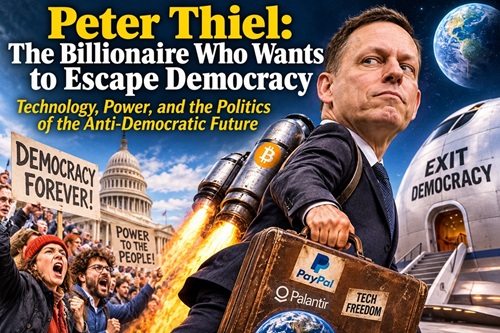 Peter Thiel is one of the most fascinating and troubling figures in contemporary Silicon Valley. A billionaire entrepreneur, venture capitalist, political patron, technological visionary, and intellectual provocateur, he occupies an unusual position at the intersection of technology, finance, philosophy, and right-wing politics. He helped create PayPal, was an early investor in Facebook, founded Palantir Technologies, and became an influential supporter of political figures on the American right, most notably Donald Trump and Vice President J.D. Vance. But Thiel is more than a successful technology entrepreneur with controversial political opinions. He represents a particular vision of the future in which technological innovation, concentrated private wealth, and individual genius are regarded as more important than democratic accountability, political equality, and collective decision-making. His worldview raises a fundamental question: what happens when people who possess extraordinary economic power begin to regard democratic institutions not merely as inefficient but as obstacles to human progress? Thiel's importance lies partly in the fact that he does not conceal this tension. Unlike many technology billionaires who publicly celebrate democracy while privately cultivating political influence, Thiel has openly questioned whether freedom and democracy are compatible. His intellectual position deserves serious examination, not least because it reveals some of the ideological assumptions underlying the emerging alliance between technological oligarchy and authoritarian populism. 1. From PayPal to Palantir: Building the Infrastructure of PowerThiel first became widely known through PayPal, the online payment company he co-founded with Max Levchin and others. Its eventual sale to eBay in 2002 made him a wealthy man and helped establish the network of entrepreneurs and investors subsequently known as the PayPal Mafia. Among its members were Elon Musk, Reid Hoffman, and other influential figures who went on to shape Silicon Valley. Thiel subsequently became one of Facebook's earliest major investors, recognizing the company's potential before it became a global communications platform. His investment demonstrated an extraordinary capacity to identify emerging technological opportunities. In 2003, he co-founded Palantir Technologies, a company specializing in data integration, analysis, and intelligence software. Palantir's technology has found applications in military, intelligence, law enforcement, and commercial environments. Palantir is particularly revealing because it connects Thiel's technological ambitions with his political philosophy. The company develops tools that enable institutions to integrate enormous quantities of information and identify relationships that would otherwise remain difficult to detect. Such capabilities can be useful in complex investigations, military operations, and logistical planning. But they also raise serious questions about surveillance, privacy, algorithmic decision-making, and the concentration of informational power. The central issue is not whether data analysis is inherently dangerous. It is who controls these systems, who is subject to their decisions, and what mechanisms exist to challenge their use. A democratic society should be especially cautious about private corporations becoming indispensable providers of intelligence infrastructure to governments. The danger is not simply that technology might be abused. It is that the institutions exercising power may become increasingly dependent on technological systems whose internal operations are inaccessible to ordinary citizens. Thiel's entrepreneurial achievement is undeniable. The political implications of the infrastructure he has helped create are considerably less reassuring. 2. The Contradiction Between Freedom and DemocracyPerhaps the most revealing document for understanding Thiel is his 2009 essay, The Education of a Libertarian, published by the Cato Institute. Its opening declaration is remarkable: "I no longer believe that freedom and democracy are compatible." This is not an incidental remark. It expresses a fundamental problem in Thiel's political philosophy. He regards individual freedom, especially the freedom of entrepreneurs and innovators, as a supreme value, but has become deeply pessimistic about democracy as a means of protecting it. His reasoning is that democratic majorities tend to demand redistribution, regulation, social protection, and political compromises that constrain entrepreneurial freedom. He specifically complained about the extension of voting rights to women and the growth of welfare constituencies, arguing that these developments had undermined libertarian politics. He subsequently clarified that he did not advocate taking away women's right to vote, but his original argument remains revealing. Thiel's solution is not primarily to improve democracy, strengthen civic institutions, or persuade voters of libertarian principles. Instead, he proposes escaping politics altogether. He expresses sympathy for experiments such as seasteading: the creation of independent communities on floating platforms outside conventional territorial jurisdictions. The underlying aspiration is to establish spaces where entrepreneurs and wealthy individuals can exercise greater autonomy from democratic governments. There is something intellectually interesting about this proposal. Political systems can indeed become bureaucratic, intrusive, and resistant to innovation. Democratic majorities are not automatically wise, and political regulation can sometimes protect established interests rather than the public. But Thiel's argument contains a glaring asymmetry. He wants freedom from political interference for individuals with sufficient resources to establish alternative jurisdictions. Yet the people who lack such resources remain dependent on the political institutions that wealthy individuals would prefer to escape. Democracy, for all its imperfections, provides a mechanism through which people without economic power can exercise some political influence. It gives them rights that are not supposed to depend on their purchasing power. The problem with Thiel's libertarianism is therefore not simply that it dislikes government. It is that it appears insufficiently concerned with the unequal distribution of power that emerges when government is weakened and private wealth becomes politically dominant. Freedom for whom, and at whose expense? That is the question his philosophy never adequately answers. 3. The Cult of the Entrepreneurial GeniusThiel's 2014 book Zero to One, written with Blake Masters, offers a remarkably influential account of entrepreneurship and technological innovation. Its central distinction is between horizontal progress, which involves copying and extending existing technologies, and vertical progress, which involves creating something genuinely new. Going from one to many is replication. Going from zero to one is innovation. Thiel argues that the most successful companies create something sufficiently distinctive to establish a monopoly. He explicitly challenges the conventional economic celebration of competition, suggesting that competition often destroys profits and encourages businesses to imitate one another rather than pursue genuinely transformative ideas. There is considerable truth in this argument. Innovation frequently requires a degree of protection from immediate competitive pressures. Companies need time and resources to develop technologies that may initially be expensive, uncertain, and commercially unattractive. But Thiel's celebration of monopoly deserves scrutiny. A temporary technological advantage is not the same as a permanent concentration of economic power. The argument that monopolies can finance innovation does not establish that monopolistic corporations should be allowed to dominate markets indefinitely. Indeed, monopolies can become precisely the forces of stagnation that Thiel claims to oppose. Once a company controls an important market, it may have stronger incentives to defend its position than to innovate further. There is also a philosophical problem with the heroic entrepreneur at the center of Thiel's worldview. Technological innovation is rarely the achievement of an isolated genius. It depends on accumulated scientific knowledge, public education, publicly funded research, infrastructure, social cooperation, and the contributions of countless employees. The entrepreneur may organize these resources exceptionally well, but does not create them out of nothing. Thiel's narrative tends to foreground the exceptional individual while backgrounding the collective conditions that make exceptional achievement possible. This is a recurring feature of Silicon Valley ideology: the successful entrepreneur becomes the protagonist of history, while society itself is relegated to the role of supporting infrastructure. 4. The Political Patron: From Trump to J.D. VanceThiel's political influence became especially visible during Donald Trump's first presidential campaign in 2016. He publicly endorsed Trump, spoke at the Republican National Convention, and joined the presidential transition team. His support was significant because he represented a new kind of political actor: the technology billionaire who was prepared to use his financial resources and personal networks to reshape the Republican Party. His most consequential political investment may have been J.D. Vance. Thiel supported Vance's political emergence, including his successful 2022 Senate campaign in Ohio. Their relationship is particularly interesting because Vance's earlier public identity was that of a critic of certain forms of economic inequality and corporate power. His political transformation brought him into an alliance with precisely the kind of wealthy technology investor who has enormous influence over the economic system he once criticized. Thiel's involvement illustrates how venture capital can become a form of political capital. He does not need to hold elected office himself. He can identify promising political figures, finance their campaigns, provide access to influential networks, and help create an intellectual environment in which their political ambitions become viable. This is perfectly legal within the American political system, but legality does not settle the democratic question. When a handful of extremely wealthy individuals can exercise disproportionate influence over which candidates become politically competitive, the formal equality of voting begins to coexist with a substantial inequality of political opportunity. The danger is not that every politician supported by a billionaire automatically becomes that billionaire's puppet. Political relationships are more complicated than that. The danger is structural: a political system increasingly responsive to wealthy patrons may gradually become less responsive to ordinary citizens. Thiel's relationship with Vance is therefore worth examining not as a simple story of political manipulation, but as an example of the growing entanglement between private technological wealth and public political power. 5. The Antichrist, Apocalyptic Christianity, and Technological ProgressOne of the more unusual aspects of Thiel's intellectual development is his increasing interest in Christian eschatology, particularly the figure of the Antichrist. In 2025, he delivered a series of private lectures in San Francisco exploring the Antichrist, technological progress, political authority, and the possibility of a future world government. The lectures attracted considerable attention when recordings became available to journalists. Thiel's argument is unusual. He worries that fear of existential catastrophe could become the justification for establishing an authoritarian global political order. Environmental concerns, nuclear war, artificial intelligence risks, and other threats might, in his interpretation, be used to justify increasingly centralized control over science and technology. The Antichrist, in this account, is not necessarily a conventional dictator who openly celebrates evil. He might instead present himself as a benevolent savior promising to protect humanity from catastrophe. Thiel thus turns a familiar political concern upside down. Rather than viewing technological recklessness as the primary danger, he identifies the attempt to restrain technological development as a potential pathway to tyranny. There is a legitimate issue buried in this argument. Governments can exploit emergencies to expand their authority. Technological regulation can become excessive, and public fear can be manipulated for political purposes. The history of authoritarianism provides ample reason to remain vigilant. But Thiel's interpretation suffers from a remarkable imbalance. He appears much more preoccupied with the dangers of restricting technological progress than with the dangers of allowing powerful technological corporations to operate without adequate democratic oversight. Why should the unrestrained development of artificial intelligence, biotechnology, surveillance systems, and military technologies automatically represent freedom? Why should those who advocate precaution be regarded as potential agents of authoritarianism, while those who control powerful technologies are presumed to be guardians of human progress? The distinction is particularly questionable when the technologies involved can themselves facilitate surveillance, military domination, and political manipulation. There is also an intellectual irony here. Thiel fears the emergence of an all-powerful authority that might control the future of humanity, yet his own political and economic preferences favor a world in which extraordinary power is concentrated in the hands of a relatively small number of technological entrepreneurs. Perhaps the Antichrist is not always a government official. Perhaps the more interesting question is whether a private technological oligarchy could exercise forms of power that democratic institutions struggle to control. Thiel's apocalyptic imagination does not seem sufficiently interested in that possibility. 6. René Girard, Mimetic Desire, and the Politics of EnemiesThiel's intellectual background is not exclusively libertarian or technological. He was strongly influenced by the French thinker René Girard, whose theory of mimetic desire attempts to explain human conflict through imitation, rivalry, and scapegoating. According to Girard, human beings frequently desire things because others desire them. This imitation generates competition, rivalry, and eventually collective conflict. Societies periodically restore order by directing their aggression toward a scapegoat. Thiel has long regarded Girard's work as an important key to understanding human history and political conflict. This influence is significant because it gives his worldview a more explicitly philosophical and religious dimension. Yet there is a question worth asking: does Thiel apply Girard's analysis consistently? If political movements are susceptible to mimetic rivalry and scapegoating, then technological elites should be no less vulnerable than ordinary citizens. Silicon Valley has its own rivalries, status competitions, ideological fashions, and collective enthusiasms. The entrepreneurial world frequently celebrates disruptive outsiders while simultaneously creating powerful conventions about what counts as innovation, success, intelligence, and progress. There is a danger that Thiel's intellectual contrarianism becomes a form of group identity in its own right: the conviction that one belongs to an enlightened minority capable of seeing through the illusions of the democratic masses. This is not necessarily a position of genuine independence. It can become another variety of mimetic identification, in which opposition to the mainstream provides its own sense of belonging and superiority. The self-appointed outsider can become the leader of a new orthodoxy. 7. Palantir and the Privatization of State PowerPerhaps the most consequential contradiction in Thiel's worldview emerges when we return to Palantir. Here we encounter a company that has become increasingly important to governments and military organizations seeking to integrate large quantities of data and use artificial intelligence for operational decision-making. Palantir's software has applications in military intelligence, battlefield coordination, immigration enforcement, and policing. Its systems can combine information from multiple databases and help officials identify individuals, relationships, locations, and potential targets. A 2025 analysis by the Brennan Center for Justice described Palantir's expanding role in military data integration, including the development of systems supporting battlefield intelligence and military operations. It also documented applications involving immigration enforcement and predictive policing. This raises a fundamental question about the relationship between private technological companies and democratic government. Traditionally, democratic societies have attempted to subject the exercise of state power to constitutional constraints, legal procedures, parliamentary oversight, and public accountability. But what happens when the practical exercise of that power increasingly depends on proprietary software developed by private corporations? The situation becomes especially problematic when the systems involved are difficult for outsiders to inspect. Citizens may be affected by decisions based on data integration and algorithmic assessments without knowing precisely how those decisions were reached. There is also the problem of institutional dependence. Once a government builds its operations around a particular technological platform, replacing that platform can become difficult and expensive. The private company consequently acquires influence extending beyond its formal contractual relationship. Developments in Britain illustrate the potential conflicts of interest. An investigation published by The Nerve in April 2026 reported that Palantir had recruited 32 former UK government and public-sector officials, including individuals previously involved in government technology strategy. The investigation raised questions about revolving-door relationships between public institutions and the company. These findings do not establish corruption, but they illustrate the importance of independent oversight. This is where Thiel's libertarian philosophy encounters its most uncomfortable contradiction. He is skeptical of democratic government when it seeks to regulate private economic power, yet his business interests include supplying governments with some of the technological infrastructure through which they exercise that power. In other words, he does not necessarily want a smaller state in every meaningful sense. He is involved in building a technologically sophisticated state whose capabilities can be strengthened through private corporations. The distinction is between public power subject to democratic accountability and public power increasingly dependent on private technological infrastructure. That is a much more important distinction than the simplistic opposition between government and the free market. 8. Technological Optimism and the Neglect of Social ConsequencesThiel's worldview belongs to a broader Silicon Valley tradition of technological optimism. The basic assumption is that human progress depends primarily on technological breakthroughs, entrepreneurial initiative, and the willingness to challenge established institutions. There is considerable merit in this outlook. Technological innovation has transformed medicine, communication, transportation, agriculture, and countless other areas of human existence. But technological progress is not identical to human progress. A society can become more technologically advanced while becoming more unequal, politically polarized, environmentally unstable, or psychologically distressed. Artificial intelligence might increase productivity while concentrating economic power. Surveillance technologies might improve security while weakening civil liberties. Genetic engineering might expand medical possibilities while creating new forms of social stratification. The existence of a technically achievable solution does not automatically establish that its implementation is socially desirable. This is precisely where Thiel's approach seems deficient. He is exceptionally interested in what technological innovators can accomplish, but less interested in the institutional and ethical questions surrounding the distribution of the resulting benefits and risks. His emphasis on exceptional entrepreneurs also encourages a particular understanding of historical progress. Instead of seeing civilization as a complex achievement involving scientific communities, democratic institutions, public investment, cultural development, and social cooperation, he tends to foreground the transformative individual. Yet the greatest achievements of modern civilization have depended on both individual creativity and collective institutions. The scientific revolution required intellectual freedom, but also universities, scientific societies, public communication, and increasingly sophisticated systems of education. The digital revolution required brilliant entrepreneurs, but also decades of publicly supported research in mathematics, computing, electronics, and communications. Technological progress is therefore not an argument against collective responsibility. It is partly an achievement of collective responsibility. 9. The Integral Perspective: A Developmental Imbalance?From an integral perspective, Thiel presents an interesting case of possible developmental imbalance. His intellectual world combines several powerful tendencies: individualism, technological futurism, libertarian economics, Christian eschatology, and a pronounced distrust of democratic mass politics. These tendencies are not necessarily incompatible. One can value individual freedom, technological innovation, religious reflection, and economic experimentation while remaining committed to democratic institutions. The problem emerges when one dimension of human development is elevated above all others. Thiel's worldview gives extraordinary prominence to individual agency, entrepreneurial achievement, technological intelligence, and the freedom to transcend existing constraints. But these values require balancing dimensions. There is the collective dimension of social solidarity, the institutional dimension of democratic accountability, the ethical dimension of responsibility toward vulnerable populations, and the ecological dimension of living within planetary limits. An integral approach would not dismiss technological innovation or entrepreneurial creativity. It would ask how these capacities can be integrated with the legitimate needs of the larger social and ecological systems in which they operate. It would also question the assumption that technological sophistication necessarily indicates higher consciousness or more advanced civilization. A technologically advanced oligarchy is not automatically a more evolved society than a technologically less advanced democracy. Indeed, the ability to create increasingly powerful technologies without developing corresponding capacities for ethical judgment, institutional restraint, and collective responsibility may represent a particularly dangerous form of developmental imbalance. There is an additional irony here. Thiel is deeply interested in philosophical and religious interpretations of history, yet his political philosophy seems remarkably resistant to one of the central insights of developmental thinking: that individual autonomy and collective responsibility must develop together. Freedom without responsibility can become domination. Individual achievement without social reciprocity can become oligarchy. 10. The Larger Question: Who Gets to Design the Future?Peter Thiel deserves neither dismissal as a mere reactionary billionaire nor uncritical admiration as a visionary entrepreneur. His intellectual independence, investment successes, and willingness to challenge conventional assumptions are genuine characteristics. He has helped finance important technological innovations and has raised legitimate questions about bureaucratic stagnation, political conformity, and the dangers of excessive regulation. His critique of complacency in established institutions is worth taking seriously. But his alternative vision deserves equally serious scrutiny. The central problem is that Thiel appears to associate freedom primarily with the autonomy of exceptionally capable individuals, particularly those with the financial resources and technological expertise to shape their own environments. Democracy, by contrast, is understood mainly as an impediment to this autonomy. This produces a peculiar conception of political freedom: the freedom of those powerful enough to escape the constraints imposed on everyone else. Yet democratic freedom has a different foundation. It rests on the principle that people should have some meaningful say in the institutions and decisions that govern their lives, regardless of their wealth, intelligence, or entrepreneurial achievements. Democracy is imperfect precisely because it involves competing interests, conflicting values, and the necessity of compromise. But these are not merely defects. They are also safeguards against the concentration of power. Thiel's preferred alternative risks replacing the messy negotiations of democratic society with the supposedly superior judgments of technological and financial elites. Who, however, decides that these elites are competent to govern? Who evaluates their mistakes? Who protects citizens when their technological experiments go wrong? And what happens when the interests of the innovators conflict with those of the people affected by their innovations? These questions cannot be answered by invoking entrepreneurial genius or technological progress. They require political institutions, ethical principles, and public accountability. Conclusion: The Future According to the Billionaire ClassPeter Thiel is an important figure because he articulates something that has become increasingly visible in contemporary politics: the growing impatience of sections of the technological elite with democratic constraints. His career demonstrates how enormous private fortunes can be converted into influence over technological infrastructure, political movements, and the institutions of government. His philosophical writings reveal a deep suspicion of democratic majorities, while his business activities help construct technologies that can substantially increase the informational and operational capabilities of states. His religious interests add another dimension to this worldview, portraying the struggle over technological progress as potentially part of a cosmic confrontation between freedom and authoritarian control. But the most revealing contradiction remains unresolved. Thiel fears the emergence of an authoritarian power capable of controlling humanity's future. Yet he appears relatively comfortable with the concentration of extraordinary technological, economic, and political power in private hands. He fears the tyranny of the state but seems insufficiently concerned about the possibility of private tyranny. He fears that democratic societies might prevent technological progress, but pays less attention to the possibility that technological progress without democratic oversight might undermine the very freedoms he claims to defend. Ultimately, the question raised by Thiel is larger than the personal philosophy of one billionaire. It concerns the future relationship between technological innovation and democratic civilization. We should certainly encourage ambitious technological experimentation. We should resist bureaucratic stagnation, intellectual conformity, and the romanticization of the political status quo. But we should also resist the idea that the people who accumulate the greatest fortunes are therefore entitled to determine the future of everyone else. The future should not belong exclusively to governments, corporations, or technological visionaries. It should remain a subject of collective human deliberation. The real question is not whether Peter Thiel and his fellow technological billionaires can build the future. They probably can. It is whether the rest of humanity will have any meaningful say in what that future looks like.
Comment Form is loading comments...
|