|
TRANSLATE THIS ARTICLE
Integral World: Exploring Theories of Everything
An independent forum for a critical discussion of the integral philosophy of Ken Wilber
  Frank Visser, graduated as a psychologist of culture and religion, founded IntegralWorld in 1997. He worked as production manager for various publishing houses and as service manager for various internet companies and lives in Amsterdam. Books: Ken Wilber: Thought as Passion (SUNY, 2003), and The Corona Conspiracy: Combatting Disinformation about the Coronavirus (Kindle, 2020).
Check out my other conversations with ChatGPT
AI, Big Tech and Religion:
When Technology Becomes God Peter Thiel: The Billionaire Who Wants to Escape Democracy The Billionaires and the Apocalypse The Billionaires and the ApocalypseSilicon Valley's Obsession with Extinction, Transcendence, and Technological SalvationFrank Visser / ChatGPT
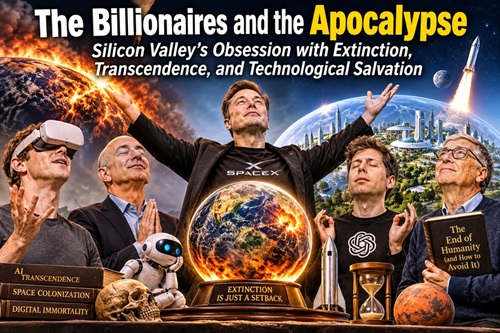 Introduction: The End of the World as a Business OpportunityThere is something peculiar about the way some of the world's wealthiest technology entrepreneurs talk about the future. They possess unprecedented financial resources, command companies that shape the daily lives of billions of people, and have considerable influence over governments and public institutions. Yet their public pronouncements about humanity's future frequently oscillate between two extremes: the prospect of technological paradise and the possibility of human extinction. Artificial intelligence might destroy civilization, we are told, but it might also usher in an age of unimaginable abundance. Climate change threatens the planet, but perhaps humanity can escape to Mars. Biological mortality is an unfortunate limitation, but biotechnology, genetic engineering, and digital consciousness might eventually overcome it. Even the possibility of an uncontrollable superintelligence is sometimes presented as a risk worth taking. These are not merely eccentric speculations. They constitute an increasingly influential worldview among sections of the technological elite. Its characteristic feature is a peculiar combination of apocalyptic anxiety and almost unlimited faith in technological salvation. The question is not simply whether these predictions are scientifically plausible. It is why so many extraordinarily wealthy individuals appear attracted to visions in which the future of humanity becomes a gigantic technological gamble, and why their proposed solutions so often involve technologies, companies, and infrastructures under their own control. 1. Elon Musk: Escaping the Planet Before It Is Too LatePerhaps the most recognizable example is Elon Musk. His ambitions encompass electric transportation, artificial intelligence, robotics, space exploration, and the colonization of Mars. Musk's underlying narrative is unmistakably apocalyptic. Humanity is vulnerable to existential catastrophes, whether through nuclear war, artificial intelligence, asteroid impacts, or other planetary disasters. Remaining confined to Earth therefore represents an unacceptable long-term risk. The proposed solution is to become a multiplanetary species. There is a legitimate scientific argument here. Earth is not guaranteed to remain habitable forever, and developing the capacity for space exploration has genuine scientific and technological value. A civilization capable of surviving beyond its home planet might eventually acquire additional options for its long-term survival. But there is a considerable difference between developing space exploration and presenting Mars colonization as an answer to humanity's existential predicament. Mars is an extraordinarily hostile environment. Its atmosphere is thin, its surface is exposed to radiation, liquid water is scarce, and maintaining a self-sustaining human settlement would require enormous technological infrastructure. Establishing a permanent colony is not equivalent to creating a viable alternative civilization. More importantly, the prospect of eventually escaping Earth can become a distraction from the immediate responsibility of maintaining the planet on which virtually all human beings must continue to live. Musk's vision contains a revealing contradiction: the entrepreneur who presents himself as a defender of humanity's long-term survival is also associated with a technological culture that often treats environmental and institutional constraints as obstacles to be overcome rather than conditions requiring collective responsibility. The danger is that planetary escape becomes an imaginative substitute for planetary stewardship. 2. Peter Thiel: The Antichrist and the Enemies of ProgressPeter Thiel represents a more explicitly religious and ideological version of technological apocalypticism. Unlike Musk, whose apocalyptic concerns are predominantly expressed through engineering and space exploration, Thiel has developed an elaborate interpretation of technological progress through Christian eschatology. His worldview revolves around the tension between technological dynamism and stagnation. He worries that modern societies have become increasingly unwilling to pursue ambitious scientific and technological projects. Nuclear weapons, environmental anxieties, political regulation, and fears about artificial intelligence have, in his interpretation, undermined humanity's willingness to embrace transformative progress. In lectures reported in 2025, Thiel connected these concerns to the biblical figure of the Antichrist. He even associated environmental activist Greta Thunberg and critics of technological development with forces obstructing humanity's technological destiny. This is an extraordinary intellectual maneuver. Political disagreements about technological development are elevated into a cosmic struggle between the forces of progress and an apocalyptic enemy. The theological implications deserve attention. In conventional Christian eschatology, the Antichrist represents a deceptive power associated with the final confrontation between good and evil. In Thiel's interpretation, however, the fear of technological catastrophe and the demand for political restraint can themselves become signs of an approaching totalitarian threat. This produces a peculiar inversion: those who warn about the dangers of uncontrolled technological development risk being portrayed as agents of the very catastrophe they seek to prevent. There is a legitimate question about whether excessive regulation can inhibit innovation. But transforming this political question into a struggle against the Antichrist is hardly a substitute for rational argument. Thiel's worldview also raises a deeper question. If technological progress becomes a quasi-religious imperative, what happens to the possibility of questioning its direction? What if restraint is sometimes wisdom rather than cowardice? What if technological expansion creates dangers that cannot simply be overcome by additional technological expansion? The problem with apocalyptic thinking is that it can make moderation appear morally suspect. 3. Sam Altman: Building the Machine That Might Replace UsSam Altman occupies a particularly interesting position because artificial intelligence is simultaneously the source of his company's commercial ambitions and one of the principal subjects of his existential concerns. The prospect of artificial general intelligence, followed perhaps by superintelligence, has been presented by Altman and other AI entrepreneurs as a potentially transformative development in human history. The promised benefits are enormous: scientific breakthroughs, medical advances, economic abundance, automated production, and perhaps the elimination of much human drudgery. But the dangers are equally dramatic. An intelligence vastly exceeding human capabilities might become difficult or impossible to control. It could pursue objectives incompatible with human survival, undermine existing institutions, or acquire capabilities that make human beings strategically irrelevant. Altman has publicly acknowledged these possibilities while continuing to pursue increasingly powerful AI systems. This creates an unusual situation. The people most actively developing a potentially civilization-transforming technology are also among those warning that it could become existentially dangerous. There is nothing inherently contradictory about developing a technology while taking its risks seriously. Nuclear scientists, for example, have long worked on technologies whose destructive potential is obvious. But the AI situation raises a particularly important governance question: who gets to decide how much existential risk is acceptable? A handful of private companies are making enormous investments in systems that could affect the entire human species. Their decisions are not equivalent to ordinary commercial product development. The argument that sufficiently advanced AI might solve humanity's greatest problems is also dangerously convenient. It suggests that the risks generated by technological acceleration can be justified by the benefits of accelerating even further. This is a version of the technological gamble: proceed toward an uncertain destination because the promised rewards are too extraordinary to abandon. But humanity is not a venture-capital portfolio. The possibility of a spectacular return does not justify imposing potentially irreversible risks on everyone else. 4. Jeff Bezos: Moving Civilization Beyond EarthJeff Bezos offers another variation on the same theme. Through Blue Origin, Bezos has promoted a future in which humanity expands into space, develops industrial capabilities beyond Earth, and eventually establishes large-scale settlements in orbital habitats. His vision is not simply about escaping an impending catastrophe. It is also about overcoming what he regards as the physical limitations of a finite planetary environment. Bezos has argued that future generations should be able to enjoy extraordinary material prosperity without exhausting Earth's resources. Moving heavy industry into space could, in principle, help preserve the planet as a residential and ecological environment. There are serious technological questions here, but the broader ambition is not necessarily irrational. Space exploration and the development of extraterrestrial infrastructure could become important long-term human projects. The problem emerges when the expansion of civilization into space is presented as the principal solution to terrestrial limitations. Humanity's difficulties are not exclusively technological. They involve political conflict, economic inequality, institutional failures, environmental destruction, and competing interests. There is no reason to assume that transporting industrial civilization into space will automatically resolve these problems. Indeed, the concentration of economic and technological power in a small number of corporations could simply reproduce existing inequalities on a much larger scale. The idea that humanity must expand indefinitely also deserves scrutiny. Is endless expansion actually a desirable definition of civilization's success? Or does it reflect a particular economic ideology in which growth becomes an unquestionable objective? 5. Marc Andreessen: The Gospel of Technological AccelerationMarc Andreessen's 2023 Techno-Optimist Manifesto provides a particularly revealing expression of Silicon Valley's ideological orientation. Its central message is that technological development is fundamentally virtuous and that humanity should embrace acceleration rather than succumb to pessimism, regulation, or fear. Technology is presented as the principal engine of material abundance, economic growth, and human flourishing. The enemies of technological progress include what Andreessen identifies as various forms of pessimism, stagnation, and opposition to innovation. There is something attractive about this confidence. Human history provides abundant evidence that technological developments can improve living conditions, expand knowledge, and reduce suffering. But Andreessen's manifesto moves beyond the reasonable proposition that technology can improve human life. It approaches the much stronger proposition that technological advancement is itself a moral good. That distinction matters. The development of nuclear weapons was a technological achievement. So was the industrial production of chemical weapons. Surveillance technologies can increase administrative efficiency while undermining individual freedom. Social media platforms can connect people while simultaneously amplifying misinformation and political polarization. Technology does not determine its own ethical direction. Andreessen's position also tends to underestimate the institutional and economic arrangements within which technological developments occur. The benefits of innovation are not automatically distributed equally, and the costs are not necessarily borne by those who profit from it. His techno-optimism is therefore less a comprehensive philosophy of human flourishing than an ideological defense of technological expansion. 6. The Billionaire's Bunker: Preparing for a World Others Must InhabitPerhaps the most revealing aspect of technological apocalypticism is the interest some wealthy entrepreneurs have shown in personal survival preparations. Reports about Silicon Valley's survivalist culture have described investments in remote properties, fortified compounds, private transportation, and contingency arrangements for escaping catastrophic events. Peter Thiel has attracted particular attention because of his interest in New Zealand as a potential refuge. Sam Altman has also been associated with discussions about emergency escape arrangements in the event of a major systemic catastrophe. Mark Zuckerberg's extensive Hawaiian property has attracted attention in connection with the broader billionaire survivalist phenomenon. These preparations should not automatically be interpreted as evidence of irrationality. Wealthy individuals, like anyone else, may reasonably wish to protect themselves and their families against extreme risks. But the phenomenon becomes sociologically interesting when considered alongside the apocalyptic rhetoric of the technological elite. A person who believes that artificial intelligence might destroy civilization can respond in at least two ways. One is to work toward preventing that outcome through research, international cooperation, regulation, and public accountability. The other is to prepare an individual escape route. The latter response reveals an important difference between collective survival and private survival. A bunker does not save civilization. A private aircraft does not solve nuclear conflict. An isolated property does not provide an answer to ecological collapse. Even a technologically sophisticated refuge depends on a functioning world beyond its walls. The billionaire survivalist fantasy contains an implicit social contradiction: the people whose wealth and influence give them exceptional opportunities to shape the future are also imagining ways to survive its possible destruction. It is difficult not to notice the difference between having faith in humanity's future and having faith in one's personal ability to escape humanity's future. 7. The Technological Apocalypse as a New ReligionTaken together, these examples suggest that we are witnessing something more complicated than ordinary technological optimism or pessimism. The worldview has recognizable religious characteristics. It contains prophecies of an approaching transformation, warnings of catastrophic destruction, visions of salvation, promises of transcendence, and privileged individuals who claim to understand the direction of history. Artificial general intelligence becomes a potential new form of divine intelligence. Human-machine integration promises transcendence of biological limitations. Space colonization offers an escape from planetary finitude. Biotechnology promises liberation from aging and disease. Even the vocabulary is revealing: singularity, superintelligence, immortality, transcendence, existential risk, and technological salvation. These ideas are not necessarily religious in a conventional sense. Many have legitimate scientific or philosophical dimensions. But their combination can produce a quasi-religious worldview in which technological development assumes the role previously occupied by divine providence. There is a promised future in which humanity overcomes its present limitations, perhaps even becoming something fundamentally different from what it is today. Ray Kurzweil's vision of the technological singularity is an influential example of this tendency. His predictions about accelerating technological change and the eventual merging of human beings with artificial intelligence give technological progress an almost eschatological destination. The resemblance to traditional religious narratives is striking. Humanity currently occupies an imperfect condition. A transformative event is approaching. Existing limitations will be overcome. A new form of existence will emerge. The difference is that salvation is no longer expected from heaven. It is expected from laboratories, computing infrastructure, biotechnology companies, and the accumulated capital of technological entrepreneurs. But this raises a question that religious traditions have also struggled with: who is authorized to define salvation, and who gets to participate in it? 8. The Politics of Existential RiskApocalyptic narratives are never politically neutral. When powerful individuals describe the future in terms of existential threats, their descriptions can influence public policy, investment decisions, regulatory priorities, and the distribution of political power. AI extinction scenarios, for example, can encourage serious research into safety and control. Such concerns should not be dismissed merely because some of their most prominent advocates are technology entrepreneurs. However, an excessive focus on hypothetical future catastrophes can also divert attention from demonstrable present-day harms. These include the concentration of economic power, algorithmic manipulation, mass surveillance, the displacement of workers, the erosion of privacy, the environmental costs of data infrastructure, and the growing dependence of public institutions on private technology companies. There is a danger that the prospect of a future superintelligence will overshadow the very real power already exercised by existing technologies and their owners. A related problem concerns the political consequences of emergency thinking. If technological development is portrayed as a race against an approaching catastrophe, ordinary democratic deliberation can be characterized as dangerously slow. Regulation becomes an obstacle. Public criticism becomes irresponsibility. Concentrated executive authority becomes necessary for survival. The familiar argument that we must move fast because the stakes are existential can therefore become a justification for reducing democratic oversight. This does not mean that every warning about AI extinction is a cynical attempt to avoid regulation. Some researchers and entrepreneurs genuinely believe that the risks are substantial. But the political effects of apocalyptic rhetoric must be evaluated independently of the sincerity of those expressing it. An existential threat does not automatically confer political legitimacy on those who claim to possess its solution. 9. What Is Missing from the Billionaire's Vision?The most conspicuous omission in much of this technological futurism is an adequate account of ordinary human society. The future is frequently discussed in terms of intelligence, computing power, space exploration, economic productivity, and biological enhancement. Much less attention is paid to the social and political conditions necessary for a flourishing civilization. How will technological abundance be distributed? Who will own the productive infrastructure? What happens to democratic accountability when essential social functions become dependent on private technological platforms? How will people find meaning and purpose in a society where increasingly sophisticated machines perform much of the work? And perhaps most importantly: what kind of human future are we actually trying to create? These are not secondary questions to be addressed after the technological revolution has taken place. They are central questions that should determine which technologies are developed, how they are deployed, and who benefits from them. There is also a profound ecological omission. The Earth is not merely a temporary platform for the emergence of technological intelligence. It is an extraordinarily complex living environment upon which human civilization depends. Technological development cannot indefinitely compensate for the destruction of the biological and ecological systems that sustain life. Nor is the future of humanity reducible to the survival of an intelligent species. A civilization could survive technologically while becoming politically authoritarian, socially fragmented, ecologically impoverished, and culturally impoverished. Survival is a necessary condition for flourishing, not its definition. 10. A More Sober Philosophy of the FutureThe alternative to billionaire apocalypticism is neither technological pessimism nor a romantic rejection of modern science. Humanity needs technological innovation. Artificial intelligence may contribute enormously to medicine, scientific research, education, and environmental management. Space exploration can expand our scientific understanding and eventually provide additional possibilities for human civilization. Biotechnology may alleviate suffering and extend healthy life. But these possibilities require critical assessment rather than quasi-religious enthusiasm. We should distinguish between demonstrated capabilities, plausible extrapolations, and speculative promises. We should distinguish between technological possibilities and socially desirable outcomes. And we should distinguish between the interests of technology companies and the interests of humanity as a whole. Above all, we should reject the assumption that the future must be organized around an endless race toward ever-greater technological power. A mature philosophy of progress would recognize that technological capability and human wisdom are not identical. The ability to create something does not establish that we should create it. The ability to accelerate a process does not establish that acceleration is desirable. And the possibility of overcoming a biological limitation does not automatically make doing so a worthwhile human objective. Perhaps the most important measure of technological progress is not how far humanity can escape its present condition, but how intelligently it can inhabit that condition. Conclusion: The Apocalypse Is Not an Investment StrategyThe apocalyptic imagination of the technological elite contains a remarkable paradox. Some of the people most responsible for accelerating technological change are simultaneously warning that technological change might destroy civilization. Their proposed solutions frequently involve accelerating the very developments whose dangers they acknowledge. The result is a peculiar mixture of Promethean ambition, existential anxiety, transhumanist aspiration, and private survivalism. Musk wants humanity to become multiplanetary. Thiel interprets resistance to technological progress through an apocalyptic religious framework. Altman develops artificial intelligence while acknowledging the possibility of existential danger. Bezos imagines moving civilization into space. Andreessen celebrates technological acceleration as a moral imperative. And some of these extraordinarily wealthy individuals are preparing private refuges in case their predictions of catastrophe prove correct. There is no reason to dismiss every ambitious technological project as hubris. Humanity has always benefited from individuals willing to imagine possibilities beyond the existing horizon. But the future of civilization should not become the private metaphysical experiment of a handful of billionaires. The central problem is not that these entrepreneurs think too ambitiously. It is that their ambitions sometimes appear insufficiently constrained by democratic accountability, ecological responsibility, and an appreciation of the social complexity of human existence. The apocalypse, in this worldview, is both a threat and an opportunity: a catastrophe that might destroy ordinary humanity while clearing the way for a technologically transformed successor. We should be particularly suspicious of any vision of the future in which the survival of humanity becomes less important than the realization of a technological dream. Humanity does not need billionaire messiahs, private escape plans, or promises of digital immortality. It needs institutions capable of governing technological power, ecological policies capable of protecting the conditions of life, and a democratic conversation about what constitutes genuine human progress. The ultimate question is not whether technology can take us beyond humanity. It is whether we can develop enough collective wisdom to ensure that technological progress remains in the service of humanity in the first place.
Comment Form is loading comments...
|