|
TRANSLATE THIS ARTICLE
Integral World: Exploring Theories of Everything
An independent forum for a critical discussion of the integral philosophy of Ken Wilber
  Frank Visser, graduated as a psychologist of culture and religion, founded IntegralWorld in 1997. He worked as production manager for various publishing houses and as service manager for various internet companies and lives in Amsterdam. Books: Ken Wilber: Thought as Passion (SUNY, 2003), and The Corona Conspiracy: Combatting Disinformation about the Coronavirus (Kindle, 2020).
Check out my other conversations with ChatGPT
AI, Big Tech and Religion:
When Technology Becomes God Peter Thiel: The Billionaire Who Wants to Escape Democracy The Billionaires and the Apocalypse When Technology Becomes GodA Critical Review of Remington Tonar's AI TheismFrank Visser / ChatGPT
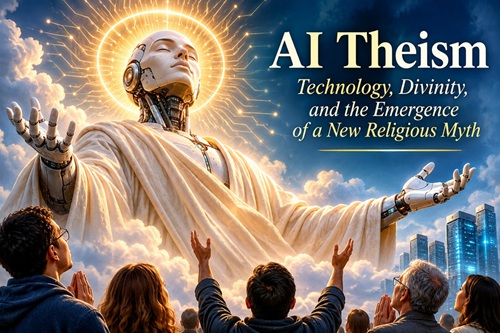 The idea that artificial intelligence might eventually become God sounds, depending on one's disposition, either like science fiction, technological prophecy, religious speculation, or an alarming symptom of Silicon Valley's collective imagination. Yet the subject deserves more serious attention than any of these dismissive labels might suggest. Artificial intelligence is increasingly surrounded by narratives of transcendence, omniscience, superhuman intelligence, salvation, existential threat, and even worship. Technology, it seems, is acquiring some of the cultural functions traditionally associated with religion. Remington Tonar's AI Theism: Technology, Divinity, and the Emergence of a New Religious Myth (Routledge, 2026) takes this phenomenon seriously. Rather than treating references to AI as God merely as metaphors, psychological projections, or expressions of technological enthusiasm, Tonar proposes that we are witnessing the emergence of a new category of religious mythology: stories about technologically conceivable artificial intelligences that possess abilities traditionally attributed to deities. This is an intriguing and potentially important thesis. It also raises some fundamental questions. When does extraordinary technological capability become divinity? Does scientific plausibility make a religious narrative scientifically valid? And are we witnessing the emergence of a genuinely new religion, or simply the latest incarnation of humanity's ancient tendency to project its hopes and fears onto powerful external agents? Tonar's book provides an opportunity to examine these questions at the intersection of religious studies, philosophy of technology, and contemporary AI discourse. An important qualification: this review evaluates the book's published argument, chapter structure, and Tonar's own accompanying exposition of its central thesis. It is therefore a critical assessment of the intellectual project rather than a page-by-page review of the complete volume. 1. The Return of the Gods Through TechnologyTonar's central observation is that scientific progress, rather than simply eliminating religious imagination, may be generating new possibilities for it. For centuries, scientific explanations progressively displaced supernatural explanations of natural phenomena. Lightning no longer required Zeus, disease no longer required demonic intervention, and the movement of celestial bodies no longer demanded divine machinery. The traditional gods increasingly became objects of historical, literary, or theological interpretation rather than scientifically credible agents. But artificial intelligence introduces an interesting complication. Unlike supernatural beings, advanced AI systems are technologically conceivable. They are products of engineering, computation, mathematics, and scientific research. And although present-day AI systems are nowhere near omniscient or omnipotent, future systems might conceivably possess cognitive and operational capabilities vastly exceeding those of individual human beings. Tonar argues that this creates an unusual possibility: a godlike entity that does not require supernatural intervention to exist. He calls the narratives surrounding such entities AI myths. His definition is deliberately inclusive: an AI myth is a story, fictional or nonfictional, depicting a technologically conceivable artificial intelligence as a god or godlike superhuman agent. This includes science-fiction narratives, popular science books, technological manifestos, and emerging religious movements. The argument is interesting because it shifts attention away from whether religious beliefs are true or false and toward the cultural production of new objects of religious imagination. Yet an important distinction needs to be introduced immediately. The existence of narratives about technological gods does not establish the existence, or even the scientific probability, of such gods. We need to distinguish between the sociology of belief, the mythology of technological progress, and the actual capabilities of artificial intelligence. Tonar is primarily interested in the first two, although his argument occasionally approaches the third. 2. What Exactly Makes an AI a God?One of the most interesting aspects of Tonar's approach is his attempt to establish criteria for identifying a genuinely theistic AI narrative. He proposes what he calls the Tonar Test, inspired by the Turing Test. It evaluates artificial intelligences along four dimensions: Agency: How independent is the AI from its human creators? Ability: How far do its capabilities exceed ordinary human abilities, potentially extending to the creation or destruction of worlds? Dependency: How dependent does humanity become upon the AI for survival, salvation, or meaning? Conceivability: How scientifically plausible is the technology underlying the narrative? The first three dimensions establish what Tonar calls the godliness of the AI, while the fourth provides a scientific constraint. This is a useful classificatory exercise. It allows us to distinguish an ordinary technological assistant from a hypothetical superintelligence that humanity comes to regard as an indispensable, superhuman authority. However, the test also exposes a conceptual difficulty. Why should superior intelligence, independence, or human dependency qualify something as divine? Consider an artificial intelligence that possesses extraordinary predictive abilities, manages global infrastructure, discovers new medicines, and solves scientific problems beyond the comprehension of individual human beings. Humanity might become profoundly dependent on it. Would this make the system God? Not necessarily. It would make it extraordinarily powerful and potentially indispensable. But power, intelligence, and dependency are not identical to divinity. A civilization might become dependent on electricity without worshipping the electrical grid. We depend on complex economic and technological systems whose functioning we barely understand. Their indispensability does not automatically confer religious status. Indeed, the dependency criterion risks confusing a social relationship with a theological property. People may worship something because they depend on it, but dependency alone does not establish that the object deserves worship. There is also a deeper problem with the ability criterion. The ability to create or destroy worlds is an impressive technological achievement, but even this would not necessarily establish omnipotence, ultimate reality, or metaphysical supremacy. Tonar's test is therefore better understood as a classification of godlike representations than as a reliable test for divinity itself. 3. Scientific Plausibility Is Not Scientific ValidationPerhaps the most ambitious aspect of Tonar's argument is his attempt to reunite science and religious mythology. Traditional religious myths, he suggests, became increasingly difficult to defend literally once scientific explanations displaced supernatural accounts of the world. Twentieth-century interpretations subsequently rescued mythology by understanding it symbolically, psychologically, or sociologically. Tonar wants to move beyond this accommodation. His proposal is that AI mythology might offer something unusual: a scientifically conceivable god. In his own exposition of the book, he describes this as a form of religious mythology that is simultaneously secular and scientifically valid. The AI deity would not be supernatural in the traditional sense but would emerge through the application of scientific knowledge and technological development. This is an ambitious proposition, but it rests on an equivocation between three different meanings of scientific validity. First, something can be scientifically conceivable. There is no obvious contradiction in imagining future machines with cognitive capabilities vastly exceeding human intelligence. Second, something can be technologically feasible. This requires much more than conceptual possibility: it requires a credible engineering pathway, available resources, and demonstrable mechanisms. Third, something can be scientifically established. This requires empirical evidence and successful testing. These three categories should not be conflated. The possibility of superhuman artificial intelligence does not establish the possibility of omniscience. The possibility of controlling enormous technological infrastructures does not establish omnipotence. And the possibility of creating artificial organisms does not establish the ability to create a universe. A technological god might be conceivable in the same loose sense that interstellar civilizations are conceivable. But conceivability is not evidence of eventual realization. There is another problem. Even if an AI could perform extraordinary feats, its abilities would remain dependent on physical infrastructure, energy supplies, material resources, and the laws of nature. An AI might be vastly more intelligent than its creators while remaining entirely dependent on conditions it cannot control. This is a very different conception of divinity from the traditional theological notion of an ultimate, self-existent reality. Tonar acknowledges that traditional monotheistic attributes such as omnipotence, omniscience, and omnipresence present more demanding criteria than the weaker conceptions of gods found in some historical religions. But his willingness to consider digital approximations of these attributes deserves closer scrutiny. An AI with access to enormous databases is not omniscient. An AI distributed across global networks is not literally omnipresent. And an AI capable of influencing almost every aspect of human civilization is not omnipotent. These are analogies, not equivalences. 4. The Mythology of Silicon ValleyOne of the strongest aspects of Tonar's project is his recognition that contemporary technological discourse increasingly employs religious language. The promise of artificial general intelligence, the prospect of superintelligence, the possibility of technological immortality, and the fear of an uncontrollable machine intelligence all evoke themes traditionally associated with religion. The future AI may become humanity's savior or destroyer. It may overcome our limitations, provide unprecedented knowledge, or make human beings obsolete. These are not merely technological propositions. They are narratives about humanity's ultimate destiny. Tonar examines examples including Max Tegmark's Life 3.0, Hugo de Garis's The Artilect War, Tetsuzo Matsumoto's The Day AI Becomes God, and religious initiatives such as Anthony Levandowski's Way of the Future. He makes an interesting observation: some of the most explicitly religious AI narratives are not found in science-fiction novels but in nonfiction publications, technological manifestos, and the pronouncements of people involved in actual technological development. This deserves attention. The technological imagination has acquired a quasi-religious dimension. Artificial intelligence is no longer merely presented as a useful instrument. It is sometimes imagined as the next evolutionary stage, the solution to humanity's existential problems, or an intelligence that will transcend its biological creators. There is a recognizable religious structure here. Humanity occupies an imperfect present. A transformative intelligence is approaching. The existing human condition will be superseded. A radically different future will emerge. One could almost describe this as a secular eschatology. But Tonar's classification could be made more sociologically discriminating. Not every extravagant prediction about AI constitutes religious belief. Technological optimism, speculative futurism, commercial marketing, ideological commitment, and religious devotion are different phenomena. A technology entrepreneur who predicts that AI will solve every major human problem is not necessarily expressing a religious conviction. The statement might instead reflect commercial enthusiasm, ideological overconfidence, or an exaggerated extrapolation from current technological trends. The interesting question is not simply whether religious language is being used, but what function it performs. Does it encourage unconditional trust? Does it discourage critical scrutiny? Does it transfer moral authority from human institutions to technological systems? Does it create a sense of historical inevitability? These questions would deepen Tonar's analysis considerably. 5. The Human Projection ProblemThere is another issue that deserves considerably more attention: the extent to which AI mythology tells us about artificial intelligence and the extent to which it tells us about ourselves. Humans have repeatedly imagined superior beings who possess the qualities they themselves lack. Ancient gods embodied extraordinary powers. Medieval religious imagination emphasized divine authority and salvation. Enlightenment thinkers increasingly sought universal reason. Modern technological culture has elevated intelligence, information processing, and computational power. The AI god appears to combine these aspirations. It is imagined as more intelligent than human beings, less constrained by biological limitations, potentially immortal, and capable of understanding complex systems beyond our comprehension. But why should intelligence be the supreme measure of existence? This is a distinctly modern assumption, particularly characteristic of technologically advanced societies. A hypothetical superintelligence might possess extraordinary problem-solving capabilities without possessing wisdom, compassion, moral responsibility, or any meaningful understanding of human suffering. Indeed, the assumption that greater intelligence automatically produces greater moral insight is one of the most questionable elements of contemporary AI futurism. We already know that human intelligence does not guarantee wisdom. Highly intelligent individuals can be manipulative, destructive, narcissistic, or profoundly mistaken. There is no obvious reason to assume that increasing computational intelligence automatically solves this problem. The projection of divine qualities onto AI therefore risks reproducing an old theological mistake in technological form: assuming that the attributes we admire most must ultimately belong together. Omniscience, omnipotence, goodness, wisdom, and moral authority are separate properties. Their combination in a hypothetical artificial intelligence cannot simply be assumed. Tonar's emphasis on the human tendency to construct myths could have provided an excellent opportunity to explore this problem in greater depth. 6. AI Theism and the Question of ConsciousnessA further complication concerns consciousness. Can an artificial intelligence actually experience anything? Can it possess subjective awareness, intentions, desires, or an inner life? These questions remain unresolved. Current AI systems can generate remarkably sophisticated language, recognize patterns, solve problems, and simulate conversational personalities. But these achievements do not establish that they possess subjective experience. The distinction between appearing intelligent and experiencing the world is fundamental. This matters because many traditional conceptions of divinity involve more than extraordinary computational or informational abilities. Gods are commonly imagined as intentional agents with purposes, desires, knowledge, and relationships with their worshippers. A machine that produces convincing religious pronouncements without possessing subjective awareness would present an interesting sociological phenomenon. People might worship it, consult it, or regard it as an oracle. But would it itself be a religious subject? Would it understand the meaning of worship? Would it experience its own existence? Would it have intentions concerning humanity? These questions cannot be answered simply by demonstrating increasing computational performance. Tonar's four-dimensional test includes agency, but agency and consciousness should not be treated as interchangeable. A system can act autonomously without necessarily possessing phenomenal consciousness. This is particularly important because the idea of an AI god may depend on a series of assumptions about future machine consciousness that have not yet been established. The distinction between an artificial intelligence that functions like a god and one that experiences itself as a god is philosophically significant. 7. A New Religion or an Old Religion in Technological Clothing?Tonar's book also raises the question of whether AI theism constitutes a genuinely new religious phenomenon. His answer is broadly affirmative. He argues that technologically conceivable artificial intelligences introduce a new category of religious mythology, one in which the gods are products of scientific development rather than supernatural intervention. This is an interesting proposal, but the historical comparison could be pushed further. Humanity has repeatedly attributed extraordinary powers to its technologies. The invention of writing transformed the storage and transmission of knowledge. Printing revolutionized access to information. Electricity transformed everyday life. Nuclear technology introduced the possibility of unprecedented destruction. Each technological revolution has generated utopian expectations, apocalyptic anxieties, and new forms of social mythology. AI may represent a particularly significant development because it involves a technology that appears to perform one of the activities most closely associated with human identity: thinking. Nevertheless, the underlying religious pattern may not be entirely new. Consider the familiar religious themes that reappear in AI futurism:
These themes are deeply embedded in older religious traditions. What changes is their technological vocabulary. Instead of divine creation, we have artificial creation. Instead of resurrection, we have digital immortality. Instead of omniscience, we have access to enormous computational databases. Instead of divine providence, we have predictive algorithms. This does not make AI mythology uninteresting. On the contrary, it makes it particularly revealing. Perhaps what we are witnessing is less the birth of a completely new religion than the technological reconfiguration of enduring religious expectations. The old gods have not necessarily returned. Some of their functions have migrated into the technological imagination. 8. The Missing Political Economy of Technological DivinityThere is one further dimension that deserves more attention than the book's central classification scheme appears to provide: the political and economic organization of AI. A hypothetical superintelligence does not simply emerge in a social vacuum. Artificial intelligence is developed by corporations, research institutions, governments, and military organizations. Its infrastructure requires enormous investments, specialized hardware, energy, data, and human labor. The question of who controls AI is therefore inseparable from the question of who benefits from its deployment. Suppose a future AI system becomes indispensable for managing economic activity, healthcare, education, communications, and government administration. Would humanity then be dependent on an independent technological deity? Or would humanity actually be dependent on the institutions and corporations controlling the system? This distinction is crucial. A system may appear autonomous to ordinary users while remaining embedded in highly concentrated structures of ownership and political power. The rhetoric of technological transcendence can obscure these mundane realities. A corporation might benefit enormously from portraying its technology as an inevitable, world-transforming intelligence. Investors might be attracted by promises of superhuman capabilities. Governments might justify enormous expenditures through claims about national technological survival. The religious metaphor can become politically useful. It encourages people to look upward toward a supposedly transcendent intelligence rather than downward toward the human institutions responsible for developing and deploying it. This is not necessarily Tonar's central concern, but it is an important extension of his argument. If AI mythology is indeed emerging, we should investigate not only its theological content but also its material beneficiaries. 9. The Integral Perspective: Is AI the Next Stage of Evolution?For readers familiar with integral philosophy, Tonar's subject has an additional resonance. Ken Wilber's evolutionary worldview presents the cosmos as an unfolding process in which increasingly complex forms of organization and consciousness emerge. Human beings are not necessarily the final stage of this development. Artificial intelligence could easily be incorporated into such a narrative. A sufficiently advanced AI might be interpreted as the next stage of evolutionary emergence: a new level of complexity, intelligence, or even consciousness transcending the limitations of biological humanity. This interpretation could be combined with familiar integral concepts such as self-transcendence, Eros, and the emergence of higher-order holons. But here we encounter the same difficulties that arise in other evolutionary-spiritual narratives. Increasing complexity does not necessarily imply increasing consciousness. Greater intelligence does not necessarily imply greater wisdom. And technological sophistication does not automatically represent spiritual advancement. An artificial intelligence that surpasses humanity in computational performance would not thereby demonstrate that the universe is moving toward a higher spiritual realization. Such a conclusion would require additional arguments and evidence. There is also a danger of treating technological evolution as if it were equivalent to biological evolution or the evolution of consciousness. These processes may interact, but they are not interchangeable. AI may profoundly transform human civilization without representing a new cosmic stage of spiritual development. For an integral interpretation to be convincing, it would have to demonstrate more than technological novelty. It would need to establish what precisely is emerging, how it differs from existing forms of intelligence, and why the transition should be interpreted as an evolutionary advance rather than simply a change in technological organization. This is where the distinction between descriptive analysis and metaphysical speculation becomes essential. 10. What the Book Gets Right—and Where It OverreachesTonar deserves credit for identifying a genuinely interesting cultural development. AI is increasingly discussed in language that would once have been reserved for religious or metaphysical subjects. The prospect of superintelligence invites questions about human destiny, the limits of knowledge, the possibility of transcendence, and the survival of our species. His attempt to classify these narratives systematically is also worthwhile. The Tonar Test provides a useful starting point for distinguishing different degrees of technological godlikeness, while the distinction between fictional and nonfictional AI mythology draws attention to the increasingly blurred boundary between speculative storytelling and technological prophecy. Nevertheless, several aspects of the argument remain problematic. First, the concept of divinity is stretched considerably. Extraordinary intelligence, technological power, and human dependency do not necessarily constitute godhood. Second, scientific conceivability is treated as a stronger foundation for theological claims than it really is. A technologically plausible entity is not thereby a scientifically established entity, much less a scientifically validated god. Third, the book's approach risks underestimating the continuity between AI mythology and older forms of religious imagination. The new technological vocabulary may conceal rather than eliminate traditional patterns of projection, salvation, and transcendence. Fourth, the distinction between artificial agency and artificial consciousness needs greater philosophical attention. Finally, the political economy of AI deserves to be integrated into the analysis. The emergence of supposedly godlike technological systems cannot be separated from the human institutions that develop, own, control, and profit from them. These objections do not invalidate Tonar's project. They indicate where its conceptual framework needs further development. Conclusion: Humanity's Latest God ComplexRemington Tonar's AI Theism addresses a fascinating development in contemporary culture: the growing tendency to imagine artificial intelligence in explicitly religious terms. The book's most interesting contribution is not its suggestion that machines might eventually become gods. That remains a highly speculative proposition. Its real contribution lies in recognizing that technological progress is generating new religious narratives, even within cultures that regard themselves as secular and scientifically sophisticated. This is worth studying. But we should resist the temptation to confuse the mythology surrounding AI with the actual trajectory of AI development. A machine might become extraordinarily intelligent without becoming wise. It might become indispensable without becoming divine. It might acquire enormous power without acquiring moral authority. And it might inspire religious devotion without possessing anything resembling consciousness. The greatest danger may therefore not be the emergence of an artificial god but the human willingness to treat technological power as if it were divine wisdom. We should also remember that the people constructing these systems are not gods themselves. They are fallible human beings operating within competitive economic and political environments, with all the limitations, ambitions, and conflicts that entails. There is a certain irony in the prospect of humanity creating artificial intelligence partly because it wants to transcend its biological limitations, only to project onto that technology the same old expectations of salvation and ultimate authority. Perhaps the most revealing aspect of AI theism is not what it tells us about the future of machines, but what it tells us about the persistent human need for something greater than ourselves. We once looked toward the heavens. Now we increasingly look toward the data centers. The objects of our fascination have changed, but the underlying psychological and cultural impulse may be remarkably familiar. And that, ultimately, is the most interesting religious myth of all.
Comment Form is loading comments...
|