|
TRANSLATE THIS ARTICLE
Integral World: Exploring Theories of Everything
An independent forum for a critical discussion of the integral philosophy of Ken Wilber
  Frank Visser, graduated as a psychologist of culture and religion, founded IntegralWorld in 1997. He worked as production manager for various publishing houses and as service manager for various internet companies and lives in Amsterdam. Books: Ken Wilber: Thought as Passion (SUNY, 2003), and The Corona Conspiracy: Combatting Disinformation about the Coronavirus (Kindle, 2020).
Check out my other conversations with ChatGPT
AI, Big Tech and Religion:
When Technology Becomes God Peter Thiel: The Billionaire Who Wants to Escape Democracy The Billionaires and the Apocalypse Musk versus Thiel: Two Billionaires, Two Visions of the Future Naomi Klein and The Politics of Catastrophe Elon Musk versus Peter Thiel: Two Billionaires, Two Visions of the FutureTechnological Salvation, Political Power and the Crisis of DemocracyFrank Visser / ChatGPT
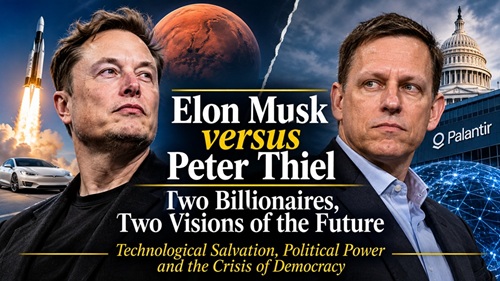 Elon Musk and Peter Thiel are two of the most influential billionaire entrepreneurs of our time. Both have accumulated extraordinary wealth through technology, both have invested heavily in shaping the future, and both have become increasingly involved in political affairs. They share a deep distrust of established institutions, an appetite for radical innovation and a conviction that humanity is approaching a historical turning point. Yet their visions of the future differ in important ways. Musk is fascinated by technological expansion: electric mobility, artificial intelligence, robotics, space exploration and the colonization of Mars. His ambition is to push humanity beyond its present biological, technological and planetary limitations. Thiel, by contrast, is more preoccupied with the political and philosophical conditions of civilization. He worries about technological stagnation, cultural conformity, democratic mediocrity and the decline of Western civilization. His interests include biotechnology, artificial intelligence, financial innovation, military technology and the preservation of political and cultural power. Musk wants to build the future. Thiel wants to understand who will control it. Both regard the existing social order as inadequate. Both believe that exceptional individuals and technological breakthroughs can overcome institutional limitations. And both have become increasingly influential in American conservative politics. Their differences are nevertheless revealing. Musk is the entrepreneur as technological messiah; Thiel is the entrepreneur as political philosopher and strategic power broker. One dreams of escaping Earth; the other is concerned with escaping the limitations of democratic modernity. Together, they illuminate a troubling development in contemporary capitalism: the emergence of billionaire entrepreneurs who increasingly regard themselves not merely as participants in society, but as its potential architects. 1. Two Different Origins of Technological PowerMusk and Thiel belong to the same generation of technology entrepreneurs, but their careers developed along different trajectories. Musk made his fortune through a succession of entrepreneurial ventures, beginning with internet companies and moving toward electric vehicles, aerospace and artificial intelligence. His career is characterized by a willingness to enter capital-intensive industries traditionally dominated by established corporations or government agencies. His signature achievement is the creation of companies that attempt to transform entire technological sectors. Thiel's career followed a more financial and strategic path. He co-founded PayPal, invested early in Facebook and became a prominent venture capitalist through Founders Fund. He also co-founded Palantir Technologies, a company specializing in data analysis and intelligence-related software. Where Musk tends to become the public face of the companies he leads, Thiel often exercises influence through investment, institutional networks and political relationships. This difference is significant. Musk's power is highly visible and personalized. Thiel's is more discreet, distributed through companies, investment structures, political connections and intellectual circles. Both forms of power deserve scrutiny, but they operate differently. 2. Musk: The Expansionist VisionMusk's worldview is fundamentally expansionist. Humanity must become multiplanetary because remaining on Earth exposes civilization to existential risks. Artificial intelligence must be developed because it could transform human capabilities. Robotics must advance because machines can perform increasingly complex tasks. Energy systems must be redesigned because civilization requires sustainable technological infrastructure. There is a certain grandeur to this vision. It takes scientific and engineering possibilities seriously and refuses to regard the existing technological order as permanent. But Musk's approach also reveals a characteristic weakness of technological solutionism: the tendency to treat problems as engineering challenges even when they are fundamentally political, social or ethical. The colonization of Mars does not solve the problem of political conflict on Earth. Artificial intelligence does not automatically produce wiser societies. Electric vehicles do not by themselves resolve the contradictions of consumer capitalism. Musk's imagination is directed toward what humanity might technologically become. Less attention is devoted to the institutions and social relationships required to make technological progress serve humanity as a whole. His preferred solution is often more technology, developed faster and on a larger scale. 3. Thiel: The Political Vision of an Anti-DemocratPeter Thiel's worldview is more explicitly political and philosophical. In his influential 2009 essay The Education of a Libertarian, Thiel expressed pessimism about the prospects of freedom and democracy. He famously suggested that freedom and democracy might no longer be compatible. This is a remarkable proposition coming from someone who has accumulated wealth within a democratic capitalist society. Thiel's concern is that democratic politics increasingly empowers majorities, bureaucracies and regulatory institutions that may obstruct individual freedom, entrepreneurship and technological innovation. He has therefore supported political arrangements and technological developments that could create greater independence from conventional democratic institutions. His interest in seasteading, for example, reflects the possibility of establishing new communities beyond the jurisdiction of existing states. His investment in the Seasteading Institute was partly motivated by the idea that experimentation with alternative political arrangements could overcome the limitations of conventional governance. His attraction to the ideas of René Girard, the French philosopher and anthropologist, adds another dimension to his thinking. Girard's theory of mimetic desire proposes that human beings frequently imitate one another's desires, producing rivalry, conflict and scapegoating. Thiel has drawn on this perspective in his reflections on politics, religion, violence and social order. This philosophical background helps explain his distrust of mass movements and collective political passions. Yet there is an obvious question: if democracy is so problematic, what political alternative does Thiel ultimately envision? The answer remains less clearly articulated than his criticism of existing institutions. His worldview suggests a preference for entrepreneurial elites, technological experimentation and political arrangements that protect individual initiative from democratic interference. But who holds these elites accountable? The danger is that an argument for individual liberty can gradually become an argument for the political privileges of those who already possess extraordinary economic power. 4. The Myth of the Creative MinorityMusk and Thiel share an implicit belief in the exceptional individual. Both admire entrepreneurs who challenge conventional thinking, disregard established expectations and pursue projects that others regard as impossible. This admiration is not entirely misplaced. Scientific and technological breakthroughs often require individuals willing to question prevailing assumptions. But there is a difference between recognizing exceptional talent and treating exceptional individuals as inherently entitled to greater political authority. The latter assumption is particularly problematic. Musk's technological achievements do not make him an expert in every domain of public policy. Thiel's intellectual interests do not establish that his political preferences are superior to those of ordinary citizens. Nor should wealth be mistaken for evidence of wisdom. The mythology of the creative minority has a long history. It can be found in aristocratic political philosophy, elitist theories of cultural development and various forms of technocratic governance. What makes its contemporary version distinctive is the fusion of technological expertise, private wealth and political influence. The billionaire entrepreneur is presented as a new kind of historical actor: someone capable of doing what governments cannot, financing what universities cannot and imagining what conventional politics cannot. But democratic institutions were never designed merely to maximize efficiency. They also exist to distribute power, protect rights and provide mechanisms for resolving disagreements among people with different interests and values. An efficient society without political accountability is not necessarily a free society. 5. Palantir and the Surveillance StateOne of the most revealing differences between Musk and Thiel concerns their relationship with state power. Musk frequently presents government bureaucracy as an obstacle to innovation. Thiel, however, has invested in a company whose business depends substantially on working with government agencies and other large institutions. Palantir develops software for integrating and analyzing large quantities of data. Its technologies are used in defense, intelligence, law enforcement and commercial environments. The company has become an important player in the modernization of military and intelligence capabilities. There is a legitimate case for using advanced data analysis to improve security, identify threats and coordinate complex operations. But these capabilities also raise serious questions about surveillance, privacy, transparency and the potential misuse of information. When governments acquire increasingly powerful analytical tools from private corporations, the distinction between public authority and private technological power becomes blurred. Thiel's relationship with Palantir therefore raises a different version of the accountability problem encountered in Musk's involvement with Starlink. In both cases, private companies develop technologies that can become essential to state functions. Their executives and shareholders gain influence over infrastructures with major consequences for national security and civil liberties. The question is not whether these technologies should exist. It is whether their deployment is subject to sufficiently strong democratic and legal safeguards. 6. Artificial Intelligence: A Shared ObsessionBoth billionaires regard artificial intelligence as a transformative technology, but their approaches reflect their different temperaments. Musk has repeatedly warned about the existential risks of advanced AI while simultaneously building his own AI enterprise through xAI. Thiel has supported AI development through his investments and his broader technology network. He is also interested in the relationship between AI, military capabilities and geopolitical competition. Their shared interest reveals an important contradiction in contemporary technological capitalism. AI is frequently described as both the greatest opportunity and the greatest threat facing humanity. Yet the companies developing it operate within competitive markets that reward rapid deployment, market dominance and the acquisition of computing resources. The result is a race in which caution can become a competitive disadvantage. There is also a political dimension. AI is not simply a neutral technology. Its applications can strengthen surveillance systems, influence public opinion, automate military decision-making and concentrate economic power. The question is therefore not merely who will develop the most powerful AI. It is who will control it, under what rules and in whose interests. Neither Musk nor Thiel has offered a convincing democratic solution to this problem. Their entrepreneurial activities may help advance AI, but technological leadership is not the same as legitimate political leadership. 7. Democracy as an Obstacle or a Safeguard?Here their differences become particularly important. Musk's relationship with democracy is inconsistent. He frequently invokes freedom of speech and individual liberty, but his political interventions have also demonstrated a willingness to use his enormous media and financial resources to influence democratic outcomes. Thiel's criticism is more fundamental. His published arguments explicitly question whether democracy and individual freedom can coexist under contemporary conditions. These positions are not identical, but they converge in their suspicion of conventional democratic processes. There is a legitimate issue beneath this criticism. Democracies can be slow, inefficient, short-sighted and vulnerable to populism. Electoral politics does not always produce technically competent policy. But the alternative to democratic imperfection is not necessarily enlightened technocracy. A system governed by exceptionally wealthy individuals may be efficient in pursuing their own objectives while remaining indifferent to the interests of everyone else. Democracy is valuable not because majorities are always right, but because it provides mechanisms for peaceful political competition, accountability and the correction of mistakes. Its institutional checks and balances are not merely bureaucratic inconveniences. They are protections against the concentration of power. This is precisely what makes the political philosophies associated with Musk and Thiel deserving of critical examination. 8. The Conservative Turn and the American Political ProjectBoth men have become increasingly involved in American conservative politics, although their motivations and methods differ. Musk's political evolution has been public, dramatic and often unpredictable. His support for Donald Trump and his involvement in the second Trump administration brought him directly into the political arena. Thiel's political involvement has been more longstanding and strategic. He supported Trump in 2016, has financed conservative political candidates and played an important role in the political rise of J.D. Vance, who previously worked for a Thiel-backed venture capital firm. Thiel's influence is therefore not limited to public endorsements. It extends into the development of political networks and the cultivation of future political leadership. This is an important distinction. Musk's political interventions often resemble those of a celebrity activist with extraordinary financial resources. Thiel's approach is closer to long-term political investment. Both approaches raise questions about the influence of private wealth on democratic representation. Their support for conservative politics should not automatically be interpreted as identical ideological commitment. Musk's positions have shifted considerably over time, while Thiel's political philosophy has deeper roots in libertarianism, elite theory and skepticism about democracy. Nevertheless, both have contributed to a political environment in which technological elites increasingly regard themselves as necessary participants in the restructuring of government. 9. Two Versions of the Post-Democratic FutureThe contrast between Musk and Thiel can now be stated more clearly. Musk's imagined future is one of technological expansion. Humanity becomes more powerful through automation, artificial intelligence, renewable energy and space exploration. Existing institutions are expected to adapt to the demands of innovation. Thiel's imagined future is more concerned with the political organization of power. Existing democratic institutions are regarded with suspicion, and technological entrepreneurship becomes a possible route toward greater independence from conventional political constraints. Musk wants to transcend technological limitations. Thiel wants to transcend political limitations. But both visions share a potentially dangerous assumption: that the people best equipped to develop the future are also entitled to exercise disproportionate influence over its direction. This is where their visions become post-democratic. The problem is not that they reject every democratic principle. Both invoke freedom, innovation and individual initiative. The problem is that their understanding of freedom can become detached from the institutional conditions that make freedom possible for everyone. A society in which a small number of wealthy individuals control communications networks, AI infrastructure, surveillance technology and strategic industries may be technologically advanced without being politically free. The question is whether their visions of the future leave sufficient room for ordinary citizens to participate in determining that future. 10. The Billionaire as a New Historical ActorMusk and Thiel are not simply successful businessmen with unconventional political opinions. They represent a new configuration of economic, technological and political power. Earlier industrial magnates such as Andrew Carnegie, John D. Rockefeller and Henry Ford also exercised enormous influence over society. They built industries, shaped labor relations, influenced public policy and helped transform the modern world. But the contemporary technological billionaire occupies a particularly strategic position. Digital platforms, satellite networks, artificial intelligence, data analytics and advanced military technologies increasingly function as essential infrastructure. Their owners can influence not only markets but also communication, information, security and political decision-making. This creates a form of private power that is difficult to regulate through conventional competition policy alone. Musk and Thiel illustrate two variations of this phenomenon. One builds and operates technological empires with enormous public visibility. The other constructs networks of investment, intellectual influence and strategic partnerships. Both demonstrate that the boundaries between business, government and political ideology have become increasingly porous. The challenge for democratic societies is to benefit from technological entrepreneurship without allowing private wealth to become an alternative source of sovereignty. Conclusion: Who Owns the Future?Elon Musk and Peter Thiel are fascinating precisely because they combine genuine intellectual and entrepreneurial achievements with political ambitions that deserve serious scrutiny. Musk's contribution to electric mobility, space exploration and technological innovation is substantial. Thiel's role in the development of Silicon Valley, venture capital and strategic technology companies is equally significant. Neither should be dismissed as merely a rich eccentric or ideological reactionary. But neither should be granted the status of a philosopher-king. Their visions reveal the growing tension between technological possibility and democratic legitimacy. The more essential private technologies become to modern society, the more difficult it becomes to distinguish entrepreneurial influence from political power. Musk's dream of a multiplanetary civilization and Thiel's skepticism about democratic governance may initially appear unrelated. Yet both raise the same fundamental question: who has the right to determine the future of humanity? The answer cannot simply be those who have accumulated the greatest wealth, developed the most powerful technologies or cultivated the most influential political networks. The future is not a private investment project. It is a collective human responsibility, and its direction must remain open to democratic debate, public accountability and ethical scrutiny. The ultimate test of technological civilization is not whether a handful of billionaires can build extraordinary things. It is whether the rest of humanity can share in their benefits without becoming subject to their unchecked power.
Comment Form is loading comments...
|